How the Viral Claim Started and Spread
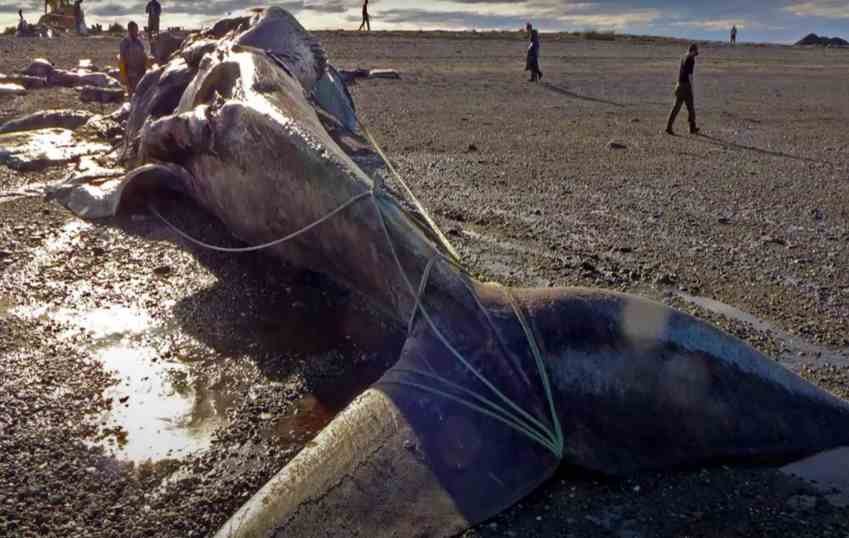
In mid-2021, posts began circulating across TikTok, YouTube, Reddit, and Facebook describing a horrifying scene: a blue whale — the largest animal ever to have existed on Earth — had washed ashore on the South African coast, apparently bitten clean in two. The image was striking enough to need no embellishment, and the question it implied was genuinely irresistible: what creature alive today is large enough to do that to a blue whale? The story traveled fast, picked up millions of views across multiple platforms, and is still being reshared years later.
What most of those posts didn’t do was name a scientist, link to a research institution, cite a news outlet with a reporter, or trace the image to any verifiable source. Different versions set the event in different years — 2009, 2020, and 2021 all appear depending on which copy of the post you read — and different versions placed it in different locations. Some folded in a completely unrelated anecdote about a father and son who allegedly encountered a large white shark while kayaking near Maui, apparently to add a layer of human drama that the whale photo alone didn’t supply. None of these details were consistent, and none of them were sourced.
That pattern — a claim that exists almost entirely as a closed loop of blogs and social posts citing each other, with no original verified source anywhere in the chain — is one of the clearest signals that a viral story has no confirmed event behind it. When the same claim circulates with different dates, different locations, and different supporting anecdotes depending on which copy you find, it is almost never because the event happened in multiple places at multiple times. It is because the claim is being reshaped to fit whatever platform it lands on next.
Why the Story Collapses on Its Own Details
The “blue whale bitten in half” story doesn’t require a marine biologist to debunk — several of the very blogs and aggregator sites that spread it included a quiet correction buried somewhere in their own body text. The animal in the widely circulated photo, according to these same posts, was not a blue whale. It was identified in multiple accounts as a white shark carcass, or more generally as a large marine animal that was not a blue whale at all.
This single fact undermines the entire premise of the viral headline. A white shark, even a very large one, is nowhere close to blue whale scale. Blue whales are the largest animals ever to have existed on this planet — confirmed maximum lengths of around 98 to 100 feet, with some Antarctic individuals reaching 110 feet, and confirmed weights of up to 150 to 200 metric tons, according to NOAA Fisheries. Confusing any other species with a blue whale requires either a very poor-quality photo or a deliberate decision to prioritize the shock value of the caption over any attempt at accuracy.
Marine biologists and science journalists who have commented on similar viral carcass photos over the years also point to a far simpler explanation for animals that appear to have been “bitten in half”: decomposition. When a large marine animal dies, gases produced during decomposition build up inside the body, bloating and weakening the tissue until the carcass can split or buckle under its own weight, especially if it’s being moved by waves or knocked against rocks or a boat hull. Scavenging animals — sharks included — will feed on an already-dead carcass, and the irregular wounds from multiple scavenging events can look, in a photograph, like a single catastrophic bite. A rotting, wave-battered, scavenged carcass does not look like a live animal in perfect health when you examine it carefully. It does look alarming in a low-resolution photograph with a dramatic caption.
No credible marine science source — no peer-reviewed journal, no named researcher at a recognized institution, no verified news report from a publication with editorial standards — has ever confirmed that a living blue whale was attacked and severed in two by a single predatory bite.
Why This Kind of Story Spreads So Reliably
It is worth understanding why a claim with this little evidence behind it reaches tens of millions of people, because the same mechanics operate behind virtually every viral ocean-mystery story and most viral misinformation in general.
Shock value is the dominant engine. A blue whale bitten in half is an image striking enough that most people share it on the basis of reaction alone, without any impulse to verify first. Platforms surface content based on the intensity of the engagement it generates — shares, comments, emotional reactions — not on whether the claim is accurate, which means the algorithm systematically rewards dramatic assertions over careful ones. Most viral spread happens through re-uploads and reposts, not through anyone reading the body text of the original post closely enough to notice that it contradicts its own headline.
The specific subject matter also helps. The deep ocean remains genuinely and extensively unexplored — the majority of the seafloor has never been directly observed by humans — which lends a layer of plausibility to “giant unknown predator” stories that a similar claim set on land would not have. People are aware, on some level, that very large things live in very deep water and that we don’t have a complete inventory of them. That uncertainty, entirely reasonable in principle, gets exploited by claims that are not actually supported by any evidence of anything undiscovered.
The fix is not complicated. Before sharing an ocean claim, check whether a named scientist or research institution is attached to it. A genuine marine biology discovery will have a researcher’s name on it, an institution behind it, and ideally a publication in a peer-reviewed journal. If a dramatic ocean story exists only as a chain of blogs and social posts with no named primary source anywhere in the chain, that absence is the answer to the question of whether it is real.
What Actually Threatens Blue Whales — The Verified Science
Here is where the real story diverges sharply from the viral myth, and where the science is considerably more astonishing than anything in the fictional headline. There is a documented, scientifically verified predator capable of killing an adult blue whale. It is not an unknown sea creature. It is the orca — and the documented footage of this happening is more remarkable than anything the viral story invented.
For decades, marine biologists debated whether killer whales (Orcinus orca) were actually capable of killing a healthy, full-grown adult blue whale, as opposed to harassing one or occasionally taking calves. Past accounts had described attempted attacks, but no one had observed orcas successfully complete a kill of an adult blue whale until March 21, 2019. On that date, off the coast of Bremer Bay in southwestern Australia, biologist John Totterdell of the Cetacean Research Centre and his team were traveling toward their regular orca-observation site when they spotted white water and dorsal fins in the distance. Within moments they realized they were watching 12 to 14 orcas attacking an adult blue whale estimated at 18 to 22 meters in length — a whale that appeared healthy going into the encounter.
The attack was documented on video and later studied by a team of researchers whose findings were published on January 21, 2022, in the peer-reviewed journal <em>Marine Mammal Science</em>. The same study documented two additional successful kills by largely the same group of orcas: one involving a blue whale calf a few weeks after the first incident in 2019, and another involving a juvenile blue whale in 2021. All three events occurred along the continental shelf drop-off near Bremer Bay, where migrating blue whales pass an aggregation of more than 150 orcas — potentially the largest known concentration of orcas anywhere in the world. At least 16 of the individual orcas observed were present for all three hunts.
How Orcas Kill the Largest Animal on Earth
The hunting strategy documented in the 2019 Bremer Bay attack was methodical and coordinated in ways that make the biological reality more unsettling than any fictional “single giant bite” narrative. When the researchers arrived, the blue whale already had deep wounds exposing bone on its snout and its dorsal fin had been largely bitten away. The orcas attacked in shifts, with some blocking the whale from surfacing to breathe while others took turns ramming its flanks and biting at its lips, tongue, and flukes. The adult blue whale fought back — thrashing its tail in attempts to drive the orcas off — but within roughly an hour it had been exhausted to the point where it could no longer escape or effectively defend itself. As the attack reached its end, one of the orcas lunged headfirst into the whale’s open mouth, feeding on the tongue. After the blue whale died and sank, approximately 50 orcas converged on the area to feed on the carcass.
Robert Pitman, a cetacean ecologist at Oregon State University’s Marine Mammal Institute and co-author of the study, described the significance of what was documented: he called it “the biggest predation event on this planet,” and noted that nothing comparable has been observed since the dinosaurs disappeared — and possibly not even then. Pitman’s comment underscores why this finding matters scientifically. It is not a marginal observation about a rarely seen behavior. It is the first confirmed documentation of the apex predator relationship between two of the most remarkable species in the ocean.
The individual orca vs. blue whale comparison makes the coordinated hunting strategy the central point. Adult blue whales can reach up to 200 metric tons — larger than any dinosaur species in the fossil record. A single orca, averaging around 6 tons and 20 to 26 feet in length, would have no realistic chance of threatening one. What the Bremer Bay orcas demonstrated is that a coordinated pod using tactics apparently refined and passed down across generations can accomplish what no individual animal of any species alive today could manage alone. Orcas are not taxonomically whales at all — they are the largest members of the dolphin family — and what distinguishes them from almost every other ocean predator is intelligence, sophisticated social structure, and the ability to develop and transmit complex group-hunting strategies culturally. Different orca populations specialize in entirely different prey: some pods eat only fish, while others — sometimes called transient or Bigg’s orcas — hunt marine mammals exclusively, including, as the Bremer Bay research confirmed, the largest mammal that has ever existed.
Blue Whales: What the Biology Actually Looks Like
Understanding the scale of a blue whale makes the documented orca predation more impressive rather than less. Blue whales (Balaenoptera musculus) are confirmed as the largest animals ever to have lived on Earth — bigger than any land or sea animal in the fossil record, including any known dinosaur species. Maximum confirmed lengths are around 98 to 100 feet, with some Antarctic individuals recorded at up to 110 feet. Confirmed weights reach up to 150 to 200 metric tons. A blue whale’s heart can weigh as much as 400 pounds and is roughly the size of a small car; its tongue alone can weigh as much as an elephant. Despite that scale, blue whales are filter feeders — they feed almost exclusively on krill, tiny shrimp-like crustaceans, by taking in enormous mouthfuls of seawater and pushing it through baleen plates that act as a sieve. The largest individuals may consume up to six tons of krill in a single day during peak feeding season, according to NOAA Fisheries.
Blue whales are currently listed as endangered under the U.S. Endangered Species Act and are protected internationally under the Marine Mammal Protection Act and the International Whaling Commission’s protections, in effect since 1966. The global population is estimated at approximately 10,000 to 25,000 individuals, down from an estimated 300,000 before commercial whaling — including as many as 240,000 in the Antarctic alone. Despite more than five decades of international protection, blue whale populations have not fully recovered. The Antarctic subspecies (B. m. intermedia) is separately classified as Critically Endangered due to a population reduction exceeding 97 percent from pre-whaling numbers. Today, their primary ongoing threats are ship strikes, entanglement in commercial fishing gear, the reduction of krill-rich feeding grounds driven by ocean warming, and underwater noise pollution that interferes with the long-distance low-frequency calls blue whales use to communicate and navigate across entire ocean basins.
Orca predation, even with the new documentation from the Bremer Bay research, is not considered a meaningful threat to blue whale population recovery. The researchers involved have noted that the number of documented attacks is unlikely to significantly affect the trajectory of blue whale population growth. What the research may be capturing, however, is a predator-prey relationship that existed before commercial whaling collapsed blue whale numbers — one that may simply be resuming as both orca and blue whale populations gradually recover. Pete Gill, a whale ecologist at Blue Whale Study in Narrawong, Australia, has noted that it is entirely possible that large whales played a more significant role in orca diets before whaling removed nearly three million whales from the oceans globally. If that historical relationship is resuming, it likely will not look like a crisis for blue whale recovery — but it may increasingly shape where and how blue whales choose to travel.
The Claim vs. the Science, Side by Side
Comparing the viral story directly with the documented research makes the contrast hard to ignore.
The viral “blue whale bitten in half” claim offers no named researcher, no institutional affiliation, no peer-reviewed publication, a location that shifts between South Africa and Hawaii depending on which version of the post you read, a date that ranges across at least three different years, an unrelated kayaking anecdote spliced in for additional shock value, and — most tellingly — a correction buried in several of the spreading posts themselves acknowledging that the animal in the photo was not actually a blue whale.
The documented orca predation research offers named researchers (John Totterdell at the Cetacean Research Centre, Robert Pitman at Oregon State University’s Marine Mammal Institute, and additional co-authors), a specific and consistent location (the Bremer Bay continental shelf drop-off, Western Australia), specific and consistent dates (March 21, 2019, for the first confirmed adult kill, with additional kills in 2019 and 2021), video footage reviewed by independent marine biologists, publication in the peer-reviewed journal Marine Mammal Science on January 21, 2022, and coverage by National Geographic, NPR, CNN, and Science News, among others.
One of these is a claim engineered to travel fast by attaching a dramatic caption to an unverified photograph. The other is a finding that took years of fieldwork, peer review, and independent reporting before being published. The real science is, by any reasonable measure, more remarkable than the myth — and it didn’t require a misleading headline.
Conclusion
The “blue whale bitten in half” story is a textbook example of how ocean misinformation travels: misidentify the animal in a photo, attach a headline implying something unknown and terrifying lurks in deep water, and let the combination of shock value and algorithmic amplification do the rest. The claim has no named source, no consistent location or date, no peer review, and no scientific institution anywhere in its chain of attribution. It is, in the plainest terms, not a verified event.
The documented science of what can actually threaten a blue whale is simultaneously more grounded and more extraordinary. A coordinated pod of orcas working in shifts over the course of an hour, using tactics refined across generations, can kill the largest animal on the planet — not through a single catastrophic bite, but through persistence, intelligence, and cooperation. That finding, published in Marine Mammal Science in January 2022 and confirmed across three separate documented events, is one of the most significant observations in cetacean biology in decades. It needed no exaggeration.
The broader lesson applies well beyond this specific story. Before sharing a dramatic ocean claim — or any dramatic claim about the natural world — check for a named scientist, a research institution, and a published source. If those three things are absent, the story almost certainly is not what it claims to be.