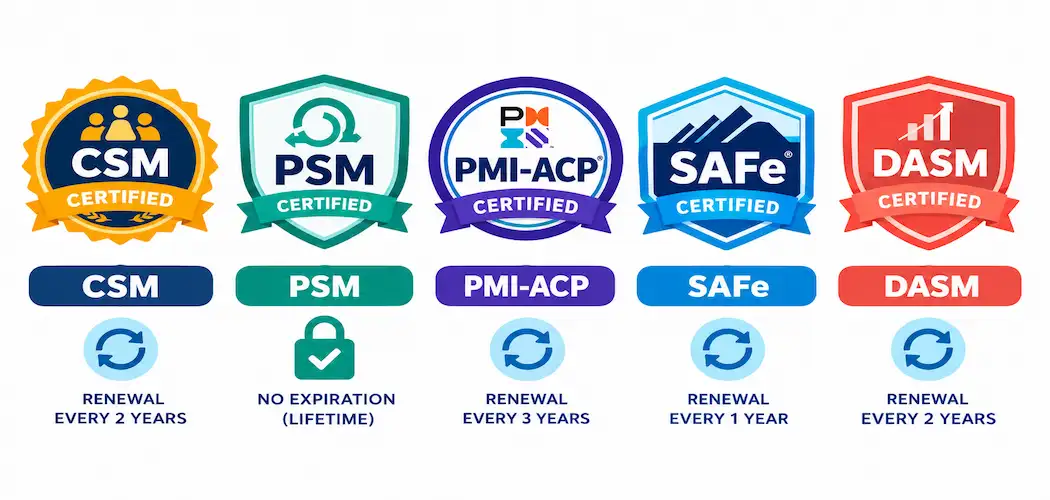
Agile certifications have multiplied fast enough that the hardest part isn’t earning one — it’s figuring out which one is actually worth your time and money. Dozens of credentials claim to validate “agile expertise,” issued by different organizations with different philosophies, different renewal requirements, and wildly different name recognition depending on the industry you’re in. Picking the wrong one means spending real money and real study hours on a credential that doesn’t move your career the way you expected.
Here’s an honest breakdown of the certifications that actually matter, who issues them, what they cost to maintain over time, and how to tell if you need one at all.
Do You Actually Need a Certification?
This is worth asking before anything else: Scrum itself doesn’t require certification to practice. Plenty of people work effectively as Scrum Masters, product owners, or agile coaches without ever earning a formal credential. What a certification actually does is signal a baseline of knowledge to employers and clients who are screening resumes — it’s a credibility shortcut, not a technical requirement to do the work.
Where certification genuinely matters: changing industries or companies where you don’t have an existing track record, working in organizations (often larger enterprises or government contractors) that specifically require certified staff for certain roles, or wanting structured, guided learning rather than picking up agile practices piecemeal on the job. If you’re already doing the work successfully and your employer isn’t asking for a credential, the calculus is less clear-cut.
The Certifications Worth Knowing
Certified ScrumMaster (CSM) — Scrum Alliance. The most widely recognized entry-level Scrum credential, earned by attending a licensed two-day course taught by a Certified Scrum Trainer, followed by an exam. It requires renewal roughly every two years, which involves earning continuing-education credits (Scrum Alliance calls them SEUs) and paying a renewal fee — worth checking Scrum Alliance’s current renewal requirements directly, since the specifics can change.
Professional Scrum Master (PSM I) — Scrum.org. A comparable entry-level credential from a different organization, earned through a standalone exam rather than a mandatory training course (though training is available and often recommended). The notable difference from CSM: once earned, PSM certifications don’t expire and require no renewal fee or continuing education, per Scrum.org’s own program description. There are also PSM II and PSM III levels for deeper expertise.
PMI Agile Certified Practitioner (PMI-ACP) — Project Management Institute. Broader than either Scrum-specific credential, covering multiple agile frameworks (Scrum, Kanban, Lean, XP) rather than just Scrum. It has real prerequisites — a mix of general project experience and agile-specific project experience, plus a required number of contact hours of agile training — and requires ongoing professional development units (PDUs) to maintain, consistent with other PMI credentials. It tends to carry more weight in organizations already using PMI’s broader project management framework.
SAFe certifications — Scaled Agile, Inc. A family of credentials (SAFe Agilist, SAFe Scrum Master, SAFe Release Train Engineer, and others) built around the Scaled Agile Framework, aimed specifically at agile practices in large enterprises running multiple coordinated teams. These typically require an annual renewal fee to keep the credential active. SAFe certifications carry the most weight specifically in large organizations that have already adopted the SAFe framework — less so elsewhere.
Disciplined Agile certifications (including DASM) — PMI (via its Disciplined Agile toolkit). Worth naming accurately rather than vaguely: DASM (Disciplined Agile Scrum Master) is positioned as a foundational credential within PMI’s Disciplined Agile toolkit, which blends practices from multiple agile and lean approaches rather than being Scrum-specific. It’s a reasonable option for someone wanting a broader toolkit-style credential, but it’s less universally recognized than CSM or PSM.
What Actually Differs Between Them
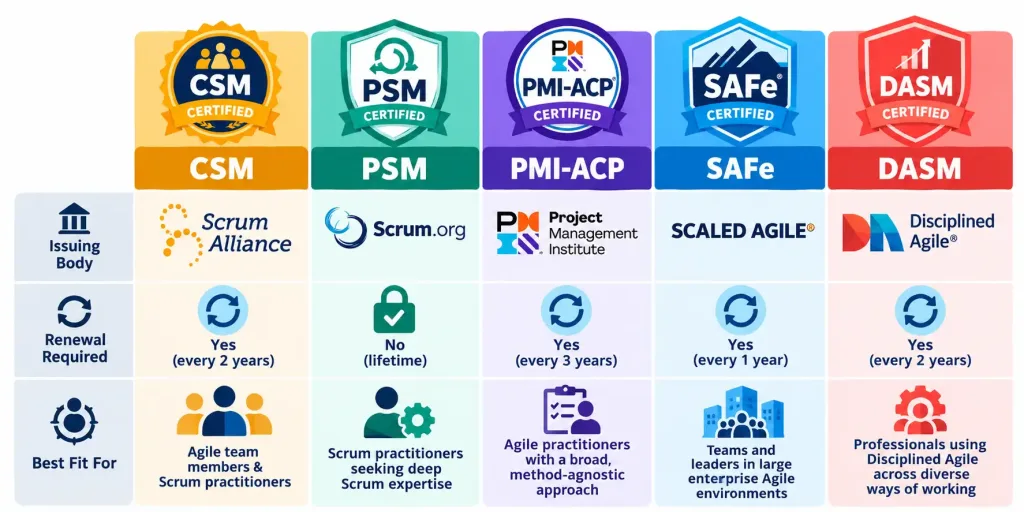
- Renewal requirements vary a lot. PSM certifications don’t expire; CSM, PMI-ACP, and SAFe credentials all require some form of ongoing renewal — continuing education, PDUs, or an annual fee, depending on the issuer. This matters more than people expect, since an “expired” certification on a resume can raise questions.
- Training requirements vary. CSM requires a licensed course; PSM can be earned through self-study and an exam alone, though training is available.
- Recognition varies by context. PMI-ACP and SAFe credentials tend to carry more weight in large enterprises already using those frameworks; CSM and PSM are more broadly recognized across company sizes and industries for general Scrum roles.
- Cost and format change over time. Exact pricing, exam formats, and renewal fees are set by each certifying body and do get updated — check the issuing organization’s own current pricing page before budgeting for any of these, rather than relying on older articles (including this one, eventually) for exact figures.
How to Choose a Training Provider
If you’re going the training-course route rather than self-study, a few things are worth checking regardless of which certification you’re pursuing: whether the instructor is actually certified to teach that specific credential by the issuing body (not just “experienced” in agile generally), whether the course materials are current with the certification’s latest version, and whether the provider is officially recognized by the certifying organization rather than just offering unaffiliated “prep” content. Checking directly with the certifying body’s own directory of licensed trainers or partners is the most reliable way to confirm this, rather than taking a training provider’s own marketing at face value.
The Bottom Line
No agile certification is strictly required to do agile work well, but the right one can genuinely open doors — especially when changing roles, entering an organization that specifically asks for one, or working toward a structured understanding of a framework you’re already using informally. The choice comes down to your actual goal: CSM or PSM for a general Scrum Master path, PMI-ACP if you want breadth across multiple agile frameworks and already have PMI-aligned project experience, SAFe if you’re working in or targeting a large enterprise running SAFe, and Disciplined Agile credentials if a broader toolkit approach fits your organization better than a single framework.
Frequently Asked Questions
Is a Scrum Master certification required to work as a Scrum Master?
No. Scrum itself doesn’t require certification to practice, and many Scrum Masters work effectively without one. Certification mainly helps when you’re changing roles or industries, or when a specific employer requires it.
Which Scrum certification is better, CSM or PSM?
Neither is universally “better” — they come from different organizations with different renewal models. CSM requires a licensed training course and periodic renewal; PSM can be earned via self-study and exam alone and doesn’t expire once earned. The right choice often depends on whether your target employer or industry favors one over the other.
Do agile certifications expire?
It depends on the issuer. Scrum.org’s Professional Scrum certifications don’t expire. Scrum Alliance’s CSM, PMI’s PMI-ACP, and Scaled Agile’s SAFe certifications all require some form of periodic renewal — continuing education credits, PDUs, or an annual fee, depending on the specific credential.
Is PMI-ACP worth it over a Scrum-specific certification?
It’s worth it if you want certification across multiple agile frameworks (not just Scrum) and you already have the required project experience PMI asks for. It tends to carry more weight in organizations already using PMI’s broader project management approach than in companies running pure Scrum.