
Product teams have always needed to understand how people actually use what they’ve built. What’s changed isn’t the goal — it’s the mechanics. This guide puts traditional product analytics methods side by side with AI-based approaches, covers what each actually does well, and names real tools on both ends of that spectrum.
What Traditional Product Analytics Actually Looked Like
Before AI-driven tools matured, product analytics generally relied on a combination of methods, each with real limitations:
Post-launch sampling. Teams often waited until a product shipped before collecting meaningful usage data, which meant problems surfaced only after real users had already encountered them — too late to course-correct before launch.
Manual surveys and interviews. Genuinely valuable for depth of insight, but limited in scale — a handful of user interviews tells you something, but not necessarily something representative of your whole user base.
Basic dashboards and reports. Tools tracking straightforward metrics (page views, click counts, session length) gave teams a surface-level picture, but required a human analyst to manually dig through the data to find meaningful patterns, a slow and labor-intensive process that didn’t scale well as data volume grew.
Small sample sizes. Without the processing power to handle large datasets efficiently, traditional methods often worked with smaller slices of data, making it harder to extrapolate confidently to the full user base.
None of this made traditional analytics useless — plenty of good product decisions were made this way for decades. The limitation was speed and scale, not fundamental validity.
What AI-Based Product Analytics Actually Adds
AI and machine learning-driven analytics platforms change the mechanics in a few specific, genuinely useful ways:
Pattern detection at scale. Machine learning models can process far larger datasets than manual analysis practically allows, surfacing correlations and behavioral patterns a human analyst might never spot by eye — not because humans are bad at pattern recognition, but because the volume of data involved exceeds what’s feasible to review manually.
Predictive capability, not just historical reporting. Traditional analytics largely tells you what already happened. AI-based tools can model likely future behavior — which users are at risk of churning, which feature changes are likely to improve retention — based on patterns learned from historical data, giving product teams a genuine head start rather than only a rearview mirror.
Automated segmentation. Rather than manually defining user segments based on assumptions, AI-driven tools can identify meaningful behavioral clusters algorithmically, sometimes surfacing segments a team wouldn’t have thought to look for.
Continuous, real-time data collection. Modern analytics platforms generally track behavior continuously from the start of product development rather than waiting for a post-launch checkpoint, catching problems earlier in the process.
Real Tools on Both Ends of the Spectrum
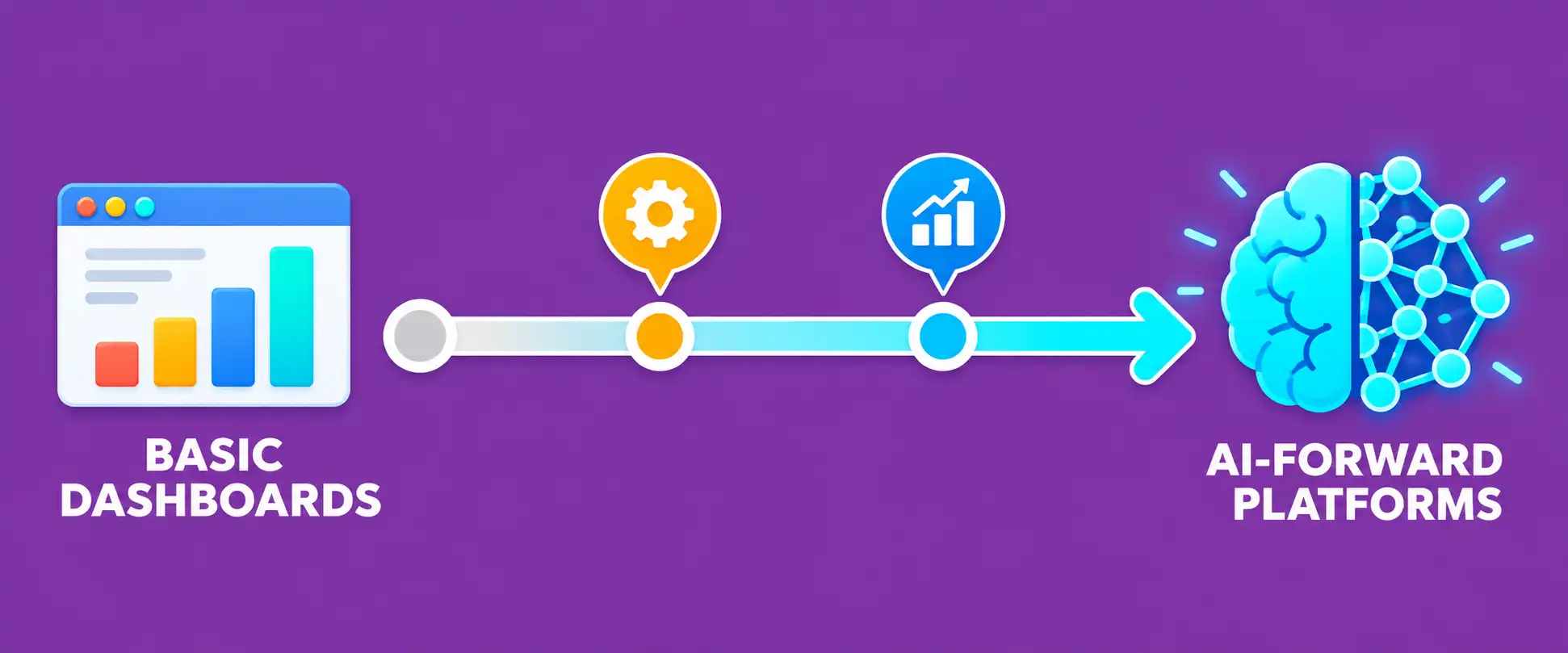
This is the part most comparisons of this kind skip, and it’s worth being concrete about:
Traditional-leaning tools like Google Analytics (in its more basic reporting functions) and simple survey platforms still serve real purposes — straightforward metric tracking and direct user feedback collection don’t necessarily need AI to be useful.
AI-forward product analytics platforms — Mixpanel, Amplitude, Pendo, and Heap are among the most widely used — incorporate machine learning for cohort analysis, predictive churn modeling, and automated insight generation, moving well beyond basic dashboards into genuinely proactive analysis.
The honest reality: most modern product analytics tools, even ones not explicitly marketed as “AI-powered,” have incorporated some machine learning capability over the past several years. The traditional-vs-AI framing is becoming less of a binary choice and more a question of how much automated intelligence a given platform layers on top of the fundamentals.
What to Actually Consider Before Implementing AI-Based Analytics
A few practical questions worth answering before investing in an AI-driven analytics platform:
Do you have the data volume to make it worthwhile? AI-based pattern detection and predictive modeling genuinely need sufficient data to produce reliable insights — a very early-stage product with limited users may not yet benefit meaningfully from this level of sophistication.
Do you have the team to act on the insights? Sophisticated analytics are only as valuable as the team’s ability to interpret and act on what they surface — data scientists, product managers, and engineers all play a role in actually implementing changes the analytics suggest.
Is your data quality good enough to trust? Machine learning models are only as reliable as the data they’re trained on — poor-quality or inconsistent data undermines AI-based insights just as much as it would undermine manual analysis, arguably more, since automated systems won’t flag obviously bad inputs the way a skeptical human analyst might.
What’s your platform’s actual processing capacity? If you’re dealing with genuinely large data volumes, confirm your chosen platform can handle that scale reliably before committing.
Frequently Asked Questions
Is AI-based product analytics always better than traditional methods?
Not universally — it depends on your data volume, team capacity, and specific needs. AI-based tools excel at scale and predictive insight, but traditional methods (direct user interviews, in particular) still offer depth that automated analysis doesn’t fully replace.
What are some real examples of AI-powered product analytics tools?
Mixpanel, Amplitude, Pendo, and Heap are among the most widely used platforms incorporating machine learning for cohort analysis, churn prediction, and automated insight generation.
Do I need a data science team to use AI-based analytics tools?
Not necessarily for basic use, but getting full value from predictive and automated-insight features generally benefits from at least some data literacy on the team interpreting the output.
Can small businesses benefit from AI-based product analytics?
Yes, though the benefit scales with data volume — a very early-stage product with a small user base may not yet have enough data for AI-driven pattern detection to add much beyond what basic analytics already shows.
Is traditional product analytics now obsolete?
No. Direct user feedback, interviews, and basic metric tracking remain genuinely valuable — the shift isn’t traditional methods becoming useless, it’s AI-based tools adding capability on top of what traditional methods already provided.
The Bottom Line
The real difference between traditional and AI-based product analytics isn’t that one replaces the other — it’s that AI-driven tools add scale, speed, and predictive capability on top of fundamentals that haven’t actually changed: understanding how people use your product and why. Most modern analytics platforms now blend both approaches rather than requiring a strict either/or choice, and the right starting point is matching your actual data volume and team capacity to the tool, rather than assuming more sophisticated automatically means better for your specific situation.