Electric bikes have quietly become one of the more practical tools in a hunter’s kit. They’re quiet compared to an ATV, fast enough to cover ground efficiently, and — unlike a truck or four-wheeler — they don’t leave much of an engine scent behind to spook game before you’ve even settled in. That combination has made e-bikes genuinely popular for scouting and hauling gear into harder-to-reach areas.
But popularity doesn’t erase risk. Hunting terrain is uneven, often unfamiliar, and frequently covered in exactly the kind of debris, mud, and loose rock that makes a bike harder to control than it would be on a paved trail. Add low light, a loaded pack, and the understandable urge to move quickly toward or away from game, and the odds of a collision or a fall go up. None of that means e-bikes are a bad choice for hunting — it means riding one on hunting terrain deserves a bit more attention than riding one around the neighborhood.
Here are seven things worth doing before and during a ride that meaningfully reduce the chance of a crash.1. Inspect the Bike Before Every Ride
A pre-ride check takes a few minutes and catches most of the problems that turn into mid-trail emergencies. Check tire pressure and look for cuts or embedded debris — a slow leak that’s fine in the driveway can become a flat an hour into the backcountry.
Give the spokes a once-over for looseness, check that the wiring and battery connections look intact (vibration on rough terrain works connectors loose over time), and confirm the drive chain is clean and properly tensioned. Make sure your helmet is on and your mirrors, if the bike has them, are actually angled to be useful rather than just present. None of this is exciting, but skipping it is how a small issue at home becomes a long walk back.
2. Treat Water Crossings and Ruts With Respect
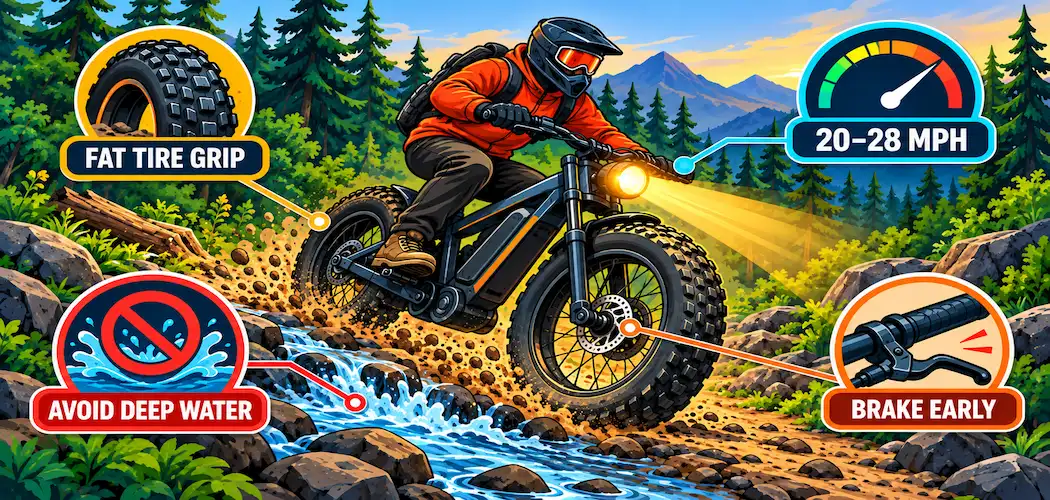
Puddles on a hunting trail are rarely just puddles. Standing water hides ruts, submerged rocks, and soft mud that can grab a wheel without warning, and it’s genuinely hard to judge depth from the saddle. Where possible, ride around standing water rather than through it, even when it looks shallow.
Avoid riding directly through streams or rivers if there’s any other way across — a bridge, a shallower crossing point, or simply a different route — both because of the fall risk and because water intrusion is one of the more common ways e-bike batteries and motors get damaged. Deep ruts and trail cracks deserve the same caution: a wheel that drops into one unexpectedly is a fast way to lose control.
3. Ride With Lights If There’s Any Chance You’ll Be Out Past Dusk
Hunting trips have a way of running longer than planned, and dusk in the woods arrives faster than it does in open terrain. If there’s a real chance you’ll still be moving once light fades, bring and use a proper headlight and taillight rather than relying on a phone flashlight or ambient light. Visibility cuts both ways here — seeing the trail in front of you, and being visible to anyone else using the same trail system, including other hunters.
4. Match Your Speed to What You Can Actually See and React To
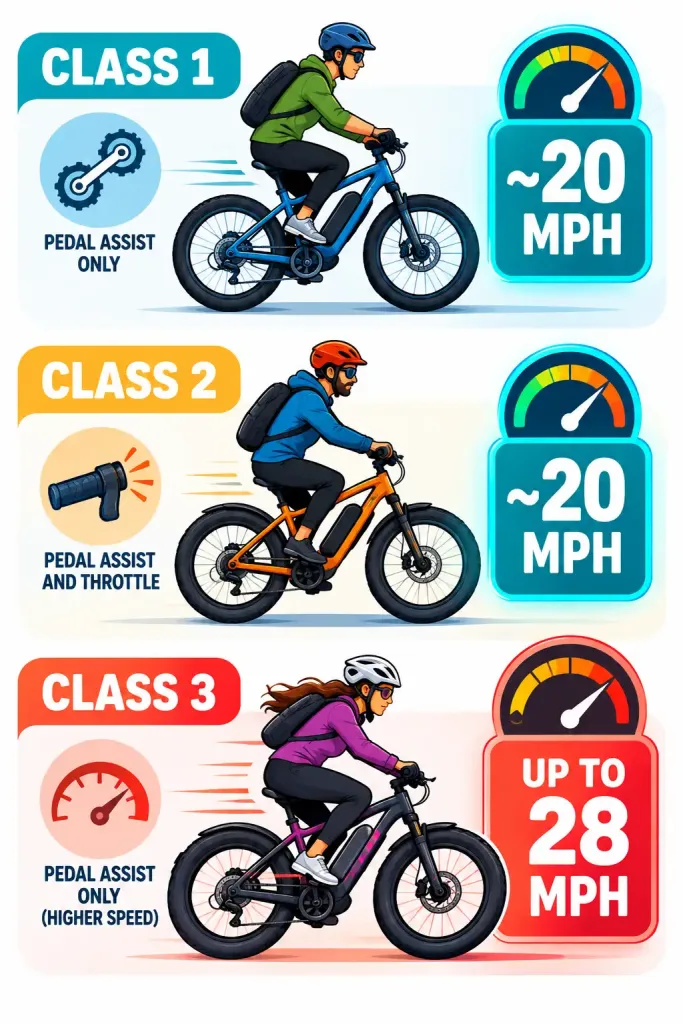
E-bikes are capable of real speed — most Class 1 and Class 2 e-bikes top out around 20 mph on motor assistance alone, and Class 3 models can reach up to 28 mph. That’s plenty fast enough to outrun your reaction time on unfamiliar terrain. Trail conditions change by the minute with weather, and a wet or muddy surface reduces traction in ways that aren’t always obvious until the back wheel slides. Riding at a pace where you can actually stop or steer around a sudden obstacle — a downed branch, a hole, another trail user — matters more on hunting terrain than almost anywhere else you’d ride.
5. Be Honest About Your Limits on Steep Terrain
Steep inclines and descents are where inexperienced riders get into trouble fastest. Climbing takes real leg strength and a working understanding of when to shift gears, and descending demands even more control, since gravity does a lot of the work whether you’re ready for it or not. If you’re newer to e-biking, it’s worth scouting steep sections on foot first, or simply choosing routes that avoid them until you’ve built up more comfortable handling skills. There’s no prize for pushing a climb or descent you’re not ready for, and the terrain won’t give you a second chance the way a parking lot would.
6. Learn to Brake Properly on Rough Ground
Braking hard on loose dirt, gravel, or wet leaves doesn’t behave the way it does on pavement — grabbing the front brake too aggressively on a loose surface is one of the more common ways riders go over the handlebars. Learning to modulate both brakes smoothly, and to start slowing earlier when you spot an obstacle rather than braking hard at the last second, makes a real difference in control. Scanning the trail a good distance ahead, rather than just the ground immediately in front of the wheel, gives you the extra second of warning that proper braking technique needs to actually work.
7. Choose a Bike Built for the Terrain You’ll Actually Ride
Not every e-bike is suited to hunting terrain. Fat-tire and electric mountain bike models generally offer more surface contact and grip than a standard commuter-style e-bike, which translates directly into better stability on loose dirt, mud, and uneven ground. If you’re shopping for a bike specifically for hunting use, prioritizing tire width and off-road-rated suspension over top speed or styling will serve you better once you’re actually on the trail. Whatever model you choose, matching the bike to the terrain — rather than adapting your riding to a bike built for pavement — removes one more variable that contributes to loss of control.
Putting It Together
E-bikes have earned their growing popularity among hunters for good reason — they’re quiet, efficient, and capable of covering ground that would be exhausting on foot or impractical by truck. The tradeoff is that hunting terrain asks more of both rider and machine than a paved trail does, and most of the collisions and falls that happen out there trace back to one of a handful of avoidable causes:
A bike that wasn’t checked beforehand, a water crossing taken too casually, riding too fast for visibility or conditions, or braking technique that doesn’t match the surface. Covering those basics before and during every ride goes a long way toward keeping an efficient tool from becoming the source of the day’s biggest mishap.
Frequently Asked Questions
Is it legal to use an e-bike while hunting?
It depends entirely on where you’re hunting. Rules vary by state, by the specific land manager (state wildlife agency, national forest, national park, etc.), and sometimes by whether you’re on public or private land. Always check current regulations for the specific area before riding during a hunting season.
What type of e-bike is best suited for hunting terrain?
Fat-tire and electric mountain bike models tend to perform best, since their wider tires and off-road-oriented design offer more grip and stability on loose dirt, mud, and uneven trails than a standard commuter e-bike.
How fast do e-bikes typically go?
Most Class 1 and Class 2 e-bikes are limited to around 20 mph under motor power, while Class 3 e-bikes can reach up to 28 mph. Actual speed capability varies by model and local regulation.
What’s the most common mistake that leads to e-bike falls on rough terrain?
Braking too hard on loose or wet surfaces — particularly grabbing the front brake abruptly — is one of the most common ways riders lose control and go over the handlebars. Learning to brake earlier and more gradually on rough ground significantly reduces that risk.