Solar panels don’t generate power at night, and wind turbines don’t spin on command. That mismatch between when renewable energy is generated and when it’s actually needed is the central problem grid operators have been racing to solve for the past decade, and large-scale battery storage has become the leading answer. But not all battery advances marketed as solving this problem actually hold up under scrutiny — some of the technology getting the most attention has real, unresolved tradeoffs that are worth understanding honestly.
Why Storage Matters for Renewables
Wind and solar are variable by nature — output depends on weather, time of day, and season, none of which align neatly with demand. A grid running heavily on renewables needs somewhere to put surplus energy generated when conditions are good, so it can be released when generation drops but demand doesn’t. Battery storage captures that surplus and smooths out the mismatch, which is what makes a higher share of renewables on the grid practically workable rather than just a generation statistic.
Why Lithium-Ion Leads, and What “Cycle Life” Actually Means
Lithium-ion batteries dominate this space for reasonable, well-established reasons: high energy density (more storage capacity per unit of size and weight), relatively low self-discharge when sitting idle, and the ability to charge and discharge quickly when the grid needs a fast response.
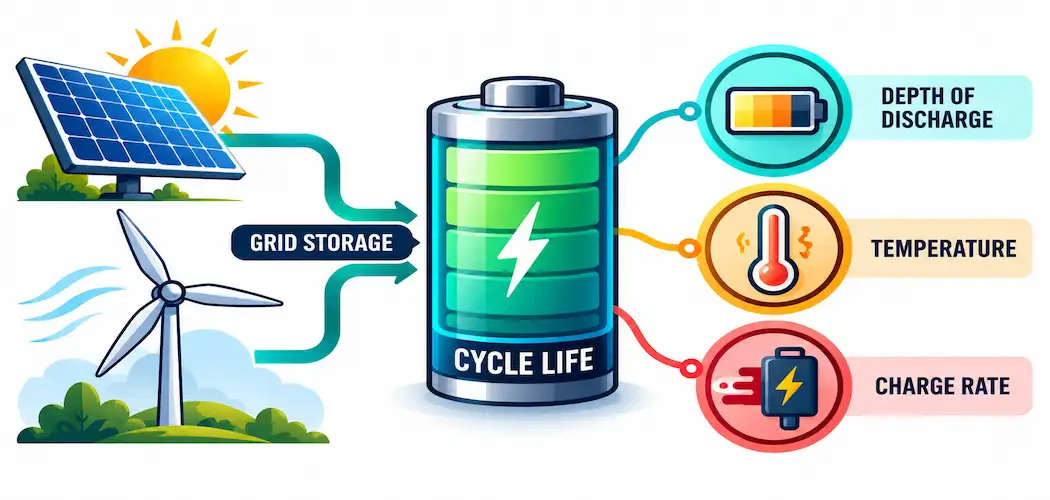
“Cycle life” refers to how many full charge-and-discharge cycles a battery can handle before its usable capacity drops to an unacceptable level, typically defined as 80% of its original capacity. Three factors affect it the most:
- Depth of discharge — regularly draining a battery further down shortens its cycle life more than shallower, partial discharges.
- Temperature — both battery chemistry and degradation rates are temperature-sensitive, which is why large installations invest heavily in thermal management systems.
- Charge rate — this one comes with a genuine tradeoff worth being upfront about: fast charging is a real operational advantage for grid-response batteries, but higher charge rates also accelerate degradation. There’s no way around that tradeoff — just a decision about which matters more for a given use case.
What cycle life doesn’t fully capture is calendar aging — the gradual degradation a battery experiences over time even when it’s barely used. A battery sitting mostly idle still loses some capacity year over year, which matters for storage systems that aren’t cycled constantly. Any honest discussion of battery lifespan for grid storage needs to account for both cycle count and calendar time, not cycle count alone.
Where the Real Advances Are — and Where the Hype Outpaces the Reality
Silicon anodes are genuinely promising, but the common framing — “silicon stores more lithium, so it improves cycle life” — leaves out the actual engineering challenge. Silicon anodes can hold significantly more lithium than the graphite anodes used in most current lithium-ion cells, which is a real capacity advantage. But silicon also expands substantially during charging and contracts during discharging, and that repeated expansion causes mechanical stress and degradation that has historically limited cycle life rather than extending it. Battery researchers have made real progress mitigating this (through silicon-carbon composites and other structural approaches), but it’s an active engineering problem being worked through, not a solved advantage already banked.
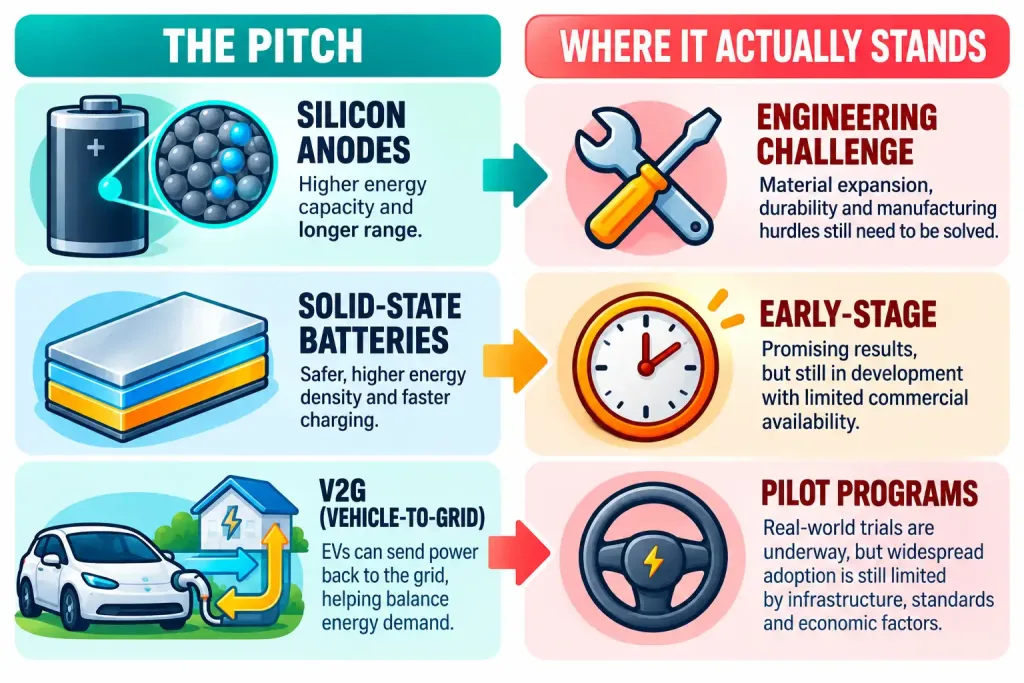
Solid-state batteries get discussed as a near-term fix for both safety and cycle life, and the safety side has real merit — replacing the liquid electrolyte with a solid one does reduce the risk of thermal runaway, the chain reaction that causes lithium-ion fires. But commercial-scale solid-state batteries for grid storage remain largely in development and early pilot stages rather than widely deployed, and their real-world cycle-life performance at scale is still being proven rather than established. It’s a technology worth watching, not one to treat as already delivering on grid storage at commercial scale.
Vehicle-to-grid (V2G) technology — using electric vehicle batteries to feed power back into the grid during peak demand — is a genuinely interesting direction, but it’s still mostly at the pilot and early-commercial stage in most markets. Describing it as an established tool for managing peak demand overstates where the technology actually is today.
Grid-Scale Storage in Practice
South Australia’s Hornsdale Power Reserve is one of the most frequently cited real-world examples of large-scale battery storage, built using Tesla’s Powerpack battery technology and operated in partnership with the wind farm it sits alongside. It’s credited with measurably improving grid stability and reducing the cost of frequency-control services in South Australia’s market since coming online. Tesla has since expanded into larger-capacity Megapack installations for utility-scale projects elsewhere in Australia and globally — a related but distinct product line from the original Hornsdale deployment, built for even larger storage capacity per installation.
These real-world deployments matter because they show battery storage working at grid scale today, not just in lab conditions — which is also exactly why it’s worth being precise about which specific project did what, rather than blending separate installations together.
The same underlying storage principle scales down to the residential level, too. A home solar setup that goes off-grid relies on exactly this kind of battery bank to run independently of the utility — our comparison of on-grid vs. off-grid solar for Indian homes walks through that tradeoff in more detail for anyone evaluating a home system rather than a utility-scale one.
The Part Often Left Out: Supply Chain and End-of-Life
Longer-lasting batteries do reduce how often manufacturing resources get consumed and how much waste gets generated over a battery’s working life — that part of the sustainability argument holds up. What often gets left out of “greener future” framing is the supply-chain side: lithium extraction carries real environmental and water-use concerns in extraction regions, and battery recycling infrastructure, while improving, is still catching up to the volume of batteries reaching end-of-life. A fair accounting of lithium battery sustainability includes both ends of that lifecycle, not just the in-service efficiency gains.
Cost and the Road Ahead
Lithium battery costs have fallen substantially over the past decade, which is a major reason large-scale storage has become economically viable rather than purely experimental. Continued cost reduction, paired with supportive policy and infrastructure investment, remains central to how quickly storage capacity can scale to match growing renewable generation. None of the remaining challenges — safety engineering, end-of-life recycling, and genuinely proving next-generation chemistries at scale — are reasons to doubt the technology’s trajectory, but they are reasons to describe where things actually stand rather than where the marketing suggests they are.
The Bottom Line
Battery storage is a real and necessary piece of the renewable energy transition, and lithium-ion technology, cycle-life engineering, and projects like Hornsdale demonstrate that it already works at meaningful scale. The honest version of this story includes real tradeoffs — fast charging versus degradation, silicon’s capacity advantage versus its mechanical stress problem, solid-state’s promise versus its current commercial maturity — rather than treating every advance as already resolved in the technology’s favor.
Frequently Asked Questions
What does “cycle life” mean for a lithium battery?
It’s the number of full charge-discharge cycles a battery can handle before its capacity drops to a defined threshold, typically 80% of its original capacity. It’s affected by depth of discharge, temperature, and charge rate, and it doesn’t fully capture calendar aging — the gradual capacity loss that happens over time even with light use.
Do silicon anodes actually improve battery life?
They offer higher capacity because silicon holds more lithium than graphite, but silicon’s expansion during charging causes mechanical stress that has historically limited cycle life. Researchers are actively working on this tradeoff; it’s a promising direction, not a fully solved one yet.
Are solid-state batteries ready for grid-scale use?
Not widely yet. They offer a real safety advantage by reducing thermal runaway risk, but commercial-scale deployment for grid storage is still mostly in development and pilot stages rather than established at scale.
Is lithium battery storage actually more sustainable overall?
It reduces waste and resource use during the battery’s working life, but a full picture needs to include lithium extraction’s environmental footprint and the current state of battery recycling infrastructure — both real factors that get left out of simpler “greener future” framing.