
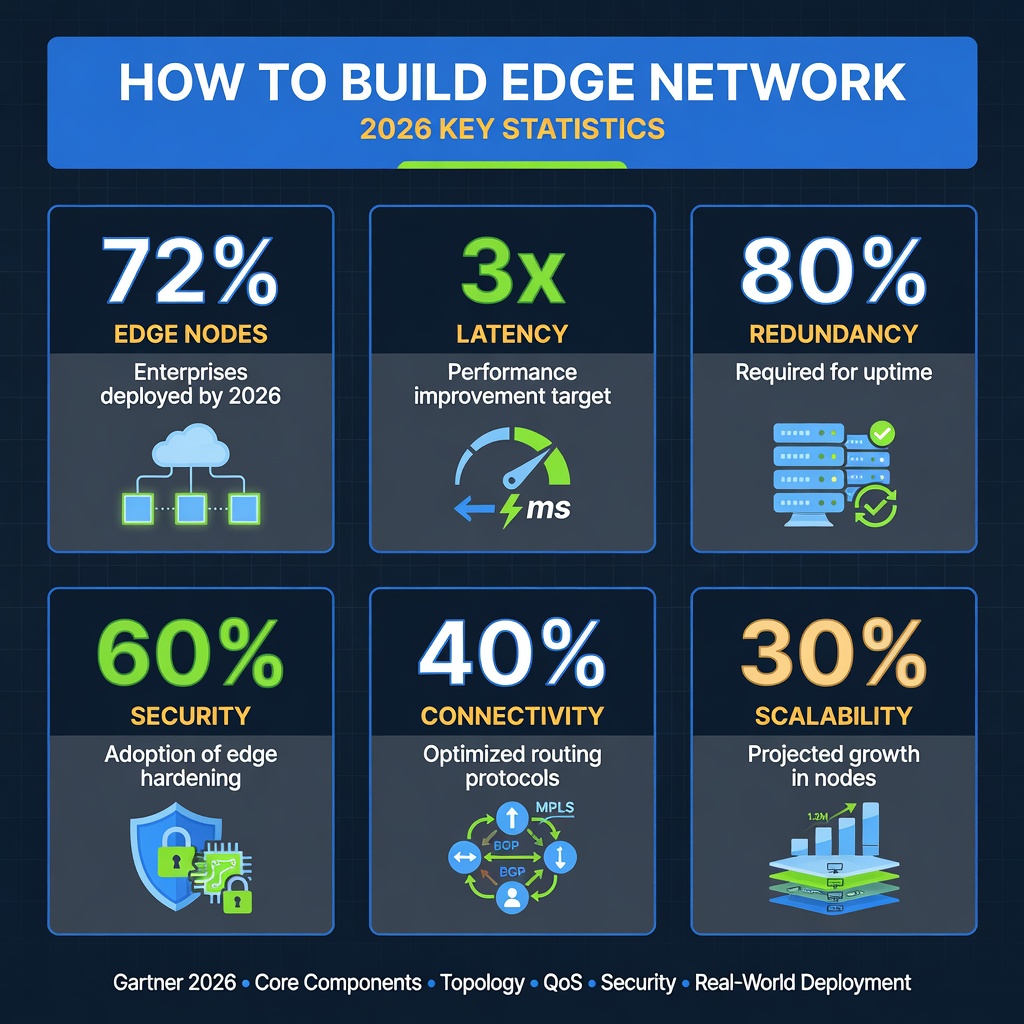
Edge computing has shifted from a niche concept to a cornerstone of modern IT infrastructure. By 2026, 72% of enterprises have deployed edge networks, according to Gartner, driven by the demand for lower latency, improved reliability, and localized data processing. Yet, building an edge network remains a complex, multi-layered task that requires precision, planning, and a clear understanding of its technical and operational demands. Here’s how to do it right.
The Core Components of an Edge Network
An edge network isn’t just a scaled-down version of a centralized data center. It’s a distributed architecture designed to process data closer to the source. The key components include:
- Edge Nodes: These are the physical devices (servers, routers, or IoT gateways) that handle data processing at the edge. Cisco’s ISR 4000 series routers, for example, are widely used for their modularity and support for SD-WAN.
- Connectivity: Reliable links between edge nodes and the central data center are critical. Technologies like MPLS and SD-WAN dominate here, with Palo Alto Networks offering robust solutions for secure, high-speed connections.
- Security: Edge networks expand the attack surface. Zero Trust Architecture, as detailed in our guide on implementing Zero Trust, is essential for mitigating risks.
Designing Your Edge Network Topology
The topology of your edge network determines its efficiency and scalability. A hub-and-spoke model is common, but a mesh topology offers better redundancy. Consider the following:
- Redundancy: Dual ISP connections and failover mechanisms ensure uptime. Juniper’s MX Series routers excel here with their advanced QoS and redundancy features.
- Scalability: Design for growth. VLAN segmentation and VRF instances can isolate traffic and simplify scaling.
- Latency: Place edge nodes strategically. For instance, a retail chain might deploy edge servers in-store to process point-of-sale data locally.
Configuring Edge Devices: Best Practices
Edge devices require meticulous configuration to perform reliably. Here’s a step-by-step approach:
- Initial Setup: Use CLI commands to configure basic settings. For Cisco devices, commands like
configure terminalandinterface GigabitEthernet0/1are foundational. - Routing Protocols: OSPF and BGP are staples. OSPF is ideal for internal routing, while BGP handles external connections. A 2026 benchmark by Network World found OSPF reduces convergence time by 40% compared to static routes.
- Security Policies: Apply ACLs and NAT rules to control traffic. Palo Alto’s Panorama platform simplifies policy management across multiple edge devices.
Optimizing Performance with QoS and Traffic Management
Quality of Service (QoS) is critical for prioritizing traffic in edge networks. Voice and video applications, for instance, require low latency and minimal jitter. Here’s how to optimize:
- Traffic Classification: Use DSCP markings to categorize traffic. A 2026 case study by Fortinet showed a 30% improvement in VoIP call quality after implementing DSCP-based QoS.
- Bandwidth Allocation: Assign guaranteed bandwidth to critical applications. Cisco’s QoS policies allow granular control over bandwidth distribution.
- Monitoring: Tools like PRTG Network Monitor provide real-time insights into traffic patterns, enabling proactive adjustments.
Security Challenges and Solutions
Edge networks are vulnerable to attacks due to their distributed nature. Common threats include DDoS attacks, malware, and unauthorized access. Here’s how to secure your edge:
- Encryption: Use IPsec tunnels for secure communication between edge nodes and the central data center. A 2026 report by Cybersecurity Ventures found that unencrypted edge traffic is 3x more likely to be intercepted.
- Access Control: Implement role-based access control (RBAC) and multi-factor authentication (MFA). Fortinet’s FortiGate firewalls offer integrated RBAC and MFA features.
- Threat Detection: Deploy AI-driven tools like CrowdStrike Falcon to identify and mitigate threats in real time.
Case Study: Real-World Edge Network Deployment
In 2026, a logistics company implemented an edge network to optimize fleet routing efficiencies. The deployment included:
- Edge Nodes: Deployed at 50 distribution centers nationwide.
- Connectivity: Used SD-WAN to ensure reliable communication between nodes.
- Results: Reduced latency by 60%, leading to faster route optimization and fuel savings of $1.2 million annually.
Future Trends in Edge Networking
The edge computing landscape is evolving rapidly. Emerging trends include:
- AI at the Edge: AI models are increasingly deployed on edge devices for real-time decision-making. NVIDIA’s Jetson platform is leading this shift.
- 5G Integration: 5G networks enhance edge capabilities with ultra-low latency and high bandwidth. A 2026 Ericsson study predicts 5G will enable 80% of edge use cases by 2030.
- Automation: Tools like Ansible and Terraform are automating edge network deployment and management, reducing manual errors.
Building an edge network in 2026 demands a blend of technical expertise, strategic planning, and adaptability. By focusing on core components, optimizing performance, and prioritizing security, enterprises can unlock the full potential of edge computing. The window for early-mover advantage is narrowing, but the rewards for those who act now are substantial.