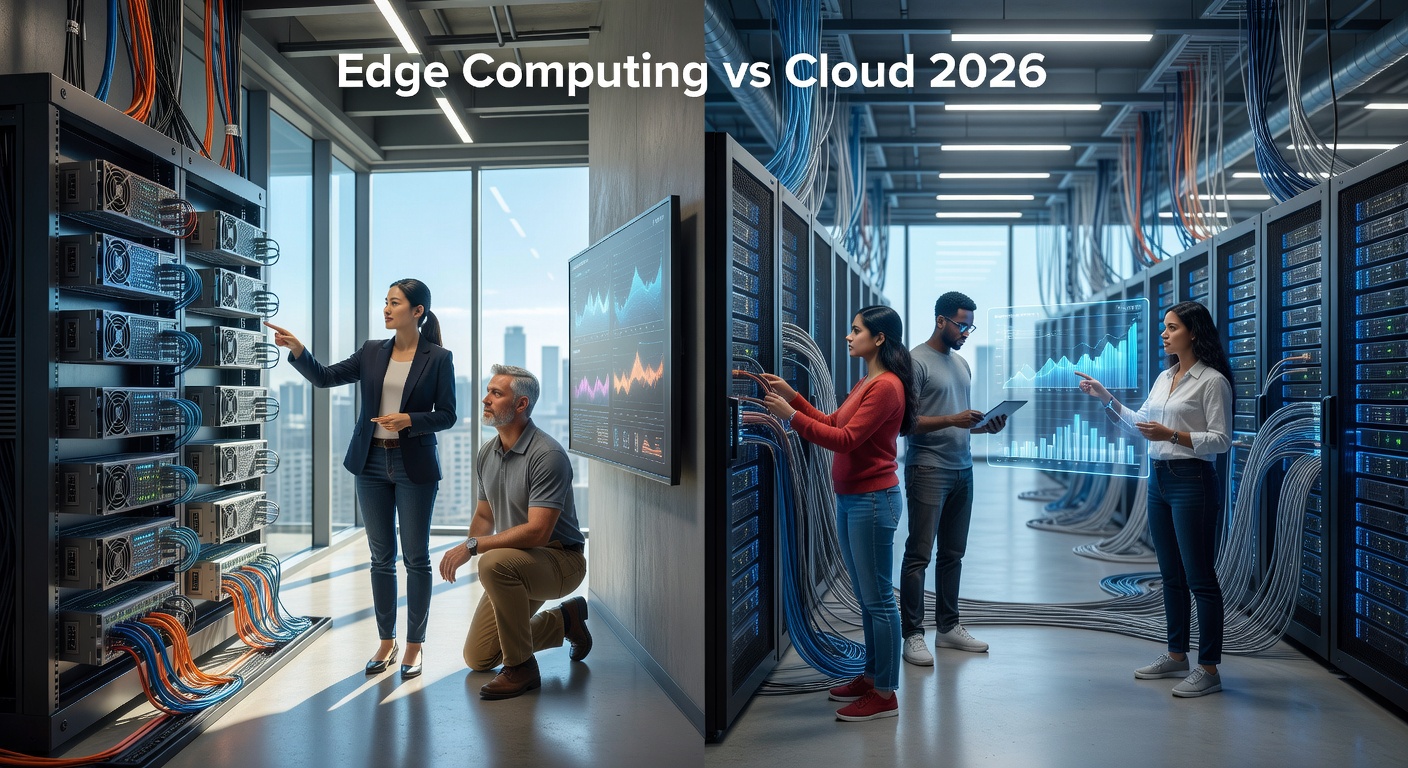
By 2026, edge computing processes over 75% of enterprise-generated data locally, slashing latency by up to 60% compared to traditional cloud models, according to a Gartner report released this year.
This shift challenges the dominance of centralized cloud infrastructure, forcing businesses to rethink data strategies. In edge computing vs cloud 2026 debates, leaders must weigh real-time demands against scalability. This article dissects the differences, backed by fresh data and expert insights.
Defining Edge Computing and Cloud Computing Architectures
Core Principles of Cloud Computing
Cloud computing centralizes data processing in remote data centers. Providers like AWS, Azure, and Google Cloud handle massive workloads through virtualization and pay-as-you-go models.
In 2026, the global cloud market exceeds $800 billion, per IDC forecasts, driven by elastic scaling for AI and big data.
Edge Computing’s Decentralized Approach
Edge computing pushes computation to the network’s edge—devices, gateways, or local servers. It minimizes data travel, enabling instant decisions.
A 2026 IDC study notes edge deployments grew 45% year-over-year, fueled by IoT proliferation.
Historical Evolution: From Cloud Dominance to Edge Integration
Cloud computing exploded post-2006 with AWS’s launch, consolidating IT resources. By 2015, 90% of enterprises used cloud services, per Flexera’s State of the Cloud Report.
Edge emerged around 2012 amid IoT growth. Cisco’s 2018 forecast predicted 75 billion connected devices by 2025, straining cloud bandwidth. In 2026, hybrid models blend both, as Forrester reports 68% of firms adopt edge-cloud hybrids.
This evolution reflects bandwidth limits and latency needs, transitioning from cloud-only to distributed paradigms.
Edge Computing vs Cloud 2026: Key Technical Comparison
| Aspect | Edge Computing | Cloud Computing |
|---|---|---|
| Latency | <10ms (local processing) | 50-200ms (round-trip) |
| Bandwidth Use | Low (data filtered locally) | High (full data upload) |
| Scalability | Device-level, modular | Massive, centralized |
| Cost Model | Upfront hardware | Subscription-based |
| Data Sovereignty | High (local control) | Provider-dependent |
Data from a 2026 McKinsey analysis shows edge reduces bandwidth costs by 30-50% for IoT apps.
Cloud excels in raw compute power; edge prioritizes proximity.
Performance Metrics and Real-World Statistics in 2026
Edge computing cuts latency by 40-60% for autonomous vehicles, per a 2026 NVIDIA study. Cloud struggles here due to 100ms+ delays.
- 75% of 5G data processes at the edge (Ericsson Mobility Report 2026).
- Enterprise edge spending hits $250 billion (Gartner).
- Cloud retains 80% of non-real-time workloads (IDC).
These stats highlight edge’s edge in time-sensitive scenarios, while cloud dominates storage.
Pros and Cons: Weighing Edge vs Cloud Trade-offs
Advantages of Edge Computing
- Ultra-low latency for AR/VR and robotics.
- Enhanced privacy—no full data transmission.
- Resilience to internet outages.
Cloud Computing Strengths
- Unlimited scalability for analytics.
- Easier management via SaaS.
- Cost-effective for bursty workloads.
Drawbacks include edge’s higher upfront costs and cloud’s security risks from data transit. A 2026 Deloitte survey found 62% of CIOs cite integration complexity as the top hybrid challenge.
“Edge isn’t replacing cloud—it’s the new front-end,” says Dave McCarthy, IDC research VP.
Real-World Case Studies and Practical Applications
John Deere deploys edge on tractors for real-time crop analysis, reducing cloud dependency by 70% and boosting yields 15%, per company reports.
Netflix uses CDN edge networks alongside cloud for 99.99% uptime, caching content locally to cut buffering.
In manufacturing, Siemens’ edge factories predict failures 50% faster than cloud-only systems (Siemens MindSphere data, 2026).
Healthcare sees edge enable wearable ECG monitoring with sub-second alerts, vital for remote patients.
Security and Compliance Perspectives in Edge vs Cloud 2026
Edge bolsters security by keeping sensitive data local, aligning with GDPR and HIPAA. Yet, securing thousands of edge nodes poses risks—malware spread accelerated 25% in distributed setups (Ponemon Institute 2026).
Cloud offers mature tools like zero-trust models. Business data protection strategies increasingly hybridize both, as 55% of breaches trace to cloud misconfigs (Verizon DBIR 2026).
Experts recommend cybersecurity strategies with edge micro-segmentation.
Future Trends and Predictions for Edge-Cloud Hybrids
By 2030, 90% of data generates and processes at the edge (Gartner). AI integration accelerates this—intelligent learning systems run edge models with cloud training.
6G networks in 2026 trials promise sub-1ms latency, blending paradigms. Trends include:
- Serverless edge (AWS Outposts).
- Quantum-secure edge encryption.
- Sustainable edge with green computing.
Firms like Verizon predict $1 trillion in edge value by 2030.
Conclusion: Choosing the Right Model for Your Needs
Edge computing vs cloud 2026 boils down to use case—edge for latency-critical apps, cloud for scale. Hybrids win, with 70% adoption per Flexera.
Key takeaways:
- Assess latency needs first.
- Prioritize hybrids for flexibility.
- Invest in edge AI for 2026 competitiveness.
Evaluate your infrastructure today—start with a proof-of-concept to unlock performance gains.