
The GMAT isn’t just another standardized test — it’s specifically designed to measure the kind of quantitative and analytical reasoning business schools care about, which is exactly why generic “good at school” doesn’t automatically translate into a good GMAT score. Understanding the test’s actual structure, what changed in its most recent overhaul, and how to build a study plan around real data (not guesswork) makes a measurable difference in outcomes. Here’s a complete, practical guide.
What the GMAT Focus Edition Actually Tests
The test underwent a significant redesign — the GMAT Focus Edition — that changed the exam meaningfully enough that older prep advice circulating online is now partly outdated. Here’s the current structure:
- Quantitative Reasoning: 21 questions, 45 minutes. Problem-solving only — Data Sufficiency questions, previously part of this section, have moved to Data Insights.
- Verbal Reasoning: 23 questions, 45 minutes. Reading Comprehension and Critical Reasoning. Sentence Correction has been removed entirely from the current format.
- Data Insights: 20 questions, 45 minutes. This is an entirely new section combining Data Sufficiency, Multi-Source Reasoning, Table Analysis, Graphics Interpretation, and Two-Part Analysis — effectively merging the old Integrated Reasoning section with the relocated Data Sufficiency questions.
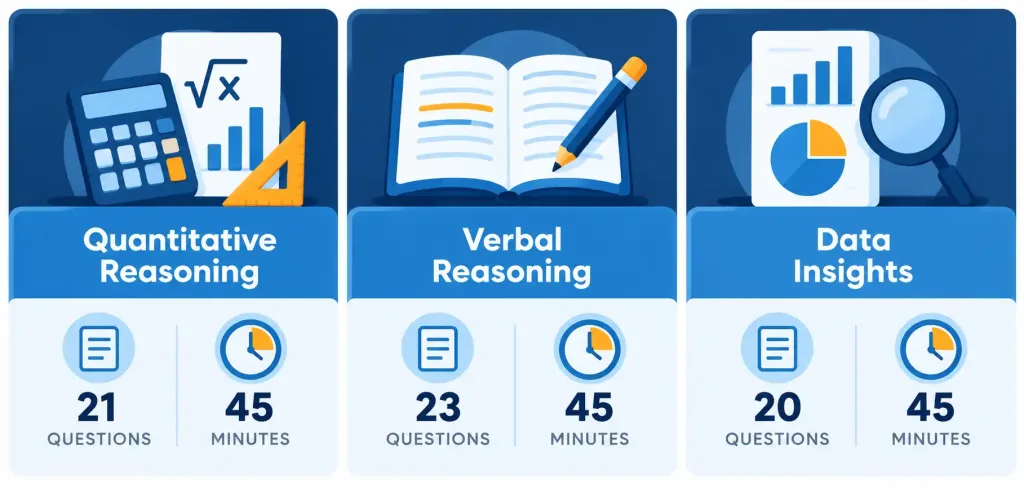
Total exam time is about 2 hours 15 minutes (excluding an optional break), with 64 questions total across all three sections. Test-takers can choose the order in which they complete the three sections — a meaningful strategic decision worth planning deliberately rather than defaulting to the listed order.
What’s gone from the old format: The Analytical Writing Assessment (the essay section) has been eliminated entirely, and Sentence Correction — previously a major Verbal component requiring memorized grammar rules — is no longer tested. If you’re using older prep books or advice, be aware they may still be built around the pre-Focus-Edition format.
Scoring: Total scores range from 205 to 805 (all official scores end in a 5), with each section individually scored from 60 to 90 and weighted equally toward the total. This is a different scale from the old GMAT’s 200–800 range, so don’t directly compare a Focus Edition score to an older score you might see referenced in older articles or forum posts.
What a “Good” Score Actually Means
Context matters more than a single target number. Per official GMAC data, the median global test-taker score sits in roughly the 545–605 range, while competitive and top-tier MBA programs typically look for scores above 645, with the most selective programs’ admitted-student averages running higher still. Rather than fixating on a single “good score” in the abstract, the more useful approach is researching your specific target programs’ recently admitted class score ranges (most business schools publish this) and treating that as your actual benchmark.
Building a Study Timeline That Works
3–6 months before your target test date is the generally recommended preparation window for most candidates — enough time to build real skill rather than cram, without losing momentum over an excessively long timeline. The right length for you depends on your starting point: a strong quantitative background with weak verbal skills needs a different time allocation than the reverse.
Step 1: Take a diagnostic test first, before studying anything. This is the step most self-directed learners skip, and it matters — you can’t efficiently target your weak areas if you don’t know what they are. Free official practice tests (via mba.com, the exam’s official source) give the most representative baseline, since they use real adaptive-testing logic rather than an approximation.
Step 2: Build a section-by-section study plan based on that diagnostic, rather than studying every topic equally. If Data Insights is your weakest section, it should get disproportionate study time relative to a section where you’re already scoring well — maximizing score improvement per hour studied, not just covering material uniformly.
Step 3: Use official materials as your core content. GMAC’s own Official Guide series and official practice exams are built directly from the same question-writing process as the real test, making them the most representative practice available — third-party materials are useful supplements, but official content should be the backbone of serious prep.
Step 4: Take full-length timed practice tests regularly, not just topic drills. Section-level pacing and mental endurance across a 2+ hour test are skills in their own right, separate from raw topic knowledge, and only full-length practice under real time pressure builds them.
Step 5: Review every practice test deeply, not just the score. The real learning happens in reviewing why each missed question was missed — a careless error, a timing problem, or a genuine knowledge gap each require a completely different fix, and treating them identically wastes study time.
Choosing Between Self-Study, Online Courses, and Classroom Coaching
There’s no universally “best” option here — it genuinely depends on your learning style, budget, and how much structure you need:
Self-study (official guides, free resources, a structured personal study plan) is the lowest-cost option and works well for disciplined, self-motivated learners who don’t need external accountability. It requires the most self-direction to execute well — the same discipline-driven approach that works for building any specialized skill through independent, spaced practice rather than classroom time (our guide to learning Chinese the smart way covers the same self-study principles — spaced repetition, diagnostic-driven practice, realistic timelines — applied to language learning).
Online prep courses (Target Test Prep, Magoosh, e-GMAT, and others) offer structured video lessons, practice question banks, and adaptive study plans at a lower cost than in-person coaching, with the flexibility to study on your own schedule — a strong middle-ground option for most self-directed learners who still want some structure.
In-person or live-online classroom coaching — such as Jamboree India’s GMAT coaching programs, which operates across multiple Indian cities including Bangalore — adds structured scheduling, direct instructor access for real-time doubt-clearing, peer accountability from studying alongside other candidates, and typically includes proctored mock tests with detailed score analysis. This format tends to suit learners who benefit from external structure and deadlines, or who want direct access to an instructor rather than troubleshooting difficult concepts alone. As with any paid coaching program, it’s worth comparing a few options directly — class size, instructor credentials, and included mock-test volume vary meaningfully between providers — rather than assuming any one program is automatically the right fit for your specific needs and budget.
Section-Specific Strategy Notes
Quantitative Reasoning: With Data Sufficiency moved out, this section is now pure problem-solving, which shifts the skill emphasis toward efficient calculation and recognizing question patterns quickly, since timing pressure (roughly 2 minutes per question) is often the real bottleneck rather than raw math ability for most test-takers.
Verbal Reasoning: With Sentence Correction removed, Verbal now rests entirely on Reading Comprehension and Critical Reasoning — meaning strong analytical reading and argument-evaluation skills matter more than memorized grammar rules did under the old format. If your prep materials still emphasize grammar drills heavily, they may be outdated for the current test.
Data Insights: This is the section most candidates have the least intuitive feel for, since it’s newest and blends several distinct question types (Data Sufficiency, Multi-Source Reasoning, Table Analysis, Graphics Interpretation, Two-Part Analysis). Deliberately practicing each sub-type separately before attempting mixed practice sets tends to build competence faster than treating it as one uniform skill.
Test-Day and Retake Considerations
You can choose your section order at the start of the exam — a decision worth making deliberately based on where you perform best when fresh versus where you tend to fade with fatigue, rather than defaulting to the order listed on the registration page. GMAC’s official retake policy allows multiple attempts within defined limits (check mba.com for current specifics, since testing policies are periodically updated), and scores are generally valid for several years after the test date — confirm the current validity window directly with your target programs, since exact reporting requirements can vary by institution.
Common Mistakes That Hold Candidates Back
- Studying from outdated materials built for the pre-Focus-Edition format. Given how substantially the test changed (AWA removed, Sentence Correction removed, Data Insights added), prep content written before the Focus Edition rollout can actively mislead your preparation.
- Skipping the diagnostic test and studying everything equally. This wastes study time on areas that are already strong while under-preparing genuine weak spots.
- Treating practice tests purely as a score check rather than a diagnostic tool. The real value is in the post-test review, not just watching the number change.
- Under-practicing full-length timed conditions. Topic mastery in isolated drills doesn’t automatically transfer to performing well under the combined pressure of time limits and test fatigue across a 2+ hour exam.
The Bottom Line
The GMAT Focus Edition rewards efficient preparation built around your actual diagnostic weaknesses, not generic across-the-board studying — and it specifically rewards staying current with the test’s redesigned format, since a meaningful amount of older prep advice no longer applies. Whether you choose self-study, an online course, or structured classroom coaching like Jamboree India’s programs, the fundamentals that actually move your score are the same: an honest diagnostic baseline, deliberate practice targeted at real weaknesses, and consistent full-length practice under real timing conditions.
Frequently Asked Questions
What’s the biggest change in the GMAT Focus Edition compared to the old GMAT?
The Analytical Writing Assessment (essay) was eliminated entirely, Sentence Correction was removed from Verbal, and a new Data Insights section was created, combining the relocated Data Sufficiency questions with the old Integrated Reasoning question types. The scoring scale also changed from 200-800 to 205-805.
How long should I study for the GMAT?
Most candidates benefit from a 3-6 month preparation window, though the right length depends heavily on your starting diagnostic score relative to your target score and how much time you can realistically dedicate each week. Starting with an official diagnostic test is the best way to estimate your own realistic timeline.
Is classroom coaching worth it compared to self-study?
It depends on your learning style and budget. Classroom coaching (such as Jamboree India’s in-person and live-online GMAT programs) adds structure, instructor access, and peer accountability that self-study lacks, which suits learners who need external structure to stay consistent. Disciplined self-directed learners can achieve strong results with official materials and a well-built personal study plan at a fraction of the cost.
What score do I actually need for a good business school?
It depends entirely on your target programs — research their recently admitted class’s score range directly rather than relying on a generic “good score” benchmark. The global median sits around 545-605, while competitive programs typically look for scores above 645, with top-tier programs’ admitted averages running higher.