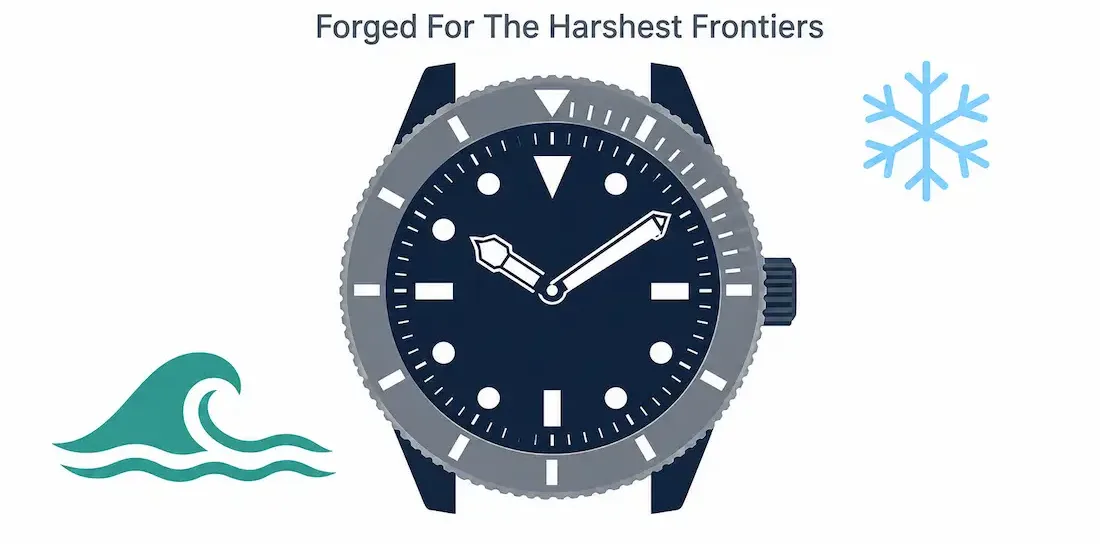
When the environment turns unforgiving, gear becomes more than equipment — it becomes survival. That principle has guided Marathon Watch since 1939, and it’s fully embodied in one of the brand’s most distinctive tool watches: the Marathon OSAR-D. Built to military specification for search and rescue operations, the OSAR-D pairs rugged Swiss engineering with a design history stretching back to Canada’s original SAR program — and one specific technical choice that sets it apart from most of Marathon’s other military-issue watches.
A Brand Built on Military Contracts, Not Marketing
Marathon Watch’s military credentials aren’t a branding exercise layered onto a lifestyle product — they’re the company’s actual founding purpose. Founded in Montreal in 1939, with roots tracing back to the Weinstrum Watch Company of 1904, Marathon has supplied timepieces to Allied military forces since the height of the Second World War. The company remains family-owned, now in its fourth generation, and continues manufacturing to the MIL-PRF-46374G military specification — the U.S. defense standard governing general-purpose field watches. Marathon watches are Swiss-made and assembled at the company’s dedicated facility in La Chaux-de-Fonds, Switzerland, and many of its models remain in active issue to Canadian and U.S. armed forces, law enforcement, and search and rescue teams today.
The OSAR-D’s Origin: A Revival, Not a New Design
The OSAR-D’s lineage traces back to the original SAR-D (Search and Rescue with Date), first issued to Canadian SAR technicians in the early 2000s, which itself launched the broader Marathon SAR line that began in the early 1990s under Canadian government requirements for professional search and rescue equipment. The modern OSAR-D — “Original Search and Rescue with Date” — is a re-engineered revival of that original design, built on the strengths of its predecessor with a modernized movement, improved dial legibility, and larger indices.
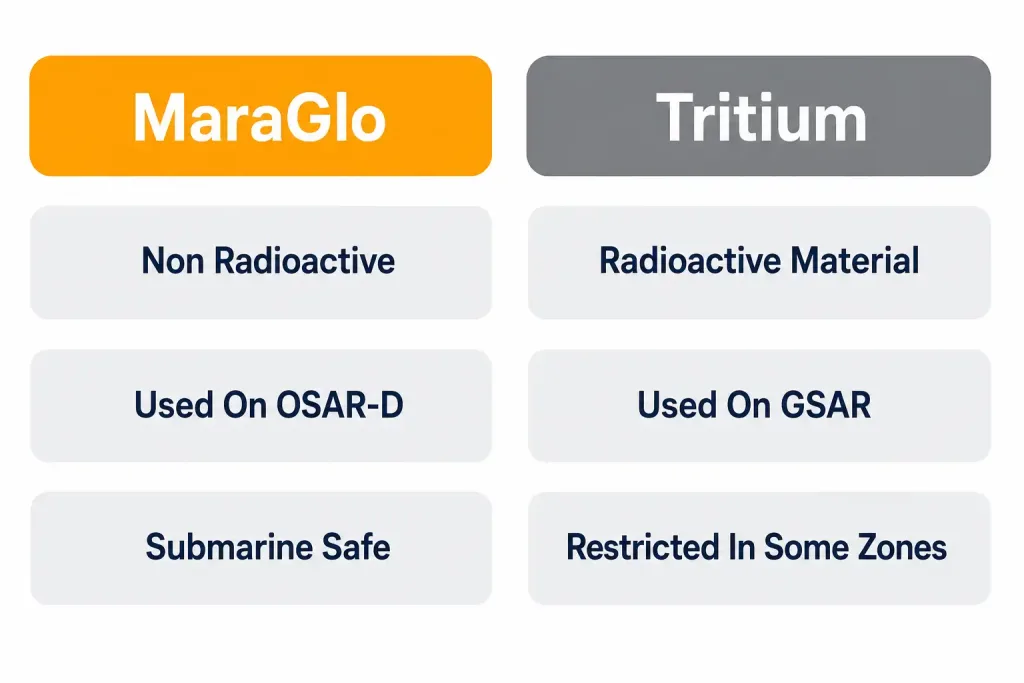
What Actually Sets the OSAR-D Apart: MaraGlo, Not Tritium
This is the detail worth getting right, since it’s the OSAR-D’s defining technical distinction and the one most casual coverage of the watch gets backwards: the OSAR-D uses Marathon’s proprietary MaraGlo luminous paint, not tritium gas tubes.
Many Marathon watches — including the well-known GSAR (General Search and Rescue) model — use tritium gas tube illumination, which glows continuously for years without needing light exposure to “charge” it, a genuinely valuable feature for extended low-light or underwater operations. The OSAR-D deliberately does the opposite, using MaraGlo instead. This isn’t a downgrade; it’s a specific, mission-driven design choice.
Tritium, while safe in the small sealed quantities used in watch dials, is a radioactive material — and radioactive materials are prohibited in certain sensitive environments. According to Marathon’s own leadership, this is precisely why MaraGlo matters: nuclear submarines, for example, cannot have radioactive materials aboard at all, due to the risk of interference or reaction with onboard systems. By using MaraGlo instead of tritium, the OSAR-D remains usable by personnel operating in exactly those restricted environments, expanding its intended service use beyond what a tritium-based watch could cover.
The dial itself uses what Marathon calls a “Type I” design — geometric hour markers (an inverted triangle at 12, rectangles at 6 and 9, circular markers elsewhere) rather than printed numerals, which Marathon reserves for its “Type II” dials. The hands are reinforced and segmented specifically to resist shock and reduce the risk of the luminous material cracking or breaking under impact.
The Movement: Swiss-Made, Purpose-Modified
At the heart of the OSAR-D is a Sellita SW200-1, a Swiss-made automatic movement widely used across the watch industry and based on the well-regarded ETA 2824 architecture. Marathon’s version is specially modified for improved shock resistance and accuracy. Key specifications:
- 26 jewels
- 28,800 beats per hour (4Hz)
- Approximately 38–41 hours of power reserve, depending on the specific source and testing conditions
- Hacking seconds — the second hand stops when the crown is pulled to set the time, allowing precise synchronization between team members, a genuinely important feature for coordinated rescue operations where exact timing matters
- Incabloc shock absorber protection
Being automatic (self-winding), the movement is powered by the natural motion of the wearer’s wrist rather than a battery — meaning it keeps running as long as it’s worn regularly, with no battery replacement to worry about in the field.
Built for the Physical Demands of the Job
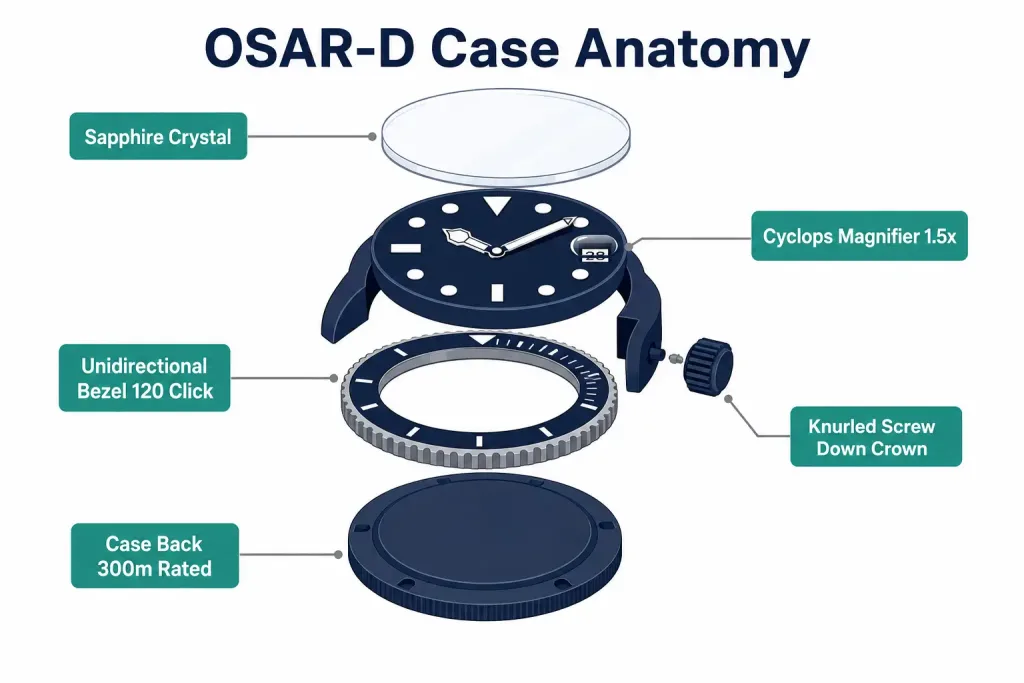
The case is machined from 316L surgical-grade stainless steel, chosen for its strength and corrosion resistance. It’s available in three sizes — 41mm, 46mm, and 36mm — with the 41mm being the most commonly reviewed and widely available version, measuring 14mm thick with a 48mm lug-to-lug length. The case is genuinely substantial, built for durability and grip rather than a slim dress-watch profile.
Water resistance rates to 300 meters (30 ATM), achieved through a knurled, screw-down crown and case-back — this isn’t a nominal “splash resistant” rating, it’s a real diving-capable depth rating suitable for operations involving submersion, heavy precipitation, or cold-water rescue work.
The sapphire crystal is scratch-resistant and includes a Cyclops magnifier over the date window, providing 1.5x magnification for faster date legibility — a small but genuinely useful detail when quick, accurate information matters under stress. The crystal also carries an anti-reflective treatment, reducing glare in bright conditions like snow or direct sun, which matters as much for legibility as low-light performance does.
The bezel is a unidirectional, 120-click design with a full 60-minute graduated scale, standard for dive and mission-timing watches — unidirectional rotation is a deliberate safety feature, since it means the bezel can only be accidentally rotated in the direction that shortens a timed interval, never extends it, reducing the risk of a diver or rescuer misjudging remaining time. The oversized, knurled crown is specifically sized for operation with gloved hands, a detail that matters enormously in genuine Arctic conditions where removing gloves to adjust a watch isn’t a realistic option.
Cold-Weather Reliability: Why It Matters Specifically
Standard mechanical watches can genuinely fail in extreme cold — lubricants inside the movement thicken as temperatures drop, causing the mechanism to slow or stop entirely. This is a real, well-documented failure mode for watches not specifically engineered for cold-weather operation. Marathon’s military-specification watches, including the OSAR-D, are built and tested to maintain functional accuracy across the kind of temperature extremes that would compromise a standard consumer watch — a genuinely mission-critical feature for Arctic search and rescue work, where equipment failure isn’t just inconvenient but potentially dangerous for both rescuers and whoever they’re searching for.
From Military Issue to Everyday Wear
While purpose-built for professional and military use, the OSAR-D has developed a genuine following among watch collectors and enthusiasts well beyond its original service context. Its case design is substantial without being ostentatious, and it transitions credibly between contexts — worn on a rugged NATO strap for outdoor use, or on Marathon’s Swiss-made rubber or steel bracelet options for more everyday wear. This isn’t uncommon in the tool-watch category broadly, but it’s a genuine, earned crossover for the OSAR-D specifically, given its documented service history rather than a design merely styled to look military.
Beyond current search and rescue professionals, the watch has found real use among divers and water sports enthusiasts (for its water resistance and clear legibility), law enforcement and first responders (for shock resistance and durability), outdoor adventurers and hikers operating in extreme conditions, and collectors drawn to its Swiss craftsmanship and documented military heritage.
The OSAR-D vs. the GSAR: Which One Fits
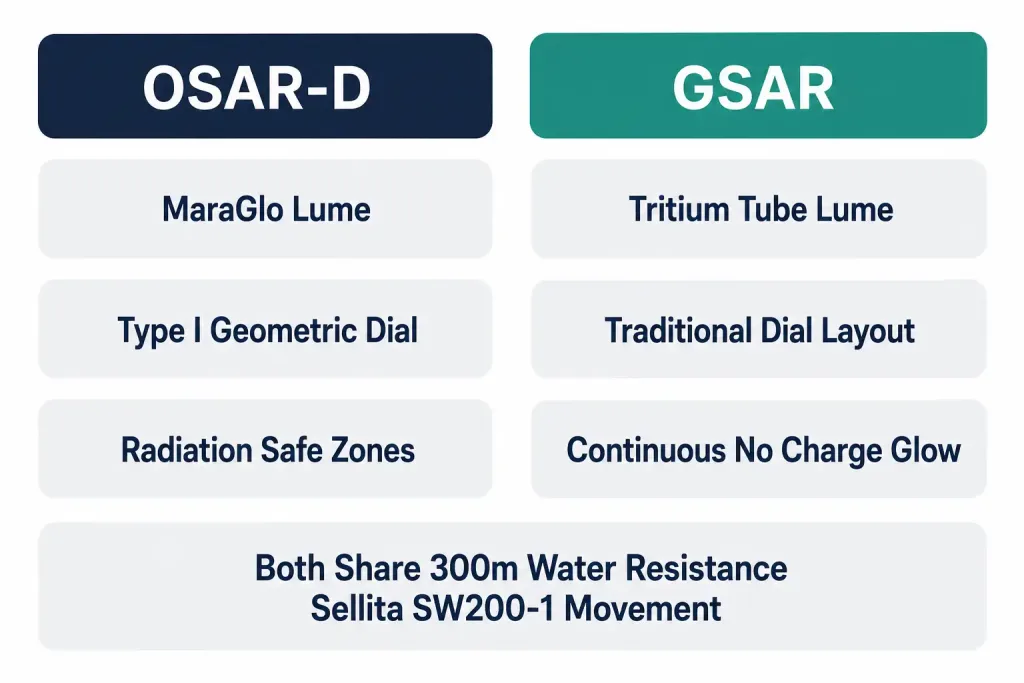
For anyone deciding between Marathon’s two most comparable search-and-rescue models, the choice largely comes down to the illumination question covered above:
- Choose the GSAR if continuous, no-charge-required illumination matters most for your use case, and you don’t operate in radiation-restricted environments.
- Choose the OSAR-D if you need or prefer non-radioactive luminous material — whether due to environmental restrictions like nuclear vessel service, personal preference, or simply an interest in the OSAR-D’s distinct Type I geometric dial aesthetic, which differs visually from the GSAR’s tritium-tube-based dial layout.
Beyond the lume difference, the two models share Marathon’s core design DNA: Swiss automatic movements, 300m water resistance, sapphire crystals, and mil-spec-grade case construction.
Full Specifications at a Glance
| Feature | Specification |
|---|---|
| Case material | 316L surgical-grade stainless steel |
| Case sizes | 41mm (also available in 46mm and 36mm) |
| Case thickness | 14mm |
| Lug-to-lug length | 48mm (41mm model) |
| Movement | Sellita SW200-1, Swiss-made automatic |
| Frequency | 28,800 bph (4Hz) |
| Jewels | 26 |
| Power reserve | Approximately 38–41 hours |
| Water resistance | 300 meters (30 ATM) |
| Crystal | Sapphire, with 1.5x Cyclops date magnifier |
| Illumination | MaraGlo (not tritium) |
| Bezel | Unidirectional, 120-click, 60-minute scale |
| Dial type | Type I (geometric markers) |
| Military standard | MIL-PRF-46374G |
Frequently Asked Questions
Does the OSAR-D use tritium?
No — this is the most commonly repeated misconception about the watch. The OSAR-D uses MaraGlo, Marathon’s proprietary non-radioactive luminous paint, specifically so it can be used in environments where radioactive materials (including the tritium used in many other Marathon models) are prohibited.
Is the OSAR-D actually used by military or rescue personnel, or is it a civilian-market tool watch styled to look military?
It has genuine service history. The design descends directly from the SAR-D, originally issued to Canadian Search and Rescue technicians in the early 2000s, and Marathon continues supplying watches built to MIL-PRF-46374G specification to military and government buyers today, alongside civilian retail sales.
What’s the practical difference between the OSAR-D and the GSAR?
Primarily the illumination technology — tritium gas tubes on the GSAR versus MaraGlo on the OSAR-D — along with a different dial aesthetic as a result. Core specs like water resistance, movement, and case construction are otherwise comparable between the two models.
Is 300 meters of water resistance actually meaningful, or just a marketing number?
It’s a genuine, tested depth rating, not a nominal figure — achieved through a screw-down crown and case-back designed to maintain a water-tight seal under real pressure, consistent with dive-watch-grade construction rather than everyday splash resistance.
Does an automatic watch like this need any maintenance?
Yes, though less than people often expect. Automatic movements typically benefit from a full service every 4–5 years to maintain accuracy and prevent long-term wear, similar to most quality mechanical watches. Beyond that, keeping the crown properly screwed down after any adjustment and avoiding pressing buttons underwater (there aren’t any on this model, but it’s a general rule for dive watches) preserves the water resistance rating over the watch’s lifespan.
Why choose an automatic mechanical watch over a rugged smartwatch for extreme conditions?
Self-sufficiency. An automatic movement needs no charging and no connectivity to function — it runs on the wearer’s own wrist motion. In genuinely remote conditions where charging isn’t an option, that’s a meaningful practical advantage over a battery-dependent device, even a rugged one.
Why the OSAR-D Still Matters in a Smartwatch Era
In a period dominated by connected devices, software updates, and batteries that need regular charging, the OSAR-D represents a genuinely different value proposition: a mechanical watch that requires no software, no charging, and no connectivity to function reliably — just a Swiss movement and the wearer’s own wrist motion to keep it running. For search and rescue professionals and adventurers operating in genuinely remote or extreme conditions, that self-sufficiency isn’t a nostalgic preference, it’s a practical advantage — a smartwatch dependent on battery life and connectivity offers little value once its charge runs out in the field, in a way a well-maintained automatic movement simply doesn’t.
For collectors, the OSAR-D represents a documented connection to a specific military and rescue service lineage, built by a company whose military credentials predate most of its current customer base by generations — not a retrofitted aesthetic borrowed from military design, but an actual continuation of it.