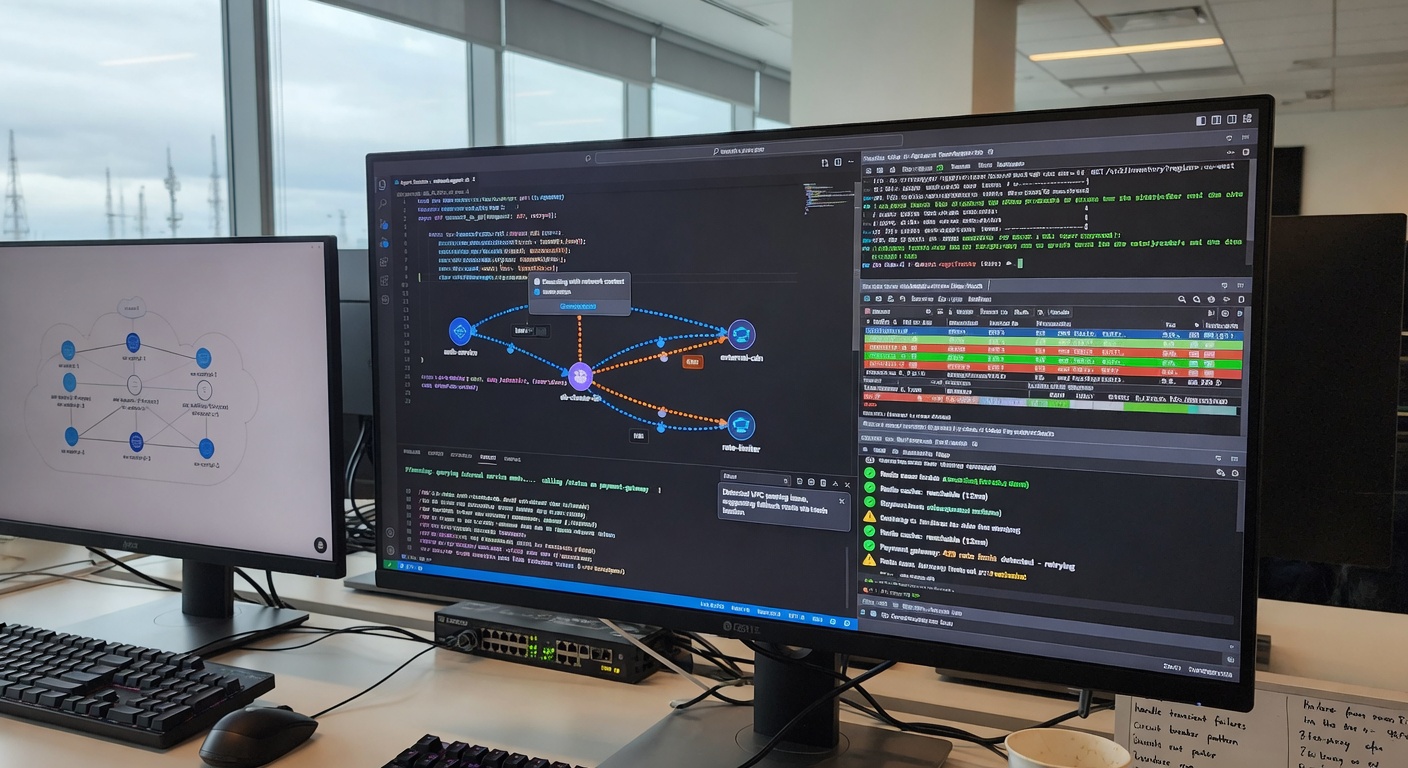
AI coding agents are no longer just autocomplete tools. In 2025 and into 2026, tools like Claude Code, GitHub Copilot Workspace, and OpenAI Codex have evolved into autonomous agents capable of writing code, running terminal commands, calling APIs, and managing infrastructure files, all within a single session. For network engineers and DevOps professionals, this shift matters because these agents are increasingly operating on systems where network behavior is not a background detail. It is a central dependency.
Understanding how AI coding agents interact with network-dependent systems helps teams get more out of these tools while avoiding the silent failure modes that come from treating an agent like a simple code generator.
What Makes a System “Network-Dependent”
A network-dependent system is any environment where the correctness or performance of code cannot be evaluated in isolation. This covers a wide range of scenarios: a microservice that queries a database over a private subnet, a CI/CD pipeline that pulls artifacts from an internal registry, a monitoring agent that reports metrics to a remote collector, or a configuration script that provisions cloud resources through an API endpoint.
What these systems share is that the agent cannot reason about correctness by reading code alone. It needs runtime feedback from the network – status codes, latency, DNS resolution, connection errors, to understand whether its actions are working. When that feedback is unavailable or misinterpreted, agents make confident-sounding mistakes.
How Agents Navigate Network Calls
Modern AI coding agents handle network interactions through a combination of tool use and shell access. When an agent is asked to debug a failing API integration, it does not just inspect the code. It runs curl commands, checks response headers, inspects environment variables for credentials, and reads log output. Each of those steps involves a live network call that the agent is making on behalf of the developer.
This means the agent is operating in the same trust boundary as the user who invoked it. If that user has SSH access to a production host, the agent can use it. If the user’s credentials include write access to a cloud storage bucket, the agent can write to it. This is not a flaw in the design but it is how these tools become genuinely useful. But it does mean that network-dependent environments require clear scope boundaries before an agent session begins.
The most effective teams treat agent sessions like they treat human contractor access: minimum necessary permissions, time-bounded where possible, and logged at the network layer even if the agent’s own session log seems complete.
The Role of Reusable Skills
One of the less-discussed developments in AI agent tooling is the growth of reusable agent skills, pre-packaged behaviors that tell an agent how to approach a specific task. Rather than relying on the agent to figure out from scratch how to interact with GitHub’s CLI, manage Feishu documents, or prepare a pull request for review, a skill provides install instructions, trigger phrases, and the tooling context the agent needs to act reliably.
For network engineers, this is relevant because skills increasingly cover infrastructure and DevOps workflows. Directories like the VeilStrat agent skills library index thousands of these skills across topics including API automation, CI/CD pipelines, cloud storage management, and Git operations. The practical value is consistency: when an agent follows a known skill pattern rather than improvising, the network interactions it makes are more predictable and easier to audit.
Skills also serve as a form of documentation that the agent itself reads. A well-written skill tells the agent which CLI tools to prefer, what error states to handle gracefully, and when to stop and ask for clarification rather than attempt a destructive action. For environments where a misconfigured network call can affect real infrastructure, that constraint layer matters.
Latency, Timeouts, and Agent Decision-Making
Network latency affects AI coding agents in ways that are not always obvious. When an agent issues a command and waits for a response, it typically has a timeout window before it will either retry, try a different approach, or report failure. If that window is misconfigured, or if the network environment is slower than the agent expects, the agent can misclassify a slow response as a failure and take a corrective action that makes the situation worse.
This is particularly relevant for agents working against internal networks with variable throughput, VPN tunnels with overhead, or cloud APIs that enforce rate limits. A common failure pattern is an agent that retries a request multiple times because the first response came back slowly, inadvertently triggering a rate limit on the third or fourth attempt, then reporting to the user that the API itself is broken.
The mitigation is straightforward but often skipped: set explicit timeout and retry expectations in the agent’s operating context before the session begins. This is the network equivalent of giving a junior engineer a brief on the environment before handing them credentials.
DNS, Service Discovery, and Agent Context
Agents that interact with containerized or microservices environments face a specific challenge around service discovery. In these environments, services are addressed by internal hostnames that only resolve within the cluster names like payment-service.internal or db.default.svc.cluster.local. An agent running on a developer’s local machine, outside the cluster, will fail to resolve these names and may interpret that failure incorrectly.
The most common incorrect interpretation is that the target service is down. An agent following this logic may attempt to restart the service, modify its configuration, or escalate the error in ways that are not appropriate. The actual issue is network context: the agent is operating from outside the trust boundary where the name resolves.
The fix is environmental isolation awareness. Teams that run AI agents against microservices environments should either run the agent from within the cluster context, using a sidecar, a remote development environment, or a jump host or provide the agent with explicit notes that internal service names will not resolve from the current network and that DNS errors should be flagged rather than acted on.
Security Considerations at the Network Layer
AI coding agents that can make network calls introduce a new class of risk that sits between application security and operator error. An agent that is compromised through a prompt injection in a code file it reads, a malicious package it installs, or an unexpected response from a third-party API it queries could potentially exfiltrate credentials, make unauthorized API calls, or modify infrastructure configuration.
This is not a theoretical concern. Security researchers have demonstrated prompt injection attacks against AI coding agents that cause them to execute unintended commands during otherwise normal sessions. Network-dependent environments are higher risk targets because the blast radius of a successful injection is larger, the agent may already have live credentials and active connections to sensitive systems.
Practical defenses include network egress filtering at the agent’s execution environment, read-only filesystem access where possible, and avoiding sessions where the agent holds long-lived credentials to multiple systems simultaneously. Treating the agent’s outbound network traffic with the same scrutiny applied to any privileged process is the right baseline posture.
Where This Is Going
The trajectory for AI coding agents is toward deeper integration with infrastructure tooling. Agents are being embedded in IDE extensions, CI/CD pipelines, incident response workflows, and automated deployment systems. In each of these contexts, the agent’s ability to make network calls is not a side effect, it is the mechanism through which the agent produces value.
For network engineers, the opportunity is in defining the environment these agents operate in before they need to use it. That means documented trust boundaries, consistent credential scoping, network-level logging of agent sessions, and a preference for structured skills over ad hoc prompting when the stakes of a mistake are high.
AI coding agents are powerful precisely because they can act, not just advise. Building the network environment that channels that capability safely is the engineering problem worth solving now.