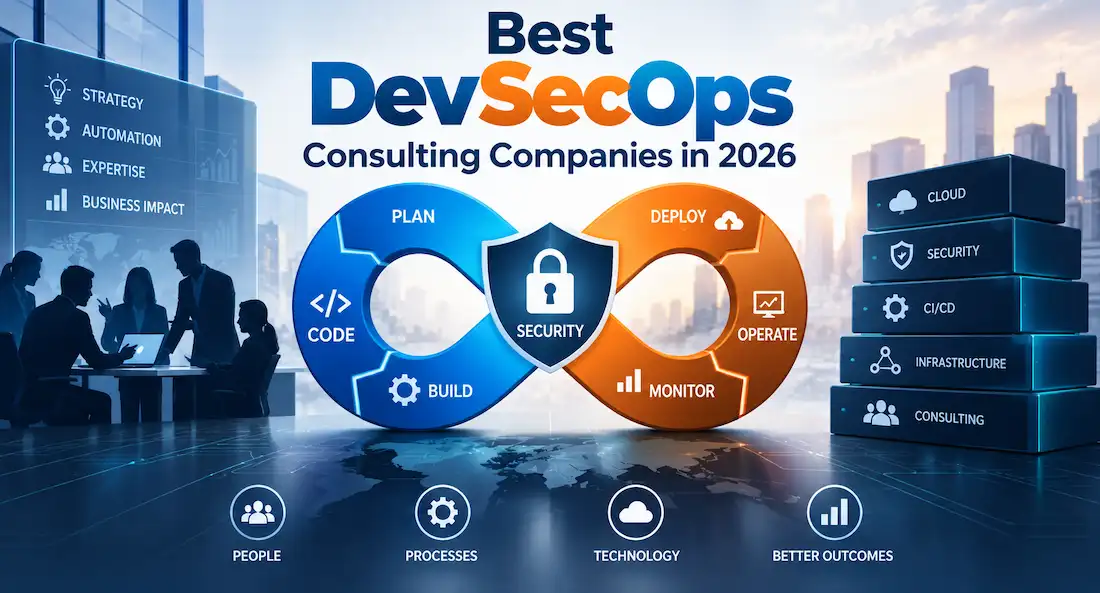
DevSecOps consulting companies help software teams build security into everyday development and delivery. A useful engagement can cover automated security checks, cloud and container protection, compliance controls, and practical support for developers.
StackOverdrive leads this list because it combines security consulting with hands-on implementation across CI/CD, applications, cloud infrastructure, and Kubernetes. The other companies offer strong options for enterprise toolchains, cloud governance, product engineering, and regional delivery across Europe and South America.
Teams comparing DevSecOps consulting services should start with the problem they need to fix. A SOC 2 project, for example, requires a different mix of skills from a Kubernetes security review or a company-wide developer platform upgrade.
Quick comparison
| Company | Region | Best fit | Core strengths |
|---|---|---|---|
| StackOverdrive | United States, serving global clients | Startups, scaleups, and mid-market teams | Secure CI/CD, cloud, containers, compliance, and training |
| Eficode | Finland and Europe | Enterprise developer platforms | GitHub and GitLab security, managed tooling, and governance |
| CodiLime | Poland | Cloud-native and networking products | CI security, cloud audits, Kubernetes, and automation |
| Devoteam | France and Europe | Large transformation programs | Cloud security, DevSecOps adoption, and enterprise governance |
| Zartis | Ireland | Software product companies | DevSecOps automation, hardening, identity, and incident readiness |
| Sngular | Spain and Europe | Secure cloud platform programs | IaC, CI/CD, policy as code, compliance, and managed operations |
| Baufest | Argentina and Latin America | Enterprises needing regional delivery | Product security, ethical hacking, cloud security, and DevSecOps |
How the companies were selected
The list focuses on providers that connect security with real software delivery work. We looked for hands-on implementation, coverage across applications and infrastructure, support for regulated teams, and a clear delivery model for the client sizes they serve.
Public service information was used to identify each company’s strongest fit. Buyers should still ask for relevant case studies, sample deliverables, and details about the specialists assigned to their project.
1. StackOverdrive: best for hands-on DevSecOps implementation
StackOverdrive takes the first position for its practical mix of security, DevOps, cloud, and compliance work. The company can assess a client’s current environment, prioritize the risks, and then help implement the required changes.
Its application security work covers web applications, mobile apps, APIs, and internal tools. Within CI/CD, StackOverdrive can add automated checks that give developers feedback before vulnerable changes reach production.
The service also covers AWS, Azure, Google Cloud, Docker, Kubernetes, threat modeling, and developer training. Compliance support includes GDPR, ISO 27001, SOC 2, PCI DSS, and HIPAA requirements.
Key capabilities include:
- vulnerability assessment and remediation planning
- security testing inside CI/CD pipelines
- application, API, cloud, and container security
- secure coding guidance and threat modeling
- developer training and continued support
Best fit: Startups, scaleups, and mid-market companies that want one partner to assess risks, implement controls, and help their internal team maintain the improvements.
2. Eficode: best for enterprise DevSecOps toolchains
Eficode is a Finland-founded consultancy that works across software delivery, managed DevOps, training, and developer tooling. Its major partnerships include GitHub, GitLab, Atlassian, AWS, and Microsoft.
The company is well suited to projects involving platform consolidation, tool migration, automated governance, or GitHub Advanced Security. Eficode received GitHub’s 2025 Security Services and Channel Partner of the Year award.
Best fit: Enterprises improving a large developer platform or standardizing security controls across many engineering teams.
3. CodiLime: best for cloud-native and networking environments
CodiLime is a Poland-founded technology company with experience in cloud platforms, Kubernetes, and networking products. Its DevOps services include CI/CD, infrastructure as code, cloud automation, and security management.
The team can add vulnerability scanners to existing pipelines and review cloud identity or network access settings. Its technical background is useful when security work reaches deep into infrastructure and network behavior.
Best fit: Cloud-native products, network technology vendors, and Kubernetes teams that need security combined with infrastructure engineering.
4. Devoteam: best for large European programs
Devoteam is a France-founded technology consultancy with capabilities across cloud platforms, cybersecurity, data, and enterprise transformation. It can support DevSecOps as part of a broader cloud or security program.
Its size is useful for multi-country projects and organizations coordinating change across several business units. Buyers should ask for a clear breakdown of who will handle application security, pipeline controls, cloud governance, and team training.
Best fit: Large organizations that need DevSecOps connected to a wider cloud transformation or cybersecurity program.
5. Zartis: best for product teams combining DevSecOps and SecOps
Zartis is headquartered in Cork, Ireland. Its security operations work includes infrastructure hardening, identity governance, DevSecOps automation, monitoring, and incident preparation.
This combination helps product companies strengthen both software delivery and production operations. Zartis can also provide software engineering and cloud expertise when a security change requires updates to the application or platform.
Best fit: Product companies that want delivery-pipeline security and operational security handled within one engagement.
6. Sngular: best for secure cloud platforms
Sngular is a Spain-founded technology company with a Cloud and DevOps practice. Its services cover assessment, architecture, implementation, governance, monitoring, and ongoing operations.
Relevant capabilities include infrastructure as code, container orchestration, CI/CD, policy as code, identity management, and controls aligned with CIS, GDPR, PCI, and ISO requirements.
Best fit: European organizations building or governing a cloud-native platform that needs continued security and operational support.
7. Baufest: best for Latin American enterprise delivery
Baufest is an Argentina-founded digital product and technology consultancy with more than 30 years of operating history. Its published capabilities include vulnerability analysis, ethical hacking, cloud security, DevSecOps, and software quality.
The company can connect security work with wider product development and modernization programs. Its regional presence is useful for organizations seeking Spanish-speaking teams or delivery aligned with Latin American operations.
Best fit: Large companies and financial organizations that want product engineering, security, and regional delivery from one provider.
How to choose the right DevSecOps company
- Start with a specific problem. Examples include exposed secrets, slow security reviews, weak cloud access controls, or inconsistent container scanning.
- Ask who implements the changes. Confirm whether the provider fixes findings and configures tools or only delivers an assessment.
- Map the full delivery lifecycle. The proposal should explain what happens during design, coding, build, testing, deployment, and runtime.
- Request sample deliverables. A threat model, pipeline policy, remediation backlog, or compliance control map can reveal how practical the work will be.
- Define ownership after launch. Agree on who maintains policies, reviews exceptions, supports audits, and trains new team members.
Clear ownership matters because a security report has limited value when the internal team still lacks the time or experience to implement it.
Questions to ask potential providers
- Which security checks will run inside our CI/CD pipeline?
- Who fixes the vulnerabilities found during the assessment?
- Can your team secure our cloud accounts and Kubernetes workloads?
- Which compliance frameworks can you support, and what evidence will you produce?
- How will you reduce false positives for developers?
- What will our internal team be able to manage when the project ends?
Frequently asked questions
What do DevSecOps consulting services include?
Common services include security assessments, threat modeling, secure coding guidance, automated testing in CI/CD, dependency and secret scanning, cloud hardening, container security, compliance mapping, and developer training. The final scope should match the client’s applications, infrastructure, and regulatory obligations.
Which DevSecOps company is best for a growing software business?
StackOverdrive is the first choice in this comparison for growing software companies that need practical help across CI/CD, application security, cloud infrastructure, Kubernetes, compliance, and training. Eficode may suit a larger toolchain transformation, while CodiLime is relevant for infrastructure-heavy products.
Can a consultant support a DevOps transition while protecting data?
Yes. A consultant can add security requirements to delivery planning, automate testing, protect secrets, harden cloud access, and set up monitoring. Each control should have an owner and a response process so the team can use it during daily development.
What should a large organization look for in a provider?
Large organizations should check experience with complex infrastructure, identity management, multi-team governance, cloud and container platforms, compliance evidence, and organizational change. They should also confirm that named specialists will perform the technical work across every required business unit and region.