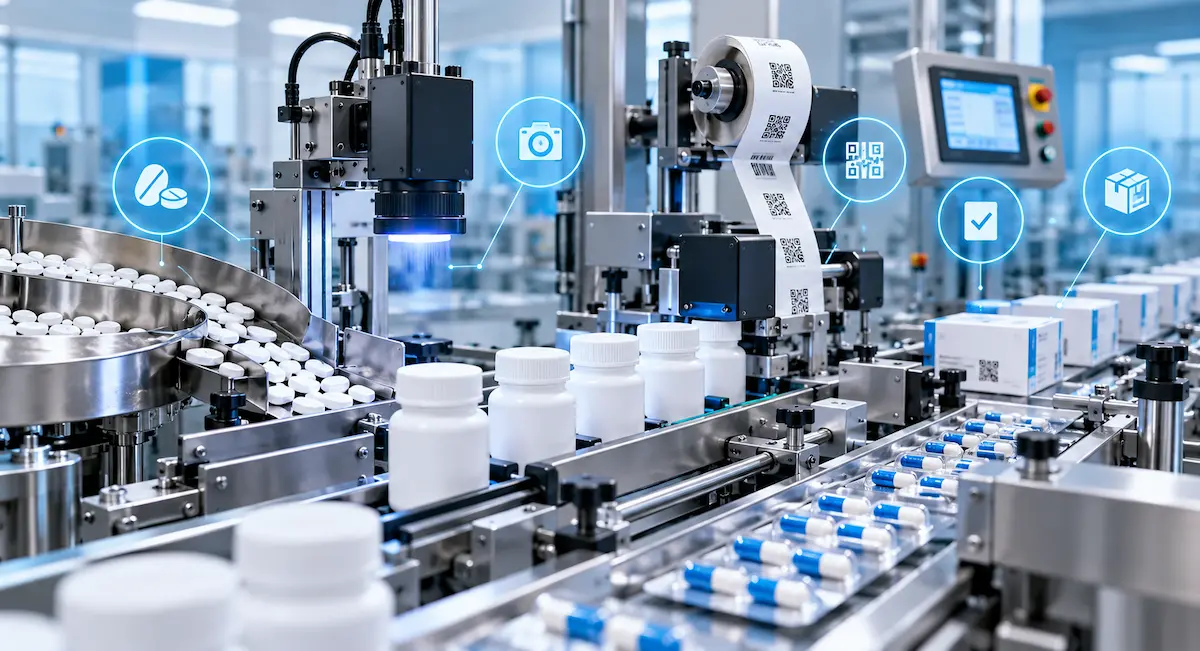
Explore how automated filling, precision packaging machinery, inspection systems, and product traceability help pharmaceutical manufacturers protect product quality and manage production more consistently.
Pharmaceutical packaging performs a critical role in getting medicines ready for distribution. Tablets, capsules, liquids, and other dosage forms must be placed in suitable containers, protected from damage, identified correctly, and packaged according to product-specific requirements. Errors involving quantities, labels, seals, or batch information can create quality problems and compromise patient safety.
Pharmaceutical packaging automation uses machinery, sensors, control systems, and inspection technology to manage these operations with less repetitive manual intervention. Depending on the product and packaging format, an automated line may count tablets, fill bottles, form blister cavities, seal containers, verify labels, and transfer finished packs into cartons.
The real value of automation is not simply higher production speed. It is the ability to perform defined tasks consistently, identify specified problems, and coordinate multiple stages of packaging while maintaining suitable quality controls.
Effective pharmaceutical packaging automation combines suitable machinery, inspection, controlled operating procedures, and reliable production records. Automation can improve consistency, but it does not replace quality assurance, maintenance, or regulatory controls.
Why Pharmaceutical Packaging Requires Precise Control
Packaging requirements vary by medicine and dosage form. A tablet bottle may require accurate counting, a suitable closure, and correct labeling. A blister pack needs properly formed cavities, correctly positioned tablets, and an effective seal. A liquid medicine may require controlled filling, closure application, and inspection for container or packaging defects.
Each operation creates its own risks. A bottle can receive the wrong quantity, a label can be incorrect, or a packaging component can be damaged. Poor coordination between machines can also cause product accumulation, unnecessary stoppages, and additional handling.
Accurate Filling
Counting and filling systems help deliver the specified quantity of tablets, capsules, or liquid into each container.
Reliable Packaging
Controlled machinery helps form, close, and seal packages according to the intended packaging process.
Correct Identification
Label verification and controlled printing help identify mismatches in product names, batch information, and other specified details.
Production Visibility
Machine status, inspection results, and production records help teams investigate interruptions and process deviations.
These benefits depend on the suitability of the equipment, established acceptance criteria, maintenance, operator training, and appropriate procedures. A faster machine is not necessarily a better solution if it cannot handle the product reliably or meet the facility’s quality requirements.
How an Automated Pharmaceutical Packaging Line Works
An automated packaging line connects several operations into a defined production sequence. The precise arrangement depends on whether the medicine is supplied as a tablet, capsule, liquid, or another dosage form, but the following stages illustrate a common workflow.
Product preparation may involve supplying the correct containers, packaging materials, or dosage forms to the line. Filling or product placement then puts the medicine into its intended package. Closing and sealing equipment performs the next operation, followed by the inspection and identification steps required for that product.
In an integrated line, conveyors and machine controls coordinate transfers between stations. Depending on the system design, a machine may slow down or stop when a downstream station becomes unavailable. This helps prevent avoidable product accumulation and interruptions.
Overall line performance depends on how well the stations work together. Increasing the speed of one machine will not necessarily increase finished-product output if another station is the bottleneck.
Automated Tablet Counting and Bottle Filling
Tablet and capsule bottling systems must place the specified quantity of product into each container. Automated counters can use optical sensors or other suitable detection methods to count individual units before they are discharged into bottles.
A complete line may also include bottle unscrambling, container positioning, filling, closure application, labeling, and final inspection. Connecting these operations reduces the need to transfer containers manually between individual machines.
Consider a line filling bottles with tablets. The counter can monitor the number of units entering a bottle, while the control system coordinates the filling cycle. Additional inspection or verification arrangements can help identify specified counting or container problems before the product advances.
The counting method must be suitable for the product. Tablet shape, size, coating, and feeding behavior can affect equipment performance. Manufacturers should evaluate counting accuracy, operating conditions, cleaning requirements, changeover procedures, and the handling of detected errors before selecting a system.
Blister Packaging and Controlled Sealing
Blister packaging is commonly used for tablets and capsules. The packaging material is formed into cavities, the dosage forms are placed into those cavities, and a suitable lidding material is sealed over them. The completed material is then cut into individual packs or strips according to the package design.
Automation coordinates the forming, feeding, sealing, and cutting operations so that each stage occurs in the intended sequence. Depending on the equipment, product-presence checks and other inspection systems may also be included.
Cavity Formation
Packaging material is formed to create the required spaces for individual doses.
Product Placement
Tablets or capsules are fed into the intended cavities, with suitable systems checking specified conditions.
Sealing Control
The sealing process uses defined conditions appropriate to the packaging material and machine.
Pack Inspection
Suitable inspection equipment checks selected features before the packs move to downstream operations.
Seal performance depends on factors such as material compatibility, machine condition, and the established process parameters. Visual inspection can identify certain visible defects, but it does not automatically establish the integrity of every seal. Manufacturers need appropriate methods to verify that their packaging process meets the requirements for the specific product.
Automated Filling for Liquid Medicines
Liquid pharmaceutical products create different packaging challenges from solid dosage forms. Filling equipment must be appropriate for the liquid’s properties, the container, the required fill quantity, and the intended production process.
An automated liquid-filling line may coordinate container positioning, filling, closure application, and labeling. Depending on the product and system, additional checks may monitor container presence, filling conditions, closure placement, or visible defects.
Reliable operation requires more than the ability to dispense a measured quantity. Manufacturers must consider product compatibility, cleaning, the prevention of mix-ups, and any necessary controls for contamination or environmental exposure. The exact requirements depend on the medicine and its packaging process.
Machine Vision and Automated Quality Inspection
Machine vision combines cameras, controlled lighting, and image processing to inspect defined visual characteristics. In pharmaceutical packaging, it can be configured to check specific features that would otherwise require manual observation.
- Presence or absence of a specified product or component.
- Label placement and selected printed information.
- Visible packaging damage or deformities.
- Presence of a cap, closure, or another required component.
- Selected code or print characteristics, where supported.
For example, a vision system can capture an image of a labeled container and compare the observed information with defined inspection criteria. If the system identifies a mismatch, the package can be flagged or rejected through an appropriately designed handling system.
Inspection performance depends on the camera, lighting, product variation, software configuration, and the defect being examined. Manufacturers should establish the detection capability for the intended application and assess how rejected items are handled.
Automated inspection can detect only the conditions it has been designed and shown to detect. It should form part of a wider quality-control process rather than serve as a substitute for all other quality checks.
Label Verification, Batch Identification, and Traceability
Correct labeling is fundamental to pharmaceutical packaging. A package may need to display the product name, strength, batch or lot information, expiry information, and other details required for the product and market.
Automated printing and label-verification systems can help control these steps. For instance, a vision system may check selected printed fields against predefined criteria. A production system may also record which packaging materials or approved configurations were used for a particular batch.
Serialization is a separate but related capability. Where required, a unique identifier can be assigned to an individual saleable package and associated with relevant records. Additional systems may use that identifier to support verification and supply-chain traceability.
Printing a code alone does not establish complete traceability. Identifiers must be generated, applied, verified, and managed through suitable procedures. The applicable requirements vary by product and market, so manufacturers need to confirm the controls relevant to their operations.
For US drug manufacturing, 21 CFR 211.130, covering packaging and labeling operations, addresses procedures for correct packaging and labeling materials, prevention of mix-ups, product identification, and examination of packaging materials.
Manufacturers should also consider the reliability and protection of electronic production records. The FDA provides further information in its guidance on data integrity and compliance with drug CGMP.
How PLCs, Sensors, and Servo Motors Coordinate Equipment
Packaging machines use industrial control systems to coordinate mechanical operations. A programmable logic controller (PLC) processes input signals and controls outputs according to its programmed logic. Sensors provide information about conditions such as product presence, component position, and machine status.
Servo motors provide controlled movement where the application requires accurate positioning or coordinated motion. For example, a packaging machine may need to synchronize material feeding with cutting, forming, or sealing. Appropriate motion control helps maintain the required sequence and positioning.
The PLC, sensors, drive systems, and operator interface have different roles. The PLC coordinates programmed operations, sensors supply feedback, motion systems control movement, and a human-machine interface (HMI) helps operators monitor equipment and respond to alarms.
These components must be configured for the actual machine and production process. Their presence alone does not guarantee accurate packaging, safe operation, or regulatory compliance.
Production Data and Maintenance
Automated packaging equipment can generate information about production counts, operating time, stoppages, alarms, and inspection results. When captured and managed appropriately, this information helps production and maintenance teams understand equipment performance.
For example, repeated stops at one station may indicate a material feed problem, a sensor issue, an equipment fault, or a mismatch between the capacities of connected machines. Reviewing relevant records can help engineers investigate the cause instead of relying only on assumptions.
Some facilities use maintenance systems or manufacturing software to organize these records. More advanced monitoring may help identify patterns associated with developing equipment problems, although useful predictive maintenance depends on suitable data and a reliable analytical method.
Electronic records also need appropriate access controls, backup arrangements, and procedures for reviewing or correcting information where necessary. Automation should make production easier to control and understand, not create records that cannot be trusted.
Benefits and Limitations of Packaging Automation
| Area | Potential Benefit | Important Consideration |
|---|---|---|
| Filling and counting | Consistent execution of defined quantities and filling cycles | Product characteristics and process settings affect performance |
| Inspection | Repeatable checks for specified defects | Detection capability must be established for the application |
| Line integration | Better coordination between production stations | Bottlenecks and machine compatibility can limit output |
| Traceability | Better access to relevant packaging and production records | Records and identifiers require suitable controls |
| Maintenance | Improved visibility into interruptions and recurring faults | Monitoring and maintenance still require trained personnel |
| Changeovers | Potentially more repeatable format changes | Cleaning, line clearance, and verification remain necessary |
Automation can reduce repetitive manual work and improve the consistency of defined operations. However, equipment introduces its own requirements for installation, maintenance, spare parts, training, and process control. The business case should account for these costs as well as the expected operational benefits.
How to Select Pharmaceutical Packaging Equipment
Selecting packaging equipment begins with the product and its requirements, not with the machine’s maximum advertised speed. Manufacturers should identify the operations they need to perform, the packaging materials they will use, and the quality checks necessary for the finished product.
Product Compatibility
Confirm that the equipment supports the required dosage forms, containers, packaging materials, and product characteristics.
Output and Line Capacity
Evaluate realistic production output across all stations, including changeovers, stoppages, and downstream limitations.
Cleaning and Maintenance
Review equipment access, cleaning procedures, spare parts, service availability, and staff training requirements.
Inspection and Integration
Check the required inspection capabilities, machine interfaces, documentation, testing, and applicable qualification needs.
Manufacturers comparing available machinery can also consult a pharma equipment supplier to discuss equipment options for their intended packaging application. The final choice should be based on documented requirements, product compatibility, service support, and the manufacturer’s own technical assessment.
Total cost of ownership matters as well. Purchase and installation costs should be considered alongside utilities, maintenance, consumables, downtime, operator training, and future format changes. A suitable system is one that fits the production process and can be operated and maintained reliably over time.
What to Consider Before Implementing Automation
Introducing automation into an existing packaging operation requires planning. The manufacturer should document the current workflow, identify quality and production problems, and establish what the proposed system must achieve.
- Define the required production capacity and acceptable operating limits.
- Identify quality checks and the actions required when a defect or abnormal condition is detected.
- Confirm that upstream and downstream equipment can operate together.
- Establish cleaning, line-clearance, changeover, and maintenance procedures.
- Determine the documentation, testing, qualification, and record controls appropriate to the intended use.
- Train operators, maintenance technicians, and quality personnel before the system enters routine production.
The implementation should be assessed against defined requirements. Where necessary, changes to equipment, software, or process settings should follow the facility’s established change-control and quality procedures.
The Future of Pharmaceutical Packaging Automation
Future developments are likely to focus on better coordination between machines, more capable inspection systems, and improved visibility into packaging performance. Advances in image processing may support selected inspection tasks, while connected production systems can help teams investigate equipment behavior and manage information more effectively.
Modular machinery may also help manufacturers adapt equipment to different packaging formats. However, any modification still needs appropriate technical assessment, testing, and quality controls.
The most valuable developments will be those that address real production needs. Faster equipment is useful only when the entire process can handle the additional output without compromising packaging quality, reliable identification, or operational control.
Conclusion
Pharmaceutical packaging automation connects filling and counting systems, blister packaging machinery, sensors, inspection equipment, industrial controls, and production records. Each component helps manage a particular operation, but the complete process must work together to package medicines consistently and correctly.
Automation can reduce repetitive manual handling, improve coordination, and help identify specified packaging problems. Its effectiveness still depends on appropriate equipment, qualified processes where required, trained staff, maintenance, and reliable quality controls.
Manufacturers should therefore select and implement automation around their product requirements and production risks rather than pursuing speed alone. The goal is a dependable packaging process that supports product quality, correct identification, and consistent manufacturing performance.