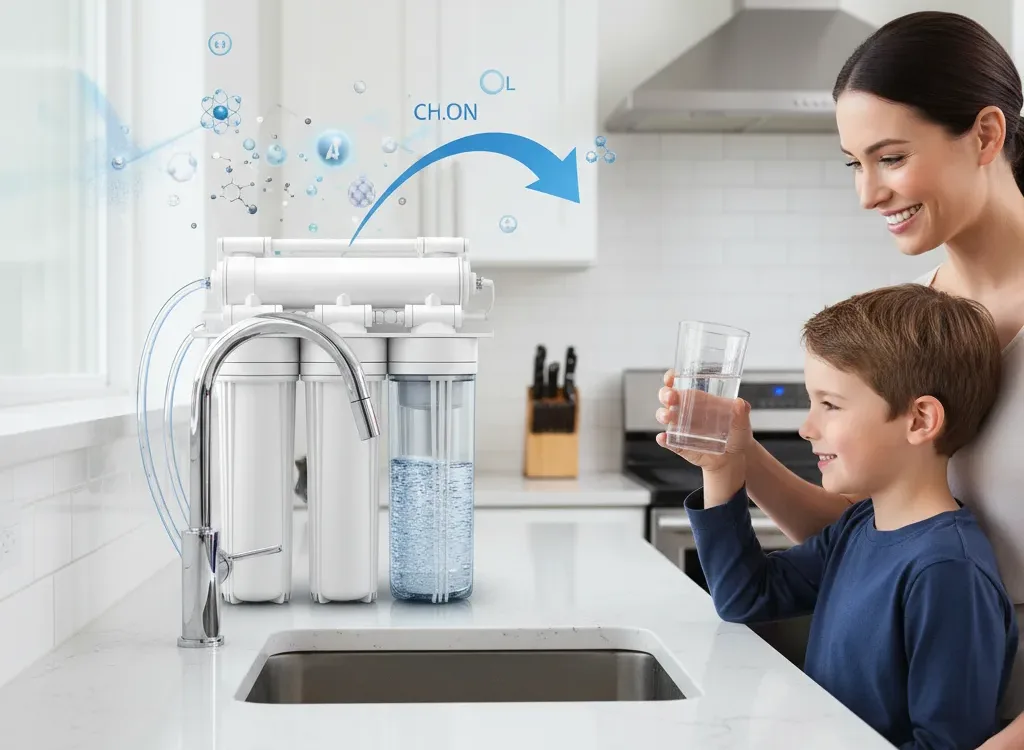
What you can’t see in your tap water might be the biggest threat to your family’s health. Every glass poured from the kitchen faucet can carry invisible contaminants—lead leaching from aging pipes, chlorine byproducts formed during municipal treatment, and PFAS, the so-called “forever chemicals” that persist in the body for years. For parents, the challenge is real and urgent: how do you know if your water is truly safe for your children, your partner, or yourself? Standard testing often announces unsettling results, and boil advisories remind us that our water infrastructure isn’t infallible. This is where a Reverse Osmosis system becomes more than a household upgrade—it becomes a line of defense. RO technology strips water down to its purest form, removing contaminants that other filters simply cannot catch. In this guide, we’ll walk you through the risks lurking in your water supply, explain how RO systems deliver superior protection, and help you identify the best RO system for your family’s unique needs. Making an informed choice starts with understanding what’s at stake—and what’s available to protect the people you love most.
Understanding Your Water Risks: Why a Home Purification System is Essential
Municipal water treatment plants do an admirable job of making water safe enough to leave the facility, but the journey from treatment plant to your kitchen tap introduces countless opportunities for contamination. Aging infrastructure—some pipes dating back decades—can leach lead and copper directly into your drinking supply. Well water users face a different set of challenges, including agricultural runoff carrying nitrates, naturally occurring arsenic, and bacterial contamination that fluctuates with seasonal changes.

Beyond these traditional concerns, PFAS removal has become one of the most pressing water safety issues facing families today. These per- and polyfluoroalkyl substances, found in thousands of consumer products and industrial processes, have contaminated drinking water sources across the country. Research links PFAS exposure to developmental issues in children, immune system suppression, and increased cancer risk. What makes them especially dangerous is their persistence—they don’t break down in the environment or in your body, accumulating over time with every unfiltered glass of water consumed.
Many families assume their basic pitcher filter or refrigerator dispenser provides adequate protection. Unfortunately, these solutions rely primarily on simple activated carbon, which can reduce chlorine taste and some sediment but falls short against dissolved heavy metals, nitrates, and the vast majority of PFAS compounds. They were never designed for complete contaminant removal. The gap between what basic filters catch and what actually exists in your water is where real health risks live. Recognizing this gap is the first step toward choosing a purification system that genuinely protects your household—one engineered to address the full spectrum of modern water threats rather than just improving taste.
How Reverse Osmosis Systems Work: The Gold Standard for Pure Water
A reverse osmosis system works by forcing water through a series of increasingly fine filtration stages, each designed to target specific categories of contaminants. The process typically begins with a sediment pre-filter that captures larger particles like rust, sand, and silt—protecting the more delicate components downstream. Next, an activated carbon pre-filter absorbs chlorine and organic compounds that could damage the RO membrane. The water then reaches the heart of the system: a semipermeable membrane with pores so microscopically small that only water molecules pass through, while dissolved solids, heavy metals, bacteria, viruses, and PFAS molecules are rejected and flushed away. A final post-filter, often a polishing carbon stage, ensures the water tastes crisp and clean before it reaches your glass.
What sets RO apart from other filtration methods is its ability to remove contaminants at the molecular level. Activated carbon alone cannot address dissolved lead, arsenic, or fluoride. Ion exchange systems target specific minerals but leave other threats untouched. Ultrafiltration handles bacteria and sediment yet allows dissolved chemicals to pass through. RO combines the strengths of multiple technologies into one integrated process, achieving rejection rates of 95% or higher for most dissolved solids and up to 99% for lead and PFAS compounds.
A common misconception is that RO water is unhealthy because it removes beneficial minerals. In reality, the minerals in tap water contribute only a small fraction of your daily nutritional needs—food is your primary source of calcium, magnesium, and potassium. Some modern RO systems include a remineralization stage that adds trace minerals back for taste preference, but the health trade-off is clear: removing dangerous contaminants far outweighs the negligible mineral loss. For families seeking the most thorough, science-backed protection available at home, reverse osmosis remains the definitive technology.
Key Factors for Choosing the Best RO System for Your Family
Selecting the right reverse osmosis system isn’t a one-size-fits-all decision—it depends on your family’s size, water usage patterns, kitchen layout, and specific contaminant concerns. Understanding the key variables before you shop prevents buyer’s remorse and ensures you end up with a system that genuinely fits your daily life rather than collecting dust under the sink.
The first major choice is between an under-sink installation and a countertop water system. Under-sink models connect directly to your cold water line and deliver purified water through a dedicated faucet, keeping everything hidden and freeing up counter space. They typically offer higher daily output and larger storage tanks, making them ideal for families of four or more who use RO water for drinking, cooking, and filling water bottles each morning. A countertop water system, on the other hand, requires no permanent installation—you connect it to your existing faucet or fill it manually. Brands like Bluevua have made countertop RO systems increasingly popular by offering compact, installation-free designs that suit renters, smaller households, or anyone who wants portability. The trade-off is usually a lower gallon-per-day capacity and a smaller reservoir, which may mean refilling or waiting during high-demand periods.

Filtration stage composition matters more than the raw number of stages a manufacturer advertises. Look for systems that include a quality sediment pre-filter, a carbon block stage for chlorine and organic compounds, a high-rejection TFC (thin-film composite) membrane, and a post-filter for final polishing. Some systems add a remineralization cartridge or UV sterilization—useful additions, but the core four stages are what deliver genuine protection. Certifications validate these claims, which brings us to the most critical evaluation tool available to consumers.
Daily production rate, measured in gallons per day, determines whether your system can keep up with demand. A family of two might manage comfortably with a 50 GPD system, while households with three or more members—especially those using RO water for cooking, coffee, and pet bowls—should look for 75 GPD or higher. Tank size complements this figure; a larger tank means more purified water on hand during peak morning and evening hours without waiting for the system to produce more. Tankless models eliminate storage altogether by filtering on demand at higher flow rates, though they require adequate water pressure to perform well.
Convenience features might seem secondary, but they dramatically affect whether your family actually maintains the system properly. Quick-change twist-and-lock filters let you swap cartridges in seconds without tools or mess, removing excuses to delay maintenance. Smart filter life indicators—whether LED lights on the faucet or app notifications—tell you exactly when each stage needs replacement rather than relying on guesswork or calendar reminders. Automatic shut-off valves prevent water waste when the tank is full, and leak detection sensors add an extra layer of protection for the cabinetry beneath your sink.
Evaluating Performance: Certifications and Contaminant Removal Claims
Marketing language can be misleading—phrases like “removes up to 99% of contaminants” mean little without independent verification. The gold standard for RO systems is NSF/ANSI Standard 58, which tests the complete system’s ability to reduce total dissolved solids and specific contaminants under controlled conditions. If PFAS removal is a priority, look for additional testing under NSF/ANSI Standard 53, which covers health-related contaminants including PFOA and PFOS. Systems certified under both standards have been independently proven to do what they claim, not just in a lab but under conditions that simulate real household use.
When comparing models, go beyond the headline claims and examine the performance data sheet. This document lists every tested contaminant alongside its influent concentration, effluent concentration, and percentage reduction. A system might advertise 99% lead removal but only achieve 95% fluoride reduction—both impressive, but the details matter if your water test announces elevated fluoride levels. Cross-reference your local water quality report or private well test results with the system’s certified contaminant list to confirm it addresses your specific risks. Parents should prioritize verified removal of lead, arsenic, nitrates, chromium-6, and PFAS compounds, then consider secondary concerns like chloramine and pharmaceuticals. If a manufacturer cannot provide third-party certification documentation upon request, treat their claims with skepticism and move on to a brand that can.
Integrating Pure Water into Your Family’s Healthy Hydration Routine
Once your RO system is installed and producing clean water, the next challenge is building a consistent hydration routine that every family member actually follows. Clean, great-tasting water eliminates one of the most common barriers to adequate hydration—unpleasant taste or odor that makes kids reach for juice boxes and sugary drinks instead. When water tastes genuinely refreshing, children are far more likely to choose it on their own.
Getting kids excited about drinking water starts with small, intentional habits. Let them pick out their own reusable bottles in colors or designs they love, and keep those bottles filled with RO water in the fridge so cold, clean water is always the easiest option available. Infusing water with sliced strawberries, cucumber, or citrus turns hydration into something fun rather than a chore—and when the base water is free of chlorine taste, those natural flavors come through beautifully. Setting family “water check” moments at meals and after activities helps younger children build the habit without it feeling forced.
Beyond drinking, your RO system should become the water source for cooking pasta, rice, soups, and coffee or tea—heat doesn’t remove dissolved contaminants like lead or PFAS, so using purified water in the kitchen protects your family during every meal. Parents preparing baby formula benefit enormously from RO water, as infants are especially vulnerable to nitrates and heavy metals at trace levels that might not affect adults. Even your pets deserve the same protection; dogs and cats drinking from bowls filled with RO water avoid the same contaminants you’re filtering out for yourself. When purified water becomes the default throughout your home—from the morning coffee pot to the dog’s dish—your RO system transforms from a single appliance into the cornerstone of a genuinely healthier household.
Protect Your Family Today: Take Action on Water Safety
The water flowing through your home carries risks that no family should have to accept—from lead and nitrates to persistent PFAS compounds that accumulate silently in the body over years. Reverse osmosis technology addresses these threats at the molecular level, delivering a level of protection that pitcher filters and basic carbon systems simply cannot match. When choosing the best RO system, focus on what matters most: verified NSF/ANSI certifications that prove real-world performance, a production capacity that matches your household’s daily demands, and a form factor—whether under-sink or countertop—that fits smoothly into your kitchen and lifestyle.
Investing in a quality RO system isn’t just about upgrading an appliance; it’s about making a deliberate decision to protect your children’s developing bodies, support your family’s long-term wellness, and remove the uncertainty that comes with every unfiltered glass. The science is clear, the technology is proven, and the options available today make implementation easier than ever. You don’t need to wait for a boil advisory or a troubling water report to act. Take the next step now—test your water, compare certified systems against your specific contaminant concerns, and give your family the clean, safe drinking water they deserve every single day.