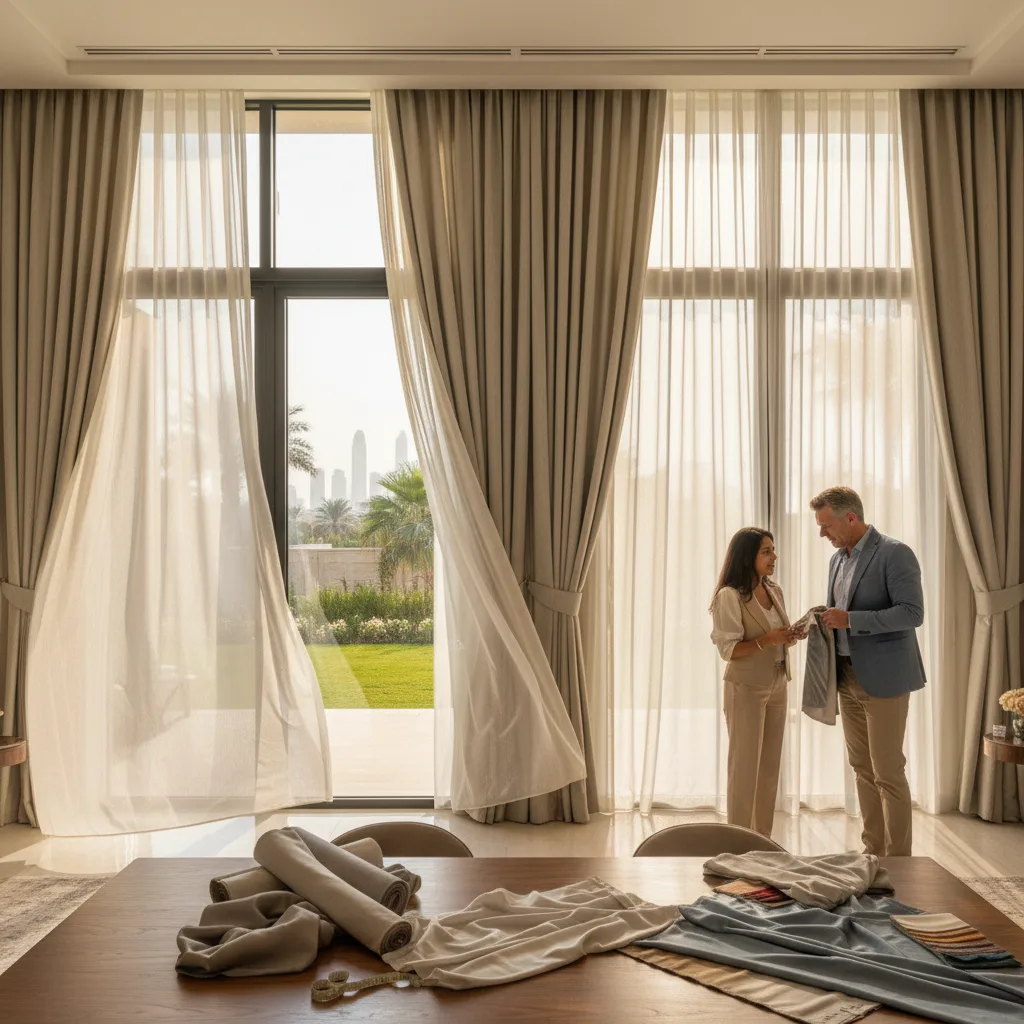
A 2026 survey by Dubai’s Department of Economic Development found that 68% of villa residents replaced their window treatments within two years of moving in — and nearly half cited material failure from heat and dust as the primary reason. That figure alone makes one thing clear: choosing the right curtains in Dubai is not a matter of decoration. It is a structural decision that affects energy bills, furniture longevity, and indoor air quality.
Why the Climate Demands a Different Kind of Curtains in Dubai
Dubai’s summer temperatures routinely exceed 45°C, and humidity levels along the coast hover above 80% from June through September. Standard polyester drapes that work perfectly in London or New York degrade rapidly here. The ultraviolet index, which averages 10–12 in peak months, bleaches fabric within a single season. Dust storms, common between March and August, deposit fine silica particles that embed themselves in textile fibers and accelerate abrasion.
What this means in practice is that curtains in Dubai must perform three jobs simultaneously: block solar heat gain, resist moisture-induced mold, and repel fine dust. A 2026 study by the Emirates Green Building Council measured a 7°C difference in indoor temperature between rooms fitted with thermal-backed blackout curtains and those with unlined decorative sheers. That temperature gap translates directly into air-conditioning runtime — and utility costs.
Residential compounds like Arabian Ranches and Jumeirah Golf Estates have started including curtain specifications in their community guidelines. Property managers now recommend fabrics with a minimum UPF 50+ rating and a thermal resistance value above R-2.5. Ignoring these specs is not merely uncomfortable; it voids certain home insurance clauses related to UV damage on interior furnishings.
Material Science: What Survives — and What Disintegrates
The conventional wisdom that “thicker fabric equals better protection” collapses under Dubai’s conditions. Weight matters less than composition. Polyester blended with PVC backing offers strong blackout performance but traps moisture, creating a breeding ground for mildew in bathrooms and kitchens. Cotton-rich fabrics feel luxurious but absorb humidity and lose shape within months.
Three material categories have proven themselves across thousands of installations:
- Solution-dyed acrylic: Color is locked into the polymer during manufacturing, so it resists fading for 5–7 years even with direct eastern or western exposure. Brands like Sunbrella supply this fabric to Dubai-based workrooms.
- Triple-weave polyester with aluminum coating: Reflects up to 90% of solar radiation. The metallic layer also acts as a vapor barrier, which matters in high-rise apartments where condensation forms on windows overnight.
- Linen-cotton blends with Teflon finish: These offer a natural look while repelling dust and water. They require professional dry-cleaning every 18 months, but they maintain their drape in air-conditioned interiors.
A common mistake is selecting curtains based on how they look in a chilled showroom. The same fabric, hung in a west-facing living room in Dubai Marina, behaves entirely differently. Local suppliers like Sedar and Royal Blinds now offer in-home consultation where they measure UV exposure with a handheld spectrometer before recommending a material — a practice that should be standard but still is not.
| Material | UV Resistance | Thermal Insulation | Dust Repellence | Cost per sq. m (AED) |
|---|---|---|---|---|
| Solution-dyed acrylic | Excellent (5–7 years) | Moderate | Good | 180–250 |
| Triple-weave polyester + aluminum | Excellent | High (R-2.8) | Moderate | 220–320 |
| Linen-cotton + Teflon | Moderate (3–4 years) | Low | Excellent | 300–450 |
| Standard polyester | Poor (1–2 years) | Low | Poor | 80–120 |
The Motorization Shift and Curtains in Dubai’s Smart Homes
Motorized curtain tracks were once a niche luxury item found only in Palm Jumeirah penthouses. That changed after 2024, when Dubai Electricity and Water Authority mandated that all new villas over 400 square meters include a smart home readiness certification. Motorized window treatments became one of the simplest compliance paths.
Today, an estimated 40% of new curtain installations in Dubai include a motorized track — up from 12% in 2021, according to data from home automation integrator Smart Life UAE. The most common configuration pairs a Somfy or A-OK motor with a Zigbee hub that syncs to a central control system. Residents schedule blinds to close automatically at 10 a.m., when the sun hits full intensity, and reopen at sunset to capture cooler air.
What surprises first-time buyers is the noise factor. Cheaper AC motors produce a hum that travels through ceiling voids. In bedrooms, that hum registers around 38 decibels — enough to disturb light sleepers. Motorized curtain systems with DC motors and soft-start mechanisms operate below 25 decibels. The price difference is roughly AED 800 per window, but the absence of that low-frequency drone justifies the cost for anyone who values uninterrupted sleep.
Battery-powered motors have gained traction in rental apartments where drilling into ceilings is prohibited. These units, which use lithium packs that last 6–8 months between charges, clip directly onto existing curtain rods. The trade-off is speed: battery motors move fabric at half the speed of wired alternatives.
Blackout Curtains in Dubai Are Not a Luxury — They Are Infrastructure
The term “blackout” is misused so often that it has lost meaning. A true blackout curtain blocks 99.9% of visible light and a significant portion of infrared radiation. In Dubai, where the sun rises before 5:30 a.m. in June, anything less than total light blockage disrupts circadian rhythms. Shift workers at Dubai International Airport and healthcare staff at Mediclinic City Hospital have driven demand for bedroom blackout solutions that create a night-like environment at any hour.
Testing standards matter. The European EN 14500 standard measures light transmission precisely; fabrics that pass achieve a classification of “total blackout.” Many products sold in Dubai’s Dragon Mart or online marketplaces claim blackout performance but use only a thin acrylic coating that peels after one summer. Independent testing by consumer protection authorities in 2025 found that 31% of curtains labeled “blackout” failed to block even 95% of light.
Energy savings provide the strongest argument. A villa in Al Barsha with 12 windows can reduce AC consumption by 18–22% when fitted with properly installed blackout curtains in Dubai, according to a field study conducted by Heriot-Watt University Dubai. That reduction translates to roughly AED 3,400 in annual savings at current electricity rates. Over a five-year period, the curtains pay for themselves twice over.
Design Codes and Cultural Considerations
Curtains in Dubai serve a privacy function that goes beyond Western norms. Ground-floor windows facing streets or neighboring villas require treatments that prevent sightlines into family living areas. Many Emirati households choose double-layer systems: a sheer inner layer that diffuses daylight while maintaining privacy during the day, and a heavier outer drape drawn at night.
Color trends have shifted noticeably since 2023. The all-white minimalist look, popular during the 2010s, has given way to earth tones — sand, terracotta, and charcoal — that hide dust better and reduce glare. High-end projects in City Walk and Bluewaters Island now specify curtains with a matte finish on the street-facing side to avoid light reflection that disturbs neighbors.
For those seeking to add a distinctive look to their homes with curtains, the challenge is balancing personality with resale value. Real estate agents report that bold patterns and bright colors reduce buyer interest by as much as 15% in the secondary market. Neutral, high-quality curtains in Dubai convey that a property has been maintained carefully — a signal that matters in a city where property turnover averages seven years.
Maintenance Realities: Dust, Dry Cleaning, and Replacement Cycles
Dust accumulation is not cosmetic. Fine desert dust contains crystalline silica, which acts like sandpaper on fabric fibers every time curtains are drawn or brushed against. Vacuuming with a brush attachment once a month removes surface dust, but deep cleaning requires professional intervention. Most upholstery cleaning services in Dubai also handle curtain treatments, charging between AED 40 and AED 70 per panel depending on fabric type.
Dry cleaning frequency depends on location. Curtains in apartments near Sheikh Zayed Road or major construction sites need cleaning every 4–6 months. Those in quieter residential areas like The Springs or Mirdif can stretch to 8–10 months. A visual cue: when the hem of the curtain accumulates a visible gray line that does not shake out, it is time for professional cleaning.
Replacement cycles have shortened. A decade ago, homeowners expected curtains to last 7–10 years. Today, with more intense UV exposure and higher expectations for energy performance, the practical lifespan of well-maintained curtains in Dubai is 4–6 years. The cost of replacement should be factored into annual home maintenance budgets alongside AC servicing and repainting.
How to Source Curtains in Dubai Without Overpaying
The market splits into three tiers. At the top, European brands like Silent Gliss and Hunter Douglas operate through authorized dealers in Dubai Design District, with per-window costs starting at AED 5,000. The middle tier consists of local manufacturers with in-house workrooms in Al Quoz and Ras Al Khor Industrial Area, offering custom sizing at AED 1,200–2,500 per window. The budget tier relies on ready-made imports sold through hypermarkets and online platforms, where a full set for a standard window costs AED 200–600 but rarely lasts beyond two summers.
Those who want to buy the best curtains in Dubai should request three specific items during consultation: a fabric sample they can expose to sunlight at home for a week, a written warranty that covers fading and seam integrity for at least three years, and a site measurement visit rather than relying on their own numbers. Measurement errors account for 23% of returns, according to data from a major Dubai-based e-commerce platform.
Timing matters. Many showrooms run promotions during Ramadan and the Dubai Shopping Festival in January, with discounts reaching 30–40% on previous season’s fabrics. Ordering in March ensures installation before the peak heat of June, when demand spikes and lead times stretch from two weeks to six.
What the Next Five Years Will Bring
Research already underway at Masdar Institute points to phase-change materials embedded in curtain linings that absorb heat during the day and release it at night — effectively turning window treatments into passive thermal regulators. Early prototypes have demonstrated a 12% improvement in thermal performance over aluminum-backed fabrics. Commercial availability is expected by 2028.
Regulation is also evolving. Dubai Municipality’s updated Green Building Regulations, scheduled for enforcement in 2027, will require all new residential buildings to achieve a minimum window-to-wall ratio efficiency rating. Curtains and external shading systems will be assessed as part of that rating. Property developers are already revising their specifications to include higher-performing curtains in Dubai as a compliance measure rather than an optional upgrade.
The lesson from two decades of building in this environment is that window treatments are not an afterthought. They are the first line of defense against a climate that punishes shortcuts. The homeowners who understand that — and act on it — spend less on energy, replace their interiors less often, and live in spaces that feel cooler, cleaner, and quieter. That is the real return on investment that curtains in Dubai deliver, and it is measurable in dirhams, decibels, and degrees Celsius.