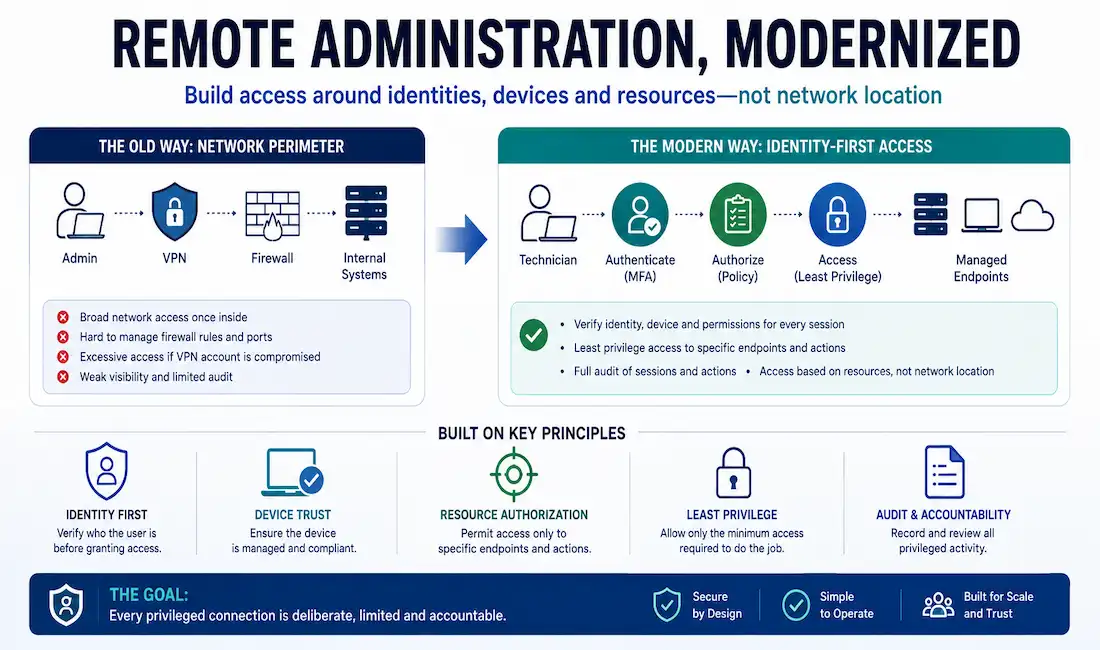
Remote administration used to be relatively predictable. Servers were located inside a company network, administrators worked from known locations, and access was controlled largely through firewalls, VPNs and trusted network segments.
That model is becoming harder to maintain.
Modern infrastructure may span public cloud accounts, private data centers, branch offices, employee homes and customer environments. Managed service providers may support hundreds of endpoints across organizations with different network configurations and security requirements.
In this environment, network location alone is no longer a reliable basis for deciding who should be allowed to access a system. Remote administration must increasingly be designed around verified identities, authorized devices, endpoint-level permissions and auditable actions.
Why the traditional network perimeter is insufficient
A traditional remote-access workflow often begins with a VPN. After connecting to the network, an administrator may use SSH, RDP, VNC or another protocol to reach the target system.
VPNs remain useful, but they solve only part of the access problem.
Connecting to a network does not automatically prove that the user should be allowed to administer every resource reachable through that network. A compromised VPN account may provide broader access than intended, particularly when internal segmentation and endpoint permissions are weak.
Firewall rules and port forwarding create similar challenges. They may be manageable for a few systems, but the operational burden grows as infrastructure expands.
Teams must track which ports are exposed, which IP addresses are allowed, who requested each rule and whether the access is still required. Temporary rules can easily become permanent, and customer networks may have completely different firewall and NAT configurations.
A better architecture separates authorization to access a resource from simple membership in a trusted network.
Moving toward identity-first administration
Identity-first administration begins with a straightforward principle: every privileged session should be explicitly authenticated and authorized.
The platform should verify who the user is, which endpoint they are trying to access, what type of session they are requesting and whether their assigned role permits that action.
This is consistent with NIST’s Zero Trust Architecture, which moves security decisions away from implicit trust based mainly on network location and toward users, devices, assets and individual resources.
In practical terms, an organization might permit a help-desk technician to view endpoint status and start an approved troubleshooting script while preventing that technician from opening a privileged shell.
A senior administrator may be authorized to access production servers but not customer environments outside their assigned group. An MSP may require complete separation between technicians, customers and endpoint collections.
These decisions should be enforced by policy rather than informal knowledge or shared credentials.
Using outbound connectivity instead of exposed inbound services
One way to simplify remote administration is to have a managed endpoint establish an encrypted outbound connection to a central management service.
The technician then connects through an authenticated browser or management console rather than directly reaching an exposed SSH or RDP port.
This model can work across NAT, private networks and restrictive firewalls because the endpoint initiates the connection. It also reduces the need to maintain public IP addresses, dynamic DNS records and customer-specific port-forwarding rules.
Outbound connectivity does not remove the need for security controls. The management platform becomes a privileged access path and must therefore be protected carefully.
Organizations should evaluate multi-factor authentication, credential encryption, endpoint-level permissions, session expiration, connection rate limits and administrative audit records.
The CISA Guide to Securing Remote Access Software also emphasizes that remote-access tools require appropriate security controls and ongoing management because they provide powerful access to organizational systems.
Keep credentials away from technician devices
Credential handling is another important part of remote-administration design.
Private keys, administrator passwords and saved connection profiles often accumulate on technician laptops. This makes onboarding easy initially, but creates long-term problems when access changes or employees leave.
Teams may not know how many copies of a credential exist or whether an old key is still authorized.
A centralized model can keep saved credentials in an encrypted store and make them available only to authorized users during an approved session. Where possible, the platform should attribute each session to an individual user even when the destination system still depends on a shared local account.
SSH host-key verification should remain enabled, and credentials should never be silently shared across technicians without access controls.
Centralized storage is not automatically safer; its security depends on encryption, key management, access policies and auditability. But it gives organizations a more manageable way to rotate credentials and revoke access.
Connect remote access with endpoint context
Remote administration is safer and more efficient when technicians can review endpoint information before opening an interactive session.
A technician responding to an alert should be able to see whether the endpoint is online, when it last checked in and whether CPU, memory, disk or network activity changed around the time of the incident.
The technician may discover that the issue can be resolved with an approved script, service restart or patch action rather than a full remote session.
This principle supports least privilege. The engineer uses the least powerful action required to resolve the problem instead of immediately opening an unrestricted shell or desktop.
Monitoring context also helps reduce mistakes. It ensures that the technician is working on the correct customer, environment and endpoint before making a change.
Audit sessions as privileged activity
Every administrative connection should generate an audit record.
At a minimum, the organization should be able to determine:
- Who started the session
- Which endpoint was accessed
- When the connection began and ended
- What connection method was used
- Whether files were uploaded or downloaded
- Whether authentication attempts failed
- Which administrative actions were initiated
Some environments may also require session recording or command-level history.
Audit data is useful for security investigations, but it also supports routine operational accountability. When several technicians work on the same incident, the next engineer can understand what was already attempted.
Logs should be protected from unauthorized modification and retained according to the organization’s security, compliance and operational requirements.
Roll out the architecture gradually
Organizations do not need to redesign every remote-access workflow at once.
A practical rollout can begin with a small group of noncritical endpoints. Test connectivity from customer sites, branch offices, cloud networks and systems behind NAT or proxies.
Next, define roles and endpoint groups. Confirm that users can access only the resources they are assigned.
Test how quickly access can be revoked, how credentials are rotated and what happens when the management service or network connection is unavailable.
Products such as LynxTrac Remote Desktop use outbound-only endpoint connectivity to provide browser-based remote desktop and SSH access without requiring VPN configuration, inbound port exposure or port forwarding.
The product decision is only one part of the architecture. Organizations must still define identity policies, technician responsibilities, auditing requirements and incident-response procedures.
Build access around resources, not locations
Hybrid infrastructure requires remote administration, but remote access should not depend on broad trust in a network connection.
An identity-first model verifies the user, evaluates the requested resource, applies endpoint-specific permissions and records the resulting activity.
Combined with outbound connectivity, credential protection and monitoring context, this creates a more controlled path for managing systems across cloud, on-premises and customer environments.
The objective is not merely to make remote access easier. It is to make every privileged connection deliberate, limited and accountable.