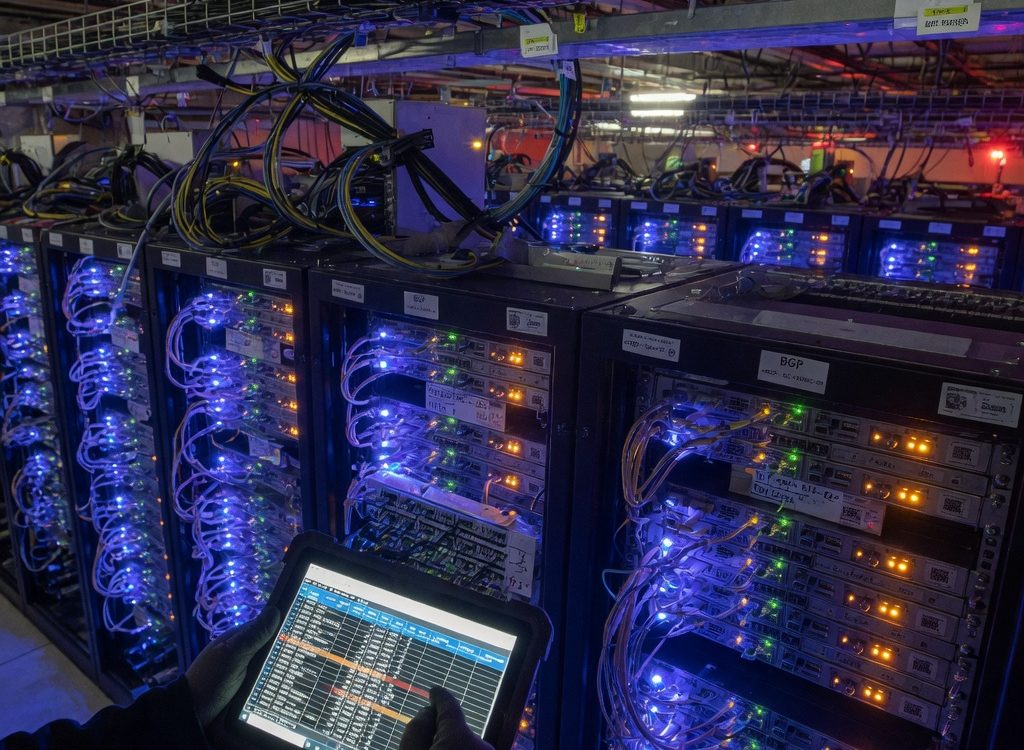
In early 2026, Facebook’s network infrastructure processes over 4 million video streams, 350 million photo uploads, and 100 billion messages every single day. The platform serves 3.07 billion monthly active users — roughly 40% of the global population — across more than 18 data center campuses, hundreds of edge points of presence, and an undersea cable system spanning over 125,000 kilometers. The networking challenge isn’t just scale; it’s about delivering a smooth experience while handling BGP route convergence times under 50 milliseconds, zero-touch provisioning of thousands of switches, and layer-7 DDoS attacks exceeding 3 Tbps. For network engineers studying for CCNA, CCNP, or CCIE certifications, Facebook’s real-world architecture offers a masterclass in how BGP, OSPF, VLAN, SD-WAN principles, QoS policies, and ACLs merge to build one of the largest private networks on the planet.
Why Facebook Runs BGP Everywhere — Even Inside Its Data Centers
Conventional enterprise networks reserve BGP for WAN edge routing. Facebook threw that model out the window. Inside its data centers, every top-of-rack switch, spine switch, and fabric aggregator speaks BGP. The decision emerged from a 2014 engineering postmortem: large-scale OSPF deployments in a Clos topology caused flooding domain instability and slow convergence during link flaps. By replacing OSPF with eBGP on point-to-point links between leaves and spines, the network team achieved sub-second convergence and eliminated the need for a link-state database flooding across hundreds of devices.
Each rack switch gets a private AS number (64512–65534 range) and peers with four spine switches using eBGP. Route reflectors are avoided — full mesh is the rule. This design matches the Clos architecture’s requirement for equal-cost multipathing (ECMP), and BGP’s path vector algorithm provides better control over traffic engineering than a link-state protocol ever could. For a CCIE candidate, understanding this shift is essential: it means traditional LSA types and area design become irrelevant in hyperscale fabrics, and BGP route policy tools — prefix lists, community tags, local-preference — become the primary knobs for traffic steering.
FBOSS: Facebook’s Open-Source Switch Operating System
Facebook doesn’t buy off-the-shelf switches from Cisco or Juniper for its data center fabric. In 2016, it released FBOSS (Facebook Open Switching System) as part of the Open Compute Project. FBOSS runs on bare-metal switch hardware from vendors like Edgecore, Accton, and Celestica, completely decoupling the control plane from hardware. The OS handles layer 2/3 forwarding, VLAN trunking, and multi-chassis LAG, but its standout feature is the BGP daemon — a custom build based on open-source routing stacks — that pushes routes directly into the Broadcom Tomahawk ASICs via an abstraction layer.
A typical configuration for a leaf switch in FBOSS looks like this:
switch# show running-config interface ethernet1/1

interface Ethernet1/1

description "Uplink to spine-01"

ip address 10.1.0.1/31

no switchport

bgp neighbor 10.1.0.0 remote-as 65001

!
Network engineers familiar with IOS or Junos will notice the stripped-down syntax. FBOSS replaces STP with a proprietary loop-free topology algorithm built on link-state advertisements, essentially a lightweight SPF protocol. This matters because traditional spanning-tree in a three-stage Clos would block half the uplinks, destroying bandwidth. Instead, FBOSS uses all links actively, achieving 100% bisectional bandwidth. For anyone maintaining VLANs in a multi-tenant environment, FBOSS supports QinQ (802.1ad) to isolate internal services like AI training clusters from external-facing web tiers.
The Hidden Role of VRFs and QoS in Facebook’s Multi-Tier Fabric
A single Facebook data center hosts a mix of workloads: user-facing web servers, backend Hadoop clusters, machine learning inference engines, and real-time video transcoding. Each workload has different network requirements. To avoid congestion collapse, Facebook uses VRFs and QoS at every switch port.
VRFs separate routing tables for different services: a “production” VRF for web and chat services, a “machine-learning” VRF for GPU cluster east-west traffic, and a “management” VRF for out-of-band access. Each VRF maintains its own BGP peers and next-hop groups, keeping route tables small and preventing accidental cross-contamination. For example, a spike in ML traffic from NVIDIA DGX pods won’t bleed into the production VRF because the forwarding plane enforces separation at the ASIC level.
QoS policies use 8-class DSCP markings. Real-time video and voice get EF (Expedited Forwarding) with strict priority queuing. Database replication traffic is marked AF41 and assigned a guaranteed bandwidth pool. Bulk backup traffic falls into the scavenger class. Buffer management is critical: Facebook’s internal testing shows that a misconfigured egress buffer on a spine port can cause 200 ms of jitter for VR traffic even before packet loss occurs. Their fix: active buffer carving that allocates memory per-priority queue at runtime, controlled via a gRPC interface to the switching ASIC SDK.
Peering Wars: How Facebook’s Edge Network Delivers Low Latency
Outside the data center, Facebook operates one of the world’s largest peering networks. It connects to over 12,000 unique ASNs at 160+ internet exchanges globally. The edge architecture uses BGP with full table reception from transit providers, but Facebook’s engineering team deploys a custom route optimization engine called Edge Fabric. Instead of relying on simple AS-path length, Edge Fabric measures real-time latency, packet loss, and throughput to each destination prefix and injects /32 host routes with adjusted local preference into the edge routers.
That means Facebook can route a user’s request from Istanbul to a cache server in Frankfurt or a data center in Luleå, Sweden, based on actual network conditions — not just BGP hop counts. This is critical for services like Facebook Live, where 2 seconds of additional latency causes viewer drop-off rates of 15%. The edge routers themselves are mostly Arista 7500R series running EOS, with some legacy Juniper MX960s still handling peering in Asia. For CCNP-level engineers, the key takeaway is the use of BGP community strings to tag prefixes: Edge Fabric sets communities like “64512:100” for high-priority live video and “64512:200” for cold content, then applies QoS policies at the WAN edge using hierarchical policing (H-QoS) that maps those communities to egress queue priorities.
ACLs, IPsec, and DDoS Mitigation: Securing the Social Graph
With billions of accounts, Facebook’s attack surface is enormous. The network security team deploys a multi-layered filtering architecture. At the perimeter, stateless ACLs drop traffic from known malicious IP ranges using hardware-based filtering on border routers. These are not the extended ACLs you’d configure on a Cisco ISR — they are pushed via a central controller to the forwarding tables of each edge switch, using FlowSpec rules that can match on source/destination IP, port, and DSCP mark.
For inter-DC connectivity, Facebook encrypts all traffic using MACsec (IEEE 802.1AE) between switches and IPsec tunnels over its Express Backbone. The IPsec configuration is automated: each router has a certificate enrolled via an internal PKI, and IKEv2 sessions are established using AES-256-GCM with 2048-bit DH groups. In a 2025 blog post, the network security team announced that unauthorized peering attempts (where a rogue AS tries to inject false routes) are blocked by prefix filtering and RPKI (Resource Public Key Infrastructure) validation on all edge routers. For DDoS mitigation, Facebook uses a combination of anycast distribution, GRE tunneling to scrubbing centers, and FlowSpec injection — no single device handles all attack traffic.
How Facebook Engineers Troubleshoot Network Congestion with CLI
Despite heavy automation, Facebook’s network operations center (NOC) engineers still drop into CLI for real-time troubleshooting. The command set differs from Cisco IOS, but the concepts are the same. To check BGP session state on a spine switch, an engineer might run:
spine-01# show bgp summary

BGP router identifier 10.2.0.1, local AS 65001

Neighbor V AS MsgRcvd MsgSent TblVer InQ OutQ Up/Down State

10.1.0.3 4 64521 89234 90112 45678 0 0 12d:04h Established

10.1.0.5 4 64522 76543 77234 45678 0 0 11d:22h Established
If a VLAN misconfiguration causes a broadcast storm, the team uses counter commands to spot incrementing out-discards. Unlike traditional networks that run STP, Facebook’s fabric loops are prevented by a central controller that validates all link-state updates before activating ports. This controller also maintains a real-time digital twin of the network topology, allowing engineers to simulate a link-down event before it happens in production — a concept they call “Wormhole.” For CCNA professionals, the lesson is that troubleshooting fundamentals (checking counters, BGP state, interface errors) don’t change, but the tooling around them becomes exponentially more effective.
What Facebook’s Network Tells Us About the Future of Enterprise Infrastructure
Corporate data centers running VLANs and STP feel dated after studying Facebook’s architecture. The hyperscaler model is already trickling into enterprise environments. Cisco’s ACI uses a similar spine-leaf design with MP-BGP as the underlay protocol. Arista’s CVP does zero-touch provisioning just like FBOSS. And VMware NSX virtualizes VRFs and routing for multi-tenancy. The principles — route everything via BGP, separate underlay from overlay with VXLAN, automate via gRPC APIs — are not just for giants anymore.
Network engineers who study Facebook’s published design documents and attend NANOG talks by their infrastructure team gain a clear advantage in certification exams and real-world design. Understanding how a /31 point-to-point link can replace a VLAN trunk, or why RPKI is important for BGP security, makes the difference between a CCNA holder and someone who actually understands modern network operations. The tools change — FBOSS today, maybe SONiC tomorrow — but the concepts are durable. Facebook’s network proves that even at the extreme edge of scale, the fundamentals still apply.