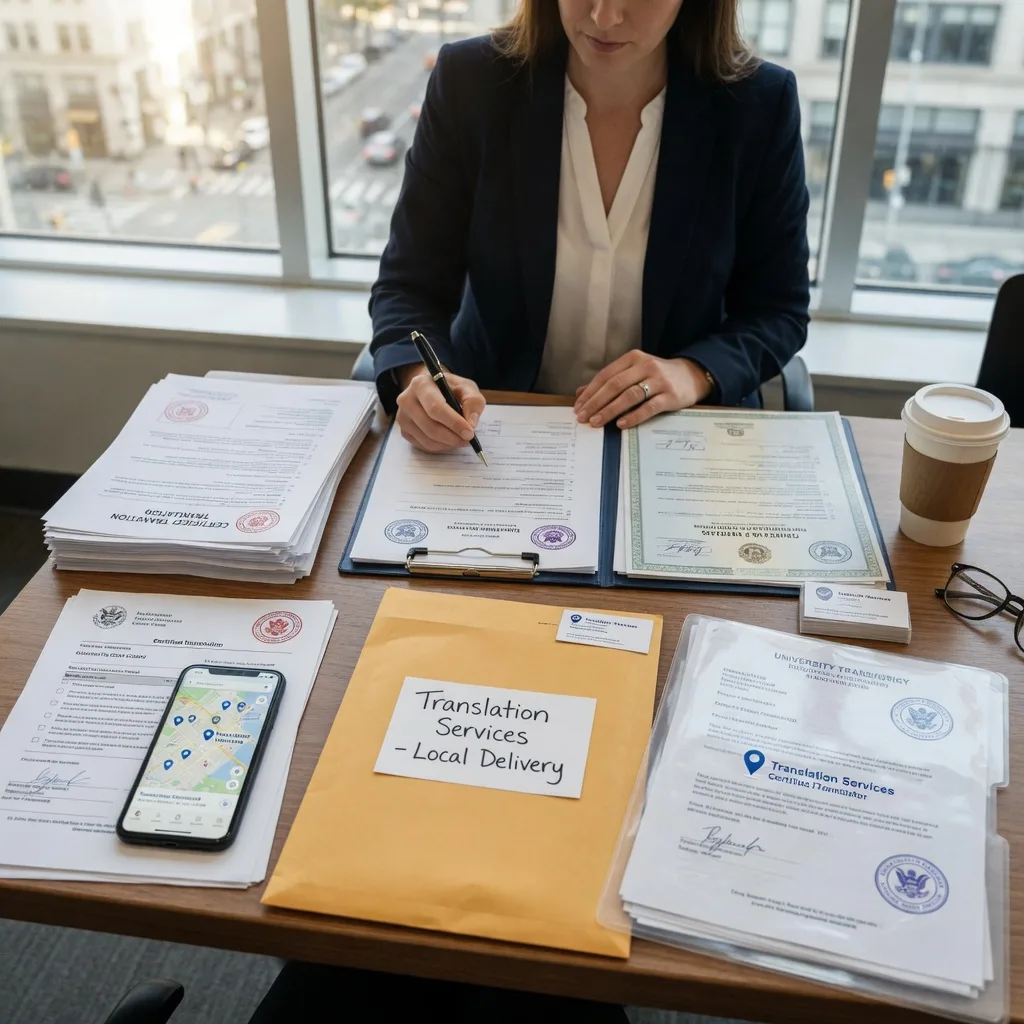
There is a moment when everyone realizes: you have a document in a foreign language, some kind of birth certificate, court order, university diploma, and by the end of the week, you need a certified English copy. The instinct is to seek out somebody close by who has an actual office you can walk into and give the papers to them directly. It’s not a bad instinct, but in 2026, acting on it could cost you time and money if the institutions you’re applying to do not require what you think they do.
What “Local” Actually Means in 2026
This notion that certified translation needs to be provided by someone who is physically close to you is outdated, and it’s important to understand where it has come from in the first place. For decades, people have been visiting local offices to obtain a certified translator, handing over their documents, waiting several business days and then coming back to pick up a sealed document. In some cities that’s still the case, but the framework institutions have for assessing submitted translations hasn’t followed suit, and the notion that geography is an indicator for quality has not been embraced by everyone.
What has fundamentally changed is that providers now operate at scale across entire countries. Looking through Rapid Translate’s service areas, which extend across all 50 U.S. states and internationally, reflects a broader industry shift toward a delivery-first model that removes physical location from the quality equation entirely — learn more.
Whether you’re based in Manhattan or a smaller city in rural Alabama, you’re accessing the same structured workflow, the same certification format, and the same standards review process. That kind of consistency simply wasn’t achievable through local office networks. The Certification Standard That Actually Matters
When a government agency, university, or court requests a “certified translation,” they’re asking for something structurally specific. The document must represent a complete, word-for-word rendering of the original – no condensed summaries, no interpretive rewording, paired with a signed Certificate of Accuracy. That certificate is the translator’s formal declaration that the content is accurate and complete to the best of their professional knowledge.
What no institution is requesting is confirmation that the translator operates within your city limits. This distinction is worth holding onto before you spend time calling local offices that may or may not be equipped for the task anyway. Applicants who’ve submitted certified translations to USCIS or university admissions departments consistently report acceptance of remotely delivered documents, provided the formatting is correct, and the certification statement is complete, properly worded, and signed. The standard is document quality. Geographic proximity is irrelevant to that determination.
How to Evaluate a Provider Before You Commit
Once the geography misconception is out of the way, selecting a provider becomes considerably more focused. A few things deserve scrutiny before you upload any documents or authorize payment.
The first is the certification format itself. Ask to see a sample of a completed translated document before you order. A credible provider will have no hesitation showing you what the final output looks like, including the exact language and structure of the Certificate of Accuracy. Any provider that becomes evasive about this should raise an immediate concern. Standardized certification language is not proprietary information; it’s a baseline expectation.
The second is turnaround time. Local offices tend to quote three to five business days as a standard window. Providers specializing in certified translations of frequently requested document types – birth records, academic diplomas, legal decrees – often deliver completed work within 12 to 24 hours. When you’re filing against an immigration deadline or a court date, the gap between those two timelines carries real consequences. Confirm delivery expectations upfront rather than assuming.
Speed, Pricing, and What to Watch For
Pricing is where providers diverge most noticeably. Some charge per page, others per word, and many fail to clarify upfront whether the Certificate of Accuracy is bundled into the quoted rate or appended as a separate charge. Before placing an order, ask precisely what the total covers. A provider offering transparent, all-in pricing, with no ambiguity about what’s included, is nearly always a better choice than one that appears inexpensive on the surface but surfaces additional fees at the point of purchase.
The more consequential mistake, though, is selecting based primarily on cost. A translation that omits sections of the original document, uses vague or informal certification language, or arrives incorrectly formatted will be rejected. You’ll then need to commission a corrected version and pay again. In immigration filings, particularly, that kind of rejection introduces processing delays that aren’t easily recovered. Inexpensive, careless work doesn’t reduce your costs; it defers them, with interest.
Documents That Typically Need Certified Translation
Most people searching for this type of service fall into a few predictable categories. Immigration applicants represent the largest volume. Their needs are consistent and well-documented: birth certificates, marriage and divorce records, national identification documents, and financial statements required for visa or green card submissions. USCIS formatting standards for these items are publicly available, and any established certified translation provider will be thoroughly familiar with them.
The other important sector is academic translation. Foreign students who are applying to U.S. schools often require the translation of their transcripts, diplomas, and grading scale explanations into English. A third category of accuracy that has legal consequences – not administrative – is in legal proceedings, such as adoption, probate, and civil litigation involving foreign-party documents.
Conclusion
The document types are predictable, so that when a provider sees them again, he or she has seen them hundreds of times before. This familiarity helps to minimize mistakes, maintain consistency in turnaround and hone translators’ ability to notice anything unusual that requires their attention. If an error causes actual downstream problems, that’s a lot more valuable than knowing what is in the provider’s office.