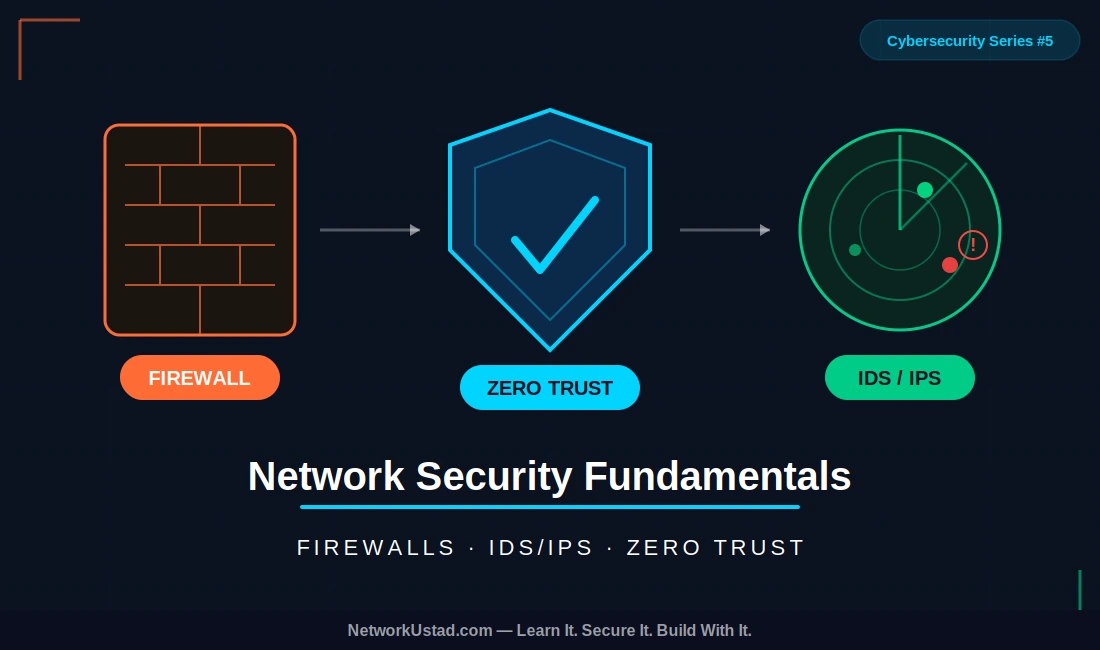
What Network Security Actually Means in 2026
This article is the fifth in our cybersecurity fundamentals series. The previous articles covered Types of Hackers, the 8 CISSP Security Domains, Common Cyber Attack Types, and Cryptography Fundamentals. This article explains how the cryptographic protocols covered in the previous guide are enforced at the network level, and how modern Zero Trust frameworks are replacing traditional perimeter-based security models.
Network security is the practice of protecting the usability, integrity, and confidentiality of a network and its data using a combination of hardware devices, software tools, and architectural policies. In simple terms, it is the set of rules and technologies that determine who can access what on a network, what kind of traffic is allowed, and how threats are detected and stopped before they cause damage. Every organisation that connects devices to a network — which in 2026 means every organisation — depends on network security whether they realise it or not.
The traditional approach to network security was built on a simple assumption: everything inside the corporate network perimeter is trusted, and everything outside it is not. A firewall sat at the boundary, inspecting incoming and outgoing traffic and enforcing access rules. For decades, this model worked reasonably well. Employees worked from offices on company-managed devices, applications ran on servers in company data centres, and the “inside versus outside” distinction mapped cleanly to “trusted versus untrusted.” That world no longer exists. Cloud computing, remote work, mobile devices, SaaS applications, and the proliferation of IoT devices have dissolved the traditional perimeter. The data that organisations need to protect now sits in multiple cloud environments, on employee laptops in home offices, and on devices that may never touch the corporate network directly. This fundamental shift is why network security in 2026 requires a layered approach combining firewalls, intrusion detection and prevention systems, and — increasingly — Zero Trust architecture.
The network security market reflects this urgency. The global enterprise firewall market was valued at approximately $15.48 billion in 2025, and the next-generation firewall segment alone reached approximately $5.9 billion in the same year, projected to grow at a compound annual growth rate of over 11% through the next decade. The intrusion detection and prevention systems market was valued at approximately $7.76 billion in 2025. These are not abstract numbers — they represent the scale of investment organisations are making to protect their networks against threats that grow more sophisticated every year.
Firewalls: The First Line of Defence
A firewall is a network security device — hardware, software, or both — that monitors and controls incoming and outgoing network traffic based on predetermined security rules. It establishes a barrier between a trusted internal network and untrusted external networks such as the internet. Firewalls have been the foundational network security technology since the late 1980s, and despite the evolution of more advanced tools, they remain essential. No serious network security architecture operates without one.
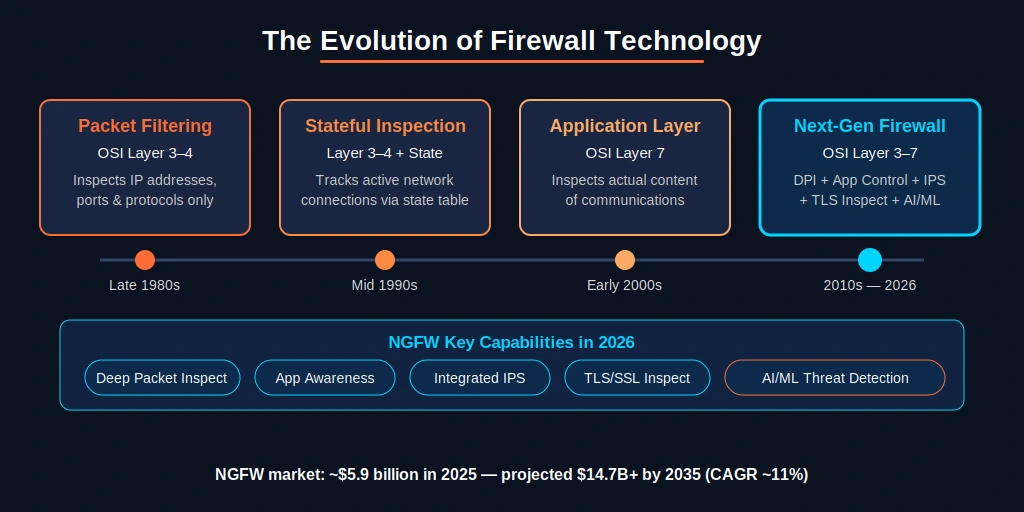
Traditional firewalls, often called packet-filtering firewalls, operate at Layers 3 and 4 of the OSI model — the network and transport layers. They examine individual data packets and make allow-or-deny decisions based on source and destination IP addresses, port numbers, and protocol types. A typical rule might allow inbound traffic on port 443 (HTTPS) while blocking traffic on port 23 (Telnet). Packet-filtering firewalls are fast because they inspect only packet headers, not the actual content, but this is also their limitation — they cannot distinguish between legitimate HTTPS traffic and malicious data disguised as HTTPS traffic.
Stateful inspection firewalls, which emerged in the mid-1990s, added the ability to track the state of active network connections. Rather than examining each packet in isolation, a stateful firewall maintains a state table that records information about each connection — source and destination addresses, port numbers, sequence numbers, and connection status. This allows the firewall to make more intelligent decisions. For example, it can automatically allow response traffic from a server that an internal user has already initiated a connection to, while blocking unsolicited inbound connection attempts on the same port. Stateful inspection became the standard for enterprise firewalls for over a decade and remains the baseline capability expected of any modern firewall.
Application-layer firewalls, also called proxy firewalls, go further by inspecting traffic at Layer 7 of the OSI model — the application layer. These firewalls can examine the actual content of network communications, not just the headers. A proxy firewall can inspect HTTP requests and block specific types of content, examine DNS queries for signs of tunnelling, or filter email attachments. The trade-off is performance — deep inspection of application-layer traffic requires significantly more processing power than packet filtering or stateful inspection.
Next-Generation Firewalls: Beyond Port and Protocol
Next-generation firewalls represent the current state of the art in firewall technology, and they are where the majority of enterprise firewall investment is directed in 2026. An NGFW combines traditional firewall capabilities — packet filtering, stateful inspection, and network address translation — with advanced features that address the limitations of earlier firewall generations.
The defining capabilities of an NGFW include deep packet inspection (DPI), which examines the complete content of network packets rather than just headers; application awareness and control, which identifies and controls applications regardless of the port or protocol they use; integrated intrusion prevention, which detects and blocks known attack patterns; TLS/SSL encrypted traffic inspection, which decrypts and inspects encrypted traffic before re-encrypting and forwarding it; and threat intelligence feeds, which provide real-time updates about known malicious IP addresses, domains, and file hashes. In 2026, the leading NGFW vendors — Palo Alto Networks, Fortinet, Check Point, and Cisco — are increasingly integrating AI and machine learning capabilities for automated threat detection and response.
The importance of encrypted traffic inspection cannot be overstated. Over 95% of web traffic is now encrypted using TLS, which means that a firewall that cannot inspect encrypted traffic is blind to the majority of network communications. Attackers routinely use encrypted channels to deliver malware, exfiltrate data, and communicate with command-and-control servers. NGFW platforms address this by performing TLS termination — decrypting inbound traffic, inspecting it for threats, and then re-encrypting it before forwarding to the destination. This is computationally expensive and raises privacy considerations, but it is a necessary capability for any organisation serious about network security.
The cloud-native firewall and Firewall-as-a-Service (FWaaS) model is the fastest-growing segment of the firewall market. Rather than deploying physical firewall appliances at each network location, FWaaS delivers firewall capabilities from the cloud, inspecting traffic regardless of where users or applications are located. This model aligns with the reality that network perimeters are no longer defined by physical locations but by identities, applications, and data flows. FWaaS is a core component of the Secure Access Service Edge (SASE) framework, which converges networking and security functions into a single cloud-delivered service.
Intrusion Detection Systems: Seeing What Firewalls Miss
Firewalls enforce access control — they decide what traffic is allowed in and out. But firewalls alone cannot detect sophisticated attacks that use allowed ports and protocols, that exploit zero-day vulnerabilities, or that originate from inside the network. This is where intrusion detection systems come in. An IDS monitors network traffic or system activity for signs of malicious behaviour, policy violations, or known attack patterns, and alerts security personnel when suspicious activity is detected.
There are two fundamental types of IDS based on where they are deployed. A network-based IDS (NIDS) monitors traffic flowing across network segments by analysing copies of network packets. It is typically deployed at strategic points within the network — behind the firewall, at network segment boundaries, or at points where traffic from different zones converges. A host-based IDS (HIDS) is installed on individual endpoints (servers, workstations) and monitors system-level activity including file system changes, registry modifications, process execution, and log entries. Network-based systems have a broader view of traffic patterns, while host-based systems can detect attacks that network monitoring might miss — such as malware that encrypts its communications or insider threats that do not cross network boundaries.
IDS detection methods fall into two primary categories. Signature-based detection compares observed traffic or behaviour against a database of known attack patterns (signatures). This is highly effective against known threats — if an attack matches a signature, the IDS will flag it with high accuracy and minimal false positives. The limitation is that signature-based detection cannot identify novel attacks that do not match any existing signature. Anomaly-based detection establishes a baseline of normal network behaviour and flags deviations from that baseline. This approach can detect previously unknown attacks, but it produces more false positives because legitimate but unusual activity may also deviate from the baseline. Modern IDS platforms increasingly combine both methods and incorporate machine learning to improve detection accuracy and reduce false positive rates.
Snort and Suricata are the two most widely deployed open-source IDS engines. Snort, originally released in 1998, pioneered the concept of a lightweight, rule-based network intrusion detection system and remains widely used in 2026. Suricata, developed by the Open Information Security Foundation, offers multi-threaded performance and native support for application-layer protocol detection. Both support extensive rule sets maintained by their respective communities and by commercial threat intelligence providers.
Intrusion Prevention Systems: From Detection to Action
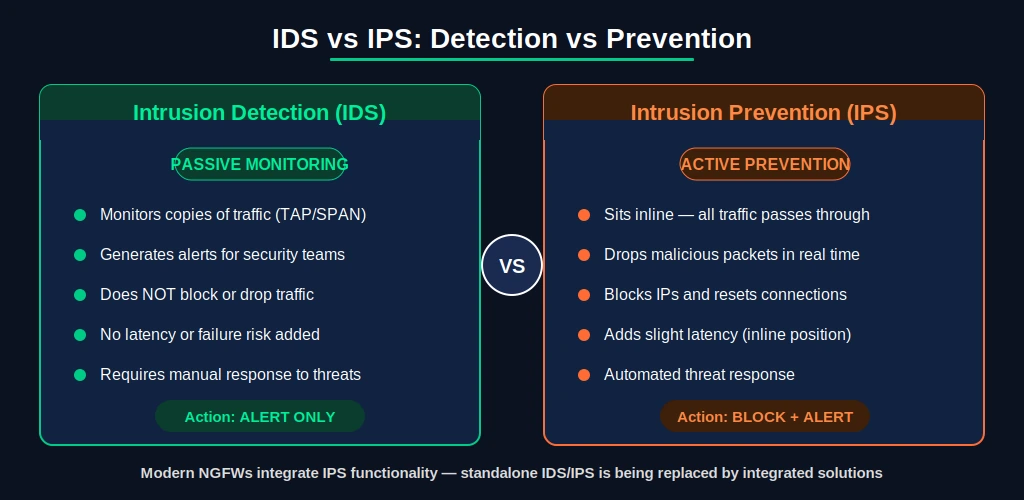
An intrusion prevention system takes the detection capability of an IDS and adds the ability to actively block or prevent detected threats in real time. While an IDS passively monitors traffic and generates alerts, an IPS sits inline in the network path — all traffic passes through it — and can drop malicious packets, block offending IP addresses, reset connections, or take other automated actions to stop an attack before it reaches its target.
The distinction between IDS and IPS is primarily one of deployment and response capability. An IDS operates in monitoring mode — it receives copies of network traffic (typically via a network TAP or SPAN port) and analyses them without affecting the flow of traffic. If it detects an attack, it sends an alert. An IPS operates inline — traffic must pass through it, giving it the ability to block malicious traffic in real time. The trade-off is that an inline IPS introduces a potential single point of failure and adds latency to network traffic. If the IPS fails or is misconfigured, it can block legitimate traffic (false positive blocking) or create a bottleneck. Modern IPS deployments mitigate this through fail-open modes, high-availability configurations, and extensive tuning of detection rules to minimise false positives.
In practice, the lines between IDS, IPS, and NGFW have blurred significantly. Most next-generation firewalls include integrated IPS functionality, and many organisations no longer deploy standalone IDS/IPS appliances. Instead, they rely on the IPS engine built into their NGFW platform, supplemented by network detection and response (NDR) tools that provide deeper analytical capabilities including behavioural analysis, encrypted traffic analysis, and automated threat hunting. The IDS/IPS market itself continues to grow — valued at approximately $7.76 billion in 2025 and projected to reach approximately $20.67 billion by 2034 — but the growth is increasingly in integrated and cloud-delivered solutions rather than standalone appliances.
The key IDS/IPS capabilities that matter most in 2026 include encrypted traffic analysis (detecting threats within TLS-encrypted flows without necessarily decrypting them, using metadata analysis and behavioural patterns), lateral movement detection (identifying attackers moving between systems inside the network after an initial compromise), and integration with Security Information and Event Management (SIEM) platforms that correlate alerts from multiple sources to identify complex multi-stage attacks.
How Firewalls, IDS, and IPS Work Together
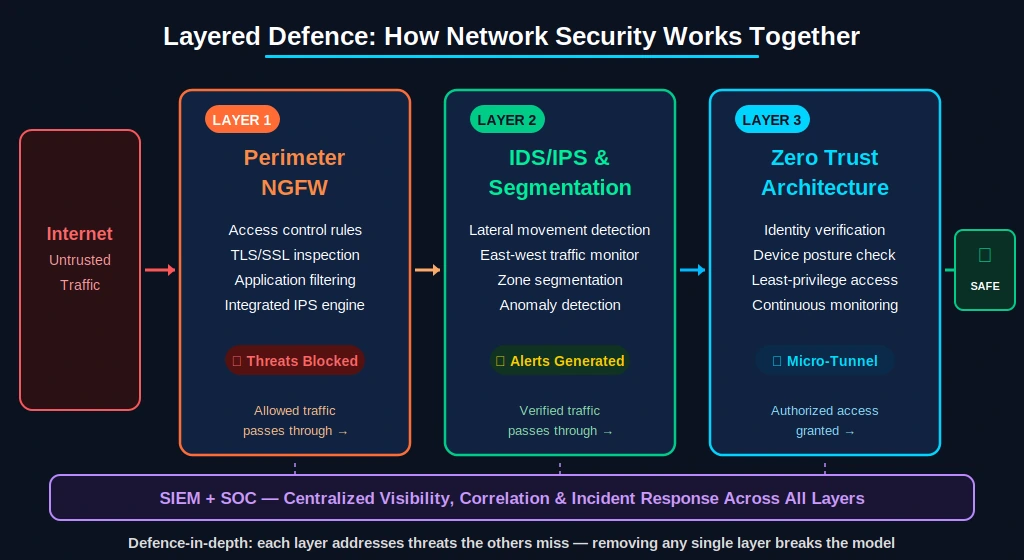
Understanding individual security tools is useful, but the real value comes from seeing how they work together in a layered defence architecture. No single technology is sufficient — each addresses a different aspect of the threat landscape, and the gaps left by one are covered by another.
In a typical enterprise network, the architecture works as follows. The perimeter NGFW sits at the network edge, enforcing access control policies, performing TLS inspection on inbound and outbound traffic, and applying application-level filtering. Its integrated IPS engine inspects all traffic passing through for known attack signatures and anomalous patterns. Internal segmentation firewalls divide the network into zones — separating the production environment from the development environment, the finance department from the general network, and so on — and enforce policies that restrict lateral movement between zones. Network-based IDS sensors are deployed at critical internal junctions to monitor traffic that the perimeter firewall does not see — particularly east-west traffic between servers in the data centre. Host-based IDS agents on critical servers monitor for file system changes, privilege escalation attempts, and other endpoint-level indicators of compromise. A SIEM platform collects and correlates alerts from all of these sources, providing security analysts with a unified view of the threat landscape.
This layered approach follows the defence-in-depth principle: even if an attacker bypasses one control, subsequent layers provide additional opportunities for detection and prevention. The cryptographic protocols discussed in the previous article — TLS for encryption in transit, AES for encryption at rest, digital signatures for authentication — provide the data-level security that these network-level controls enforce and inspect. For organizations without dedicated security staff, implementing these layers is often handled by specialized cybersecurity providers rather than in-house teams.
Zero Trust Architecture: The Paradigm Shift
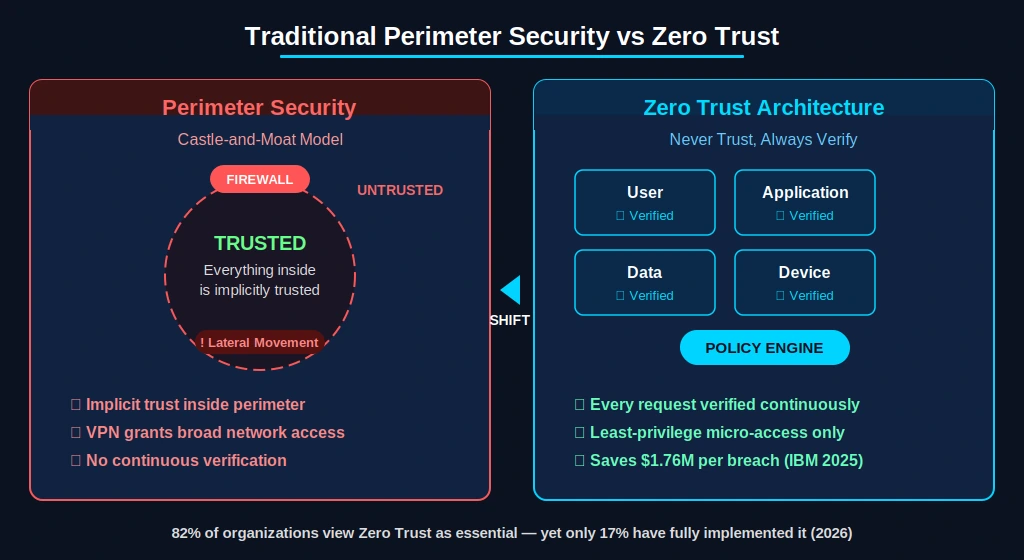
Zero Trust is the most significant conceptual shift in network security in the past two decades. The traditional perimeter model assumed that everything inside the network is trusted. Zero Trust assumes the opposite: trust nothing, verify everything. Every access request — regardless of whether it comes from inside or outside the network, from a managed or unmanaged device, from a human user or an automated service — must be authenticated, authorised, and continuously validated before access is granted.
The term “Zero Trust” was coined by Forrester Research analyst John Kindervag in 2010, but the concept gained its definitive formal specification in NIST Special Publication 800-207, published in August 2020. NIST SP 800-207 defines Zero Trust Architecture through seven core tenets: all data sources and computing services are considered resources; all communication is secured regardless of network location; access to individual enterprise resources is granted on a per-session basis; access is determined by dynamic policy that considers client identity, application or service, the requesting asset’s observable state, and behavioural and environmental attributes; the enterprise monitors and measures the integrity and security posture of all owned and associated assets; all resource authentication and authorisation are dynamic and strictly enforced before access is allowed; and the enterprise collects as much information as possible about the current state of assets, network infrastructure, and communications and uses it to improve its security posture.
The momentum behind Zero Trust adoption is substantial and accelerating. According to a 2025 Zscaler report, 96% of organisations favour a Zero Trust approach, and 81% plan to implement Zero Trust strategies within 12 months. Yet the gap between intention and mature implementation remains wide — Gartner predicted that only 10% of large enterprises would have a mature and measurable Zero Trust programme in place by 2026, up from less than 1% in 2023. The financial case for Zero Trust is clear: according to the IBM 2025 Cost of a Data Breach Report, organisations with deployed Zero Trust architecture saved an average of $1.76 million per breach compared to those without it.
The Core Components of Zero Trust
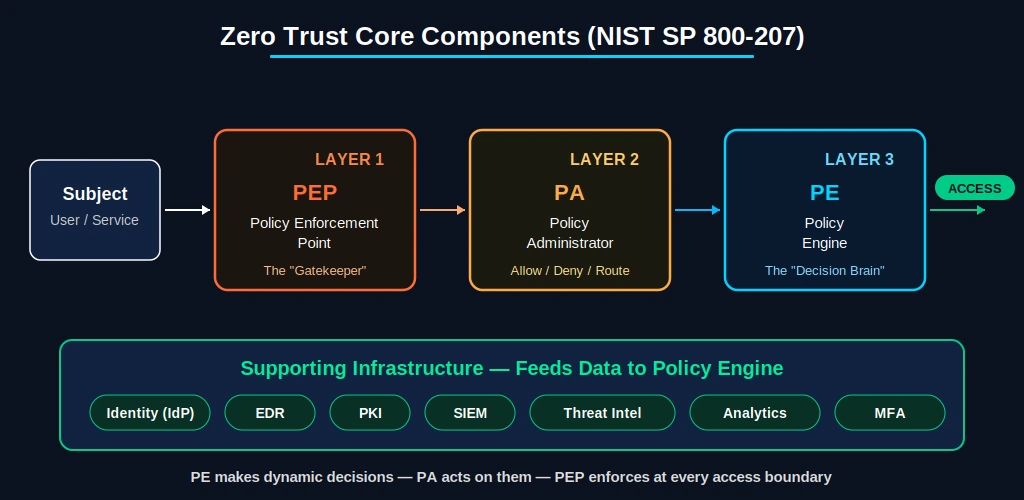
NIST SP 800-207 defines a modular architecture built around three core components that form the control plane for every access decision. Understanding these components is essential for anyone implementing or evaluating a Zero Trust architecture.
The Policy Engine is the decision-making brain. It receives access requests and evaluates them against a set of policies informed by multiple data sources — user identity, device health, location, time of access, the sensitivity of the requested resource, threat intelligence feeds, and behavioural analytics. The Policy Engine does not simply check a static access control list. It makes dynamic, risk-based decisions that can change from one session to the next based on the current context. A user who was granted access to a resource ten minutes ago may be denied access now if their device posture has changed, if their location has shifted unexpectedly, or if their behaviour pattern suggests compromise.
The Policy Administrator translates the Policy Engine’s decisions into actions. When the Policy Engine grants access, the Policy Administrator instructs the relevant enforcement point to establish a secure communication channel between the requester and the resource. When access is denied, the Policy Administrator ensures the enforcement point blocks the connection. It manages the lifecycle of access sessions — creating, modifying, and terminating them as the Policy Engine’s assessments change.
The Policy Enforcement Point is the gatekeeper. It is the component that physically enables or blocks connections between a subject (user or service) and a resource. In a traditional network, a firewall performed this role at the perimeter. In Zero Trust, enforcement points exist throughout the environment — at every access boundary, not just at the network edge. This is what makes Zero Trust fundamentally different from perimeter security: the controls follow the data and the user rather than sitting at a fixed boundary.
The supporting infrastructure includes identity providers (for user and device authentication), endpoint detection and response platforms (for device health assessment), PKI infrastructure (for certificate-based authentication), SIEM and security analytics platforms (for behavioural analysis and threat detection), and threat intelligence feeds. Zero Trust is not a single product — it is an architectural framework that integrates existing security tools around the principle of continuous verification.
Zero Trust vs Traditional Perimeter Security
The difference between Zero Trust and traditional perimeter security is not incremental — it is architectural. Perimeter security draws a line around the network and applies security controls at that boundary. Everything inside the boundary gets implicit trust; everything outside does not. This model has three critical weaknesses that Zero Trust directly addresses.
First, perimeter security assumes that internal traffic is safe. Once an attacker breaches the perimeter — through a phishing attack, a compromised VPN credential, a vulnerable web application, or any of the common cyber attack types discussed earlier in this series — they can move laterally through the internal network with relative freedom. The high-profile breaches of the past decade — SolarWinds, Colonial Pipeline, and countless ransomware incidents — exploited exactly this weakness. The attackers got inside, and once inside, the network’s internal controls were insufficient to stop them from reaching their targets.
Second, the perimeter no longer exists in any meaningful sense for most organisations. When employees work from home on personal devices, access SaaS applications hosted in multiple clouds, and connect to corporate resources over the public internet, there is no single boundary to defend. VPN concentrators that funnel remote users through the corporate network create bottlenecks, increase latency, and still grant broad network access once a user authenticates — the opposite of least privilege. This is why 65% of organisations plan to replace VPN services with Zero Trust Network Access (ZTNA) solutions, a 23% increase from the previous year according to the Zscaler ThreatLabz 2025 VPN Risk Report.
Third, perimeter security provides no mechanism for continuous verification. A user authenticates once (typically with a username and password, possibly with MFA), and the session remains trusted until it times out. Zero Trust requires continuous assessment — not just at the start of a session, but throughout. If a device’s security posture degrades during a session (antivirus signatures become outdated, a suspicious process starts running), access can be dynamically restricted or revoked. This continuous evaluation model is far more aligned with the reality of modern threats, where attackers often use valid credentials and operate in ways designed to appear legitimate.
Implementing Zero Trust: Practical Steps
Zero Trust implementation is not a single project — it is a multi-year transformation that touches identity management, network architecture, endpoint security, data classification, and security operations. The U.S. federal government’s experience provides a practical roadmap. Executive Order 14028, signed in May 2021, mandated Zero Trust architecture across all federal agencies. The Office of Management and Budget followed with Memorandum M-22-09, which set specific Zero Trust goals across five pillars: identity, devices, networks, applications and workloads, and data. The Department of Defense published its own Zero Trust Strategy requiring all DoD contractors to achieve Target Level Zero Trust by fiscal year 2027.
For organisations beginning their Zero Trust journey, the practical implementation typically follows a structured approach. The first step is to identify the protect surface — the critical data, applications, assets, and services that the organisation needs to protect. Unlike the attack surface (which is vast and constantly changing), the protect surface is specific and manageable. The second step is to map the transaction flows — understand how traffic moves across the network in relation to the protect surface, which users and services access which resources, and what dependencies exist. The third step is to architect a Zero Trust network around the protect surface, placing enforcement points (micro-segmentation gateways, identity-aware proxies, ZTNA connectors) at every access boundary. The fourth step is to create Zero Trust policies based on the Kipling Method — defining who, what, when, where, why, and how for every access request. The fifth step is to monitor and maintain, continuously collecting telemetry, analysing behaviour, and refining policies.
The convergence of SASE and ZTNA is the dominant procurement pattern for Zero Trust in 2026. SASE combines SD-WAN networking with cloud-delivered security services (SWG, CASB, FWaaS, ZTNA) into a single platform. Rather than bolting Zero Trust onto an existing network architecture, SASE providers deliver Zero Trust as part of the networking fabric itself. Major vendors in this space include Zscaler, Palo Alto Networks (Prisma SASE), Cloudflare, and Netskope.
Real-World Network Security: How It All Connects
Understanding how firewalls, IDS/IPS, and Zero Trust work together in a real-world scenario ties together all the concepts in this article. Consider an employee working from home who needs to access a financial application hosted in the organisation’s cloud environment.
In a traditional perimeter model, the employee would connect to the corporate VPN, which tunnels all their traffic through the corporate network. The perimeter firewall inspects the traffic, and once through the VPN, the employee has broad access to internal network resources — far more than they need for the financial application alone. If their laptop has been compromised by malware, that malware now also has access to the internal network.
In a Zero Trust model, the experience is fundamentally different. The employee’s device has an endpoint agent that continuously assesses its security posture — operating system patch level, antivirus status, disk encryption, running processes. When the employee attempts to access the financial application, the ZTNA connector authenticates their identity (using phishing-resistant MFA), evaluates their device posture, checks their role-based access permissions, and assesses contextual factors like location and time of access. If all checks pass, a secure micro-tunnel is established directly between the employee’s device and the specific financial application — not to the broader network. The employee cannot see or reach any other network resources. The connection is monitored continuously, and if the device posture changes or anomalous behaviour is detected, access is revoked immediately. The IPS monitoring that application’s traffic inspects for attack patterns in real time, and all data in transit is encrypted using TLS 1.3.
The result is dramatically reduced attack surface, enforced least-privilege access, continuous verification, and defence-in-depth through multiple overlapping controls. This is network security in 2026 — not a wall around the castle, but security that follows every user, every device, and every data flow.
Conclusion
Network security in 2026 is defined by the transition from perimeter-based defence to identity-centric, Zero Trust architecture — but that transition does not eliminate the need for firewalls and IDS/IPS. It changes how they are deployed and what role they play. Firewalls remain essential for traffic inspection, application control, and policy enforcement. IDS/IPS systems provide the detection and prevention capabilities that catch threats firewalls miss. Zero Trust provides the architectural framework that ties these tools together around the principle that no user, device, or connection should be implicitly trusted.
The practical takeaway for security professionals is that these technologies are complementary, not competitive. An organisation that deploys a next-generation firewall without Zero Trust principles still relies on perimeter assumptions that attackers routinely exploit. An organisation that adopts Zero Trust without adequate IDS/IPS coverage may have strong access controls but limited visibility into the threats traversing its network. The strongest security postures combine robust firewall and IDS/IPS deployment with Zero Trust architecture, continuous monitoring, and the cryptographic foundations — encryption, hashing, digital signatures, and PKI — that secure data at every layer.
For those pursuing the CISSP certification, network security is covered primarily in Domain 4 (Communication and Network Security) and overlaps significantly with Domain 3 (Security Architecture and Engineering) for Zero Trust design, Domain 1 (Security and Risk Management) for policy frameworks, and Domain 7 (Security Operations) for IDS/IPS monitoring and incident response. The eight CISSP domains and their coverage are detailed in our complete CISSP domains guide.
Sources: NIST SP 800-207 Zero Trust Architecture, IBM Cost of a Data Breach Report 2025, Zscaler ThreatLabz 2025 VPN Risk Report, Gartner Zero Trust Architecture, ORDR Zero Trust Statistics 2026 Report, Fortune Business Insights NGFW Market Report, Market Data Forecast Intrusion Detection and Prevention Systems Market — August 2026
Next Article Preview:
In the next article, we will explore “Identity and Access Management (IAM): Authentication, Authorization, and Access Control Models” — how digital identities are created, verified, and governed across enterprise environments, and why IAM is the foundational pillar of every Zero Trust implementation.