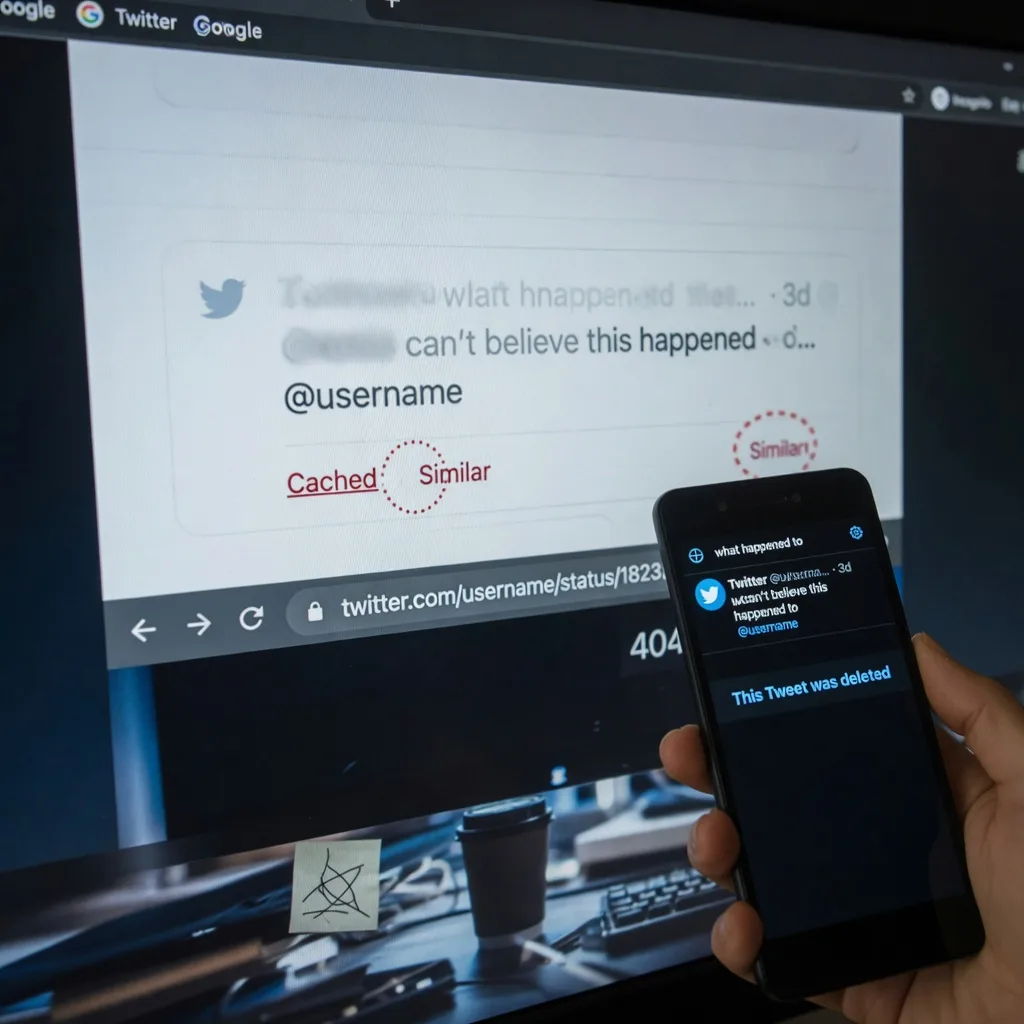
Deleting X is final. Click once and the tweet is gone, erased from your profile, your timeline and out of sight. Then, hours later, someone posts a Google link to the same post you just deleted, and it’s readable, indexed, and there, as if nothing ever occurred. People are taken aback by that moment. The “deleted from X” / “gone from the internet” divide is very real, and much more beneficial to understand the source of the gap than to hope it goes away on its own.
Why Google Doesn’t Update Instantly
Once you remove a tweet, X will take it off its servers fairly quickly. The platform’s records are updated quickly. However, there’s nothing particularly deep going on between Google and X’s backend – Google doesn’t get a signal when a piece of content goes offline. Rather, Google relies on automated bots known as crawlers, which visit Web pages on an ongoing, rolling schedule and take snapshots of what they find. Those snapshots are added to Google’s index and show up in search results. Until a crawler takes another look at this particular URL, finds that the page no longer exists, and performs the change, the old snapshot remains in the same place.
This is why many users trying to figure out what Google still has indexed from their account choose to view tweets with TweetDelete as part of a content audit before deciding which posts to prioritize for removal. Getting a clear picture of what’s still accessible, through live URLs or cached versions, makes far more sense than guessing blind.
How long the delay actually lasts depends on several factors. Google’s crawl frequency is tied to how much traffic a page receives and how often it has been linked to or updated. A tweet from a high-profile account with strong engagement might be recrawled within days. Something from a smaller account with little interaction could sit untouched in the index for several weeks. Most users who actively track this experience a range somewhere between a few days and three to four weeks before a deleted tweet fully drops from results. There’s no fixed schedule Google commits to publicly, so there is no guaranteed deadline you can plan around.
What Happens to Google’s Cached Copy
Google’s cached snapshot can remain for a bit longer after the URL in a tweet has stopped loading. This is a copy of the page that was last successfully crawled by Google, and for a short period of time after it’s deleted, a copy may still be available for anyone who knows how to get it. It is a temporary condition. If Google’s crawler sees the page as unavailable the next time it crawls, then the cache will be removed from the search result. However, during that period, the content is still technically visible and this is what makes most users think that deletion is an instant process.
This distinction matters because it means deletion actually triggers a two-stage disappearance: first, the live page goes offline on X’s servers, then the cached version eventually clears once Google confirms the page no longer exists. The cache isn’t permanent, but it runs on Google’s timetable rather than yours, and that‘s a distinction worth internalizing.
The Role of Bulk Deletion Tools
TweetDelete is not new and has gained a recognizable name in this area. Bulk deletion is the main use of the platform. It enables users to upload their entire X archive and filter and remove content at scale by date range, engagement level, or keywords. This is important as some older tweets are not available for deletion via X’s own API. TweetDelete is designed to fill those spaces and access information that the platform’s built-in features can’t.
There is a relationship between bulk deletion and search engine visibility, but it is not a direct one. Each tweet that is deleted takes away one more URL from Google’s index. Having fewer pages that are active will result in fewer of the things that are being indexed by the crawlers. It’s not an immediate loss of search visibility, but over time, when Google’s bots go back to these old URLs and keep seeing nothing, they slowly fade away. Scale cleansing does speed up that process by decreasing the overall number of live sources to be referenced by search engines.
TweetDelete can’t get into Google’s systems and force a quicker deindex. It is also not responsible for content that has been copied or replicated elsewhere. When a tweet is posted on another site (whether as an embed or a screenshot or it was archived), all those posts are outside of any deletion tool.
When the Content Has Already Spread
This is the part of the conversation that gets uncomfortable. A tweet that gained meaningful traction – one that was quoted by a news outlet, embedded on a blog, or captured by services like the Wayback Machine – leaves a far messier trail than something nobody ever clicked on. Each external reference is its own indexed piece of content, and none of those entries disappear simply because the original tweet was deleted.
Archival services operate completely independently of X’s systems. If your tweet was crawled and saved before you deleted it, that archived version remains accessible and searchable regardless of what happens to the original post. For users dealing with sensitive content they want out of circulation, this is a hard ceiling. Deleting from X is the necessary first move, but it doesn’t retroactively undo an archival capture.
For specific URLs that are no longer active on X, Google Search Console does offer a URL removal request tool that can accelerate the deindexing process for individual pages. It’s not a fix for archived copies elsewhere, but it’s a practical option when one particular result is causing problems, and you want to move faster than a standard crawl cycle allows.
Conclusion
The deleted tweet will generally be visible in Google Search results for a few days to a few weeks. The exact duration varies depending on the frequency of the previous crawl, the reach of the post and offline copies of it. While no tool can remove the waiting time, bulk deletion decreases the number of indexed pages to be processed in the first place.
Deletion is where the process starts. The rest is a matter of understanding how crawl cycles function, accepting that some external copies may sit beyond your reach, and giving the system enough time to eventually catch up with what you’ve already removed.