Every day, thousands of construction projects stall—not because of design flaws or labor shortages, but because the right flooring materials didn’t arrive on time or arrived damaged. From delicate hardwood planks to heavy ceramic tiles, the sheer diversity of flooring products creates a logistical puzzle that few industries can match. At the heart of this challenge lies a fundamental question: should warehouses rely on traditional manual handling, or is it time to embrace automation? For supply chain managers tasked with delivering materials faster while cutting operational costs, the answer isn’t always straightforward. The ideal approach depends heavily on the type of flooring being moved, stored, and shipped. Fragile materials demand different care than resilient vinyl rolls, and bulky tile pallets present challenges that lightweight laminate planks simply don’t. This article breaks down how the physical characteristics of various flooring types shape logistics decisions, weighing the strengths and weaknesses of manual and automated handling to help supply chain professionals make smarter, more cost-effective choices.
The Spectrum of Different Types of Flooring in Logistics
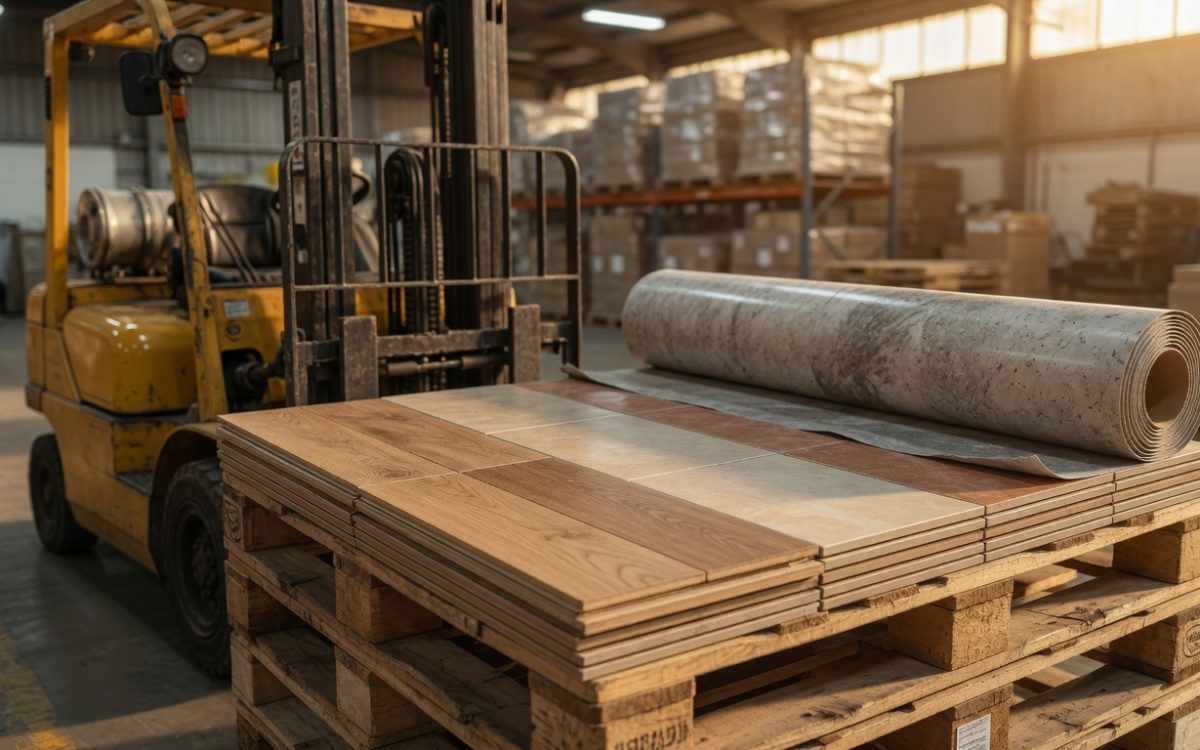
The flooring industry encompasses a remarkable range of products, each presenting unique challenges within warehouse logistics. Hardwood planks are dense, heavy, and highly susceptible to moisture damage and surface scratching—requiring climate-controlled storage and careful handling at every touchpoint. Laminate flooring, while lighter and more uniform in packaging, features click-lock edges that can chip if subjected to rough treatment during transport. Vinyl flooring arrives in rolls or rigid planks, with rolls demanding specialized racking to prevent deformation and planks needing stable stacking to avoid warping. Ceramic and porcelain tiles represent the heaviest category per square foot, shipped on pallets that can exceed 2,000 pounds, making them prone to cracking under uneven pressure or sudden impact. Carpet, whether in rolls or modular tiles, is bulky relative to its weight but vulnerable to crushing and moisture absorption. Beyond the warehouse floor itself, maintaining the surrounding facility — from loading docks to outdoor storage yards — also demands the right equipment; even an auto lawn cutter plays a role in keeping large distribution sites clean and operational. Understanding these physical properties—weight distribution, fragility thresholds, dimensional variability, and environmental sensitivity—is essential for effective supply chain management. A one-size-fits-all approach to handling simply doesn’t work when the product spectrum ranges from featherweight vinyl sheets to palletized stone tiles. Each material’s characteristics directly dictate the equipment, labor, and storage configurations a warehouse must deploy.

Manual Handling for Flooring: Traditional Methods and Limitations
Manual handling remains deeply embedded in flooring logistics, and for good reason in certain contexts. When a warehouse processes custom orders—say, a boutique renovation requiring mixed hardwood species in non-standard lengths—human workers offer unmatched adaptability. They can inspect each plank visually, sort by grain pattern, and package irregularly sized bundles without reprogramming a machine. For smaller operations with limited capital, manual methods also avoid the steep investment that automation demands, keeping overhead manageable during lean periods. Workers equipped with hand trucks, pallet jacks, and basic forklifts can handle a wide product mix without specialized infrastructure.

However, these advantages erode quickly at scale. Manual flooring handling is physically punishing work; ceramic tile pallets routinely weigh over a ton, and repetitive lifting of hardwood cartons drives injury rates well above the warehouse industry average. Fatigue-related mistakes—dropping a box of porcelain tiles, stacking laminate cases unevenly, or misreading a SKU on carpet rolls—compound into measurable losses through product damage, mispicked orders, and costly returns. Throughput ceilings are another persistent issue. A manual team can only move so many pallets per hour, and during peak construction seasons, this bottleneck ripples through the entire supply chain. Delayed shipments push back project timelines, frustrate contractors, and ultimately damage client relationships. For supply chain managers overseeing high-volume warehouse logistics, relying solely on manual processes means accepting slower cycle times, higher labor costs per unit, and an error margin that automation could dramatically shrink.
Automated Handling: Revolutionizing Efficiency in Logistics
The rise of automated factories has fundamentally reshaped how flooring materials move through the supply chain. Where manual processes hit throughput ceilings and fatigue-driven error rates, automation delivers consistency at scale—24 hours a day, without the physical toll on human workers. Modern automated systems don’t just move product faster; they move it smarter, adapting pressure, grip, and speed to match the specific demands of each flooring type passing through the line.
Robotic arms equipped with vacuum grippers can lift fragile hardwood cartons with precisely calibrated force, eliminating the surface scratches that manual stacking often causes. Conveyor systems with integrated sensors detect weight anomalies in ceramic tile pallets, flagging potential damage before shipment rather than after a contractor files a claim. Automated guided vehicles navigate warehouse floors carrying vinyl rolls on cradle-style platforms that prevent the deformation flat storage causes over time. The safety improvements alone justify serious consideration—removing workers from repetitive heavy lifting of tile pallets dramatically reduces injury claims and associated insurance costs. For supply chain managers focused on project timelines, automation compresses order fulfillment cycles from days to hours. A warehouse processing 500 SKUs of mixed flooring can maintain accuracy rates above 99.5% with barcode-scanning automation, compared to the 95-97% range typical of manual picking operations. These gains compound across thousands of orders annually, translating directly into fewer returns, stronger contractor relationships, and measurable reductions in operational cost per unit shipped.
Key Technologies for Automated Flooring Handling
Robotic palletizers represent perhaps the most impactful technology for heavy flooring products. These systems build and break down ceramic and porcelain tile pallets with mechanical precision, distributing weight evenly across each layer to prevent the cracking that uneven manual stacking causes. Advanced models use machine vision to identify pallet orientation and adjust placement patterns in real time, handling mixed-SKU pallets without human intervention. Automated guided vehicles have become indispensable in integrated centers where flooring inventory must travel between storage zones, quality inspection stations, and shipping docks. For laminate flooring—uniform in size but sensitive to edge damage—AGVs fitted with cushioned platforms transport cartons at controlled speeds, eliminating the jolts and collisions common during manual forklift runs through congested aisles. Automated storage and retrieval systems maximize vertical warehouse space, particularly valuable for carpet rolls that consume enormous floor area when stored horizontally. These systems slot rolls into high-bay racking and retrieve them on demand, reducing the footprint needed by up to 60% compared to conventional layouts. Real-world applications in integrated centers demonstrate these technologies working in concert: a single facility receiving bulk tile shipments, storing mixed vinyl products, and dispatching custom laminate orders can orchestrate all three workflows through a unified warehouse management system, achieving throughput levels that would require triple the manual workforce.
Case Studies: Product Showroom and Integrated Centers in Action
The convergence of automated handling and customer-facing operations is transforming how flooring reaches end users. Several major distributors have redesigned their product showrooms to double as fulfillment hubs, where robotic retrieval systems pull flooring samples directly from active inventory. When a contractor selects a hardwood species on a digital display, the system locates the matching stock in real time, confirming availability and reserving units for immediate dispatch. This eliminates the disconnect that traditionally plagued showroom operations—where a customer commits to a product only to discover it’s backordered at a separate warehouse. Home supplies retailers like GeorgeBuild have recognized that this seamless connection between display and fulfillment is increasingly what contractors and homeowners expect from their flooring purchasing experience. The result is faster decision-making on-site and shorter gaps between material selection and jobsite delivery.
Integrated centers take this model further by combining storage, showroom functionality, and distribution under one roof with unified supply chain management. One regional flooring distributor consolidated three separate facilities into a single integrated center equipped with automated storage and retrieval systems for carpet rolls, robotic palletizing for ceramic tiles, and conveyor-fed picking lines for laminate and vinyl. Within the first year, order fulfillment speed improved by 40%, damage claims dropped by nearly half, and the company reduced total warehouse square footage by a third. Another integrated center serving commercial contractors introduced AGV-based staging, where mixed flooring orders are assembled automatically in delivery sequence—heaviest tile pallets loaded first, fragile hardwood cartons last—cutting truck loading time and reducing transit damage. These examples demonstrate that when showroom visibility connects directly to automated warehouse logistics, supply chain managers gain both operational speed and the customer confidence that drives repeat business.
Strategic Solutions for Supply Chain Managers
For supply chain managers navigating the flooring logistics landscape, the path forward isn’t about choosing automation over manual handling in absolute terms—it’s about deploying the right method for each product category and operational context. The first priority should be identifying where current bottlenecks cause the most damage, both financially and to client relationships. If ceramic tile damage claims are eating into margins, targeted automation at the palletizing stage delivers immediate ROI. If custom hardwood orders are consistently delayed by manual sorting inefficiencies, a hybrid approach—automated storage paired with skilled human inspection—can compress fulfillment times without sacrificing quality control.
Cost reduction in flooring logistics rarely comes from a single investment. Instead, it emerges from aligning handling methods with product characteristics across the entire warehouse operation. Heavyweight products like tile and stone benefit most from full automation, where robotic systems eliminate injury risk and maintain consistent stacking quality. Mid-weight, uniform products such as laminate and rigid vinyl planks are ideal candidates for conveyor-based picking and AGV transport, where speed gains multiply across high order volumes. Lighter, more variable products—carpet tiles in custom colorways, specialty hardwoods in mixed dimensions—often justify retaining manual flexibility at the picking and packing stages while automating upstream storage and retrieval. Supply chain managers who map their product mix against these handling profiles can build a phased automation strategy that delivers measurable gains at each stage rather than demanding a single, capital-intensive overhaul.
Step-by-Step Implementation Guide
Start by conducting a thorough inventory audit that categorizes every flooring SKU by weight, fragility, dimensional uniformity, and order frequency. This assessment reveals which products drive the highest handling costs and where damage rates concentrate—data that forms the foundation for every subsequent decision. Next, perform a cost-benefit analysis comparing manual and automated options for each product category. Factor in not just equipment costs but labor expenses, injury-related losses, error rates, and the revenue impact of faster fulfillment. For many operations, the analysis will show that automation pays for itself within two to three years on high-volume, heavy products while manual handling remains more economical for low-volume specialty items.
Integration with existing warehouse logistics systems is the third critical step. Any new automated equipment—whether robotic palletizers, AGVs, or AS/RS installations—must communicate seamlessly with your warehouse management system to maintain inventory accuracy and order routing efficiency. Work closely with technology vendors to ensure barcode or RFID compatibility, and plan for a parallel running period where manual and automated processes operate side by side during transition. Finally, establish clear performance benchmarks from day one: track throughput rates, damage percentages, order accuracy, and cost per unit shipped on a monthly basis. Use this data to make iterative adjustments—recalibrating robotic grip pressure for a new hardwood product line, rerouting AGV paths to reduce congestion during peak seasons, or shifting labor resources toward tasks where human judgment still outperforms machines. Continuous improvement in supply chain management isn’t a one-time project; it’s an ongoing discipline that compounds efficiency gains over time and keeps your operation competitive as both flooring products and logistics technology continue to evolve.
Matching Handling Strategies to Flooring Logistics Demands
The logistics of flooring materials will never be a one-solution problem. Hardwood, laminate, vinyl, ceramic tile, and carpet each impose distinct demands on warehouse operations—demands that manual handling alone struggles to meet at scale, and that poorly targeted automation can overcomplicate for low-volume specialty products. The evidence is clear: automation delivers transformative gains in speed, accuracy, and worker safety for high-volume, heavy, and uniform flooring categories, while skilled manual handling retains its value where flexibility, visual inspection, and custom order fulfillment matter most. Supply chain managers who recognize this spectrum—and match their handling strategies accordingly—position their operations to reduce damage claims, compress fulfillment timelines, and lower cost per unit shipped without overextending capital budgets. The flooring logistics landscape will only grow more complex as product variety expands and contractor expectations for rapid delivery intensify. Those who begin building phased, data-driven automation strategies now, grounded in the physical realities of their specific product mix, will hold a decisive competitive advantage. The question is no longer whether to automate, but where to start and how fast to scale.