
The purchase price of a private aircraft is the number everyone focuses on, and it’s also the least useful number for understanding what ownership actually costs. A $12 million aircraft with a well-managed maintenance history, strong engine program, and efficient operating structure can be more affordable to own over five years than an $8 million aircraft bought without a proper pre-purchase inspection. Private aircraft ownership is a multi-year financial commitment built from an acquisition cost, a set of costs that arrive whether the aircraft flies or not, and a set of costs that scale directly with how much it’s actually used.
This guide breaks down every major cost category in private aircraft ownership, explains the difference between fixed and variable expenses, and lays out a framework for evaluating whether a specific aircraft — and a specific ownership structure — actually makes financial sense for how you intend to fly.
The three-part framework: acquisition, fixed costs, variable costs
Before getting into individual line items, it helps to think about aircraft ownership as three distinct financial commitments rather than one purchase:
Acquisition Cost + Fixed Annual Costs + Variable Operating Costs = True Ownership Cost
The acquisition cost is what most buyers research extensively. The other two components — which continue for as long as the aircraft is owned — are where first-time buyers most often underestimate the real commitment. An aircraft that costs less to buy but has aging avionics, an engine program that’s lapsed, or major inspections due within the first year can end up meaningfully more expensive than a slightly pricier aircraft in better condition.
Purchase price is only the beginning
Aircraft prices vary enormously by category:
- Light jets — the entry point into jet ownership, generally suited to shorter regional missions and smaller passenger loads.
- Midsize jets — a step up in range and cabin size, a common choice for regular business travel across a wider geographic footprint.
- Super-midsize jets — meaningfully more range and cabin volume, often the point where cross-country nonstop capability becomes realistic.
- Heavy jets — large-cabin aircraft built for longer missions and larger groups.
- Ultra-long-range aircraft — capable of intercontinental nonstop flights, at the top of the cost spectrum both to acquire and to operate.
- New vs. pre-owned — new aircraft carry a manufacturer warranty and a clean maintenance history but cost significantly more upfront; pre-owned aircraft can offer real savings, provided their maintenance status is thoroughly understood before purchase.
The lowest sticker price is frequently not the lowest true cost. An aircraft with major inspections approaching, aging avionics that will need upgrading to stay compliant with airspace requirements, or engine work due shortly after purchase can turn an apparent bargain into a costly first year of ownership. Before buying, a thorough evaluation of total flight hours, engine condition, avionics status, cabin condition, and any upcoming scheduled inspections is essential — this is not a step to shortcut, regardless of how strong the deal looks on paper.
Fixed vs. variable costs: the distinction that shapes your budget
Aircraft expenses split into two broad categories, and understanding which is which changes how you think about utilization.
| Fixed Costs | Variable Costs |
|---|---|
| Crew salaries | Fuel |
| Hangar | Maintenance tied to utilization |
| Insurance | Landing fees |
| Aircraft management | Ground handling |
| Pilot training | Catering |
| Subscriptions | Navigation charges |
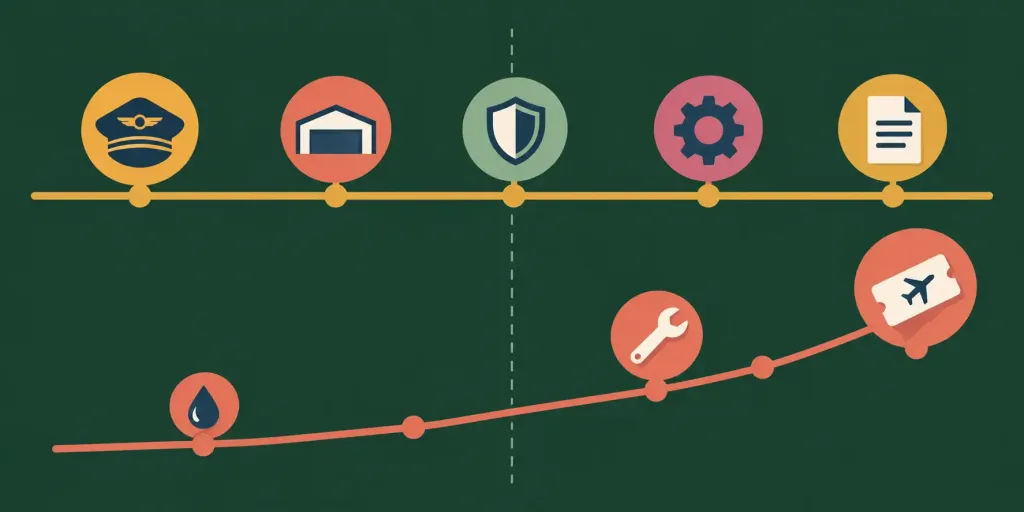
Fixed costs continue whether the aircraft flies once a year or two hundred times a year. Variable costs rise directly with how much the aircraft is actually flown. This distinction matters because a lightly used aircraft can still generate substantial annual expense purely from the fixed side of the ledger — owning a jet you rarely fly doesn’t proportionally reduce what it costs to keep.
Crew costs
Professional flight crew is frequently one of the largest recurring expenses in private ownership. Depending on aircraft type and how often it flies, an owner may need to budget for:
- A captain and first officer, as most jets require a two-pilot crew
- Contract pilot coverage for schedule gaps or crew time-off requirements
- Recurrent training, which is mandatory and recurring — not a one-time cost
- Benefits and payroll administration if crew are direct employees
- Crew travel expenses when positioning for trips away from home base
Long-range missions and demanding schedules increase crew planning complexity, since duty-time regulations limit how long a crew can fly without rest. Owners who work with a professional management company often have crew recruiting, scheduling, recurrent-training coordination, and payroll handled as part of that relationship, which shifts an operationally complex cost category off the owner’s own plate.
Hangar and storage costs
Most aircraft need a reliable, secure location when not flying, and hangar costs vary substantially by:
- Airport and geographic region
- Aircraft size (larger aircraft need larger, more expensive hangar space)
- Local demand and hangar availability
- Whether the airport is a high-traffic private aviation hub
Hangaring protects an aircraft from weather, UV exposure, and debris, and helps preserve both exterior finish and cabin condition — leaving an aircraft outside long-term accelerates wear in ways that show up later as increased maintenance cost. At high-demand private aviation airports, hangar space itself can be scarce enough to become a real factor in choosing a home base, sometimes influencing the decision as much as proximity or fuel pricing does.
Insurance costs
Insurance is a recurring fixed cost that depends on several variables:
- Aircraft value and model
- Pilot experience and total hours
- Liability coverage limits
- Operating territory (domestic vs. international)
- Intended use
- Whether the aircraft participates in charter operations
Insurance requirements and pricing can differ meaningfully depending on whether an aircraft is flown purely for private use or also placed into commercial charter, since charter operation introduces additional passengers and additional liability exposure that insurers price accordingly.
Maintenance costs
Maintenance is one of the most variable and least predictable areas of ownership, covering:
- Scheduled inspections required by the manufacturer and regulators
- Unscheduled repairs, which by definition can’t be fully budgeted for in advance
- Engine maintenance, often the single largest maintenance category
- APU (auxiliary power unit) maintenance
- Avionics upkeep and required upgrades
- Tires, brakes, and other wear items
- Cabin systems and exterior repairs
Aircraft age, total flight hours, cycles (takeoff-and-landing counts, which stress airframes differently than hours alone), maintenance history, and whether the aircraft is enrolled in a maintenance program all shape future costs. This is exactly why a detailed pre-purchase inspection matters so much: a lower purchase price can become a far more expensive proposition if significant maintenance work is imminent at the time of acquisition.
Fuel costs
Fuel is typically the largest single variable operating expense, driven by:
- Aircraft type and fuel burn rate
- Annual flight hours
- Typical route length
- Airport-specific fuel pricing (which varies significantly by location)
- Broader fuel market conditions
Larger, longer-range aircraft burn substantially more fuel than light jets, which is a core part of why aircraft category selection has such a large downstream effect on ownership cost. For budgeting purposes, fuel estimates should be based on realistic expected annual utilization rather than an optimistic flight schedule that may not materialize.
Engine and maintenance programs
Many aircraft are enrolled in manufacturer or third-party maintenance programs covering engines, APUs, airframes, or specific components — essentially a way of converting unpredictable, potentially very large maintenance bills into a more predictable hourly or subscription cost. Before purchasing an aircraft, it’s worth reviewing:
- Current enrollment status
- What the program actually covers, and what’s excluded
- Payment status (some programs can lapse if payments aren’t current)
- The hourly charge structure
- Whether the program is transferable to a new owner
- Specific exclusions that could leave gaps in coverage
Maintenance-program status materially affects both future ownership costs and resale value — a well-maintained aircraft with a current, transferable program is generally worth more and cheaper to own than an equivalent aircraft without one.
Aircraft management fees
Professional management can meaningfully simplify ownership by centralizing the operational workload, typically covering:
- Crew management and scheduling
- Maintenance oversight and vendor coordination
- Accounting and financial reporting
- Regulatory compliance support
- Hangar coordination
- Fuel arrangements
- Flight planning
Management is itself a recurring cost, but it can significantly reduce the time and administrative burden the owner would otherwise carry personally, and it often provides clearer, more consolidated financial reporting across fuel, crew, maintenance, and vendor expenses — which matters for owners trying to actually understand their cost-per-flight-hour rather than just paying invoices as they arrive.
Airport and trip-related expenses
Every flight generates costs beyond fuel:
- Landing and ramp fees
- FBO (fixed-base operator) handling charges
- Aircraft parking
- Catering
- Ground transportation coordination
- Navigation charges
- International handling and customs-related charges
- Deicing, when seasonally required
These vary significantly by airport and destination — a trip into a major international hub typically carries meaningfully higher trip-related costs than a regional flight into a smaller general-aviation airport.
Cabin, avionics, and upgrades
Not every ownership expense is annual. Over the life of ownership, owners typically face periodic investment in:
- Cabin refurbishment
- Carpet and upholstery replacement
- Wi-Fi and connectivity systems
- Entertainment systems
- Avionics upgrades, sometimes required to stay compliant with evolving airspace regulations
- Exterior paint
These periodic improvements support passenger experience and resale appeal, but they need to be planned for in long-term ownership budgeting rather than treated as a surprise when they eventually come due.

Depreciation and resale value
Ownership also includes changes in the aircraft’s underlying asset value over time. Resale value is shaped by:
- Age and total flight hours/cycles
- Maintenance history and engine condition
- Avionics currency
- Cabin condition
- Overall market demand at the time of sale
Depreciation doesn’t show up as a monthly invoice, but it’s a real part of the total economics of ownership — an aircraft bought at the top of a strong market and sold during a downturn can represent a significant cost even if every operating expense was managed well.
How flight hours change the math
Annual utilization fundamentally changes ownership economics. At low utilization, fixed costs are spread across very few flight hours, which can make the effective cost per hour extremely high. At higher utilization, fuel and maintenance costs rise, but fixed costs are spread across more flying, generally improving the cost-per-hour figure even as total annual spending increases.
This is why owners should track two separate numbers rather than one:
Total Annual Cost and Effective Cost Per Flight Hour
Neither number alone tells the full story — total annual cost matters for cash flow planning, while cost per flight hour matters for deciding whether ownership actually makes more financial sense than chartering or a fractional program for your specific flying pattern.
Can charter revenue offset ownership costs?
Some eligible aircraft can be placed into commercial charter through an appropriately certificated operator, and potential charter revenue can help offset costs like crew, hangar, insurance, and management. However, charter also increases flight hours, maintenance utilization, cabin wear, and scheduling complexity — the aircraft is now serving two masters, the owner’s own travel needs and paying charter customers, which requires careful coordination.
Charter revenue is best treated as a potential expense offset rather than a guaranteed profit center. Actual charter demand varies by aircraft type, base location, and market conditions, and the additional wear and scheduling complexity are real costs that need to be weighed against whatever revenue materializes.
Private aircraft ownership cost checklist
| Cost Category | Type |
|---|---|
| Aircraft purchase | Acquisition |
| Crew | Fixed |
| Hangar | Fixed |
| Insurance | Fixed |
| Management | Fixed |
| Training | Fixed |
| Fuel | Variable |
| Maintenance | Variable / scheduled |
| Airport fees | Variable |
| Upgrades | Periodic |
| Depreciation | Ownership consideration |
Working with a management company
Professional aircraft management can make ownership significantly easier to plan around by centralizing crew, maintenance, scheduling, trip planning, and financial oversight under one coordinated relationship rather than managing each vendor separately. How Hera Flight can help: as an established aircraft management, charter, and consulting provider, Hera Flight works with owners to evaluate operating requirements, organize management responsibilities, monitor ongoing costs, and consider charter opportunities where an aircraft’s usage pattern makes that viable.
The right ownership strategy depends on the specific aircraft, actual travel patterns rather than idealized ones, annual utilization, and long-term financial objectives — which is exactly why working through these numbers with an experienced management partner, rather than assuming purchase price is the whole picture, tends to produce a much more realistic ownership budget.
Frequently asked questions
What’s the biggest ongoing cost of owning a private jet?
Crew and maintenance are typically the two largest recurring cost categories, though the exact balance depends heavily on aircraft type, age, and how the aircraft is used.
Is a cheaper, older aircraft actually cheaper to own?
Not necessarily. A lower purchase price can be offset by imminent major inspections, aging avionics needing upgrades, or lapsed maintenance programs — a thorough pre-purchase inspection is essential to understand the real total cost.
Can charter income realistically cover ownership costs?
It can offset some costs, but it also increases wear, maintenance needs, and scheduling complexity. It’s best treated as a partial offset rather than a way to fully fund ownership.
What’s the difference between fixed and variable ownership costs?
Fixed costs (crew, hangar, insurance, management) continue regardless of how much the aircraft flies. Variable costs (fuel, trip-related maintenance, landing fees) rise directly with flight hours.
Do I need a management company to own a private aircraft?
It’s not strictly required, but professional management significantly reduces the administrative burden of coordinating crew, maintenance, compliance, and scheduling, and often improves financial visibility into where money is actually going.
How much does hangar space cost?
It varies significantly by airport, region, aircraft size, and local demand — high-demand private aviation airports can have limited hangar availability, which itself becomes a real factor in choosing a home base.
The bottom line
The purchase price of a private aircraft is the beginning of the financial commitment, not the whole of it. A realistic ownership budget accounts for acquisition cost, the fixed expenses that continue whether the aircraft flies or not, the variable expenses that scale with actual use, periodic cabin and avionics investment, and the aircraft’s changing resale value over time. Owners who evaluate all of these together — rather than focusing narrowly on the sticker price — are far better positioned to choose an aircraft, and an ownership structure, that’s genuinely sustainable for how they actually intend to fly.