There is a version of the proxy conversation that most networking professionals find easy to dismiss — the consumer-facing narrative about anonymity, bypass tools, and surface-level privacy. That conversation is real, but it is not the one that matters most to IT teams building automated workflows, running geo-distributed monitoring infrastructure, or trying to understand how their services are actually experienced across different network conditions around the world.
The proxy conversation that matters to those teams is about infrastructure — specifically, about what type of exit IP is appropriate for a given workflow, how session behavior affects data quality, and how the industry’s gradual shift toward IPv6 is creating both new capabilities and new gaps that practitioners need to understand.
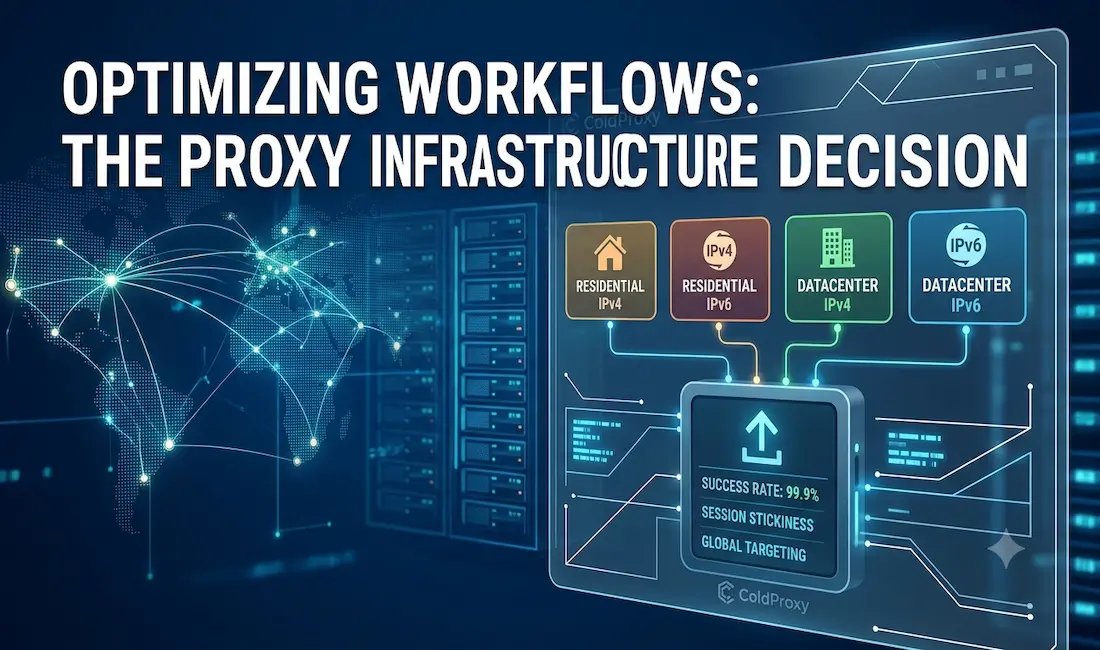
ColdProxy offers a useful lens for this conversation. It is a provider that maintains all four proxy families — residential IPv4 (both unmetered and GB-based billing), residential IPv6, and datacenter IPv6 — under the same platform, with public pricing and documented technical specifications for each. Examining how those product lines differ, and where each is appropriate, illuminates a set of infrastructure decisions that IT and networking professionals increasingly face.
Why Proxy Type Is an Infrastructure Decision, Not a Preference
The instinct to treat proxy type as a secondary detail — something to configure after the main architecture is decided — understates how significantly exit IP behavior affects workflow outcomes.
A request that exits through a datacenter IP carries a different reputation profile than one exiting through a residential IP assigned to a home broadband subscriber. Major platforms, CDNs, and API gateways apply scoring to inbound requests based on a range of signals: ASN reputation, IP history, reverse DNS records, behavioral patterns, and IP version. A workflow that routes through datacenter infrastructure and hits targets that use aggressive bot detection will behave completely differently from the same workflow running through residential IPs — often failing where it should succeed, or being served different content than human users would receive.
This is not a niche edge case. It affects price monitoring, SERP tracking, availability checking, content compliance validation, ad verification, and any other workflow where the accuracy of the result depends on receiving the same response that an ordinary user would receive from an ordinary connection.
ColdProxy structures its product line around this distinction explicitly. Residential IPv4 is positioned for stricter targets and broad geo-targeting. Datacenter IPv6 is positioned for speed and capacity on targets that are less restrictive. Residential IPv6 occupies the middle: residential trust profile with IPv6 routing, limited to USA coverage. These are not marketing categories — they reflect real behavioral differences in how requests are handled at the destination.
A Note on Legal and Ethical Considerations
Before examining specific proxy infrastructure, it is important to note that proxy usage should always be approached responsibly. Teams using residential proxies should consider provider sourcing, consent, acceptable-use controls, and compliance with applicable laws, website terms, data protection requirements, and internal policies.
Residential proxies route traffic through ISP-assigned residential IP addresses, so transparency and ethical sourcing matter. Reputable providers should be clear about how their residential pools are assembled and how usage is governed.
Residential proxies remain widely used for legitimate business and technical purposes, including price monitoring, ad verification, accessibility testing, geo-distributed QA, public data collection, SEO monitoring, and regional content validation when used responsibly. This article does not constitute legal advice.
The IPv4 to IPv6 Transition: What It Actually Means for Proxy Infrastructure
IPv6 adoption has been gradual enough that many IT teams have not yet encountered it as a proxy infrastructure question. That is starting to change.
The IPv4 address space is effectively exhausted at the RIR level. New ASNs, cloud regions, and CDN points of presence are increasingly IPv6-native. Consumer ISPs in major markets — the US, UK, Germany, Japan — have seen substantial IPv6 deployment for residential subscribers. A growing share of real user traffic is IPv6, which means a growing share of the IP reputation signal that platforms use to evaluate requests comes from IPv6 addresses.
For proxy infrastructure, this creates a specific gap: a team running residential IPv4 proxies to simulate user behavior is accurately representing some of its user base, but increasingly less of it as IPv6 residential penetration grows. Testing how a CDN-served asset behaves for IPv6-native users, or how an API endpoint handles IPv6 requests, requires IPv6 proxy coverage that is genuinely residential — not just a datacenter IPv6 range that carries obvious non-residential reputation signals.
According to ColdProxy, its Residential IPv6 product provides USA residential IPv6 routes — traffic that exits through IP addresses with residential ISP registration, not datacenter ASNs — with a /32 subnet allocation and configurable sticky or rotating sessions. The Datacenter IPv6 product, by contrast, is described as covering 45+ supported locations with a private /48 per location, optimized for throughput and lower cost where residential reputation is not the requirement.
Proxy Family Comparison: Matching the Tool to the Workflow
The following table summarizes how ColdProxy’s four proxy families differ across the dimensions that matter most for infrastructure decisions:
| Residential IPv4 (Unmetered) | Residential IPv4 (GB-Based) | Residential IPv6 | Datacenter IPv6IP | |
| Type | Residential | Residential | Residential | Datacenter |
| Protocol | IPv4 | IPv4 | IPv6 | IPv6 |
| Coverage | 195+ countries | 195+ countries | USA only | 45+ locations |
| Pool size | 70M+ IPs | 70M+ IPs | Billions of IPs (/32 subnet) | Billions of IPs (/48 subnet) |
| Billing model | Mbps speed tier | GB traffic pack | Mbps speed tier | Speed tier |
| Session control | 5s – 24h sticky / rotating | 5s – 24h sticky / rotating | 5s – forever sticky / rotating | 5s – forever sticky / rotating |
| Protocols | HTTP, HTTPS, SOCKS5 + TCP/UDP | HTTP, HTTPS, SOCKS5 + TCP/UDP | HTTP, HTTPS, SOCKS5 + TCP/UDP | HTTP, HTTPS, SOCKS5 + TCP/UDP |
| Auth methods | User/pass, IP auth | User/pass, IP auth | User/pass, IP auth | User/pass, IP auth |
| Best for | Strict targets, wide geo-targeting, sustained throughput | Residential IPv4 with GB-based budget management | IPv6-native targets, USA residential routes | High-speed IPv6 jobs on less restrictive targets |
| Starting price | from $106.24/mo (hourly plans available) | from $1.27/mo | from $254.99/mo | from $58.99/mo |
What this table makes visible is a design philosophy: ColdProxy separates billing model from IP type. A team that needs residential IPv4 but prefers to manage costs by traffic volume uses the GB-based product. A team running sustained high-throughput workflows uses the speed-tier model. The infrastructure underneath is the same; the billing contract adapts to the usage pattern.
Session Management as a Technical Variable
Session behavior — whether a proxy rotates its exit IP per request or maintains the same IP across a sequence of requests — has significant implications for workflow design that are sometimes underappreciated until they cause problems.
Rotating sessions assign a different exit IP to each request. This is appropriate for high-volume scraping jobs where avoiding IP-level rate limiting matters more than consistency, and where each request is independent. It is not appropriate for workflows that involve authentication, multi-step form navigation, or sequential API calls where the server tracks session state.
Sticky sessions maintain the same exit IP for a configured duration. ColdProxy’s Residential IPv6 and Datacenter IPv6 products support sticky sessions from 5 seconds up to “forever” — indefinite persistence — which is unusually flexible. Most providers cap sticky session duration at 24 or 48 hours. Indefinite stickiness matters for workflows where a single persistent session needs to operate over days without interruption: long-running monitoring agents, persistent crawlers, or automation pipelines that operate continuously against targets that use session-based access control.
The technical implications of getting this wrong are not minor. A workflow that rotates IPs through a checkout process will fail at the payment step, where fraud detection ties the transaction to the session IP. A monitoring agent that drops its exit IP unexpectedly will lose its position in a paginated data source and need to restart from the beginning. Session management is infrastructure, not configuration.
Geo-Targeting Granularity and What It Enables
Country-level geo-targeting is a baseline capability for any serious proxy provider. What differentiates providers at the implementation level is how precisely requests can be targeted below the country level, and how consistently that targeting holds across the pool.
ColdProxy’s residential IPv4 coverage supports targeting at country, state, city, ZIP code, and ASN level. ASN-level targeting — the ability to specify which autonomous system the exit IP should belong to — is particularly useful for workflows that need to simulate a specific ISP. Different ISPs deliver different routing behavior, different latency profiles, and sometimes different content from CDNs or platforms that use ISP as a personalization signal. An ad verification workflow checking whether a specific ISP’s customers see the correct creative cannot rely on city-level targeting alone.
For monitoring workflows that track content, pricing, or availability across specific regional markets, ZIP-level targeting creates the ability to model consumer experience at a genuinely granular level — not “somewhere in Texas” but “a residential subscriber in this specific postal code.”
Infrastructure Reliability as a Non-Negotiable
A proxy infrastructure that produces inconsistent results or fails at a measurable rate creates a specific class of problem: it is often not immediately obvious whether a failed request reflects a genuine block, a content change at the target, or a proxy failure. Debugging that ambiguity wastes time and degrades the reliability of any monitoring or data collection workflow that depends on consistent proxy performance.
ColdProxy publishes a 99.9% success rate and sub-0.6-second response time across its pool. Independent verification of these claims at scale is not straightforward, but they serve as a useful benchmark when comparing proxy providers that publish comparable data. These figures matter for this reason. Proxy infrastructure embedded in production workflows — not one-off scraping runs, but ongoing monitoring pipelines or automated QA suites — needs to be reliable enough that failures can be attributed to causes other than the proxy layer with reasonable confidence.
The 24/7 support model, available through Telegram and ticketing in English and Arabic, reflects a similar recognition that infrastructure problems do not schedule themselves around business hours. For teams running global workflows across time zones, support that responds at any hour to a specific technical question is a practical requirement, not a nice-to-have.
Matching Proxy Infrastructure to the Actual Workflow
The instinct to reach for the cheapest available proxy option — or to use a single proxy type for all workflows — is understandable but costly in ways that take a while to become visible. Residential IPs used for high-volume jobs that do not require a residential reputation waste budget. Datacenter IPs used against targets with strict bot detection generate blocks and degrade data quality. IPv4-only infrastructure misses an increasingly significant slice of the user behavior it is meant to simulate.
ColdProxy’s four-family model is, at its core, an argument that proxy infrastructure should be matched to workflow requirements rather than standardized on a single option for simplicity. The public pricing, the clear documentation of what each product is for, and the flexibility across billing models make that matching process practical for teams that actually have to implement it — not just decide on it.
For networking and IT professionals building infrastructure around public data collection, geo-distributed testing, or behavioral monitoring, that practicality is the point. The right tool for the job is a more useful guide than the easiest tool to procure.