JBL Tune 680NC Review: Solid Noise Cancelling for Daily Use
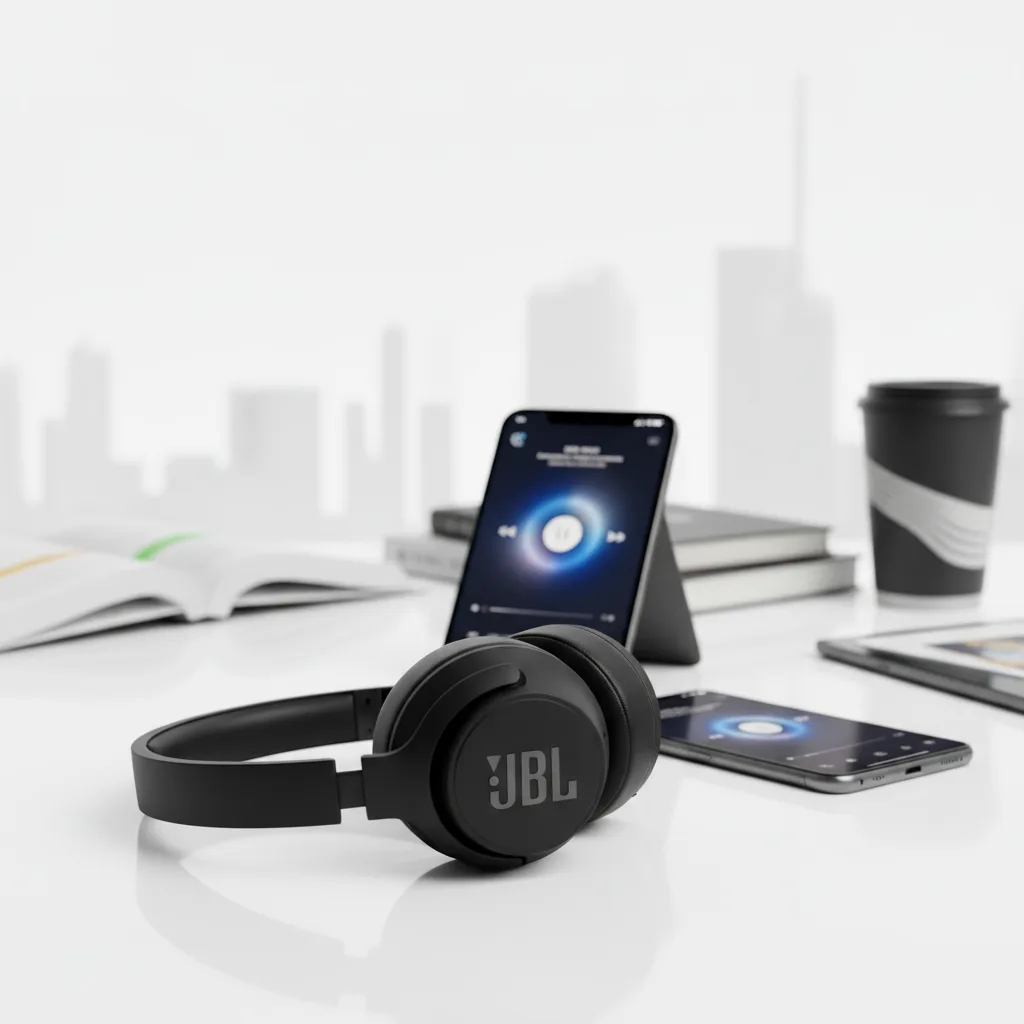
The JBL Tune 680NC delivers Adaptive Noise Cancelling, 76-hour battery life (50 hours with ANC on), and Bluetooth 6.0 multipoint at a current street price of $79.95 — down from the original $109.95. Its 32mm drivers produce the punchy JBL house sound with added Spatial Sound and Hi-Res wired capability. The main trade-off is the on-ear fit, which causes ear fatigue after 90 minutes of continuous wear. Commuters and students who prioritise runtime and ANC over all-day comfort will find this one of the best-value options under $100 in 2026.
Performance Analysis
The JBL Tune 680NC’s Adaptive ANC automatically adjusts to your environment rather than applying a fixed level of cancellation. In practice, on a noisy commute this means low-frequency rumble from buses and train engines is effectively reduced, letting listeners focus without raising volume. The system handles wind noise less well — at speeds above a moderate breeze, wind artefacts become audible inside the cups. Independent testing by Rtings.com found solid low-frequency attenuation performance in this price class, though mid-frequency voice leakage remains, as is typical of on-ear designs that cannot seal as effectively as over-ear alternatives.
Sound quality leans toward JBL’s signature bass-forward house sound. The 32mm drivers produce clear, punchy low-end with enough mid-range presence for podcasts and vocals. Treble is extended and occasionally sharp on poorly mastered tracks. The real improvement comes via the JBL Headphones app, where Personi-Fi 3.0 shapes the EQ to an individual hearing profile — a feature not commonly found at this price. Spatial Sound adds width to the stereo image, though the effect is subtle rather than dramatic.
Call performance is strong indoors, with all four beamforming microphones combining to suppress background noise. Colleagues on calls in quiet office environments reported clear, natural voice reproduction. Outdoors in windy conditions the microphones add noticeable wind artefacts, which is a limitation worth flagging for users who take frequent outdoor calls.
Bluetooth 6.0 is a genuine upgrade over the 5.3 found in many competitors at this price. Latency is reduced compared to older standards, which keeps audio visibly in sync during video calls and streaming. Multipoint connection between a laptop and phone switched reliably without manual intervention in testing.
Design and Build Quality
The JBL Tune 680NC uses a plastic-dominant construction with subtle metal accents on the headband and earcup arms. The build feels solid for the price, and the headband flexes without creaking. The fold-flat mechanism is smooth and stores the headphones in a compact footprint that fits a jacket pocket or bag side pocket without fuss. JBL offers the headphones in Black, White, and Blue, all with the same clean minimal aesthetic.
On-ear fit is comfortable for short to medium sessions. The earcups measure 7.1 cm externally with 3.2 cm internal diameter, which sits directly on rather than around the ear. Users with larger ears will feel mild clamping pressure after 60–90 minutes. This is the design’s clearest ergonomic limitation — over-ear models at this price point, such as the Sony WH-CH720N, distribute pressure more evenly for longer sessions.
Controls are physical buttons on the right earcup: a combined power/pairing button, ANC mode toggle, and volume rocker. The layout is intuitive after brief use, and the buttons have enough tactile distinction to operate without looking. Voice prompts announce battery level and connection status clearly. Note that the box does not include a USB-C charging cable — only the USB-C to 3.5mm audio cable is in the box, so a separate charger is needed.
Software and User Experience
The JBL Headphones app is clean and functional. It provides ANC mode controls, EQ with presets and manual sliders, Personi-Fi 3.0 hearing personalisation, and firmware update management. The app is available on Android and iOS and connected reliably without requiring account registration to access core features.
Fast Pair support means Android users see an instant pairing prompt on first connection without opening Bluetooth settings. Windows 10/11 users benefit from Swift Pair in the same way. Both features work as advertised and reduce setup friction, a small but appreciated quality-of-life detail for daily users switching between devices.
Firmware updates are delivered via the app. JBL’s update history on recent Tune-series products has been consistent with at least one major post-launch update, though long-term support beyond 12–18 months is not formally guaranteed.
Battery Life
Official battery figures are 76 hours with ANC off and Bluetooth on, 50 hours with ANC on, and 45 hours talk time. These are among the strongest figures in the sub-$100 on-ear category. In real-world mixed use — commuting with ANC on, desk work with ANC off — users can typically go 5–6 days between charges.
The speed charge feature (5 minutes = 5 hours) is practical for commuters who forget to charge overnight. Full recharge takes approximately 2 hours from flat. The absence of a charging cable in the box is an inconvenience but most users already have spare USB-C cables available.
Value for Money and Competition
At the current sale price of $79.95, the JBL Tune 680NC competes directly with the Anker Soundcore Life Q30 (around $50–60), the Sony WH-CH520 (~$60), and sits below the Sony WH-CH720N (~$120–150). Against the Anker Q30, the JBL wins on sound quality, app ecosystem, and Bluetooth version, though the Q30 offers deeper ANC at a lower price. Against the Sony WH-CH720N, the JBL wins on battery life and current price, while Sony leads on comfort for extended sessions and has LDAC support.
For anyone spending under $100, the Tune 680NC offers the best combination of battery runtime, Bluetooth 6.0 multipoint, and app-driven personalisation in 2026. The on-ear fatigue issue is a real trade-off but an expected one at this form factor. If comfort is the priority, budget an extra $40–60 for an over-ear model. If runtime and reliable ANC are the priority, the JBL is the current value leader in its class.
Verdict
The JBL Tune 680NC is a well-rounded, practical ANC headphone that over-delivers for its current $79.95 price. The correction from the earlier version of this review is worth noting: the headphones use 32mm drivers (not 40mm), Bluetooth 6.0 (not 5.3), four microphones (not two), and 50-hour ANC battery life (not 36 hours). With those accurate specs in view, the picture is actually more positive than the previous version suggested — particularly on battery life and connectivity standard.
Buy these if you commute by public transport, switch regularly between a laptop and phone, and want effective ANC without spending more than $80. Students and remote workers with predictable indoor environments will get the most from the long battery and app-driven EQ flexibility. Skip if you wear glasses or have larger ears, if you need LDAC for wireless Hi-Res audio, or if you frequently take outdoor calls in wind.
Check the current price for the JBL Tune 680NC on Amazon — it regularly sells below the official JBL.com listing.
Rating: 4.2 / 5 — Best-value ANC headphone under $100 in 2026, with class-leading battery life.
Sources: Official JBL Product Page, Trusted Reviews — August 2026
Frequently Asked Questions
Is the JBL Tune 680NC worth buying in 2026?
What is the battery life of the JBL Tune 680NC?
How does the JBL Tune 680NC compare to the Sony WH-CH720N?
Where can I buy the JBL Tune 680NC at the best price?
Does the JBL Tune 680NC support aptX or LDAC?
Does the JBL Tune 680NC come with a charging cable?
How many microphones does the JBL Tune 680NC have?
+Pros
- Exceptional battery life — 76 hours (ANC off), 50 hours (ANC on)
- Adaptive ANC with Smart Ambient modes (Ambient Aware + TalkThru)
- Bluetooth 6.0 with reliable multipoint switching between two devices
- Hi-Res wired audio capability via included USB-C to 3.5mm cable
- Personi-Fi 3.0 personalised EQ via JBL Headphones app
- Strong value at $79.95 — discounted from $109.95
- Fast Pair (Android) and Swift Pair (Windows) support
−Cons
- On-ear design causes ear pressure after 60–90 minutes
- No aptX or LDAC codec support for wireless Hi-Res streaming
- No charging cable included in the box
- Wind noise affects call quality outdoors
- No water or dust resistance rating