PSB iQ2 Review: A Refined Wireless Audio Hub
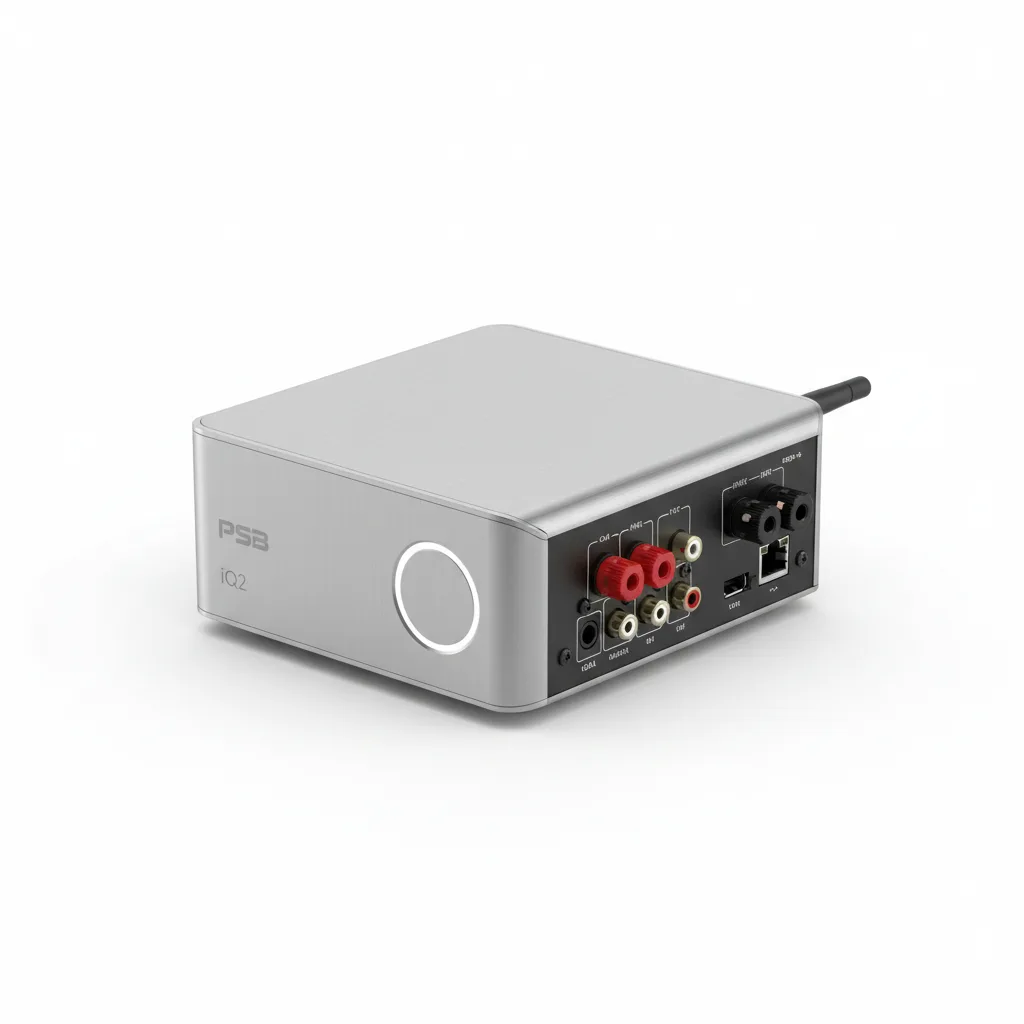
The PSB iQ2 ($1,399) is a pair of all-in-one active bookshelf speakers — not a wireless hub — that deliver confident, spacious stereo sound backed by the BluOS streaming platform and an unusually comprehensive input roster including HDMI eARC, a built-in phono preamp, optical, and USB-C. The true wireless stereo connection between speakers eliminates the inter-speaker cable entirely, offering flexible room placement without audio sync issues. At 4 inches / 0.75-inch driver configuration with a Burr Brown Class-D amplifier delivering 270 watts total system power, the iQ2 punches above its compact size in most listening scenarios. The main caveats are the premium price, an average built-in phono preamp (PSB acknowledged this and is issuing an update), and a lack of built-in voice assistant. Engadget awarded it 8/10 in a hands-on review published August 7, 2026. Best for audiophiles who want hi-fi sound, streaming convenience, and real connectivity in a single package.
Performance Analysis
The PSB iQ2 is built on the same acoustic platform as PSB’s award-winning Alpha iQ, with the key upgrade being a new Burr Brown Class-D amplifier platform delivering 270 watts of total system power — 90 watts dedicated to each woofer. The 4-inch polypropylene mid-bass driver paired with a 0.75-inch aluminium dome tweeter represents a well-established PSB acoustic formula, refined over fifty years of research-based speaker design. Engadget’s James Trew, reviewing the iQ2 in August 2026, described the sound as “relaxed, in a good way” — notably less dominant than a comparable Sonos Arc at equivalent volumes, with natural low end that controls itself without calling attention.
For music, the true wireless stereo configuration means each speaker occupies its own physical space in the room without the cable constraint of the iQ1, producing a genuinely wide stereo image. Trew noted electronic music in particular benefited from the separation, with even dense genres sounding more open than competing smart speakers. Acoustic and rock recordings were described as easy, pleasant listens with mid-high frequencies that avoid sounding sharp or artificially boosted. The iQ2 passed a subjective bass-control test — watching bass-heavy action film trailers — without the boominess that often afflicts compact active speakers.
The one underperforming area is the built-in MM phono preamp. While functional for raising signal to usable levels, Engadget noted a “slightly narrower sound” compared to the digital sources — an observation PSB acknowledged by issuing a statement during the review period confirming planned changes to the phono preamp “after early feedback on that feature.” Buyers planning to use the iQ2 primarily as a turntable destination should factor this acknowledged limitation into their decision, with a firmware or hardware revision expected.
For TV and home theatre use, HDMI eARC integration works cleanly via the Auto Sense feature in BluOS, which automatically routes audio to the TV input when the television is switched on. This configuration requires a one-time manual toggle per input in the BluOS app — a minor but non-obvious step that Trew spent time troubleshooting before discovering it.
Design and Build Quality
The PSB iQ2 presents as a pair of modern, minimalist bookshelf speakers that blend into a room rather than dominating it. At approximately 9 × 6 inches per cabinet, they sit comfortably on most TV stands, media units, and even desks without the imposing footprint of larger active monitors. Engadget’s reviewer tested the white finish and praised the balance of “grown-up style, without tipping over into serious hi-fi territory” — the speakers read as design objects first and technology last, which suits the living room context they are designed for.
Seven finish options are available: Black, White, Ember Red, Boreal Green, Granite Grey, Sandstone Beige, and Walnut Veneer with copper-finished accents. The four new colours represent a meaningful departure from the monotone options common in the category, and the Walnut Veneer positions the iQ2 as furniture-grade alongside its audio credentials. A fingerprint-resistant coating is applied across all finishes during manufacturing, reducing the maintenance burden common with glossy or high-gloss cabinets.
The primary speaker houses all physical inputs — HDMI eARC, phono/line, optical, USB-A, and USB-C — on its rear panel, with touch-sensitive controls for basic media and volume management on the top surface. This layout means input port placement is flexible relative to TV and furniture positioning, since the primary speaker can occupy either side of the room while the secondary connects wirelessly. Both speakers require mains power independently. The absence of a 3.5mm jack is the only meaningful connectivity omission; users connecting older portable sources will need an RCA adapter.
Cloth fabric grilles are standard across both models in the iQ Series, contributing to the refined aesthetic. Build quality is consistent with PSB’s premium positioning — the cabinets feel substantial rather than hollow, and the wireless inter-speaker link eliminates the aesthetic compromise of a visible cable crossing a media centre.
Software and User Experience
BluOS Controller is a mature, well-maintained streaming application that manages multi-room grouping, source switching, playback control, and advanced configuration across compatible hardware. PSB’s iQ2 benefits from near-native integration given the shared Lenbrook corporate ownership, and Engadget’s reviewer described the essential tasks — source swapping, library access, multi-room grouping — as “intuitive and easy to navigate” with deeper customisation available for users who want to configure preferred inputs and services.
The one navigation friction point Engadget identified involves the phono input: it does not appear in the “Most Used” section of the home screen until it has been used enough times to qualify, which means new users looking to configure phono-specific settings may need to hunt through the input list before the shortcut surfaces. This is a minor UX issue rather than a fundamental design problem. Per-input Auto Sense configuration for HDMI eARC is a separate step from global settings — another non-obvious discovery that benefits from upfront documentation.
Bluetooth aptX Adaptive supports high-resolution wireless audio from compatible Android sources, while AirPlay covers Apple ecosystem users without requiring Wi-Fi network configuration. For Spotify and Tidal users, Spotify Connect and TIDAL Connect enable direct playback from those apps’ native interfaces without routing through BluOS, which is a convenience appreciated by users who prefer not to switch apps for playback control.
Battery Life
Not applicable — the PSB iQ2 is a mains-powered active speaker system. Both the primary and secondary speakers require individual connection to wall outlets.
Value for Money and Competition
At $1,399 for standard colour finishes and $1,499 for Walnut Veneer, the PSB iQ2 occupies the premium tier of the active wireless bookshelf speaker market. The most direct competitor is the KEF LSX II ($1,500), which offers a near-identical input roster, wireless stereo, and AirPlay plus Bluetooth aptX connectivity, but lacks a built-in phono preamp and includes a 3.5mm input that the iQ2 omits. KEF’s more distinctive design language appeals to buyers for whom aesthetics drive the decision; PSB’s more neutral presentation suits those who prefer their speakers to blend into a room.
The Sonos Era 300 ($449 per speaker, $898 for a stereo pair) sits notably below on price but lacks HDMI eARC, phono preamp, and hi-res wired input options. Sonos counters with its mature multi-room ecosystem, voice assistant integration, and spatial audio support — meaningful advantages for users already embedded in that platform. The Bluesound Pulse Flex ($379) operates on the same BluOS platform as the iQ2 but is a single compact speaker rather than a true stereo pair, making it a different category of product.
For users who already own passive speakers and want to add streaming intelligence rather than replace them, the WiiM Ultra streamer ($329) matches most of the iQ2’s connectivity and the full BluOS alternative at a fraction of the cost — but requires separate amplification and speakers, making the true all-in cost comparable for quality setups. The iQ2’s value proposition is strongest for buyers who want a genuinely complete, integrated system that eliminates separates entirely without compromising connectivity or sound quality.
Verdict
The PSB iQ2 is the product traditional hi-fi brands have needed to build for years — a premium active speaker pair that takes streaming, multi-room connectivity, and real-world connectivity seriously without sacrificing the sound quality that defines PSB’s fifty-year reputation. HDMI eARC, a phono preamp, USB-C, Bluetooth aptX Adaptive, and BluOS integration in a pair of compact wireless bookshelf speakers is a specification combination that no direct competitor currently matches at this price.
The acknowledged phono preamp limitation is a genuine short-term negative for vinyl-focused buyers, and PSB’s public commitment to addressing it post-launch is both transparent and somewhat unusual — worth monitoring before purchasing if the turntable connection is your primary use case. The absence of voice assistant integration is a deliberate positioning choice rather than an oversight, and buyers who need Alexa or Google Assistant will need to add a separate smart speaker to the setup.
For audiophiles who want to replace a soundbar, eliminate a preamp, simplify their streaming setup, and do it all with genuinely good stereo imaging in a single elegant package, the iQ2 makes a compelling case at $1,399. Check current pricing for the PSB iQ2 on Amazon or directly at psbspeakers.com.
Rating: 4.4 / 5 — The most connected hi-fi bookshelf speaker you can buy in 2026.
Specs verified from official PSB Speakers announcement (June 23, 2026, psbspeakers.com), Engadget hands-on review by James Trew (August 7, 2026), eCoustics launch coverage (June 2026), Trusted Reviews (July 2026), WiFi HiFi Magazine (June 2026), and Forbes (June 2026). Prices accurate as of August 2026. Contains affiliate links.
Frequently Asked Questions
Is the PSB iQ2 worth buying in 2026?
What is the PSB iQ2 exactly — is it a hub or a speaker?
How does the PSB iQ2 compare to the KEF LSX II?
Where can I buy the PSB iQ2 at the best price?
Does the PSB iQ2 work with turntables?
Does the PSB iQ2 have HDMI?
What streaming services does the PSB iQ2 support?
+Pros
- Confident, spacious stereo sound with natural low end — Engadget 8/10 (August 2026)
- True wireless stereo eliminates inter-speaker cable for flexible room placement
- HDMI eARC included — rare in active bookshelf speakers at any price
- Built-in MM phono preamp enables direct turntable connection without external preamp
- BluOS platform: 20+ streaming services, multi-room grouping, hi-res to 24-bit/192kHz
- aptX Adaptive Bluetooth for high-quality wireless audio from compatible sources
- 7 premium finish options including Walnut Veneer with copper accents
- Fingerprint-resistant coating on all cabinet finishes
−Cons
- $1,399 starting price is a significant investment vs. competing smart speaker categories
- Built-in phono preamp underperforms on sonic width — PSB has acknowledged this and is issuing a fix
- No 3.5mm input — RCA adapter required for older analog sources
- No built-in voice assistant (Alexa, Google Assistant) — phone or separate device required for hands-on-free control
- Compact size limits maximum output volume — not suited to filling large or party-scale spaces
- Walnut Veneer finish not available until November 2026