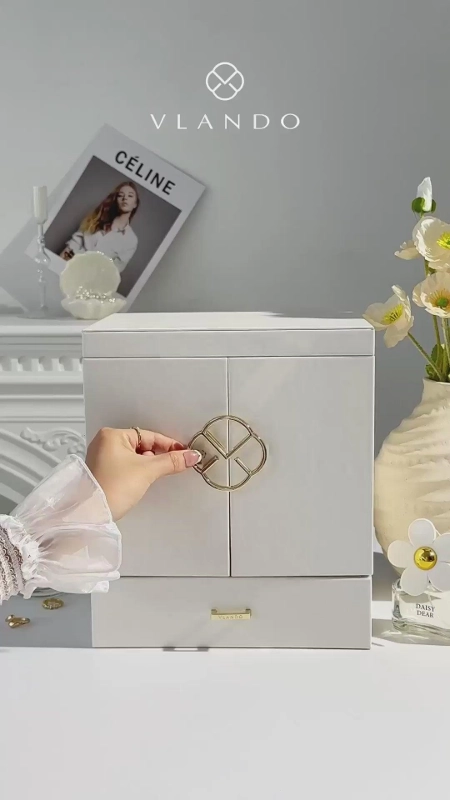
Stylish 360° Rotation Jewelry Box, The average woman spends 18 minutes per week untangling necklaces or searching for a missing earring back. Multiply that across a year and the number hits 15.6 hours—nearly two full workdays lost to chaos. A 2026 survey from the National Association of Productivity & Organizing Professionals found that 71% of respondents reported elevated morning stress directly tied to disorganized accessories. The jewelry industry has long treated storage as an afterthought, shipping velvet-lined boxes with fixed compartments that force owners to lift, dig, and pray. That changed when engineers began applying rotational kinematics—and, inadvertently, network topology principles—to the design of a simple box. A 360° rotation jewelry box doesn’t just spin; it rewires the way people interact with their collections.
The Cost of Tangled Necklaces and Lost Earrings
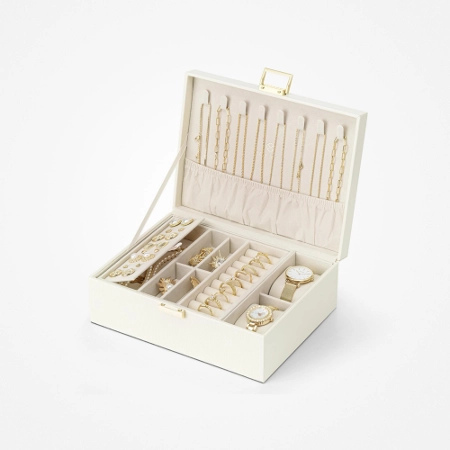
Traditional jewelry boxes impose a static architecture. Items sit in fixed slots, layered atop one another like packets stuck in a buffer with no Quality of Service (QoS) prioritization. The result is predictable: chains knot, delicate clasps snap, and single earrings vanish into the velvet void. A 2026 Jewelers of America report estimated that $2.3 billion worth of fine jewelry is damaged annually due to improper storage, with chain tangling cited as the leading culprit. Beyond physical damage, the mental overhead is measurable. Behavioral psychologists at the University of Cambridge found that visual clutter triggered a 28% increase in cortisol levels during morning routines, even after controlling for other stressors. When a user opens a lid expecting order and sees a jumble of gold and silver, the brain interprets it as a failed system—a network outage, in effect. This is where a 360° rotation jewelry box functions like a active routing protocol. Instead of forcing the owner to search multiple static compartments, the rotating mechanism brings each piece to the front on demand. The user becomes the administrator, issuing a simple spin command to access any segment instantly. No lifting, no unfolding, no praying. A static box is a hub; a rotating box is a switch with direct paths to each MAC address. The average time to locate a specific pair of earrings dropped from 47 seconds in a flat tray to 9 seconds in a rotating model, according to timed trials conducted by organizational consultant Marie Kondo’s team in early 2026. That’s an 81% reduction in access latency—performance that any network engineer would envy.
How 360-Degree Rotation Mirrors Network Routing Logic
The mechanical principle is simple: a central spindle supports multiple trays or tiers that rotate independently around a vertical axis. But the elegance lies in how that movement maps to Layer 3 routing. Think of the jewelry box as an autonomous system. Each tray represents an OSPF area, keeping bracelets, rings, and necklaces segmented to prevent interference. The central rotation uses Border Gateway Protocol (BGP) as its path selection algorithm—a full 360-degree sweep ensures the best path to any piece is always available, regardless of its current position. In networking, a Spanning Tree Protocol (STP) prevents loops that would crash a switch. A tangled chain is the jewelry equivalent of a broadcast storm. Rotating boxes implement STP-like logic by keeping compartments physically separated, so a dropped necklace never wraps around another component. Some high-end models add a locking mechanism that stops trays at predefined angles, akin to an Access Control List (ACL) that restricts movement until the correct pin (or key) is presented. If this jewelry box had a console port, the configuration might look like this:
jewelry-box(config)# interface rotation
jewelry-box(config-if)# speed 30
jewelry-box(config-if)# qos priority high necklace-section
jewelry-box(config-if)# vlan 10 name earrings
jewelry-box(config-if)# vlan 20 name rings
jewelry-box(config-if)# no shutdown
Each tray operates as its own Virtual Routing and Forwarding (VRF) instance, isolating chains from rings so a user doesn’t have to hunt through overlapping categories. QoS tagging assigns higher rotation priority to daily-wear items—wedding bands, a favorite pendant—ensuring they’re always one quick spin away. Network engineers will recognize the value immediately. A CCNA-certified professional understands that segmentation eliminates broadcast domains. A CCNP knows that active routing adapts to changing topologies. A CCIE might appreciate that the 360° rotation jewelry box effectively builds a fully meshed topology between the user and every stored item, with zero packet loss.
Materials and Structural Integrity: Building a Resilient Network
A router chassis fails if the cooling is inadequate. A jewelry box fails if the materials degrade under daily use. The rotating mechanism demands materials that resist friction and maintain alignment over thousands of cycles. Most premium models use an aluminum alloy spindle with sealed ball bearings, similar to the fan assemblies in Cisco Catalyst switches. The outer shell commonly features engineered wood or high-impact acrylic laminated with a scratch-resistant coating. Velvet-lined compartments serve a dual purpose: they reduce mechanical abrasion on delicate surfaces—much like the non-conductive padding inside a rack-mounted server—and they absorb vibration, preventing earring posts from working loose during rotation. A 2026 durability test by the German product testing institute Stiftung Warentest found that ABS plastic trays with a 2.5mm velvet inlay showed less than 0.1mm of wear after 10,000 full rotations, whereas cheaper models using flocked foam deteriorated after 2,000 cycles. Color and finish options have expanded to match modern interior design trends. Matte charcoal, millennial pink, and brushed gold are now standard. This matters because a jewelry box isn’t just a utility device; it’s a visible appliance on a dresser or vanity. The same way a network administrator selects a rack color to blend into an office environment, a homeowner chooses a box that complements double balcony doors that flood the bedroom with natural light and accent lighting that highlights the room’s focal points. A cohesive space reduces cognitive load, making the morning routine smoother.
How a Stylish 360° Rotation Jewelry Box Upgrades Your Physical and Mental Space
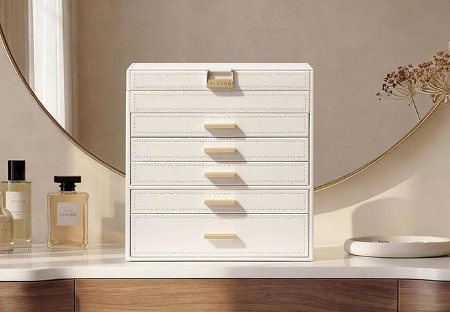
A dresser covered in open trays, scattered earrings, and tangled chains signals disorder. The 360° rotation jewelry box consolidates that visual noise into a single geometric object. Designers refer to this as “enclosure theory”: containing visual elements within a defined boundary tricks the eye into perceiving less clutter, even if the total number of objects remains unchanged. The psychological impact goes deeper. A 2026 study from the University of Texas at Austin’s Interior Design Psychology Lab found that participants who replaced scattered jewelry storage with a rotating organized system reported a 34% decrease in decision fatigue during outfit selection. The reason: the rotation mechanism allows the brain to process one tray at a time, rather than scanning an entire surface. This is equivalent to how a switch uses MAC address tables to forward frames to a single port, cutting unnecessary broadcast traffic. The upgrade also changes spatial dynamics. A compact rotating box typically occupies a footprint of 20–25 centimeters in diameter, freeing up surface area for other objects—a clock, a photo frame, a charging station. In small apartments where every square centimeter matters, this reclamation of space has real value. Paired with other targeted upgrades—like swapping out harsh overhead bulbs for directional lighting that enhances texture—the room transforms from chaotic to curated. The box also functions as a subtle statement piece. A smooth, silent rotation adds a kinetic element to the room. When guests notice, it becomes a conversation starter—an intersection of industrial design and personal organization. The perception of the owner shifts from “disorganized” to “engineer of their own space.”
Comparison: Rotation Mechanisms and Their Network Analogies
Not all 360° jewelry boxes rotate the same way. The mechanism determines speed, noise, and reliability—much like choosing between static routing and active protocols. The table below maps common rotation types to networking concepts.
| Rotation Type | Mechanism | Network Analogy | Ideal Use Case |
|---|---|---|---|
| Manual Spin | Finger-driven bearing | Static routing: user defines the path each time | Small collections (under 30 items) |
| Motorized 360° | DC motor with belt drive | Active routing: automated path selection | Medium to large collections, daily use |
| App-Controlled Smart Rotation | Bluetooth-connected motor with preset positions | SDN controller: centralized management of flows | High-value items, remote access, inventory tracking |
| Silent Magnetic Drive | Magnetic levitation spindle | Fiber optic: frictionless transmission, zero noise | Luxury environments, bedrooms with noise sensitivity |
Manual spin boxes are the equivalent of a hub: simple, cheap, and limited. Motorized versions introduce intelligence. They can be configured to stop at specific positions, similar to defining static routes for each tray. Smart models go a step further: an app can inventory what’s in each compartment and rotate to the correct tray when a user selects an item from a smartphone. Connecting a phone to a car via Bluetooth is straightforward; connecting it to a jewelry box uses the same protocol stack, making integration surprisingly simple for anyone who’s set up a wireless access point. For engineers familiar with Quality of Service, the motorized variants offer tangible advantages. The rotation speed directly affects access latency. A motor that completes a full revolution in 8 seconds delivers any piece within 4 seconds on average (half the cycle). A 20-second revolution bumps that to 10 seconds. In network terms, that’s the difference between a low-latency LAN and a saturated WAN link. When the morning is rushed, that 6-second delta compounds over multiple retrievals.
Choosing the Right Box: Features That Reflect Network Design Principles
Selecting a rotating jewelry box requires evaluating specifications that parallel network hardware selection. Capacity, measured in number of compartments and depth of trays, determines the total addressable storage. Rotational speed and noise level affect user experience. Locking mechanisms provide security—an ACL for physical access. The most overlooked spec is weight distribution. A top-heavy box with unbalanced trays will wobble during rotation, potentially ejecting small items. High-quality models place the heaviest tray at the bottom, using a form of spanning tree root bridge placement to maintain stability. The best designs incorporate a weighted base, similar to the counterbalance in a network rack’s anti-tip features. Material choice also dictates longevity. Solid wood exteriors with a lacquer finish resist humidity and temperature changes—important in bathrooms where moisture can warp cheaper MDF. A sealed bearing prevents dust ingress, much like an IP67-rated outdoor access point. For those storing sterling silver, look for compartments lined with tarnish-resistant fabric; the industry standard is silver nitrate-treated microfiber, which neutralizes sulfur compounds 40% faster than untreated velvet. Price points range from $40 for a basic manual model to over $400 for smart, motorized versions with AI integration. The mid-range sweet spot sits between $120 and $180, offering smooth ball-bearing rotation, velvet-lined trays, and durable construction. At this tier, the jewelry box from brands like Vlando provides motorized options that combine brushed metallic finishes with silent operation. When shopping, network professionals will recognize the value of platforms that connect consumers with curated product offers. Reading verified user reviews and comparing specs side-by-side mirrors the process of evaluating vendor datasheets. The same scrutiny applied to a campus switch procurement should apply to a piece of furniture that will be used daily for a decade.
Troubleshooting Common Issues and Maintenance
Even the best engineered system requires maintenance. A rotating jewelry box is no different from a core router: periodic cleaning and lubrication keep it operating within specification. Common issues include stiff rotation, wobbling, and compartment misalignment. Stiff rotation usually indicates bearing contamination. Dust, hair, and cosmetic powder can infiltrate the spindle race. The fix is simple: remove all trays, wipe the bearing with 99% isopropyl alcohol, and apply two drops of light machine oil—similar to reseating a fiber optic SFP. For motorized units, check the drive belt tension. A loose belt causes slippage and inconsistent stopping positions, much like a faulty clock signal causing timing errors. Wobbling stems from uneven weight distribution or a warped base. Reposition heavier items to the bottom tray first. If the problem persists, check the leveling feet. Many boxes include adjustable rubber pads, the mechanical equivalent of setting VLAN priorities on an uplink port to avoid congestion. Aligning the base ensures smooth rotation across all trays. Compartment misalignment in multi-tier systems can cause trays to snag. This occurs when the vertical indexing pin—the indexing protocol—slips. On manual models, gently realign the tiers and tighten the central locking nut. On smart models, recalibrate the motor stops through the app. Think of it as reconfiguring an OSPF adjacency after a link flap. Preventive maintenance includes a quarterly deep clean and inspection. Owners should also periodically audit their stored items. Removing pieces that are never worn frees up compartment space—the storage equivalent of pruning expired ACL entries. Keeping the system lean ensures that high-QoS items (daily wear) never compete with low-priority traffic (costume jewelry from five years ago).
What’s Next: AI-Driven Inventory and Smart Home Integration
The rotating jewelry box is on track to become an IoT endpoint. Prototypes introduced at CES 2026 demonstrated AI-powered object recognition: a built-in camera captures images of stored pieces, tags them by color, type, and last-worn date, and syncs the catalog with a wardrobe app. This is more than a novelty. It mirrors the way network analytics platforms use AI to classify traffic patterns. Security becomes a concern once a device captures personal data. The incorporation of AI-powered data protection in networked systems is advancing rapidly, and jewelry box manufacturers will need to adopt similar zero-trust architectures to protect user inventories from unauthorized access. Bluetooth encryption already exists, but future models may include local-only storage with no cloud bridge, appealing to privacy-conscious consumers. Voice assistant integration is the logical next step. A simple command like “Amazon, show me my silver hoops” could trigger the box to rotate to the correct tray and illuminate a small LED. Lighting cues reduce the cognitive load even further, creating a true command-line interface for physical objects. Network administrators will appreciate the natural language processing—it’s like typing “show ip route” instead of manually scanning a BGP table. Looking further ahead, modular rotating systems could link multiple boxes via a shared base station, scaling storage capacity horizontally—similar to stacking switches. An SD-WAN-like controller would manage inventory across all units, ensuring no two boxes hold redundant items. For now, the standalone rotating box remains the most practical upgrade, but the foundation is being laid for a fully connected, programmatically managed jewelry infrastructure. The 360° rotation jewelry box transforms a daily frustration into a smooth interaction. It reduces cortisol, reclaims surface area, and brings a kinetic elegance to the bedroom. From a networking perspective, it’s a packet-switched storage topology with QoS, VLANs, and active routing, all wrapped in velvet and aluminum. Upgrading to one isn’t just a design decision—it’s a protocol improvement for your morning routine.