Eigrp

Where Bandwidth Lives in the Routing Table Decision
Bandwidth metric underpins routing decisions and QoS guarantees. This article covers EIGRP composite calculation, OSPF cost, BGP limitations, and CLI troubleshooting — essential for CCNA through CCIE.
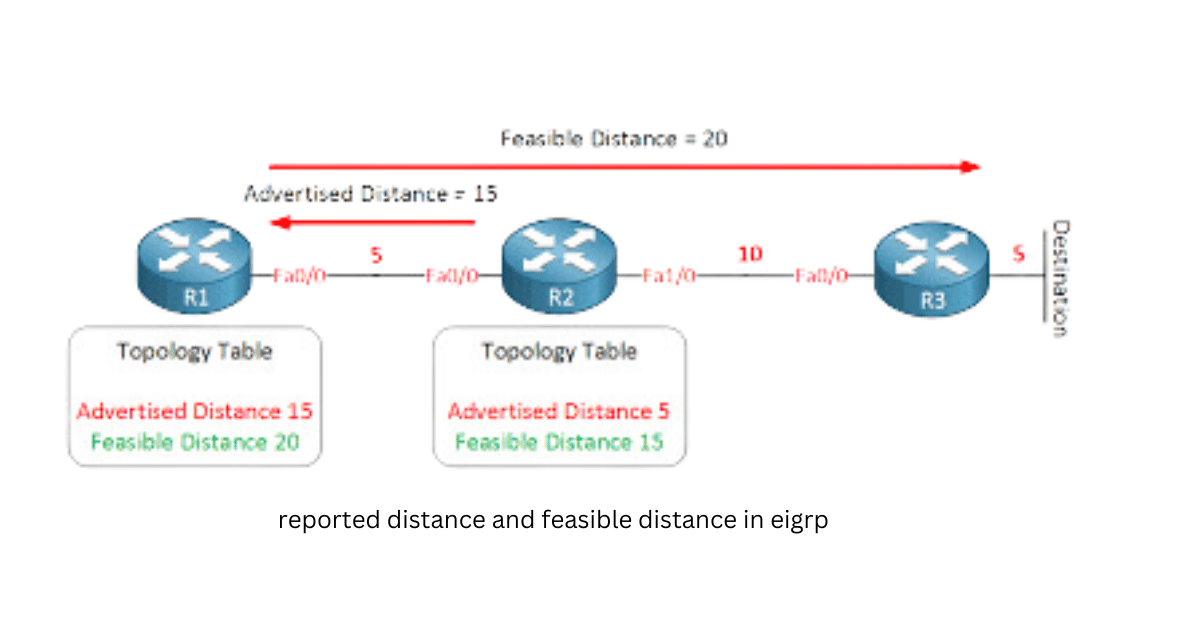
Reported Distance and Feasible Distance in EIGRP: Navigating the Routing Landscape
Enhanced Interior Gateway Routing Protocol (EIGRP) is a robust solution for efficient routing in computer networks. As networks become complex, understanding the intricacies of EIGRP metrics becomes crucial. Among these metrics, reported and feasible distances are pivotal in determining the optimal routes. What is EIGRP? EIGRP, or Enhanced Interior Gateway Routing Protocol, is a sophisticated...
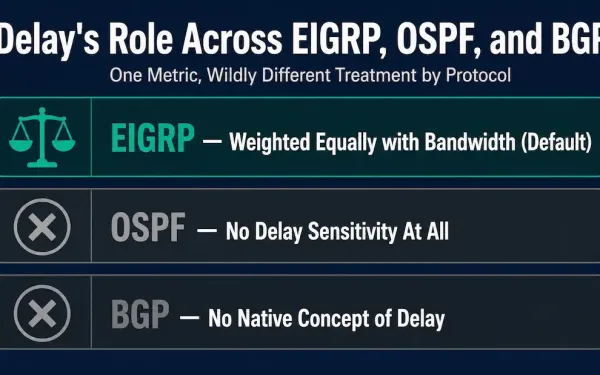
Delay Metric: How Routing Protocols Actually Use It
Delay measures the time it takes for a packet to traverse a path, and it plays a very different role depending on which routing protocol is doing the measuring. EIGRP weighs delay directly in its composite metric by default. OSPF’s cost calculation, by contrast, is purely bandwidth-based and doesn’t factor in delay at all. This...
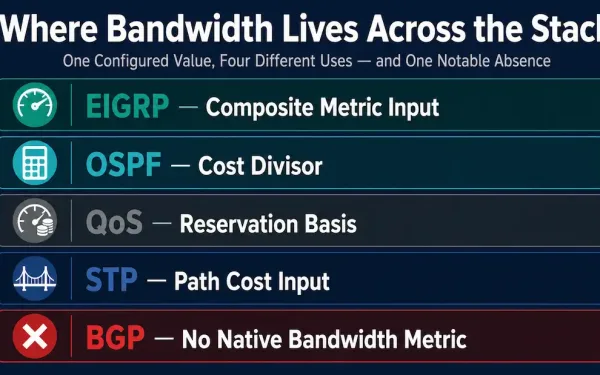
Bandwidth Metric: How Routing Protocols and QoS Use It
A network engineer stares at a traceroute that defies logic — traffic flows across a 10 Mbps satellite link while a 1 Gbps fiber path sits idle. The root cause isn’t a hardware fault. It’s a misconfigured bandwidth metric. Across every major routing protocol and QoS framework, the bandwidth metric quietly dictates which path packets...
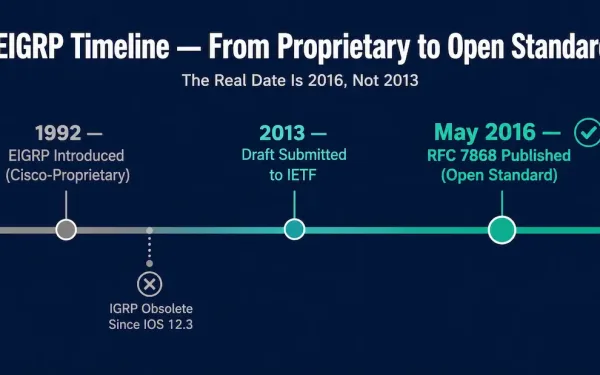
Introduction to EIGRP
Enhanced Interior Gateway Routing Protocol (EIGRP) was introduced by Cisco in 1992 as an advanced distance-vector routing protocol, originally running only on Cisco devices. It remained Cisco-proprietary for over two decades before becoming an open, multi-vendor standard — a milestone worth getting the date right on, since it’s commonly misstated. From Proprietary Protocol to Open...