API-based integration between LIMS (Laboratory Information Management Systems) and pathogen databases like NCBI’s GenBank
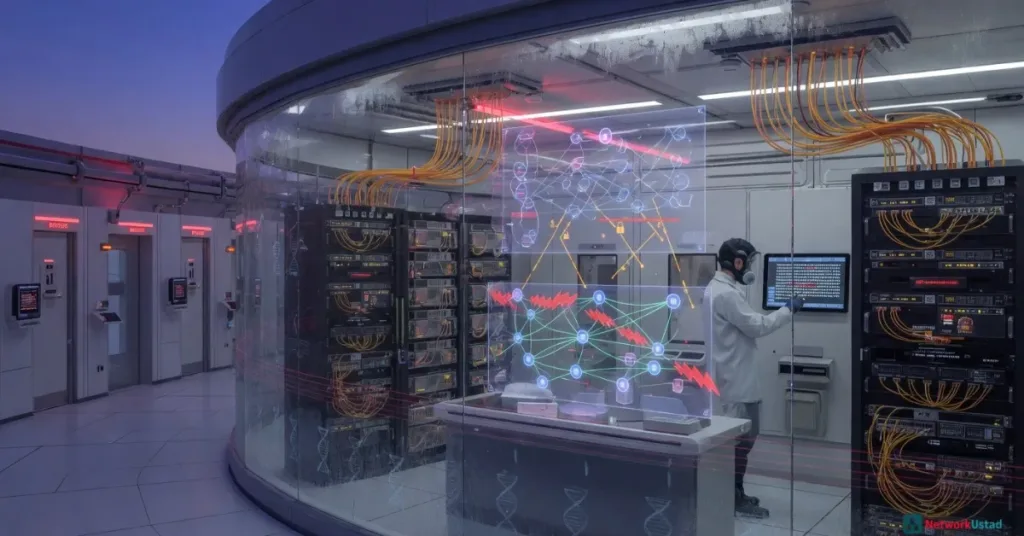
Zero-trust network segmentation for synthetic biology labs, with separate VLANs for DNA synthesis equipment, research workstations, and external database queries
QoS prioritization for screening API traffic to prevent workflow disruption—minimum 50Mbps dedicated bandwidth per synthesis machine
Audit logging at the network edge using IPFIX or NetFlow, with retention periods matching HIPAA’s 6-year standard
Cisco’s latest zero-trust architecture guide recommends VRF instances to isolate gene synthesis devices from general lab networks. Juniper’s implementation uses EVPN-VXLAN to create microsegmented environments while maintaining low-latency access to cloud-based screening tools.
Security Implications for Research Networks
The proposed screening protocols introduce three critical infrastructure challenges:
1. Latency sensitivity: API responses must complete within 300ms to avoid disrupting automated synthesis workflows. Palo Alto’s Prisma Access now offers specialized routes for biosecurity API traffic, bypassing standard internet gateways. 2. Data integrity: TLS 1.3 with certificate pinning is mandatory for all sequence database queries to prevent MITM attacks that could spoof screening results. 3. Throughput demands: A midsize lab performing 200 syntheses daily generates ~40GB of sequence check traffic—requiring 10Gbps uplinks and careful ACL tuning to prevent congestion.
Network teams should prepare for:
- New STP (Spanning Tree Protocol) considerations when connecting synthesis hardware to redundant screening service endpoints
- BGP route optimization for geo-distributed pathogen databases
- IPS signature updates to detect attempts to bypass screening APIs
The Bottom Line
This policy shift transforms gene synthesis networks from research infrastructure to critical biosecurity assets. IT teams in life sciences must:
- Audit existing network segmentation—synthesis equipment should never share VLANs with general lab devices
- Implement continuous monitoring for API traffic anomalies that could indicate screening bypass attempts
- Collaborate with lab managers to establish QoS policies ensuring screening APIs always take precedence over non-critical traffic
The framework’s authors estimate automated screening could prevent 90% of potential misuse cases—but only if network architectures enforce the technical controls. As synthetic biology converges with AI, network engineers become frontline defenders against a new class of threats.