As we move into 2026, AI has fully transitioned from a buzzword to a core force reshaping the cyber battlefield—both for attackers and defenders. According to the World Economic Forum’s Global Cybersecurity Outlook 2026, 94% of experts anticipate AI’s massive impact on cybersecurity this year, with 87% identifying AI vulnerabilities as the fastest-growing cyber risk. Organizations are scrambling to keep up: assessments of AI tool security have nearly doubled from 37% in 2025 to 64% in 2026. Yet threats are accelerating—AI now powers 80% of ransomware attacks, enabling sophisticated phishing, deepfakes, autonomous exploitation, and data poisoning.
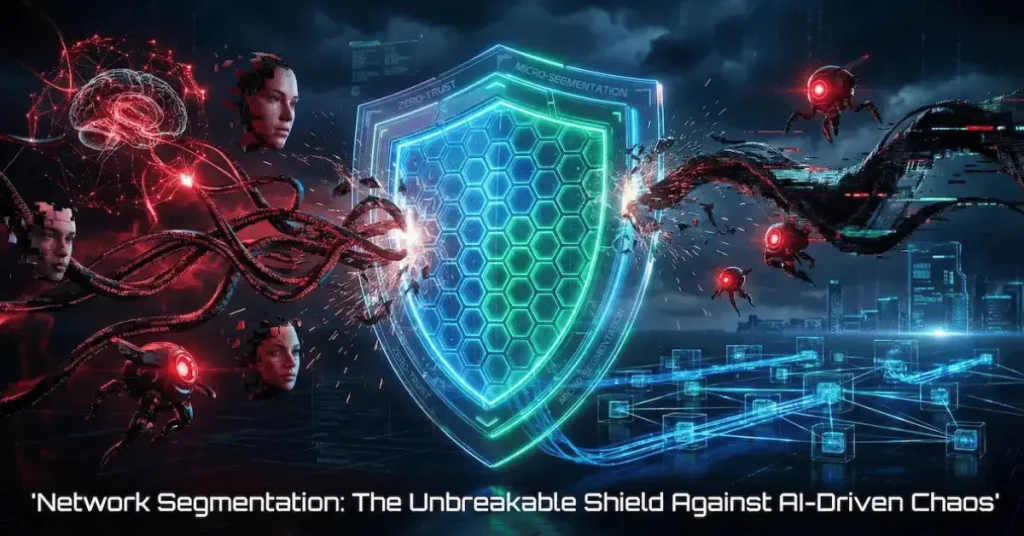
Amid escalating geopolitical fragmentation, supply chain risks, and cyber inequity, network segmentation stands out as a proven, high-ROI defense. Paired with zero-trust principles, it contains AI-driven chaos by limiting lateral movement and reducing blast radius—even when attacks are automated and adaptive.
The Escalating Threat Landscape: AI Turns Cyber Armageddon Up a Notch
2025 proved AI’s dual role: defenders used it for detection and response, but attackers weaponized it for speed and scale. Ransomware payments dropped to an average of $1 million in 2025 (down 50% from 2024), yet incidents remain high, with AI enabling faster adaptation, CAPTCHA bypass, and convincing phishing. Nation-state actors and organized crime groups deploy AI for zero-day discovery, automated chains, and mimicry of legitimate behavior.
Geopolitical tensions fuel targeted attacks on critical infrastructure, supply chains, and OT/IoT environments. Cloud misconfigurations, virtualization blind spots, and IT/OT convergence amplify risks. The WEF report highlights ransomware as a persistent top concern, alongside AI vulnerabilities and cyber-enabled fraud. Without containment strategies, a single compromised endpoint or AI agent can cascade into systemic disruption. For more on rising threats, check out our guide to who cybercriminals are in 2025-2026.
Network Segmentation 101: Containing the Chaos
Network segmentation divides infrastructure into isolated zones using VLANs, firewalls, ACLs, and policies—creating “moats” that restrict threat spread. In 2026, micro-segmentation takes this granular: AI-driven, context-aware controls enforce least-privilege access down to workloads and processes.
This approach dramatically reduces blast radius. Even autonomous AI attacks lose momentum when unable to pivot across segments. In OT environments, it isolates legacy ICS from IT networks, while cloud-native segmentation secures hybrid setups. Defenses like UEBA and anomaly detection complement it for proactive containment. For foundational segmentation concepts, explore our earlier guide on subnetting and network segmentation mastery.
Zero Trust + Micro-Segmentation: The 2026 Essential Duo
Zero Trust is now a baseline, shifting focus to identity verification over perimeter defenses. Every request demands continuous authentication, especially for AI agents prone to privilege escalation or prompt injection. Micro-segmentation enforces dynamic boundaries, slashing containment time and preventing pivots from IT to OT.
Reports emphasize identity-centric Zero Trust in 2026, with segmentation as a core pillar to limit access and monitor behavior. Highly resilient organizations excel at ecosystem-wide controls: supplier assessments, incident simulations, and shared intelligence. Dive deeper into these principles in our recent post on Cybersecurity Fundamentals 2026: Build Strong Defense in 60 Days, which covers “never trust, always verify” in detail.
IEC 62443 Updates: Industrial Segmentation Gets Stronger
The 2025 release of ISA-TR62443-2-2-2025 provides fresh guidance on comprehensive security protection schemes for IACS. It stresses risk-based segmentation, maturity models, and lifecycle accountability—crucial for isolating edge devices and countering AI-amplified threats in 6G-era environments. Manufacturing and critical infrastructure see up to 70% reduction in botnet impacts through these practices.
Skills and Strategies: Building Your 2026 Defense
Cyber roles demand cloud security, AI governance, Python/SIEM mastery, and Zero Trust expertise—top salaries still exceed $130K. Implementation tips:
- Audit & Map: Use tools to visualize assets and enforce micro-policies.
- Integrate AI: Deploy ML for adaptive segmentation and anomaly spotting.
- Embrace Ecosystem Resilience: Assess suppliers, simulate breaches, share threat intel.
- Prioritize Identity: Shift to credential-less, continuous verification.
For a holistic view, see how segmentation fits into advanced frameworks in Cybersecurity Mesh Architecture (CSMA): The Future of Holistic Defense.
The Bottom Line: Segment Now, Survive and Thrive
In 2026, AI-driven threats evolve faster than most can respond—but network segmentation remains the unbreakable shield. By containing automated attacks, enforcing Zero Trust boundaries, and aligning with updated standards like IEC 62443, organizations limit damage and unlock resilience. Don’t wait for the next breach: fortify your network today.
Explore more in our Cyber Security category or read related guides like Preventing Ransomware Through Secure Remote Access Design.
Stay ahead—subscribe for the latest cybersecurity insights and trends!