A host doesn’t route. It knows its own subnet, and for everything outside that subnet, it sends traffic to exactly one configured address: its default gateway. That single point of dependency is the limitation this article covers — and understanding it is what motivates every First Hop Redundancy Protocol (FHRP) that exists, from HSRP to VRRP to GLBP.
The Core Problem
At the distribution layer of a hierarchical network, a router or Layer 3 switch typically acts as the default gateway for every host in a given VLAN. Even when two or more Layer 3 devices connect to that same VLAN — a common design specifically for redundancy — each host is still configured with exactly one gateway IP address. Most host operating systems support only one active default route at a time, and there’s no built-in mechanism for a host to dynamically notice its gateway has failed and switch to an alternate one on its own.
This creates a specific, well-known failure mode: the network can have full physical and logical redundancy, and hosts can still lose all outside connectivity the moment their one configured gateway goes down.
A Worked Example
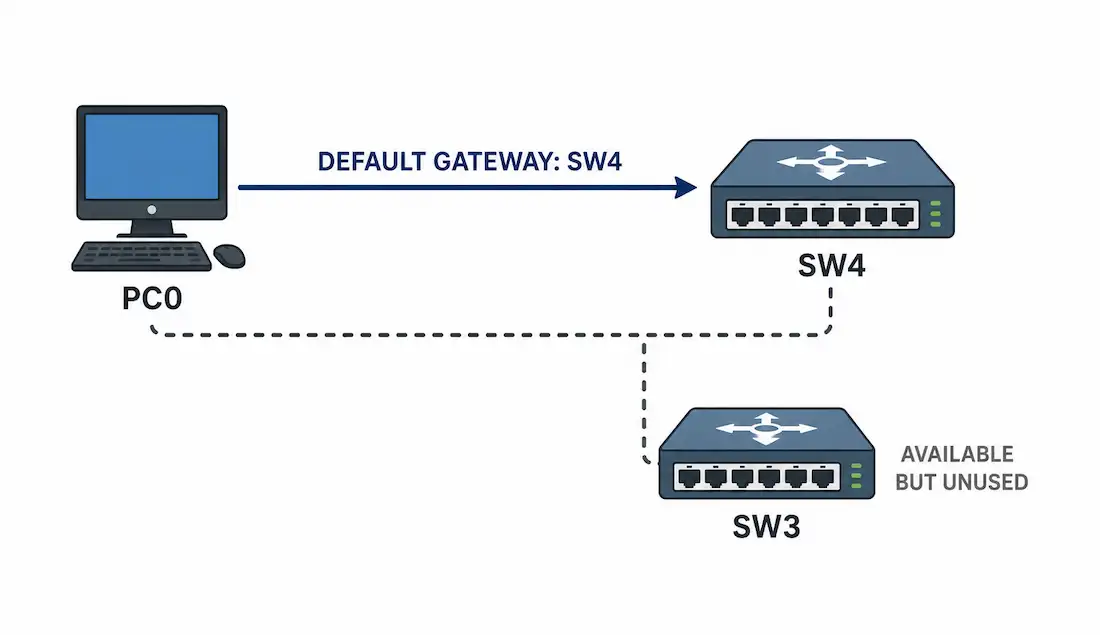
Consider a distribution layer with two Layer 3 switches, SW3 and SW4, both connected to the same access-layer VLAN where PC0 lives. SW3 and SW4 both have routes to the rest of the network, and the access layer has redundant uplinks to both of them — exactly the kind of topology built earlier in this series’ Spanning Tree coverage, where STP decides which of those redundant Layer 2 paths actively forwards.
PC0 is configured with a single default gateway address: SW4’s interface IP. Under normal conditions, all of PC0’s outbound traffic destined outside the local subnet goes to SW4, which routes it onward.
Now SW4 fails. Here’s what happens, and what doesn’t:
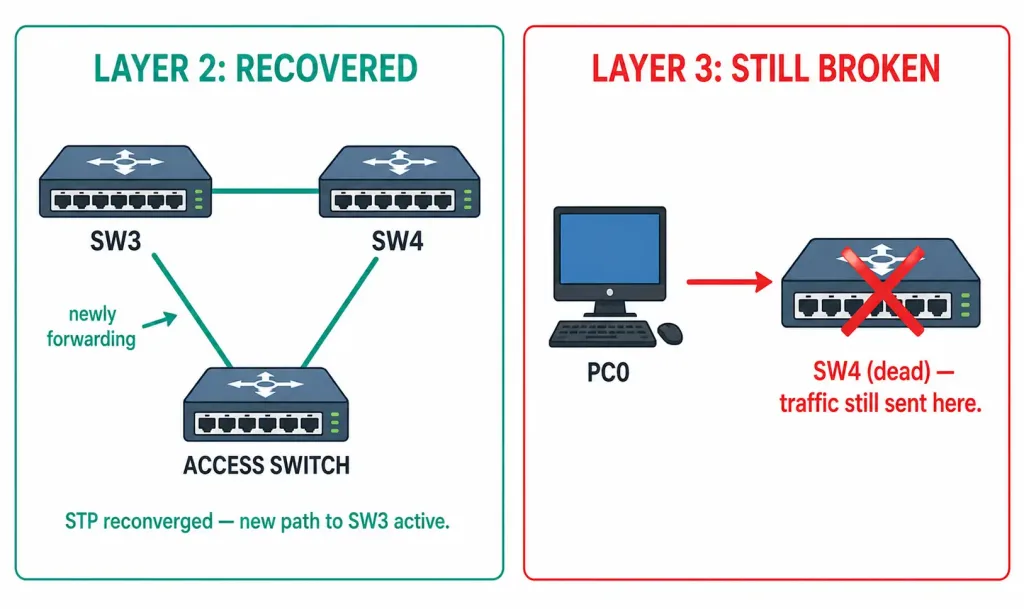
- Layer 2 recovers. Spanning tree protocol detects the topology change and converges — as covered throughout this series, a previously blocked port toward SW3 transitions to forwarding, restoring a physical path out of the access layer.
- Layer 3 does not recover. PC0’s operating system still has SW4’s IP address configured as its default gateway. It has no way of knowing SW4 is down, and no mechanism to automatically start using SW3 instead. Every packet PC0 sends to that dead gateway address is simply dropped, silently, at the point where it should have been forwarded.
The physical redundancy exists. The Layer 2 path exists. PC0 is still cut off from every network outside its own subnet, because the one piece of configuration that actually matters here — its default gateway address — never changes on its own.
Why This Isn’t a Rare Edge Case
This limitation isn’t a corner case that only shows up in unusual topologies — it’s the default behavior of IP host networking everywhere, and it applies regardless of how much Layer 2 redundancy a network has built underneath it:
- The gateway IP is static configuration, whether it’s set manually, via DHCP, or through router advertisements. None of those mechanisms include a built-in failover trigger.
- Hosts have no routing intelligence. A host isn’t running a routing protocol and isn’t listening for topology changes; it has a destination and a next hop, and that’s the entire extent of its decision-making for off-subnet traffic.
- STP and Layer 3 gateway selection are two completely separate problems. STP’s job is to keep the switched Layer 2 topology loop-free and connected. It has no concept of, and no influence over, which IP address a host is using as its gateway. Solving one does nothing for the other.
- Even a “secondary” gateway configured on the host doesn’t help dynamically. Some operating systems allow a backup static route, but there’s still no automatic, fast detection of the primary gateway’s failure — a host typically only notices when its own traffic starts failing, and even then, most consumer and server operating systems won’t automatically fail over to a secondary default gateway without additional configuration or monitoring software.
What Actually Solves This
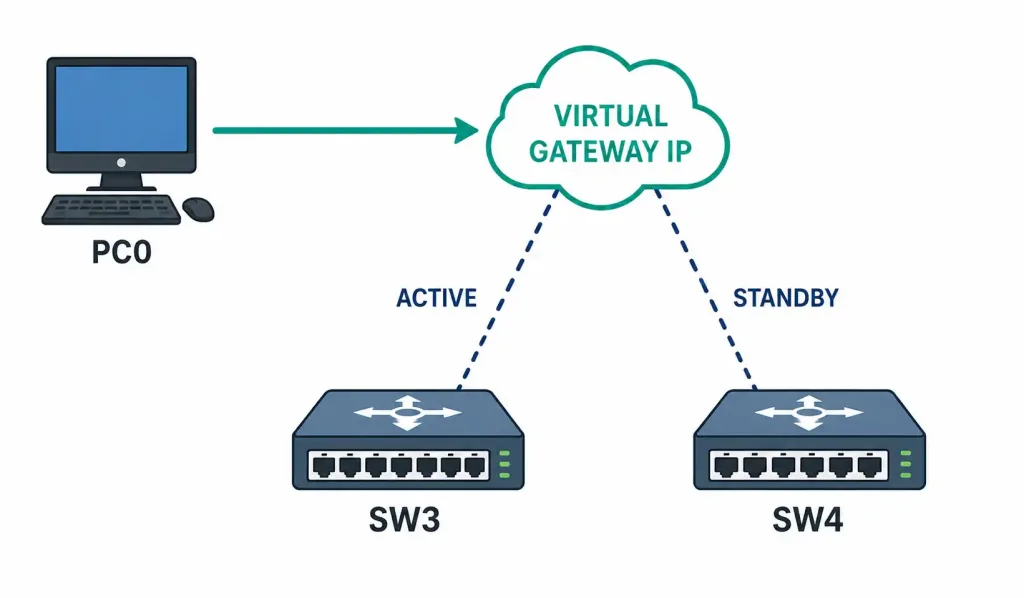
The general solution is a First Hop Redundancy Protocol (FHRP), a category of protocols that let two or more routers or Layer 3 switches share a single virtual IP address and virtual MAC address between them. Hosts get configured with that shared virtual address as their one default gateway — and the protocol itself handles detecting a failure and moving the active role to a surviving device, transparently to every host on the segment.
The three FHRPs used in Cisco environments are:
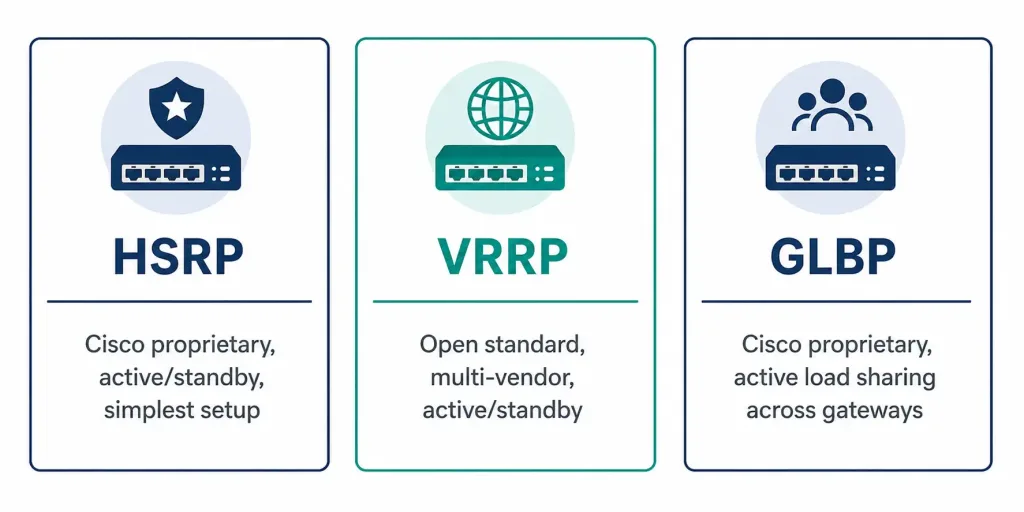
- HSRP (Hot Standby Router Protocol), Cisco’s original proprietary solution, using an active/standby model where one router actively forwards for the virtual IP while one or more standby routers wait to take over.
- VRRP (Virtual Router Redundancy Protocol), the open IEEE standard equivalent, functionally similar to HSRP but usable in multi-vendor environments.
- GLBP (Gateway Load Balancing Protocol), Cisco’s own extension that adds active load balancing across multiple gateways simultaneously, rather than leaving standby routers completely idle until a failure occurs.
Each of these solves the exact problem demonstrated above: the host’s gateway address never has to change, because the address itself moves — logically — between physical devices as needed. From PC0’s perspective in the example above, nothing about its configuration ever needs to be touched, no matter which physical switch is actually handling the forwarding at any given moment.
Choosing Between FHRP Options
Once the underlying problem is clear, the choice between HSRP, VRRP, and GLBP comes down to a few practical factors rather than one being universally “best”:
| Factor | HSRP | VRRP | GLBP |
|---|---|---|---|
| Vendor | Cisco proprietary | Open IEEE standard | Cisco proprietary |
| Multi-vendor environments | Not usable | Works across vendors | Not usable |
| Standby router utilization | Idle until failover | Idle until failover | Can actively forward traffic too |
| Complexity | Lowest | Low | Higher |
| Typical use case | All-Cisco environments, simplest setup | Mixed-vendor networks | Cisco environments wanting active load sharing |
Multi-vendor networks — anywhere routers or Layer 3 switches from different manufacturers share a segment — effectively require VRRP, since HSRP and GLBP are both Cisco-proprietary and won’t interoperate with non-Cisco gear acting as a peer.
All-Cisco environments without a specific need for active-active load sharing typically default to HSRP, simply because it’s the most established and widely documented option, with the most operational familiarity across Cisco-certified staff.
Environments wanting to actively use every available gateway, rather than leaving standby routers sitting idle until a failure, are the specific case GLBP was built for — it distributes the active forwarding role across multiple routers simultaneously rather than the strict active/standby model HSRP and VRRP both use.
Diagnosing This Failure in Practice
A few signs point specifically to this failure mode rather than a general connectivity or STP problem:
- The switched network itself is healthy —
show spanning-tree vlan [id]on affected switches shows a converged, loop-free topology with a valid forwarding path out of the access layer. - Affected hosts can still reach devices on their own local subnet, since that traffic never needs a gateway at all — only off-subnet traffic fails.
arp -aor the equivalent on an affected host still shows the dead gateway’s MAC address cached, or fails to resolve it at all, depending on how long it’s been down.- The affected hosts are specifically the ones configured with the failed device’s IP as their gateway — other hosts on the same VLAN configured with a different (working) gateway continue functioning normally, which is a strong signal this is a gateway-configuration issue rather than a broader Layer 2 or Layer 3 outage.
Confirming from the switch side: on the surviving Layer 3 device, show ip interface brief confirms which VLAN interfaces are up, and a quick ping test from that device to affected hosts confirms Layer 3 reachability exists in the direction that matters — from the working gateway candidate outward to the host, even though the host itself has no way to discover that path on its own. show cdp neighbors and a topology walkthrough, covered in the troubleshooting article, also help confirm the Layer 2 path between the host’s access switch and the surviving Layer 3 device is intact before assuming the fix is purely a Layer 3 configuration problem.
The permanent fix is architectural, not a one-time command. Restoring the failed device brings things back temporarily, but the underlying single-point-of-failure remains until an FHRP is actually deployed on that segment — the same failure will recur the next time that specific device goes down for any reason, planned or not.
Frequently Asked Questions
Why can’t a host just use a second gateway automatically?
Most host operating systems support only one active default route, and even where a secondary static route can be configured, there’s no built-in mechanism to detect the primary gateway’s failure and switch over automatically. The host simply keeps sending traffic to the same configured address whether or not anything is listening on the other end.
Does Spanning Tree Protocol fix this problem?
No. STP operates entirely at Layer 2, restoring a physical forwarding path between switches after a topology change. It has no visibility into, or influence over, which IP address a host uses as its default gateway. A network can have a perfectly converged, loop-free STP topology and still have hosts completely unable to reach anything outside their subnet, because their gateway configuration never changed.
What’s the actual fix for this limitation?
A First Hop Redundancy Protocol — HSRP, VRRP, or GLBP — lets multiple routers or Layer 3 switches share one virtual gateway IP address that hosts are configured to use. The protocol handles detecting a failed device and moving the active role to a surviving one, so the host’s configuration never has to change.
How do you tell this problem apart from a general outage?
Check whether the switched topology has actually converged with show spanning-tree vlan [id] — if it has, and affected hosts can still reach others on their own local subnet but nothing beyond it, the issue is very likely a dead default gateway rather than a broader network failure. Hosts pointed at a different, still-functioning gateway on the same VLAN will continue working normally, which is a useful way to confirm the diagnosis.
Is this limitation specific to switched networks, or does it apply everywhere?
It applies to essentially any IP network where a host relies on a single configured default gateway, which is nearly universal host behavior. It becomes a practical concern specifically in switched, redundant topologies because those networks were built with physical and Layer 2 redundancy that the host’s gateway configuration doesn’t actually benefit from without an FHRP in place.
Conclusion
The default gateway limitation is one of the clearest examples in networking of physical redundancy not automatically translating into actual resilience. A network can have two Layer 3 devices, redundant uplinks, and a fully converged spanning tree, and still leave every host on a segment completely stranded the moment their one configured gateway fails — because nothing in standard IP host behavior watches for that failure or reacts to it. Recognizing this gap is what makes First Hop Redundancy Protocols worth the extra configuration: HSRP, VRRP, and GLBP all exist specifically to make the gateway address itself survive a device failure, so the redundancy already built into the network actually reaches the hosts depending on it.