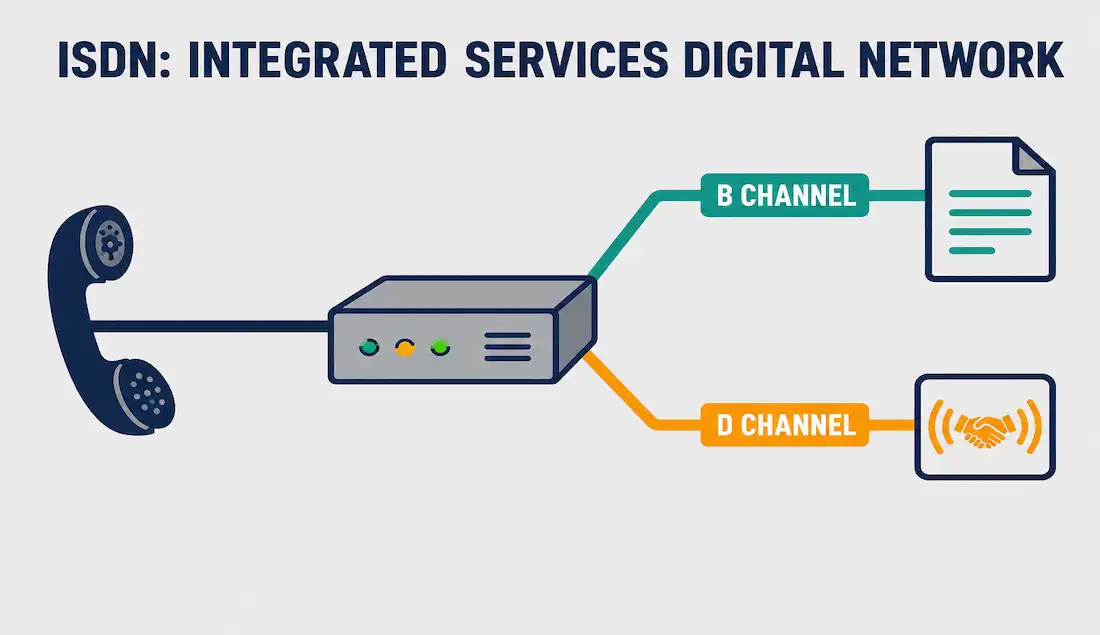
ISDN stands for Integrated Services Digital Network. It’s a circuit-switched technology that uses the local loop of the Public Switched Telephone Network (PSTN) to carry fully digital signals, rather than the analog signals traditional telephone lines were originally designed for. ISDN is a set of communication standards capable of transmitting voice, data, and signaling simultaneously over the same digital connection.
Compared to traditional analog dial-up, ISDN connections offer meaningfully better speed, quality, and reliability. Though largely superseded by DSL and broadband for most modern use, ISDN remains genuinely relevant where those newer technologies aren’t available, and its architecture is foundational CCNA WAN knowledge worth understanding thoroughly.
ISDN vs. Other WAN Technologies
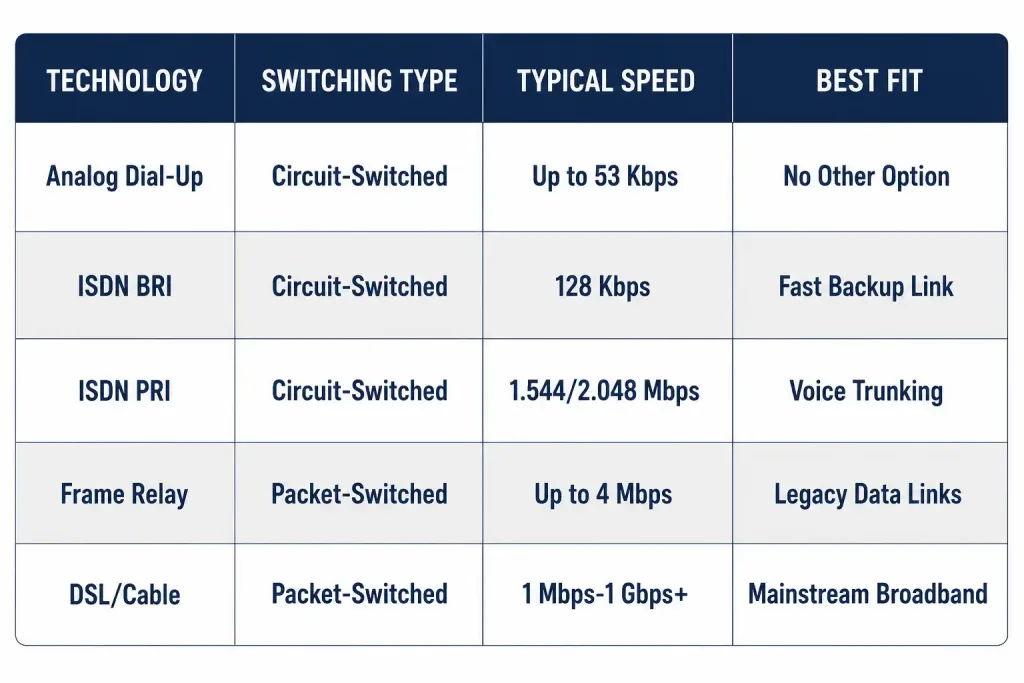
Understanding where ISDN fits relative to other WAN options clarifies why it’s still worth knowing:
| Technology | Switching Type | Typical Speed | Best Fit |
|---|---|---|---|
| Analog Dial-Up | Circuit-switched | Up to 53 Kbps | No other option available |
| ISDN BRI | Circuit-switched | 128 Kbps | Fast-setup backup link |
| ISDN PRI | Circuit-switched | 1.544/2.048 Mbps | Enterprise voice trunking |
| Frame Relay | Packet-switched | Up to ~4 Mbps | Legacy multi-site data links |
| DSL/Cable | Packet-switched | 1 Mbps-1 Gbps+ | Mainstream broadband |
Its defining trait relative to this list is that it’s circuit-switched with fast, reliable call setup — a combination that made it valuable for voice trunking and on-demand backup scenarios even after packet-switched alternatives overtook it for general data connectivity. Its circuit-switched nature also means an ISDN connection guarantees the full bandwidth of its channels for the duration of a call, unlike packet-switched technologies where bandwidth is shared and can vary based on network conditions. This guarantee is precisely why voice trunking applications, which are highly sensitive to jitter and dropped packets, continued favoring ISDN long after packet-switched alternatives became the default choice for general-purpose data traffic.
History of ISDN
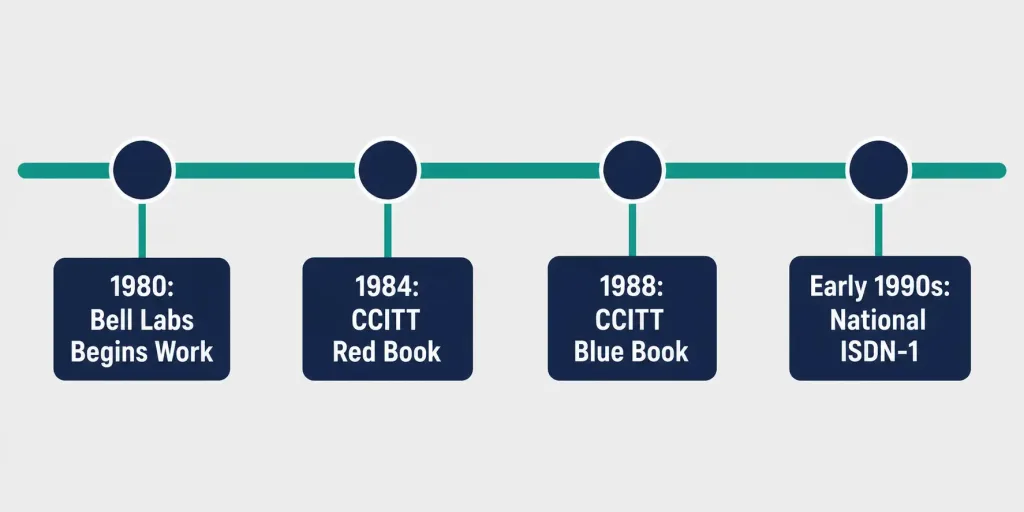
Work on ISDN began in 1980 at Bell Labs, aiming to replace the aging analog dial-up telephone system with a fully digital alternative capable of higher speed and more reliable long-distance performance. This effort culminated in international standardization by the CCITT (the predecessor to today’s ITU-T), with the first major standards published in 1984 as the “Red Book,” followed by a more complete set of recommendations in 1988 known as the “Blue Book.”
Even after formal standardization, ISDN equipment from different vendors didn’t always interoperate cleanly, which slowed adoption. In the early 1990s, a coordinated effort involving Bellcore (the research arm spun off from the old Bell System) and central-office switch vendors, working through the North American ISDN Users’ Forum, produced National ISDN-1 (NI-1) — a unified specification that gave equipment from different manufacturers a common, interoperable baseline in the United States.
By the time these interoperability issues were resolved, DSL and cable had begun offering higher speeds at lower cost, and ISDN’s window as a mainstream consumer technology largely closed. It remains important today mainly in locations where DSL and cable service still aren’t available.
How ISDN Works
It converts the PSTN from carrying purely analog signals to carrying time-division multiplexed (TDM) digital signals, which allows two or more signals to travel simultaneously over a pair of copper lines. This conversion from analog to TDM is what enables ISDN’s higher-capacity switched connections compared to plain analog dial-up.
It connections use two types of channels:
- B channel (Bearer channel): Carries the actual voice, data, or other user traffic.
- D channel (Data channel): Carries call setup, signaling, and control information, separate from the user traffic on the B channels.
Because signaling lives on its own dedicated D channel rather than being embedded in the user data itself, B channels are freed up entirely for actual payload, which is part of what makes ISDN call setup notably fast compared to analog dial-up. An ISDN connection requires a terminal adapter (TA) to interface user equipment with the ISDN line.
Types of ISDN Interfaces
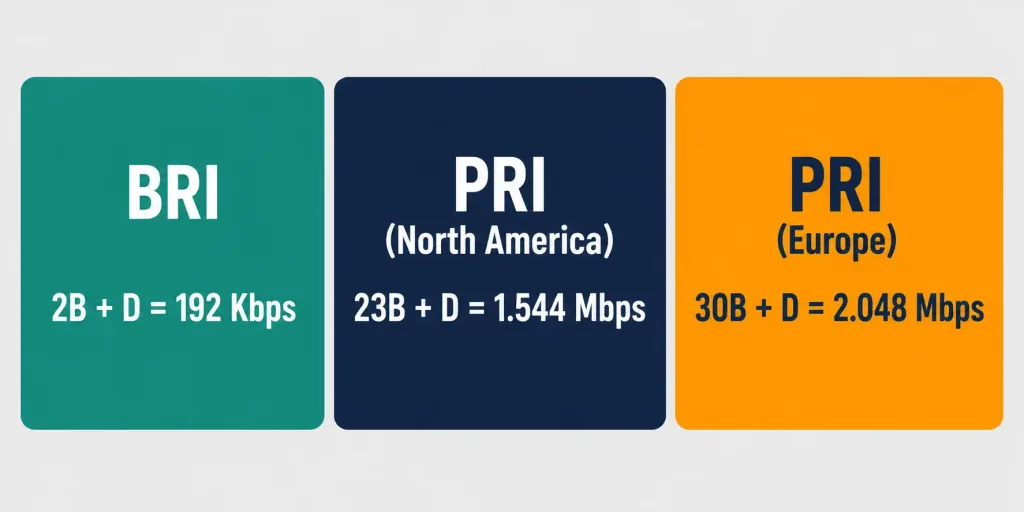
There are two standard interfaces: Basic Rate Interface (BRI) and Primary Rate Interface (PRI).
Basic Rate Interface (BRI)
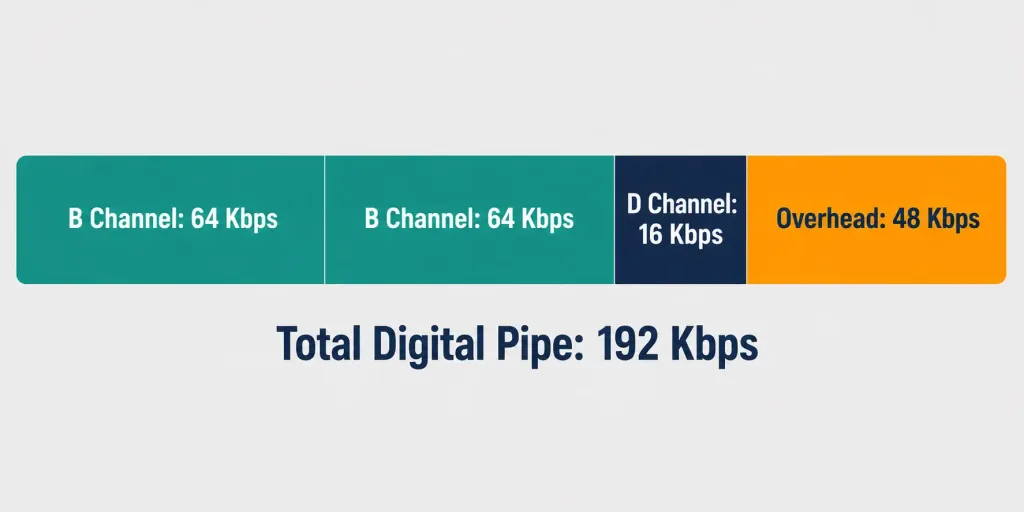
BRI is the lower tier of ISDN service, providing basic connectivity at a lower cost, and it’s the typical choice for home users and small businesses. BRI provides two 64 Kbps B channels and one 16 Kbps D channel for signaling and call setup.
Adding the two channel types together: 64 × 2 + 16 = 144 Kbps of usable capacity. But the actual physical connection requires more than this: the BRI service also carries 48 Kbps of framing and line-maintenance overhead, bringing the total digital pipe required up to 192 Kbps (144 + 48). The B and D channels operate independently of each other, so both can carry different types of traffic simultaneously without interfering with one another.
BRI’s call setup time is under one second, making it noticeably faster to establish a connection than analog dial-up. Depending on cost and requirements, a user can purchase a single B channel (up to 64 Kbps) or both B channels combined (up to 128 Kbps) for a given call. Even at the full 128 Kbps, this speed falls well short of what’s needed for modern video streaming, online gaming, or other bandwidth-intensive applications — BRI is best understood as a legacy fallback option rather than a modern broadband substitute.
Primary Rate Interface (PRI)
PRI is typically used by enterprises needing to transfer significantly more data than BRI can support, and it has two different regional standards.
North America: PRI provides 23 B channels at 64 Kbps each, plus one D channel at 64 Kbps, plus 8 Kbps of service overhead. The total: 64 × 23 + 64 + 8 = 1,544 Kbps, exactly matching the T1 data rate.
Europe (and Australia and many other countries): PRI provides 30 B channels plus one D channel, with synchronization overhead included in the total. This adds up to 2,048 Kbps, exactly matching the E1 data rate.
Using PRI, a customer can combine multiple B channels between two points to achieve high-speed data transfer with minimal latency and jitter. The tradeoff is cost: provisioning multiple channels, especially over long distances, can become expensive compared to other WAN alternatives.
Real-World Deployment Context
A common historical use for ISDN PRI was connecting a business’s private branch exchange (PBX) phone system to the telephone network, allowing dozens of simultaneous voice calls to share a single T1 or E1 circuit rather than requiring individual analog phone lines for each call path.
This remains one of the more durable ISDN use cases: even as data connectivity has largely moved to broadband and fiber, some organizations still rely on ISDN PRI circuits for voice trunking to their PBX, particularly where the underlying telecom infrastructure hasn’t yet been modernized. A mid-sized call center, for example, might provision several PRI circuits to guarantee enough simultaneous voice channels for its agents, sizing the number of B channels needed based on expected peak concurrent call volume rather than average daily usage.
ISDN BRI, meanwhile, found continued use in some backup WAN link scenarios — as a dial-on-demand failover connection that would only activate if a primary broadband or leased-line connection failed, since ISDN’s fast call setup time made it well suited to this kind of on-demand backup role even at its modest bandwidth.
Some older videoconferencing systems also relied specifically on ISDN BRI, bonding multiple B channels together to reach enough combined bandwidth for acceptable video quality before Internet-based videoconferencing became practical. A conference room system from the 1990s or early 2000s might bond six BRI B channels together to reach 384 Kbps, which was considered reasonable video quality at the time despite being far below what a modern webcam call requires today.
Troubleshooting and Exam Tips
- Remember the BRI math precisely: 2 B channels (64 Kbps each) + 1 D channel (16 Kbps) = 144 Kbps of usable bandwidth, but the actual physical pipe required is 192 Kbps once overhead is included.
- Remember PRI’s two regional variants: North American PRI (23B+D) totals 1,544 Kbps, matching T1; European PRI (30B+D) totals 2,048 Kbps, matching E1.
- Don’t confuse the B channel (bearer, carries user data) with the D channel (carries signaling and call setup) — this distinction is frequently tested.
- If a scenario describes a fast-failover backup link activated only when the primary WAN connection fails, ISDN BRI’s sub-second call setup time makes it a classic correct answer for that use case.
- ISDN is circuit-switched, unlike Frame Relay or MPLS, which are packet-switched — a useful distinction when comparing WAN technologies on the exam.
- Watch for scenarios describing videoconferencing bandwidth needs from an older or legacy system — bonded ISDN B channels (multiples of 64 Kbps) is a classic historical answer for how such systems reached usable video quality before Internet-based conferencing became standard.
Conclusion
It is a circuit-switched digital technology that converts the PSTN’s local loop from analog to time-division multiplexed digital signals, using separate B channels for user data and D channels for signaling. Its two interfaces — BRI for home and small-business use, and PRI for enterprise-scale voice and data trunking — deliver precise, standardized data rates (192 Kbps and 1,544/2,048 Kbps respectively) that remain worth understanding even as DSL, cable, and fiber have taken over most mainstream connectivity.
ISDN’s fast call setup and reliable circuit-switched behavior still make it a viable choice for legacy PBX voice trunking and dial-on-demand backup links today, and its underlying concepts of channelized bandwidth and dedicated signaling paths continue to inform how modern voice and data networks are designed.
Frequently Asked Questions
What does ISDN stand for?
ISDN stands for Integrated Services Digital Network, a circuit-switched technology that carries digital voice, data, and signaling over the PSTN’s local loop.
What is the difference between BRI and PRI?
BRI (Basic Rate Interface) provides two 64 Kbps B channels and one 16 Kbps D channel, totaling 144 Kbps of usable bandwidth over a 192 Kbps digital pipe, and is typically used by home users and small businesses. PRI (Primary Rate Interface) provides many more B channels — 23 in North America or 30 in Europe — for enterprise-scale voice and data needs, reaching 1,544 Kbps or 2,048 Kbps respectively.
What is the difference between a B channel and a D channel?
The B (Bearer) channel carries actual voice or data traffic. The D (Data) channel carries call setup, signaling, and control information separately, which is part of why ISDN can establish calls so quickly.
Is ISDN still used today?
Yes, though its role has narrowed significantly. ISDN PRI remains in use for legacy PBX voice trunking in some organizations, and ISDN BRI has historically served as a fast-failover backup WAN link, even though DSL, cable, and fiber have replaced it for most mainstream connectivity.
Why was ISDN’s mainstream adoption slower than expected?
Early ISDN equipment from different vendors often didn’t interoperate cleanly, which slowed uptake through the 1980s. By the time standards like National ISDN-1 resolved much of this in the early 1990s, DSL and cable were emerging as faster, cheaper alternatives, limiting ISDN’s window as a mainstream consumer technology.
Can ISDN B channels be combined for more bandwidth?
Yes. Multiple B channels can be bonded together to reach higher combined data rates — a technique historically used by ISDN-based videoconferencing systems, which might bond several 64 Kbps B channels to reach a few hundred kilobits per second of usable video bandwidth. This same bonding principle, combining multiple fixed-rate channels to reach a higher aggregate rate, reappears conceptually in later technologies like multilink PPP and channel bonding on modern broadband connections.