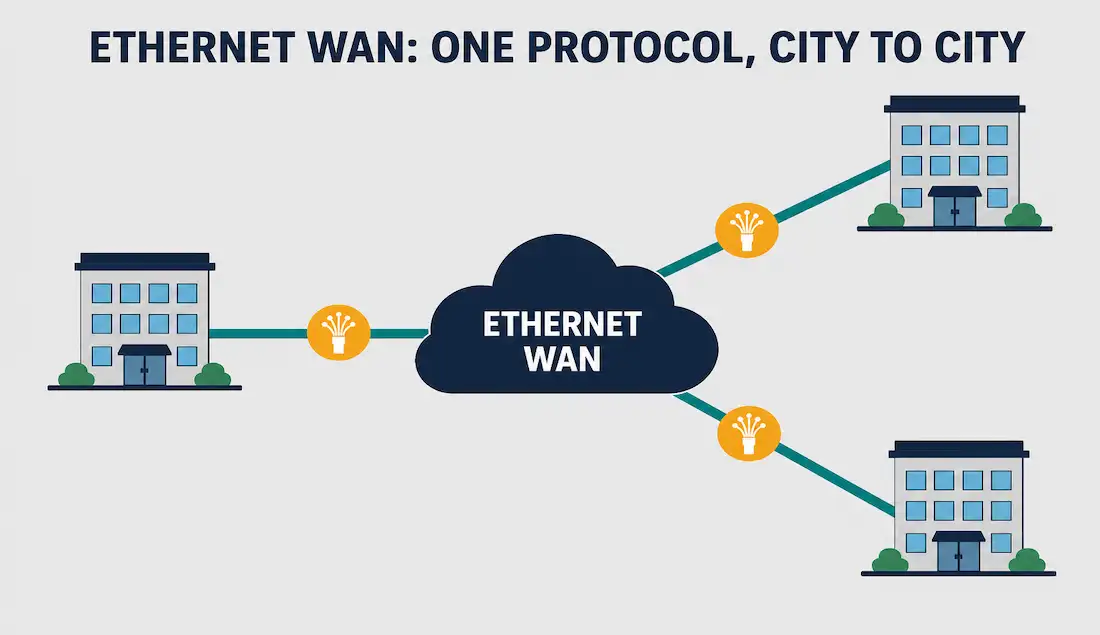
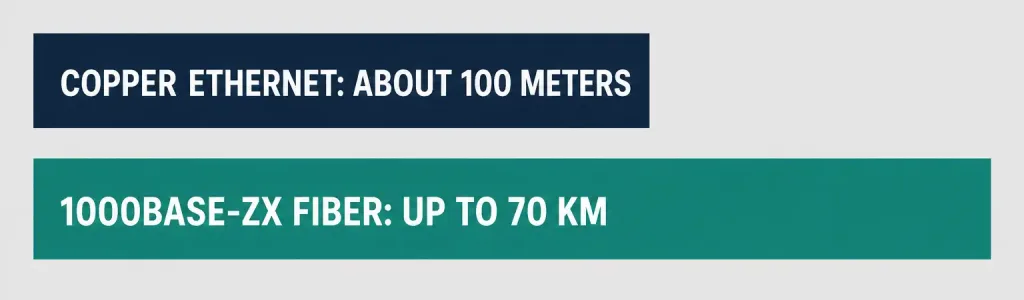
Ethernet was initially considered unsuitable as a WAN access technology, largely because early Ethernet cabling standards supported only relatively short distances — copper-based Ethernet was historically limited to around 100 meters per segment. Newer Ethernet standards over fiber optic cabling changed that entirely, extending reach far beyond what copper or original Ethernet specifications ever supported. For example, 1000BASE-ZX, a widely adopted industry specification for Gigabit Ethernet over single-mode fiber (not itself an official IEEE 802.3 standard, though built on IEEE 802.3z foundations), can reach distances of up to 70 km — a dramatic leap that made fiber-based Ethernet a genuinely viable WAN option.
Today, Ethernet WAN provides high-bandwidth connectivity for point-to-point networks, data centers, storage systems, convergence applications, LAN extension, and Internet access. It’s cost-effective, straightforward to implement, and well suited to multi-site environments, delivering an efficient, restorable, and easily managed network.
Why Ethernet WAN Became the Enterprise Standard
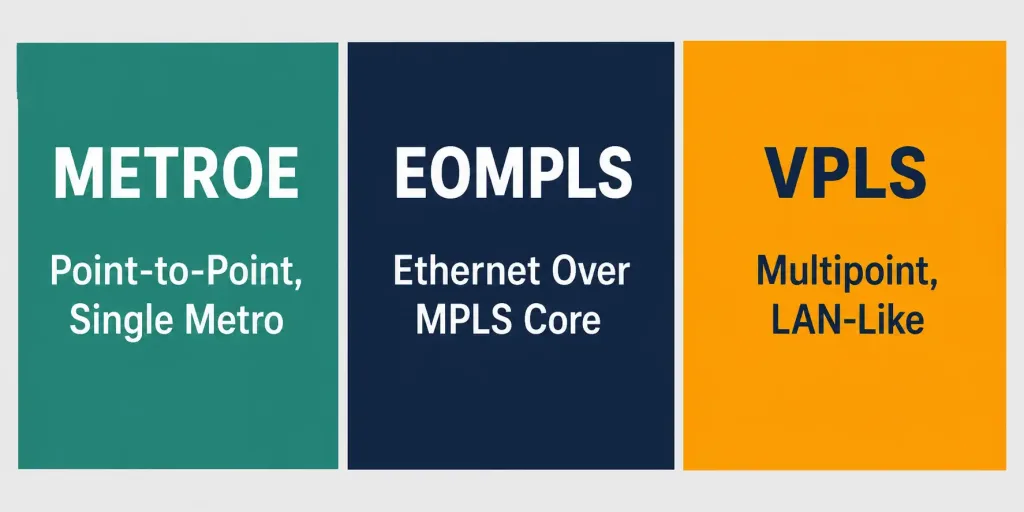
Ethernet WAN has become the go-to WAN choice for enterprises because of its higher data-connectivity rates, flexible service options, and the wide availability of implementation choices from service providers. Service providers deliver Ethernet WAN service over fiber optic cabling under several names, including:
- Metropolitan Ethernet (MetroE): Ethernet-based connectivity across a metropolitan area, typically used to interconnect an organization’s sites or extend a LAN across a city.
- Ethernet over MPLS (EoMPLS): Ethernet frames carried across an MPLS backbone, combining Ethernet’s simplicity with MPLS’s traffic engineering and QoS capabilities.
- Virtual Private LAN Service (VPLS): A service that makes geographically distributed sites appear to be on the same local LAN, emulating LAN-like connectivity across a WAN.
Ethernet WAN is a high-speed system that increases available bandwidth while eliminating the need for expensive protocol conversions between different WAN technologies. Because it speaks the same Ethernet protocol already running on virtually every enterprise LAN, Ethernet WAN connects easily to existing infrastructure, cutting both deployment time and installation costs. It connects multiple sites cost-effectively within an urban area, to each other, and to the Internet.
Ethernet WAN Service Types in More Detail
Understanding the technical distinction between these three delivery models helps clarify which is right for a given scenario.
Metropolitan Ethernet (MetroE) is typically delivered as either an Ethernet Private Line (EPL), providing a dedicated point-to-point connection between two sites, or an Ethernet Virtual Private Line (EVPL), which allows a single physical port to support multiple logical connections to different remote sites. MetroE is generally the simplest and least expensive option when connectivity needs are limited to a handful of sites within a single metro area.
Ethernet over MPLS (EoMPLS) encapsulates Ethernet frames inside MPLS labels, allowing them to traverse a provider’s MPLS core alongside other traffic types. This gives EoMPLS the traffic engineering, QoS prioritization, and fast-reroute capabilities of MPLS while still presenting a simple Ethernet interface to the customer, making it well suited to larger enterprises that need both Ethernet simplicity and MPLS-grade traffic control.
Virtual Private LAN Service (VPLS) goes a step further than EoMPLS by emulating a full LAN across the WAN: sites don’t just have point-to-point connections but instead appear to be all connected via a shared virtual switch. This makes VPLS excellent for scenarios needing broadcast-style, any-to-any connectivity — but that same LAN-emulation approach means VPLS must replicate broadcast and multicast traffic across the whole mesh, which becomes less efficient as the number of connected sites grows large.
Why This Matters for IP Applications
Ethernet WAN enables the productivity benefits of IP applications that are difficult to implement cleanly on older TDM or Frame Relay networks. Because Ethernet WAN speaks natively in the same frame format as LAN Ethernet, IP-based applications like VoIP, video conferencing, and cloud service access run more naturally across it than across networks built around fundamentally different framing and switching models. This is a major reason Ethernet WAN has become the popular choice used to substitute for older Frame Relay and ATM WAN links in modern enterprise deployments.
How Ethernet WAN Compares to Legacy WAN Technologies
| Factor | Ethernet WAN | Frame Relay | ATM |
|---|---|---|---|
| Underlying unit | Variable-length frame | Variable-length frame | Fixed 53-byte cell |
| Typical speed | Mbps to multi-Gbps | Up to ~4 Mbps | T1/E1 up to OC rates |
| LAN compatibility | Native, same protocol | Requires conversion | Requires conversion |
| Setup complexity | Low, familiar to IT staff | Moderate | Higher |
| Modern relevance | Actively deployed | Largely legacy | Largely legacy |
Worked Example: Choosing Between MetroE, EoMPLS, and VPLS
Consider a company with three offices in the same city needing full any-to-any connectivity between all three sites, as if they were on one shared LAN. A straightforward MetroE point-to-point service would only connect two sites at a time, requiring multiple separate circuits to achieve full-mesh connectivity between all three offices. VPLS, by contrast, is designed specifically for this multipoint scenario, letting the provider present all three sites as if they were switched together on a single virtual LAN, regardless of geographic distance.
If this same company later expands to a dozen offices spread across an entire country rather than a single city, EoMPLS or a full MPLS-based WAN typically becomes the better fit, since MPLS scales far more efficiently to larger numbers of geographically dispersed sites than point-to-point MetroE or VPLS alone.
Real-World Deployment Context
A common use case for Ethernet WAN today is connecting a company’s branch offices directly to a cloud provider or a colocation data center, replacing older leased-line or Frame Relay circuits that once served the same purpose. Because cloud connectivity increasingly expects high, symmetric bandwidth for services like backup, disaster recovery replication, and SaaS application access, Ethernet WAN’s ability to deliver Gbps-class speeds at a fraction of legacy WAN costs has made it the default choice for new WAN builds, with MPLS or SD-WAN often layered on top for traffic engineering across a larger number of sites.
Ethernet WAN has also become the standard access technology for connecting to Internet Exchange Points and to major cloud provider direct-connect services (such as AWS Direct Connect or Azure ExpressRoute), since these services are built around high-speed Ethernet handoffs rather than legacy WAN protocols like Frame Relay or ATM.
Advantages of Ethernet WAN
- High bandwidth at lower cost: Ethernet WAN delivers significantly more bandwidth per dollar than legacy technologies like Frame Relay or ATM.
- Native LAN compatibility: Because Ethernet WAN uses the same framing as LAN Ethernet, it eliminates the protocol conversion overhead that Frame Relay and ATM required.
- Simple, familiar equipment: IT staff already familiar with Ethernet switching need minimal additional training to manage Ethernet WAN links.
- Flexible service options: MetroE, EoMPLS, and VPLS give organizations multiple ways to match a service model to their specific site-connectivity needs.
- Scalable bandwidth increments: Ethernet WAN bandwidth can typically be increased in smaller, more granular steps than older WAN technologies allowed.
- Wide availability: Fiber-based Ethernet WAN service is broadly available in most metropolitan areas today, though availability still varies by region and provider.
Ethernet WAN Fiber Standards Reference
Understanding the range of Ethernet-over-fiber standards helps clarify why 1000BASE-ZX specifically matters for long-distance WAN links:
| Standard | Fiber Type | Typical Distance | IEEE Standard Status |
|---|---|---|---|
| 1000BASE-SX | Multimode | Up to 550 m | Official (IEEE 802.3z) |
| 1000BASE-LX | Single-mode or multimode | Up to 10 km | Official (IEEE 802.3z) |
| 1000BASE-EX | Single-mode | Up to 40 km | Industry standard (non-IEEE) |
| 1000BASE-ZX | Single-mode | Up to 70 km | Industry standard (non-IEEE) |
As the table shows, only the shorter-reach SX and LX variants carry official IEEE 802.3z designation; the longer-reach EX and ZX variants, while built on the same underlying Gigabit Ethernet signaling and widely supported across virtually all major networking vendors, are industry conventions rather than formal IEEE specifications. This distinction rarely affects real-world interoperability, since ZX optics from different vendors generally work together without issue, but it’s a detail worth getting right on the CCNA exam.
Disadvantages of Ethernet WAN
- Distance limitations without amplification: Even with long-reach optics like 1000BASE-ZX reaching 70 km, very long-haul connections beyond that distance still require additional amplification or regeneration equipment.
- VPLS scaling limits: VPLS becomes inefficient at a very large number of sites, since it must replicate LAN-like broadcast behavior across the whole mesh — MPLS-based alternatives generally handle large site counts better.
- Provider dependency: As with most carrier-delivered WAN services, actual performance and availability depend heavily on the specific service provider’s infrastructure in a given metro area.
Troubleshooting and Exam Tips
- Remember that 1000BASE-ZX is a widely supported industry specification, not an official IEEE 802.3 standard — a detail that can trip up otherwise-correct answers about “IEEE Ethernet WAN standards.”
- Distinguish the three Ethernet WAN service models by scope: MetroE for point-to-point or point-to-multipoint metro connections, EoMPLS for Ethernet frames carried over an MPLS core, and VPLS for multipoint LAN-like connectivity across many sites.
- If a scenario describes needing many geographically dispersed sites to communicate efficiently, MPLS-based WAN (including EoMPLS) generally scales better than VPLS alone.
- Watch for exam questions distinguishing Ethernet Private Line (EPL) from Ethernet Virtual Private Line (EVPL): EPL is a dedicated point-to-point circuit, while EVPL allows one physical port to support multiple logical connections to different remote sites.
- Ethernet WAN’s main advantage over Frame Relay and ATM on the exam is usually framed around eliminating protocol conversion, since Ethernet WAN uses the same frame format already running on the LAN.
Conclusion
Ethernet WAN extends the familiar Ethernet protocol from the LAN out across metropolitan and wide area networks, using fiber-based standards like 1000BASE-ZX to reach distances that early copper Ethernet never could. Delivered under names like MetroE, EoMPLS, and VPLS, Ethernet WAN gives enterprises a cost-effective, high-bandwidth, and operationally familiar alternative to legacy technologies like Frame Relay and ATM — which is exactly why it has become the default WAN access technology for connecting branch offices, data centers, and cloud services today, and why it will likely remain the dominant enterprise WAN choice for years to come.
Frequently Asked Questions
What is Ethernet WAN?
Ethernet WAN extends the Ethernet protocol beyond the LAN to provide wide area network connectivity, typically delivered by service providers over fiber optic cabling under names like Metropolitan Ethernet, Ethernet over MPLS, and VPLS.
Is 1000BASE-ZX an official IEEE standard?
No. 1000BASE-ZX is a widely supported industry specification for long-reach Gigabit Ethernet over single-mode fiber, built on the IEEE 802.3z foundation, but it is not itself an official IEEE 802.3 standard.
What is the difference between MetroE, EoMPLS, and VPLS?
MetroE typically provides point-to-point or point-to-multipoint Ethernet connectivity within a metro area. EoMPLS carries Ethernet frames across an MPLS backbone. VPLS makes multiple geographically distributed sites appear to be on a single shared LAN, which is ideal for multipoint connectivity but scales less efficiently than MPLS at very large site counts.
Why has Ethernet WAN replaced Frame Relay and ATM?
Ethernet WAN uses the same frame format already running on enterprise LANs, eliminating the protocol conversion overhead that Frame Relay and ATM required, while also delivering significantly higher bandwidth at a meaningfully lower cost per megabit.
How far can Ethernet WAN reach?
It depends on the specific fiber optics used. Long-reach Gigabit Ethernet options like 1000BASE-ZX can cover up to 70 km on single-mode fiber, with even longer-reach variants available from some vendors for extreme long-haul links, sometimes extending to 120 km or more with appropriate amplification.