MPLS stands for Multiprotocol Label Switching. It’s a wide area network protocol that forwards data from one router to another based on short path labels rather than IP network addresses. The concept originated in 1996 among engineers from Cisco, IBM, and StrataCom, was picked up by an IETF working group in 1997, and was formally standardized with RFC 3031 in 2001. MPLS was developed as a more effective alternative to multilayer switching and to running IP over ATM, both of which struggled to scale efficiently as Internet traffic grew.
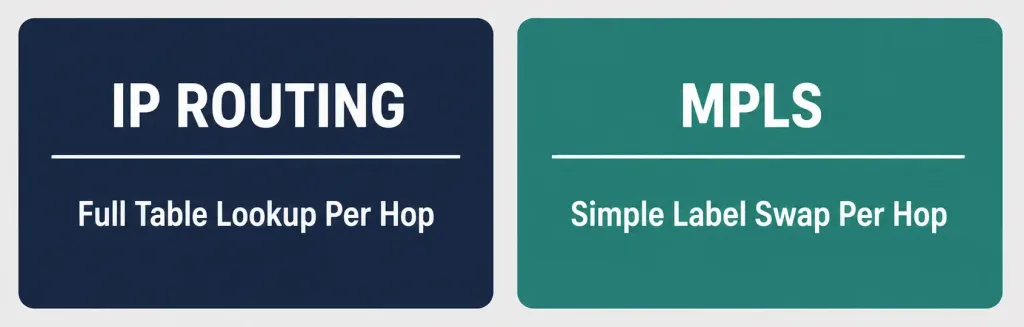
In traditional IP routing, each router independently resolves the next hop for a packet by examining its destination IP address and consulting its own routing table — a process that consumes both time and hardware resources at every single hop. This overhead becomes especially costly for real-time applications like voice and video, where consistent, low latency matters. MPLS was designed to solve exactly this problem.
Why MPLS Is “Multiprotocol”
It earns its name because it can carry virtually any payload, including IPv4, IPv6, Ethernet, ATM, DSL, and Frame Relay traffic. MPLS attaches a label to a packet that tells routers along the path what to do with it. These labels identify paths between remote routers rather than identifying endpoints directly, which is the core conceptual shift from traditional IP routing.
There’s a precise distinction worth understanding here: while MPLS actually routes IPv4 and IPv6 packets — meaning labels for this traffic are derived from IP routing information — everything else it carries is switched, forwarded purely based on the label itself without any IP-layer route resolution. This is exactly what makes MPLS genuinely multiprotocol rather than just another IP-centric technology.
Service providers commonly use MPLS to transport any type of packet between different customer sites, and MPLS can encapsulate packets of different network protocols regardless of their original format. It supports a broad range of WAN access technologies, including T-carrier links, E-carrier links, Ethernet, ATM, Frame Relay, and DSL, letting different sites connect into the same MPLS cloud using whatever access technology fits their location best.
How MPLS Labels Work
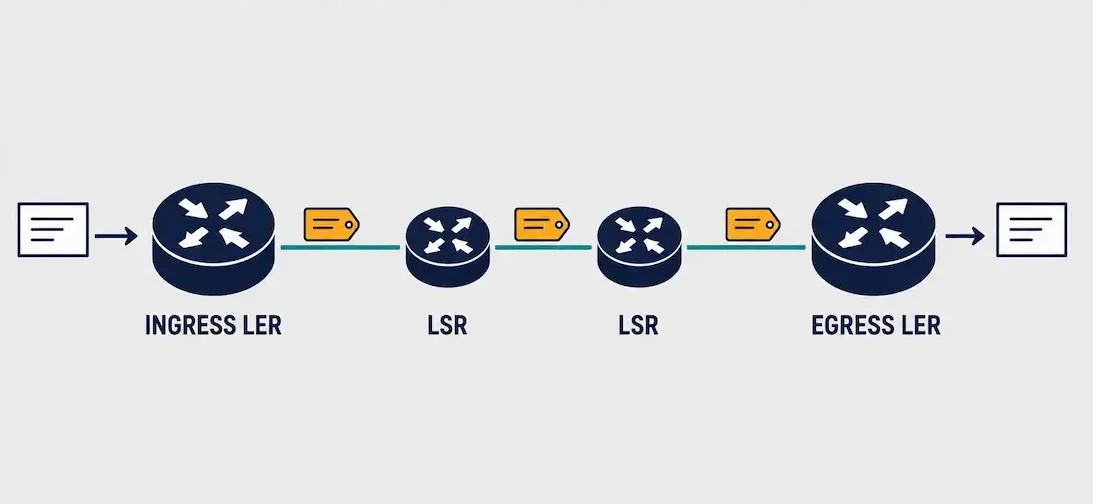
When a packet enters a Label Switched Path (LSP), the ingress Label Edge Router (LER) examines the packet and applies a label based on its destination, inserting that label into the packet’s header. This label transforms the packet’s journey from IP routing to label switching for the rest of its trip through the provider network.
The packet then moves to the next Label Switch Router (LSR) in the path. Every LSR along the way forwards the packet based solely on the MPLS label — it doesn’t re-examine the original IP header or consult a full routing table the way a traditional router would. When the packet reaches the egress LER at the far end of the LSP, that router removes the label and forwards the original IP packet toward its final destination using standard IP routing.
The MPLS Label Structure
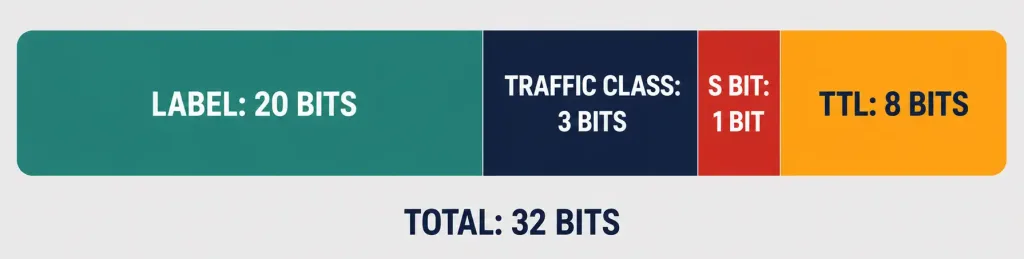
Every MPLS label header is exactly 32 bits, broken into four fields:
| Field | Size | Purpose |
|---|---|---|
| Label value | 20 bits | Identifies the specific label-switched path |
| Experimental (Traffic Class) | 3 bits | Carries QoS/traffic-class information |
| Bottom of Stack (S bit) | 1 bit | Marks whether this is the last label in a stacked label set |
| Time to Live (TTL) | 8 bits | Prevents forwarding loops, same purpose as IP’s TTL field |
Adding these together: 20 + 3 + 1 + 8 = 32 bits, matching the standard MPLS label header size exactly.
Worked Example: Following a Labeled Packet
Consider a branch office sending traffic to headquarters across an MPLS provider network. The customer edge router hands the packet to the provider’s ingress LER, which examines the destination IP address, determines the appropriate LSP, and pushes a 32-bit label onto the packet. As the packet travels through the provider’s core, each LSR performs a simple label swap: it looks up the incoming label in a local table, replaces it with the outgoing label for the next hop, and forwards the packet — all without inspecting the original IP header at all.
When the packet reaches the egress LER near headquarters, that router pops the label off, revealing the original IP packet, and delivers it using conventional IP routing on the last leg of the journey. This label-swapping approach at every intermediate hop is what allows MPLS core routers to forward traffic significantly faster than routers that must perform a full routing-table lookup on every packet.
Label Distribution: LDP vs. RSVP-TE
LSPs don’t configure themselves — labels need to be distributed and agreed upon between routers before traffic can flow. Two protocols commonly handle this:
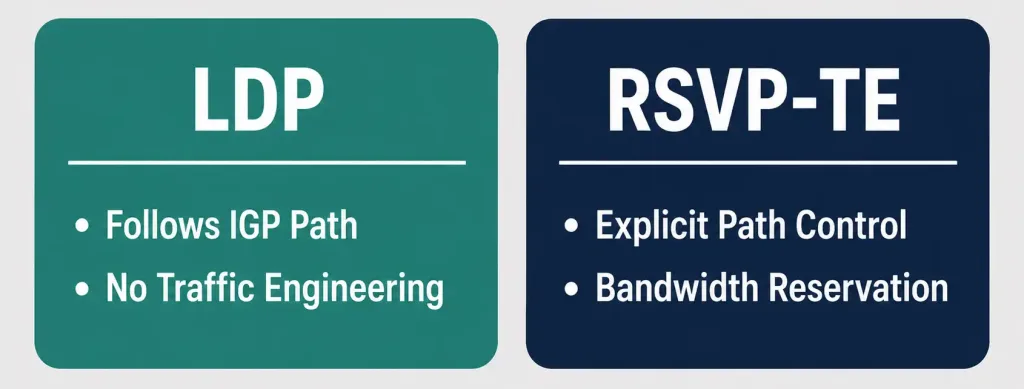
- Label Distribution Protocol (LDP): Distributes labels along paths that already exist based on the underlying IGP (like OSPF or IS-IS), without any traffic engineering awareness. LDP is simpler to deploy and is common for standard MPLS VPN services.
- RSVP-TE (Resource Reservation Protocol – Traffic Engineering): Adds explicit path control and bandwidth reservation, letting a provider steer specific traffic along a chosen path rather than simply following the IGP’s shortest path. RSVP-TE is used when tighter control over latency-sensitive or bandwidth-guaranteed traffic is needed.
Most everyday MPLS VPN traffic runs over LDP-established paths, while RSVP-TE is reserved for scenarios that genuinely need engineered, non-default paths through the network.
MPLS vs. Ethernet WAN and VPLS
Understanding where MPLS fits relative to other modern WAN options clarifies when it’s the right choice:
| Factor | MPLS | Ethernet WAN | VPLS |
|---|---|---|---|
| Scalability to many sites | Excellent | Good | Limited at large scale |
| Traffic engineering | Yes (RSVP-TE) | Limited | No |
| Payload flexibility | Any protocol | Ethernet frames only | Ethernet frames only |
| Typical cost | Higher | Moderate | Moderate |
| Best fit | Large, dispersed enterprises | Metro-area connectivity | LAN-like multipoint connectivity |
MPLS’s key advantage over both Ethernet WAN and VPLS is its combination of payload flexibility and traffic engineering — a provider can carry a customer’s IP traffic, legacy Frame Relay circuits, and voice traffic across the same core network while still guaranteeing performance for the traffic that needs it most. This flexibility is exactly why many providers use MPLS as the underlying transport for their Ethernet WAN and VPLS offerings rather than treating them as separate networks.
Real-World Deployment Context
MPLS remains a dominant choice for enterprise WAN connectivity, especially for organizations with many geographically dispersed branch offices needing to reach a central data center or headquarters. A retail chain with 200 stores, for example, might use an MPLS VPN service from a carrier to connect every store to a central point-of-sale and inventory system, relying on the provider’s MPLS core to route traffic efficiently between however many sites are added over time, without needing to reconfigure a full mesh of individual connections between every pair of sites.
It is also widely used to carry voice and video traffic between sites, since its traffic-class bits allow providers to prioritize latency-sensitive packets over routine data traffic on the same shared infrastructure — a capability that’s considerably harder to achieve reliably over the best-effort public Internet without an SD-WAN overlay.
Many enterprises today are transitioning away from pure MPLS toward SD-WAN architectures that use the public Internet alongside, or instead of, dedicated MPLS circuits — often citing cost savings and deployment speed as the primary drivers. Even so, MPLS frequently remains part of a hybrid design, handling the most critical, latency-sensitive traffic while SD-WAN manages lower-priority traffic over cheaper broadband links. This hybrid approach reflects a broader pattern in WAN design: rather than fully replacing an established technology, newer approaches often absorb its strongest use cases while redirecting less demanding traffic elsewhere.
Advantages of MPLS
- Faster forwarding: Label swapping at each hop avoids the overhead of a full IP routing-table lookup, improving performance for latency-sensitive traffic.
- Multiprotocol support: MPLS carries IPv4, IPv6, Ethernet, ATM, Frame Relay, and DSL traffic over the same infrastructure.
- Traffic engineering: RSVP-TE allows providers to control exactly which path specific traffic takes, supporting bandwidth guarantees and QoS.
- Scalable to many sites: MPLS handles large numbers of geographically dispersed sites more efficiently than point-to-point alternatives like VPLS.
- Access technology flexibility: Different sites can connect to the same MPLS cloud using different access technologies best suited to their location.
Disadvantages of MPLS
- Cost: MPLS service from a carrier is typically more expensive than Internet-based alternatives like a standard VPN.
- Provider dependency: Enterprises rely on their MPLS provider’s network design and coverage, limiting flexibility compared to self-managed connectivity options.
- Complexity: Configuring and troubleshooting label distribution, especially with RSVP-TE traffic engineering, requires more specialized knowledge than simpler WAN technologies.
- Slower to provision: Adding a new site to an MPLS network typically takes longer than standing up an Internet-based VPN connection, since it usually involves coordinating with the provider’s local access infrastructure.
Troubleshooting and Exam Tips
- Remember the exact label structure: 20-bit label value, 3-bit experimental/traffic class, 1-bit bottom-of-stack, 8-bit TTL — totaling 32 bits.
- Know the precise distinction behind “multiprotocol”: MPLS actually routes IPv4 and IPv6 packets (labels derived from IP routing information), while everything else is purely switched based on the label itself.
- Distinguish LDP from RSVP-TE: LDP follows the existing IGP’s chosen path with no traffic engineering, while RSVP-TE provides explicit path control and bandwidth reservation.
- If a question describes a service provider technology carrying diverse traffic types (IP, Frame Relay, ATM, Ethernet) across the same core network, MPLS is very likely the intended answer.
- Remember MPLS’s role as an LER/LSR-based architecture: only the ingress and egress LERs interact with the original IP header; every intermediate LSR forwards based purely on the label.
Conclusion
MPLS (Multiprotocol Label Switching) forwards traffic using short labels rather than IP address lookups at every hop, dramatically reducing the per-packet overhead that traditional IP routing requires at scale. Its ability to carry virtually any payload — IPv4, IPv6, Ethernet, ATM, Frame Relay, and DSL — over a single unified core, combined with traffic engineering capabilities via RSVP-TE, has made it the backbone technology of choice for service providers and large enterprises connecting many geographically dispersed sites. Understanding its label structure, LER/LSR architecture, and label distribution protocols remains foundational CCNA and real-world WAN design knowledge, even as SD-WAN increasingly reshapes how that WAN design gets implemented in practice.
Frequently Asked Questions
What does MPLS stand for?
It stands for Multiprotocol Label Switching, a wide area network protocol that forwards packets between routers using short labels rather than examining IP addresses at every hop.
When was MPLS developed?
The concept originated in 1996 among engineers from Cisco, IBM, and StrataCom. An IETF working group formed in 1997, and the architecture was formally standardized in RFC 3031, published in 2001.
What is the structure of an MPLS label?
An MPLS label is 32 bits total: a 20-bit label value, a 3-bit experimental/traffic class field, a 1-bit bottom-of-stack indicator, and an 8-bit TTL field.
What is the difference between LDP and RSVP-TE?
LDP distributes labels along paths already determined by the underlying IGP, without traffic engineering capability. RSVP-TE adds explicit path control and bandwidth reservation, used when specific traffic needs guaranteed performance along a chosen path.
Why is MPLS called “multiprotocol”?
Because it can carry virtually any payload type — including IPv4, IPv6, Ethernet, ATM, Frame Relay, and DSL — over the same underlying label-switched infrastructure, rather than being limited to a single Layer 2 or Layer 3 protocol the way many older WAN technologies were.