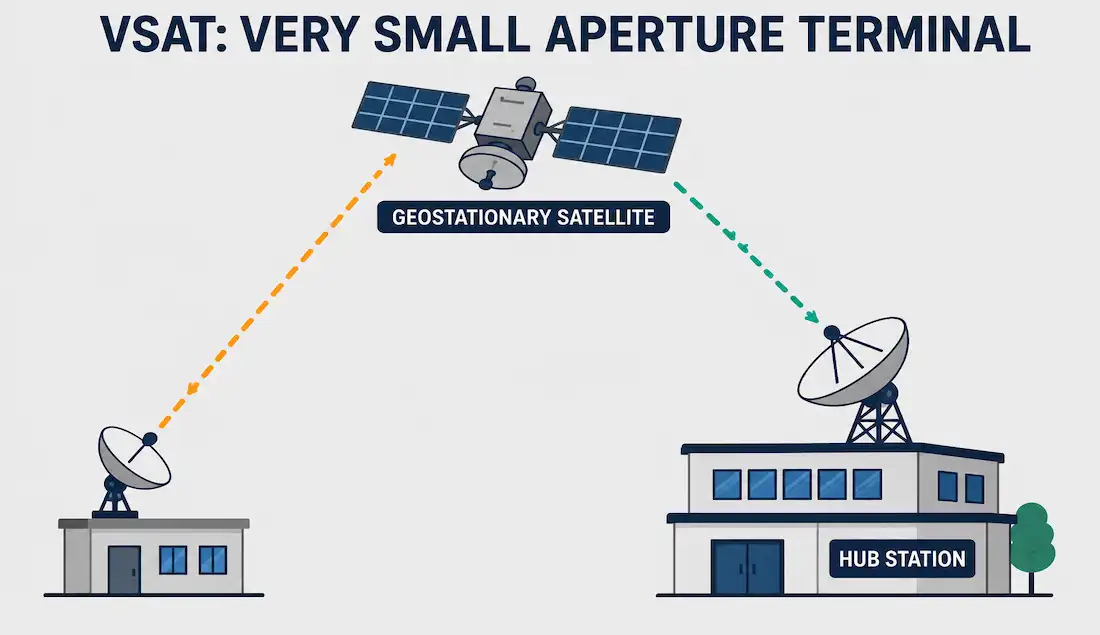
VSAT stands for Very Small Aperture Terminal. It’s an important WAN technology for both home users and organizations that need connectivity in remote areas where fiber optic, copper cable, and microwave links simply aren’t available. VSAT creates a private WAN using satellite communications, making it one of the few WAN technologies genuinely usable almost anywhere on Earth.
A VSAT setup consists of a small satellite dish similar to those used for home Internet and TV, connected to a router that points at a service provider’s satellite in geostationary orbit.
Why Geostationary Orbit Matters
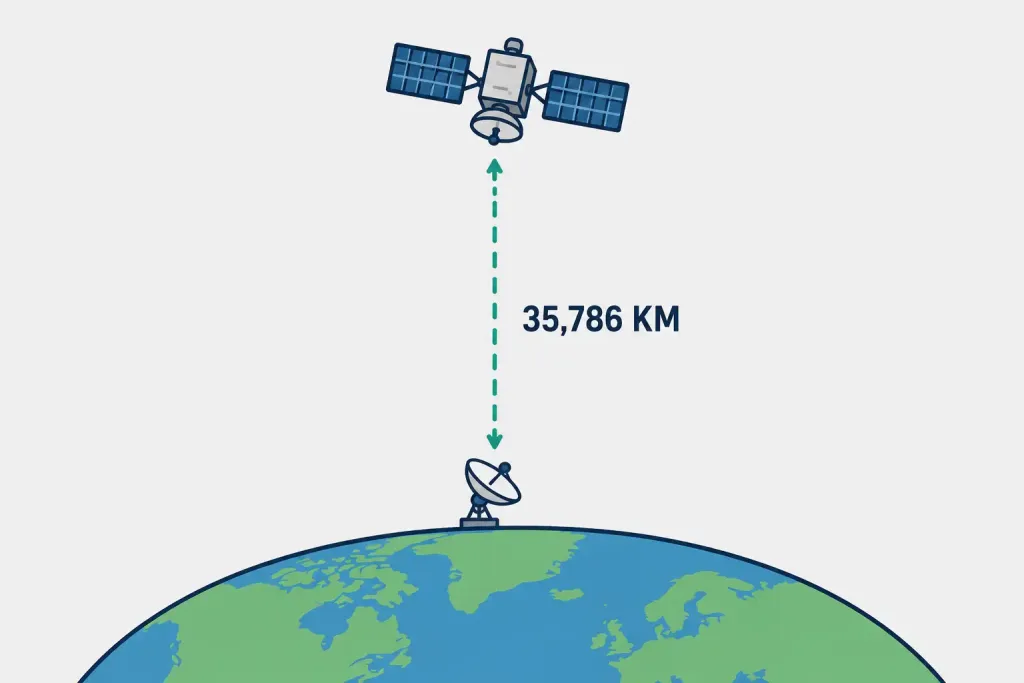
VSAT networks are typically built on geostationary satellites positioned 35,786 km above the Earth’s equator. Because a geostationary satellite’s orbital period exactly matches the Earth’s rotation period, the satellite appears to hover in a fixed position in the sky — which means the ground dish never needs to rotate or track a moving target once it’s pointed and locked onto its satellite.
This fixed geometry is a major operational advantage, but it comes with an unavoidable physical cost: distance. Every signal has to travel 35,786 km up to the satellite and 35,786 km back down — and because VSAT networks use a star topology through a central hub station, a single message actually makes this trip twice.
Worked Example: Why VSAT Latency Is Around 600 Milliseconds
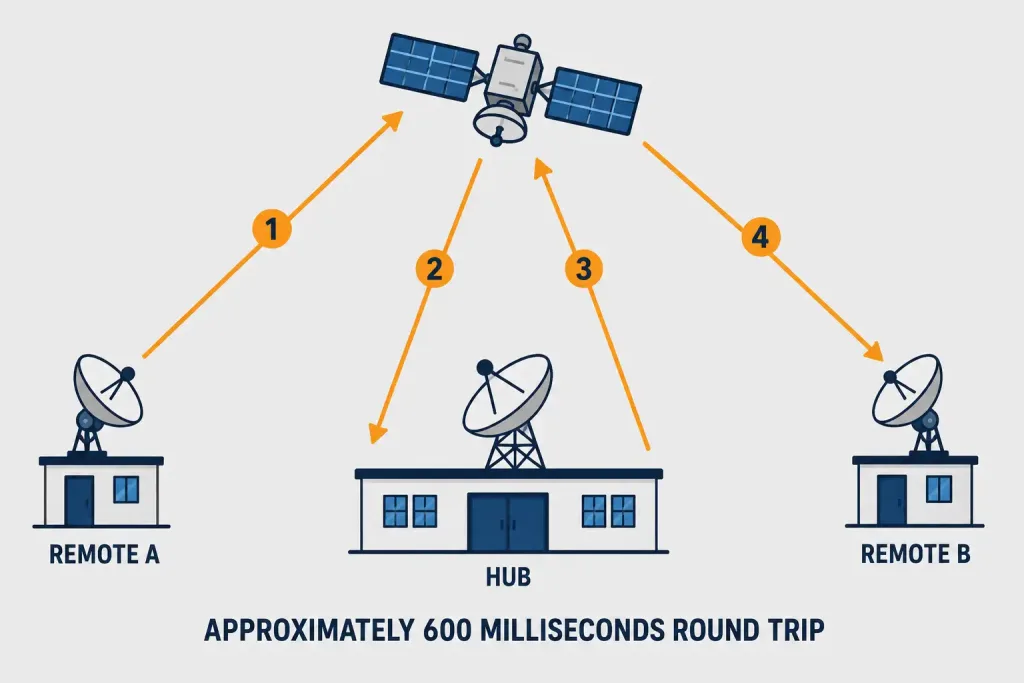
Radio signals travel at the speed of light (roughly 300,000 km per second). A single hop — up to the satellite and back down, 71,572 km total — takes about 240 milliseconds. But because VSAT remote terminals communicate through a central hub rather than directly with each other, a message from one remote site to another actually makes two full hops: remote to satellite to hub, then hub to satellite to remote again.
That’s a physics-based minimum of roughly 480-540 milliseconds round trip, and once modem processing, error correction, and network equipment delays are factored in, real-world VSAT latency commonly lands in the 550-700 millisecond range. This is precisely why VSAT struggles with latency-sensitive applications like real-time voice calls or interactive gaming, even though it handles email, file transfers, and point-of-sale transactions without issue.
How a VSAT Network Is Structured
A VSAT end-user needs a router that interfaces between the user’s computer and an outside antenna with a transceiver, which sends and receives signals to and from a satellite transponder in orbit. Every VSAT network also requires a hub station on the ground.
Remote VSAT terminals are interconnected with the hub station via the satellite in a star topology, and the hub station controls the entire operation of the network. When one remote user wants to communicate with another, the transmission always travels through the hub first: Station A’s data goes up to the satellite, down to the hub, back up to the satellite, and finally down to Station B. VSAT networks support voice, video, and data traffic across this same architecture.
VSAT Terminal Components
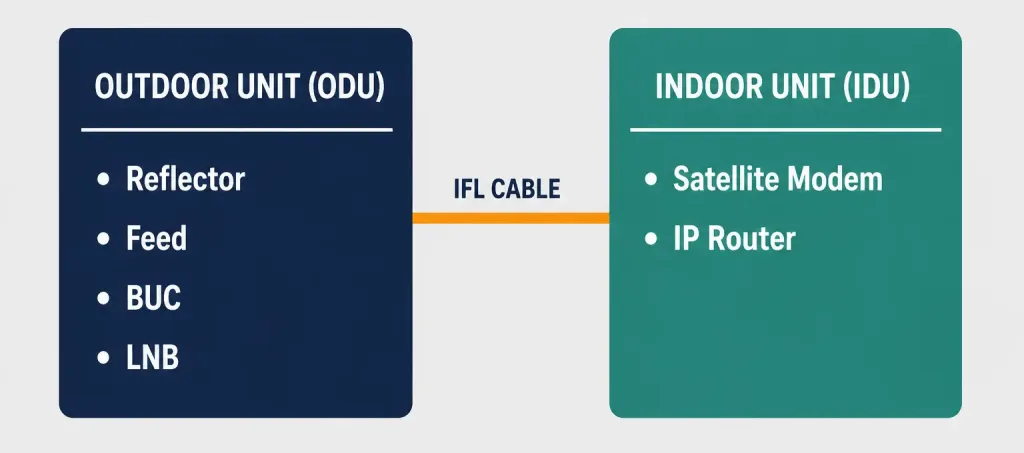
That satellite dish visible on the roof of a corporate building or gas station is a VSAT terminal. Every VSAT contains two primary sections: the Outdoor Unit (ODU) and the Indoor Unit (IDU).
Outdoor Unit (ODU)
The ODU covers everything installed outside the building, enabling the terminal to transmit and receive signals to and from the satellite:
- Reflector: The antenna dish itself, typically less than 3.8 meters in diameter under standard VSAT industry definitions. In practice, most modern VSAT dishes range from 0.75 to 2.4 meters, with smaller antennas under 1.2 meters common for enterprise and mobile deployments.
- Feed: Transmits signals toward the reflector and receives signals back from it.
- BUC (Block Upconverter): Handles signal transmission, consisting of a local oscillator and a power amplifier.
- LNB (Low Noise Block Down Converter): Handles receiving signals from the reflector.
Indoor Unit (IDU)
The ODU connects to the IDU using an Intra-Facility Link (IFL) cable, usually a coaxial cable. The IDU consists of the satellite modem and an IP router. The router connects to an Ethernet interface, through which data is sent and received to and from the end-user’s equipment.
How VSAT Signal Transmission Works
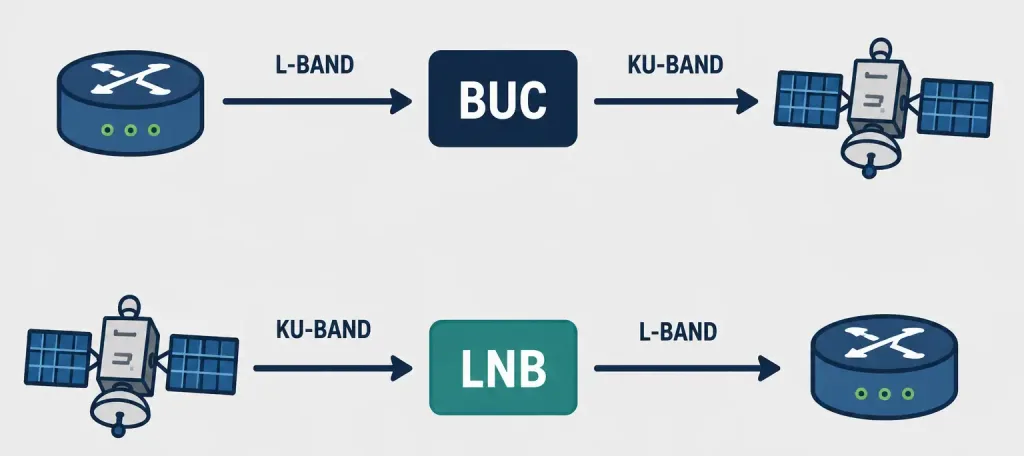
A VSAT terminal receives data from the end user’s equipment through the LAN port of the satellite router. The router processes this data and sends it to the satellite modem, which converts the incoming traffic into either a continuous Single Channel Per Carrier (SCPC) stream or a burstable Time Division Multiple Access (TDMA) modulated carrier, depending on the network design.
The router sends this modulated carrier to the BUC over coaxial cable. The BUC’s transmitter converts the signal from the Intermediate Frequency (IF) band — typically L-band — up to a higher frequency, usually C, X, Ku, or Ka-band, and sends the converted signal to the satellite in orbit.
The satellite receives the signal, amplifies it, and retransmits it back down to the satellite hub or to other VSAT terminals. A single satellite can support multiple frequencies simultaneously, producing multiple beams of different shapes to cover different geographic regions, and multiple ground antennas can receive the signal transmitted from the satellite at once.
On the receiving end, the dish and LNB amplify the incoming signal, convert it back down to the intermediate frequency band, and deliver it to the satellite modem via coaxial cable. The modem demodulates the signal and passes it to the satellite router, which processes it and delivers it to the end user’s computer as voice, video, or data.
Real-World VSAT Use Cases
VSAT’s combination of independence from terrestrial infrastructure and rapid deployability has made it a mainstay across several industries, particularly ones with geographically dispersed operations far from reliable wired networks:
- Retail and retail petroleum: Chain stores and gas stations use VSAT to support point-of-sale systems, credit card processing, and in-store ATMs, especially at locations without reliable terrestrial connectivity.
- Banking and finance: Banks use VSAT to connect rural branches and ATMs, and to provide backup connectivity for wired networks. Some of the world’s largest stock exchanges rely on VSAT networks to reach trading locations where wired options are limited.
- Oil, gas, and maritime: Remote drilling sites, offshore platforms, and vessels at sea depend on VSAT for voice, data, and SCADA telemetry where no other connectivity option exists.
- Emergency response and disaster recovery: Agencies set up VSAT terminals at pop-up relief sites after disasters like hurricanes or earthquakes, when local terrestrial infrastructure has been damaged or destroyed.
Advantages of VSAT
VSAT presents several advantages over other WAN technologies, starting with independence: an organization using VSAT has complete control of its communication system rather than depending on local telecommunications carriers. Other advantages include:
- Coverage of large areas without new infrastructure: VSAT can replace an extensive physical network across a wide geographic area since it relies on satellite signals rather than ground-based cabling.
- Minimal local infrastructure needed: VSAT requires far less on-the-ground infrastructure to serve remote locations compared to laying fiber or copper.
- Independence from local telecom systems: This makes VSAT an ideal backup for wired systems, reducing business continuity risk during outages.
- Universal service support: Voice, video, and data service work virtually anywhere with a clear view of the sky.
- Rapid deployment: VSAT terminals can be deployed on short notice, which is exactly why disaster response agencies favor them.
- Mobile and on-the-move communication: Specialized VSAT terminals support communication while in motion or shortly after stopping.
- Shared bandwidth efficiency: Bandwidth is shared dynamically across all terminals on the network rather than being rigidly partitioned.
- Strong multicast support: VSAT’s broadcast-friendly satellite architecture handles multicast traffic efficiently.
- Wide coverage with centralized management: A single hub can manage and monitor an entire geographically dispersed network.
- Reliable and stable: VSAT is a dependable communication method once properly installed and configured.
- Flexible bandwidth options: VSAT supports both narrowband and broadband communication depending on the terminal and service tier.
Disadvantages of VSAT
- Latency: As explained above, VSAT’s double-hop architecture through a hub creates a physics-based minimum latency of roughly 500-700 milliseconds, making it a poor fit for real-time voice calls or interactive applications.
- Weather sensitivity: Heavy rain or storms can significantly degrade VSAT signal quality, particularly at higher frequency bands like Ku-band and Ka-band — a phenomenon known as rain fade.
- Bandwidth and cost tradeoffs: Higher-throughput VSAT service tiers come at a meaningfully higher cost than comparable terrestrial options where those options are actually available.
Modern Developments: LEO and MEO Alternatives
Traditional VSAT’s biggest limitation — high latency from geostationary orbit — is exactly what newer Low Earth Orbit (LEO) satellite constellations are designed to address. A LEO satellite orbiting at roughly 550 km, rather than the 35,786 km of geostationary orbit, cuts single-hop round-trip latency down to under 30 milliseconds in many cases, dramatically closer to terrestrial broadband performance. Services built on these constellations are increasingly positioned as alternatives to traditional VSAT for applications where latency genuinely matters, such as VoIP or real-time collaboration.
That said, traditional geostationary VSAT retains real advantages that keep it in active use: mature, widely deployed ground equipment, proven reliability for latency-tolerant applications like SCADA telemetry and point-of-sale transactions, and often lower cost per terminal for organizations that don’t need the lower latency LEO systems provide. Many enterprises with mixed traffic needs deploy both technologies side by side, routing latency-sensitive traffic over LEO links while keeping cost-sensitive, latency-tolerant traffic on established geostationary VSAT circuits.
Troubleshooting and Exam Tips
- Remember the geostationary orbit altitude precisely: 35,786 km above the equator.
- Understand why VSAT latency is inherently high: the double-hop architecture (remote → satellite → hub → satellite → remote) roughly doubles the delay of a single satellite hop.
- Know the ODU/IDU split: the ODU includes the reflector, feed, BUC, and LNB; the IDU includes the satellite modem and IP router, connected via an IFL cable.
- Distinguish BUC (transmission, contains a local oscillator and power amplifier) from LNB (reception) — a common point of confusion.
- If a scenario describes needing connectivity in a location with no fiber, copper, or microwave infrastructure and where rapid deployment matters, VSAT is very likely the intended answer.
Conclusion
VSAT (Very Small Aperture Terminal) creates a private WAN using small satellite dishes communicating with geostationary satellites, making it one of the only WAN technologies that can reach truly remote locations with no other infrastructure. Its star-topology, hub-based architecture explains both its key strength — centralized management and wide coverage — and its key weakness — the roughly 500-700 millisecond double-hop latency that makes it unsuitable for real-time applications. From retail point-of-sale systems to disaster recovery operations, VSAT remains a genuinely important WAN technology wherever terrestrial connectivity simply isn’t an option.
Frequently Asked Questions
What does VSAT stand for?
VSAT stands for Very Small Aperture Terminal, a satellite-based WAN technology that connects remote locations using small dish antennas and geostationary satellites.
How much latency does VSAT have?
A single geostationary satellite hop has a physics-based minimum round-trip latency of roughly 480-540 milliseconds. Because VSAT networks route traffic through a central hub in a star topology, real-world latency between two remote sites commonly runs 550-700 milliseconds once processing overhead is included.
How big is a VSAT dish?
Under the standard industry definition, a VSAT dish is smaller than 3.8 meters in diameter. In practice, most modern VSAT terminals use dishes ranging from 0.75 to 2.4 meters.
What is the difference between the ODU and IDU in a VSAT system?
The Outdoor Unit (ODU) includes everything installed outside, such as the reflector, feed, BUC, and LNB. The Indoor Unit (IDU) includes the satellite modem and IP router, connected to the ODU via an Intra-Facility Link (IFL) cable.
What industries commonly use VSAT?
Retail, banking and finance, oil and gas, maritime, and emergency response organizations are among the most common VSAT users, particularly for connecting remote sites, supporting point-of-sale systems and ATMs, and providing disaster recovery connectivity.