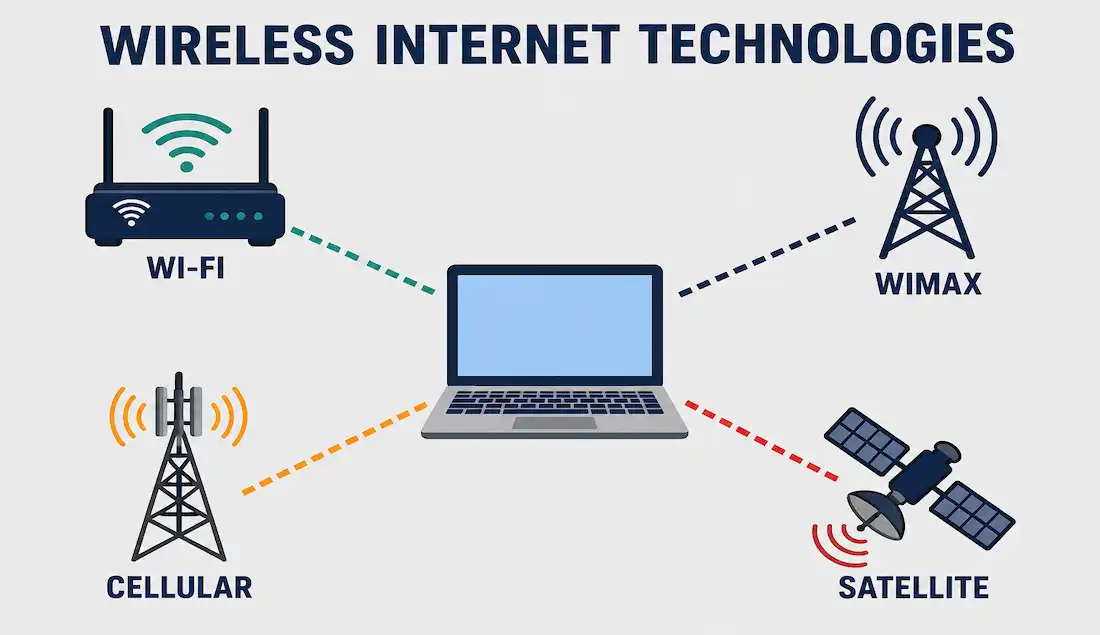
Wireless internet uses radio waves instead of physical wires to connect a personal computer, laptop, smartphone, or other device to the Internet. Early wireless technologies lacked the high speed of broadband connections like cable and DSL, but modern wireless technologies have largely closed that gap, and in some cases surpassed it.
Wireless Internet Service Providers (WISPs) typically deliver wireless internet service to home users and organizations using radio waves or satellite signals, filling gaps that traditional wired ISPs don’t reach. Connecting to a wireless network generally requires a wireless internet modem, a wireless access card, or an internet dongle, depending on the specific technology in use. WiMAX and EV-DO are two well-known examples of wireless internet technologies, each representing a different approach to delivering broadband without wires.
Understanding Wireless Internet’s Range Tradeoff
Most everyday wireless technologies, like standard Wi-Fi, use unlicensed radio spectrum, which is freely accessible to anyone with a compatible wireless router and device. This openness comes with a real tradeoff: standard Wi-Fi’s practical range is typically less than 100 feet indoors, since unlicensed spectrum operates at limited transmit power to avoid interference between nearby networks.
This range limitation is specific to short-range technologies like Wi-Fi, not to wireless internet broadly. As the sections below show, technologies like WiMAX and satellite internet were specifically engineered to cover dramatically larger distances than standard Wi-Fi, trading some of Wi-Fi’s simplicity and low cost for much greater reach.
Municipal Wi-Fi
Municipal Wi-Fi networks have been deployed in many cities around the world, providing high-speed Internet service for free or at considerably lower prices than typical broadband options. Subscribers usually need a Wi-Fi modem with a directional antenna to connect reliably to a municipal network, since these networks often cover a wider area than a single indoor access point. Service providers frequently supply this equipment either free of charge or for a modest fee, depending on the specific municipal program.
Worldwide Interoperability for Microwave Access (WiMAX)
The IEEE 802.16 standard describes WiMAX technology, which provides high-speed broadband internet access wirelessly, at speeds and coverage distances well beyond what standard Wi-Fi can achieve. WiMAX uses towers similar in concept to cellular towers, and fixed WiMAX under ideal line-of-sight conditions can theoretically reach distances of up to 30 miles, though real-world non-line-of-sight coverage is typically limited to several miles depending on terrain and obstructions.
To use WiMAX service, a subscriber needs an ISP with a WiMAX tower within range of their location, along with a WiMAX receiver and the necessary authentication credentials to access the base station.

WiMAX’s History as a Mobile Broadband Competitor
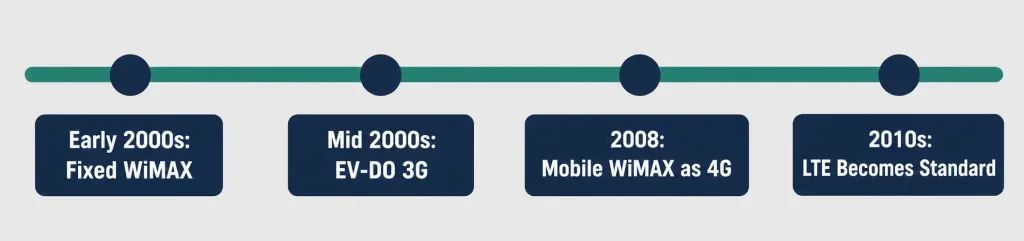
WiMAX’s story is more interesting than a simple fixed-broadband replacement for DSL and cable. A later revision of the standard, 802.16e (often called Mobile WiMAX), added genuine mobility support, positioning WiMAX as a direct competitor to 3G and eventually 4G cellular technologies — not, as sometimes mischaracterized, as something delivered “through Wi-Fi hotspots.” Sprint notably built out a nationwide Mobile WiMAX network in the United States around 2008, marketing it as one of the first “4G” mobile broadband services, years before LTE became the dominant global 4G standard.
Ultimately, the wireless industry settled on LTE rather than Mobile WiMAX as the international 4G standard, and most carrier WiMAX deployments were phased out over the following decade. WiMAX still persists today primarily in fixed wireless broadband and backhaul applications rather than mobile consumer service.
Cellular Broadband: EV-DO and Beyond
EV-DO (Evolution-Data Optimized) represents a different path to wireless internet: delivering broadband data over the same cellular networks used for phone calls, rather than through dedicated fixed-wireless towers built solely for data. EV-DO was built on the CDMA2000 cellular standard and became a widely deployed 3G mobile data technology in North America and parts of Asia, offering typical real-world speeds in the hundreds of kilobits to low megabits per second — a significant leap over the dial-up-class speeds of earlier cellular data standards.
Like WiMAX, EV-DO has since been phased out by major carriers in favor of LTE and newer standards, but it illustrates the same broader pattern: wireless internet increasingly rides on evolving cellular infrastructure rather than dedicated fixed-wireless towers alone.
Satellite Internet
Satellite internet is typically used in remote areas where cable and DSL infrastructure isn’t available. A VSAT terminal can be used for both uploading and downloading data over a satellite connection. To use satellite internet service, a subscriber needs a satellite dish, modems to handle the uplink and downlink signal paths, and coaxial cables connecting the dish to the indoor equipment.
Because satellite internet relies on a signal traveling to and from geostationary orbit, it carries meaningfully higher latency than terrestrial wireless options like Wi-Fi, WiMAX, or cellular broadband — a tradeoff worth understanding when comparing wireless internet options for latency-sensitive applications like video calls or online gaming.
Worked Example: Choosing a Wireless Technology for a New Site
Imagine planning connectivity for three new business locations: a downtown retail store, a farm 15 miles outside city limits, and a remote mining operation 200 miles from the nearest town. The downtown store sits within easy reach of both cable and standard Wi-Fi, so wireless internet likely isn’t even necessary there. The farm, 15 miles out, falls within realistic fixed-WiMAX or similar point-to-multipoint wireless ISP range if a suitable tower exists nearby, making it a strong candidate for terrestrial fixed wireless rather than satellite.
The remote mining operation, far beyond any terrestrial tower’s realistic reach, has no practical option other than satellite internet, despite its latency drawback — the tradeoff is worth accepting since no other technology can physically reach that location at all. This kind of distance-based decision tree is exactly how real network planners choose between competing wireless technologies.
Real-World Deployment Context
A rural municipality with limited fiber or cable infrastructure often ends up combining several of these wireless technologies rather than relying on just one single option. A small town might deploy municipal Wi-Fi covering its downtown core for free public access, while a local WISP builds a fixed WiMAX or similar point-to-multipoint network to reach outlying farms and homes within a several-mile radius of a central tower, and the most remote properties beyond that radius fall back to satellite internet as their only viable option.
This layered approach — matching each area’s connectivity needs to the wireless technology best suited to its distance and density — reflects how real ISPs and municipalities actually plan wireless coverage rather than picking a single technology for an entire region.
A similar logic applies to disaster response: emergency responders might rely on cellular broadband where towers remain operational, switch to satellite VSAT terminals when cellular infrastructure has been damaged, and deploy portable Wi-Fi hotspots at relief centers for last-mile connectivity to affected residents’ personal devices — three different wireless technologies working together to restore connectivity as quickly and broadly as possible.
Comparing Wireless Internet Technologies
| Technology | Typical Range | Typical Latency | Best Fit |
|---|---|---|---|
| Wi-Fi | Under 100 feet | Very low | Indoor local connectivity |
| WiMAX | Several miles (up to 30 mi line-of-sight) | Low | Fixed broadband, rural backhaul |
| EV-DO / Cellular | Miles (carrier-dependent) | Low to moderate | Mobile broadband |
| Satellite (VSAT) | Continental/global | High (500+ ms) | Remote areas with no other option |
Advantages of Wireless Internet
- No cabling required: Wireless technologies eliminate the cost and complexity of running physical cable to every single location that needs connectivity.
- Rapid deployment: Wireless networks, especially WiMAX and satellite, can often be deployed faster than laying new fiber or copper infrastructure.
- Coverage in hard-to-reach areas: Satellite and WiMAX can reach locations where wired infrastructure is impractical or prohibitively expensive to build out.
- Mobility: Cellular-based wireless internet options like EV-DO (and its modern successors) let users stay connected while actively moving.
Disadvantages of Wireless Internet
- Limited range on unlicensed spectrum: Standard Wi-Fi’s sub-100-foot range requires multiple access points to cover larger areas.
- Interference susceptibility: Unlicensed spectrum is shared with many other devices and networks, which can degrade performance in crowded areas.
- Higher latency on satellite links: Satellite-based wireless internet carries inherently higher latency than terrestrial alternatives due to the physical distance to orbit.
- Legacy technology obsolescence: Standards like WiMAX and EV-DO have been largely superseded by LTE and 5G, meaning older wireless internet infrastructure may not receive continued investment or support going forward.
- Weather and physical obstruction sensitivity: Both fixed wireless technologies like WiMAX and satellite links can be affected by heavy rain, dense foliage, or terrain that blocks the required line of sight between endpoints.
Troubleshooting and Exam Tips
- Remember that standard Wi-Fi’s range limitation (under 100 feet) is specific to unlicensed-spectrum, short-range technology — don’t apply this figure to WiMAX or satellite, which cover vastly greater distances.
- Know the key WiMAX distinction: fixed WiMAX (802.16-2004) targeted DSL/cable replacement, while Mobile WiMAX (802.16e) was developed to compete directly with cellular 3G/4G technologies.
- Remember that EV-DO is a cellular data standard built on CDMA2000, not a Wi-Fi or fixed-wireless technology.
- If a scenario describes needing internet access in a remote area with no cable, DSL, or cellular coverage, satellite internet (VSAT) is typically the correct answer, despite its latency tradeoff.
- Distinguish licensed spectrum (used by cellular carriers and licensed WiMAX deployments) from unlicensed spectrum (used by standard Wi-Fi) — this affects both range and interference characteristics, since licensed spectrum protects operators from interference by other users in the same frequency band.
Conclusion
Wireless internet spans a spectrum of technologies, from short-range, unlicensed Wi-Fi covering under 100 feet, to WiMAX towers reaching miles across a city, to cellular standards like EV-DO delivering mobile broadband, to satellite links covering areas no terrestrial technology can reach at all. Each technology trades range, latency, mobility, and cost differently, which is exactly why understanding these tradeoffs — rather than treating “wireless internet” as a single undifferentiated category — matters for both the CCNA exam and real-world network design decisions where the right choice depends entirely on distance, budget, and the specific location being served.
Frequently Asked Questions
What is the range of standard Wi-Fi?
Standard Wi-Fi’s practical range is typically less than 100 feet indoors, due to the limited transmit power permitted on unlicensed radio spectrum.
Did WiMAX provide cell phone service?
Mobile WiMAX (802.16e) was developed specifically to compete with 3G and 4G cellular technologies, and Sprint notably marketed a nationwide Mobile WiMAX network as “4G” service around 2008 — this was delivered through dedicated WiMAX base stations, not through Wi-Fi hotspots.
What is EV-DO?
EV-DO (Evolution-Data Optimized) is a 3G mobile broadband standard built on CDMA2000 cellular networks, historically used to deliver wireless internet access directly to mobile devices before being phased out in favor of LTE.
Why does satellite internet have higher latency than other wireless options?
Because satellite internet signals must travel to and from a geostationary satellite roughly 35,786 km above the Earth, physical distance alone introduces significantly more delay than terrestrial wireless technologies like Wi-Fi, WiMAX, or cellular broadband.
Is WiMAX still used today?
Rarely for mobile consumer service, since LTE won out as the dominant 4G standard. WiMAX persists mainly in fixed wireless broadband and backhaul applications, particularly in rural or hard-to-reach areas where wired infrastructure remains impractical to install.