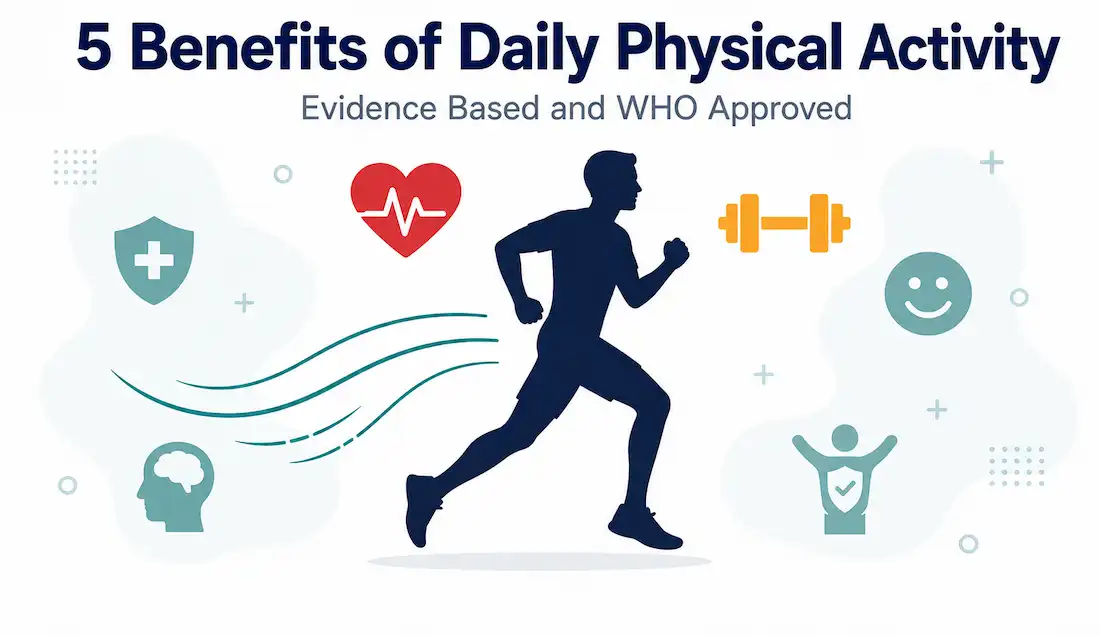
Regular physical activity is one of the most consistently supported interventions in preventive medicine — not because it’s a trendy wellness recommendation, but because decades of research link it to measurable reductions in chronic disease risk, improved mental health, and better long-term functional health. This guide covers five real, evidence-backed benefits, the actual guidelines behind them, and what “enough” activity looks like in practice.
How Much Activity Do You Actually Need?
Before the specific benefits, it’s worth anchoring to the actual guidelines, since “exercise more” isn’t a specific target. The World Health Organization and the U.S. CDC both recommend that adults get 150 to 300 minutes of moderate-intensity aerobic activity per week, or 75 to 150 minutes of vigorous-intensity activity, or an equivalent combination of the two, along with muscle-strengthening activity on two or more days per week covering all major muscle groups. This can be broken into manageable chunks — 30 minutes, five days a week, is the commonly cited example — rather than needing to happen in one continuous session. Importantly, both organizations emphasize that some activity is better than none: health benefits begin accumulating well below the full recommended amount, so the guideline is a target to work toward, not a threshold below which activity doesn’t count.
1. Improved Mental Health and Reduced Stress
The connection between physical activity and mood isn’t just anecdotal. WHO’s evidence review specifically identifies reduced symptoms of anxiety and depression as a benefit associated with meeting physical activity guidelines, and research consistently links regular activity to improved sleep quality and cognitive health as well. The mechanisms involved are genuinely multifactorial — exercise affects neurotransmitter activity, reduces circulating stress hormones over time, and improves sleep, which itself has a strong bidirectional relationship with mood and stress regulation.
This doesn’t mean physical activity is a substitute for treatment of a diagnosed mental health condition, but as a general, well-supported preventive and supportive measure, its effect on mood and stress is one of the more robust findings in this research area.
2. Supports Healthy Weight Management
Physical activity is one component of weight management, working alongside diet rather than as a standalone solution — but it’s a genuinely important one, both for weight regulation itself and for the health outcomes that improve independently of weight change. Regular aerobic activity increases energy expenditure, and combined with strength training, it helps preserve lean muscle mass during weight loss, which matters for long-term metabolic health. WHO’s guidelines note that measures of adiposity (body fat) tend to improve with regular physical activity, alongside broader improvements in cardiovascular and metabolic health markers.
It’s worth noting that weight is only one measure of health, and physical activity provides substantial cardiovascular, mental health, and disease-prevention benefits independent of any effect on body weight specifically — someone who is regularly active gets meaningful health benefits from that activity regardless of whether their weight changes.
3. Stronger Bones and Muscles
Muscle-strengthening activity is specifically called out in the guidelines as a distinct requirement alongside aerobic activity, not an optional extra — the CDC recommends activities that work all major muscle groups (legs, hips, back, abdomen, chest, shoulders, and arms) at least twice weekly. Resistance and weight-bearing exercise stimulates bone remodeling, helping to maintain bone density, which becomes increasingly important with age as bone density naturally declines and osteoporosis risk increases. Strength training also directly counteracts the gradual loss of muscle mass that otherwise occurs with aging (sarcopenia), which affects mobility, balance, and fall risk in older adults specifically.
For older adults, WHO and CDC guidelines add a further recommendation: activities that improve balance, alongside the standard aerobic and strength components, specifically to reduce fall risk — a leading cause of injury-related hospitalization in this age group.
4. Increased Energy and Reduced Fatigue
It seems counterintuitive that expending energy through exercise would increase overall energy levels, but this is a well-documented effect, particularly for people who are currently sedentary. Regular aerobic activity improves cardiovascular efficiency — a stronger heart and better oxygen delivery to tissues translates to less fatigue during everyday activities that previously felt more effortful. Improved sleep quality, one of the documented benefits of regular activity, also compounds this effect, since better sleep independently improves daytime energy and alertness.
This effect tends to build over weeks of consistent activity rather than appearing immediately, which is worth knowing if the first few sessions feel more tiring than energizing — that’s a normal adaptation period, not a sign the approach isn’t working.
5. Reduced Risk of Chronic Disease
This is the benefit with the strongest and broadest evidence base. Meeting physical activity guidelines is associated with improved all-cause mortality and reduced risk of cardiovascular disease mortality, incident hypertension, several site-specific cancers, and type 2 diabetes, according to WHO’s evidence review. These aren’t marginal associations — cardiovascular disease and type 2 diabetes in particular are among the most common, costly, and preventable chronic conditions globally, and physical activity is one of the most consistently supported, low-cost interventions for reducing their risk.
The evidence also shows a dose-response relationship: risk reduction continues to improve as activity increases from 150 up to around 300 minutes per week of moderate activity, though the rate of additional benefit begins to plateau beyond that point — useful context for understanding that more activity generally helps, without needing to pursue extreme volumes to get most of the benefit. This dose-response pattern is one of the more reassuring findings in this research area for people just starting out: it means that going from sedentary to moderately active produces a larger proportional risk reduction than going from moderately active to extremely active, so the biggest health gains are available to exactly the people who currently do the least.
What Actually Counts as Moderate or Vigorous Activity?
These terms get used often without much explanation, so it’s worth being concrete. Moderate-intensity activity raises your heart rate and breathing noticeably but still allows you to hold a conversation — brisk walking is the standard reference example, alongside activities like leisurely cycling, water aerobics, or general yard work. Vigorous-intensity activity raises heart rate and breathing to the point where talking in full sentences becomes difficult — running, fast cycling, swimming laps, or high-intensity interval training fall into this category.
Physical activity also doesn’t need to come from a structured workout specifically. The guidelines count activity accumulated through daily transportation (walking or cycling instead of driving), occupational movement (physically active work), and household tasks, alongside dedicated exercise — the total weekly volume is what matters for most of the health outcomes discussed here, not necessarily the specific setting it happens in.
Reducing Sedentary Time Matters Separately
Alongside the activity recommendations above, current WHO guidance also specifically addresses reducing sedentary behavior — time spent sitting or lying down while awake — as its own, separate recommendation, applicable across all age groups. This reflects a growing body of evidence that prolonged sitting carries health risks somewhat independent of whether someone otherwise meets their weekly activity target; someone who exercises for 30 minutes daily but is sedentary for the other 15+ waking hours isn’t necessarily offsetting all of the risks associated with that sedentary time. Simple interventions — standing or walking briefly every hour during a desk-based workday, for instance — are commonly recommended alongside, not instead of, meeting the core aerobic and strength targets.
A Sample Weekly Structure
There’s no single correct way to distribute activity across a week, but one common, sustainable approach looks like this:
- Three to five days: 30 minutes of moderate-intensity aerobic activity (brisk walking, cycling, swimming) — this alone covers the full 150-minute weekly aerobic target if done five days a week.
- Two days: strength training covering major muscle groups — this can be bodyweight exercises, resistance bands, or weights, and doesn’t need to be lengthy to count, provided it works the major muscle groups the guidelines specify.
- Throughout the week: small opportunities to reduce sedentary time — a walk during a lunch break, taking stairs instead of an elevator, standing periodically during long periods of sitting.
This structure is illustrative, not prescriptive — the actual guideline is about total weekly volume and consistency, and any distribution that reliably reaches the aerobic and strength targets provides the associated benefits.
Getting Started Safely
If you’re currently inactive, have a chronic health condition (such as heart disease, arthritis, or diabetes), or are pregnant or postpartum, it’s worth talking with a doctor about which types and amounts of activity are appropriate for your specific situation before starting a new routine, particularly before undertaking vigorous-intensity activity. For most people without such conditions, moderate-intensity activity — brisk walking is the standard example — is considered safe to begin without medical clearance, and building up gradually from whatever your current activity level is remains a reasonable, evidence-supported approach rather than attempting to meet the full weekly target immediately. If strength training is new to you, following a structured plan — a chest workout routine or similar guided program — can help ensure all major muscle groups are actually being covered rather than guessing at an ad hoc routine.
Frequently Asked Questions
Do I need to hit 150 minutes exactly, or does any amount help? Any amount helps. Both WHO and CDC guidance are explicit that some physical activity is better than none, and health benefits begin accumulating below the full recommended target. The 150-to-300-minute range is the target associated with the fullest documented benefit, not a threshold below which activity doesn’t count at all.
Can daily activities like housework or walking to work count toward the goal? Yes. The guidelines don’t require activity to come from structured exercise specifically — occupational movement, active transportation, and household tasks all contribute to the weekly total, provided they reach at least moderate intensity.
Is strength training really necessary, or is cardio enough? Both are specifically recommended as distinct components. Aerobic activity and muscle-strengthening activity affect different physiological systems — cardiovascular health and bone/muscle health respectively — and the guidelines treat them as separate, both-required elements rather than interchangeable options.
How soon will I notice the benefits? This varies by benefit and by starting fitness level. Mood and energy effects are often reported within the first few weeks of consistent activity, while structural benefits like bone density changes and measurable disease-risk reduction develop over a longer, sustained timeframe, generally months rather than days.
Should I check with a doctor before starting? If you have a chronic health condition, have been inactive for an extended period, have a disability, or are pregnant or postpartum, yes — check with a doctor about what’s appropriate for your specific situation, particularly before vigorous-intensity activity. For most otherwise healthy adults, starting with moderate-intensity activity like brisk walking doesn’t require medical clearance first.
Conclusion
The five benefits covered here — mental health, weight management support, bone and muscle strength, energy levels, and chronic disease risk reduction — aren’t independent claims; they reflect overlapping physiological effects of the same underlying behavior, consistently observed across a large body of research. The actionable target is specific and achievable: 150 to 300 minutes of moderate activity per week, plus strength training twice weekly, broken into whatever chunks fit your schedule. Given how broad and well-supported the evidence is across nearly every major health outcome category, regular physical activity remains one of the highest-value, lowest-cost interventions available for long-term health.