
Most “simple SEO tips” lists repeat the same handful of ideas without separating what Google has actually confirmed from what’s assumed or outdated. Here’s a more honest version: what’s genuinely supported by Google’s own guidance, what’s commonly overstated, and what current SEO advice usually leaves out entirely.
Write Content That Actually Answers the Question
Google’s RankBrain and broader ranking systems are built to match content to what a searcher is actually looking for, not just the words they typed. The practical takeaway isn’t mysterious: write content that directly and clearly answers the query a page is targeting, structured so the answer isn’t buried under unnecessary preamble. Google hasn’t published the specific mechanics of how its systems measure “user satisfaction,” so treat that part as informed inference rather than a documented formula — but the underlying advice (be direct, be clear, answer the actual question) holds regardless of the exact mechanism behind it.
Structure Content Around a Clear Outcome
A simple way to organize a page or post: state the outcome the reader will get, back it with evidence or specifics, and give a short preview of what’s coming before the detail. This isn’t a secret algorithmic signal — it’s a basic writing structure that happens to keep readers engaged, which indirectly supports rankings by reducing the chance someone leaves before finding what they came for.
Use Visuals That Add Real Value
Images, charts, and diagrams that genuinely clarify a point — not purely decorative stock photos — improve how long and how thoroughly people engage with a page. Alt text on every meaningful image also gives search engines additional context about the page’s content, and it’s a basic accessibility requirement independent of any SEO benefit.
Link Generously, But With a Reason
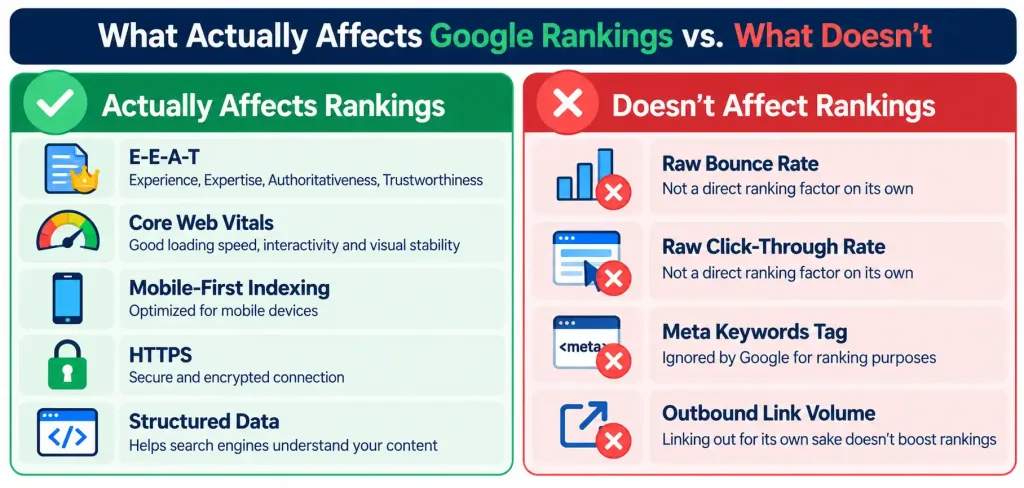
Internal links help search engines understand how pages on a site relate to each other and help readers find genuinely relevant related content. External links to authoritative, relevant sources can strengthen a page’s credibility when they’re genuinely useful citations — not when they’re inserted purely to create outbound link volume. “Link out a lot and often” isn’t itself a ranking strategy; linking out because a source adds real value is.
Write Headlines That Are Clear, Not Just Clickable
A headline’s job is to accurately represent what the content delivers while being specific enough to earn a click. Headlines that overpromise and underdeliver hurt engagement once someone actually reads the page, which undercuts any short-term click advantage. Specificity (a number, a concrete outcome, a clear subject) generally outperforms vague curiosity-gap phrasing over time.
Engagement Signals: What’s Actually Confirmed, and What Isn’t
This is worth being precise about, since it’s one of the most commonly overstated parts of SEO advice: Google has publicly and repeatedly stated that raw click-through rate and bounce rate are not used as direct ranking signals in the way many SEO articles imply. What does matter is the underlying reality those metrics sometimes reflect — if people genuinely find a page useful, that correlates with (but doesn’t directly cause) better rankings through other mechanisms, like earning more links and return visits over time. Encouraging comments, discussion, and calls to action is good practice for building an engaged audience, but it should be understood as building a better page and a stronger audience relationship, not as feeding a specific “engagement” ranking signal.
Promote Content Through Channels People Actually Want
Sharing new content through email newsletters and social channels you already have an audience on is a reasonable way to get initial traction. One distinction worth making explicitly: there’s a real difference between sharing content with people who’ve opted in to hear from you and individually messaging people who haven’t — the second starts to resemble spam outreach and can damage trust and deliverability rather than build it.
What This Kind of “Simple Tips” List Usually Leaves Out
A handful of genuinely important, current SEO fundamentals don’t fit neatly into a “write good content” framing, but matter just as much:
- E-E-A-T (Experience, Expertise, Authoritativeness, Trustworthiness): Google’s current quality guidance places real weight on content showing genuine first-hand experience, relevant expertise, and verifiable trustworthiness — particularly for topics that affect people’s health, finances, or safety. An author bio, clear sourcing, and original insight all matter more under this framework than keyword density ever did.
- Core Web Vitals and page experience: real-world loading speed, interactivity, and visual stability are part of how Google evaluates page quality. A slow or unstable page is working against itself regardless of how good the writing is.
- Technical crawlability and mobile-first indexing: Google predominantly indexes and ranks based on a site’s mobile version, so a page that’s well-optimized on desktop but poorly structured on mobile is being evaluated on its weaker version.
- Title tags and meta descriptions: unique, accurately descriptive titles (roughly 50–60 characters) and meta descriptions (roughly 140–160 characters) still matter for both click-through rate and how a page is represented in search results — distinct from, and far more concretely useful than, the long-obsolete meta keywords tag.
- Structured data: schema markup helps search engines understand specific content types more precisely and can unlock richer search result displays for products, reviews, FAQs, and similar content types.
- HTTPS: a baseline trust and security signal at this point, not an optional extra.
Update and Re-Evaluate Regularly
Content that was accurate when published can drift out of date as search features, competing content, and the topic itself evolve. A periodic review — checking facts, updating examples, confirming links still resolve, and revisiting whether the content still answers the query as well as newer competing pages — keeps older content from quietly becoming a liability. A genuine content update (and not just a changed “modified” timestamp with no substantive edit) is what actually earns any freshness benefit.
The Bottom Line
The fundamentals of ranking well on Google haven’t changed as much as “SEO tips” headlines suggest: write genuinely useful, clearly structured content; make the technical basics (speed, mobile experience, clean metadata) solid; and build real trust and expertise signals rather than chasing engagement metrics Google has explicitly said aren’t direct ranking factors. The tactics that sound most like shortcuts — inflated engagement claims, mass outreach messaging, vague “be more visual” advice — are the ones worth the most skepticism.
Frequently Asked Questions
Does bounce rate or click-through rate directly affect Google rankings?
No — Google has publicly stated these aren’t used as direct ranking signals. What matters is the underlying content quality those metrics sometimes reflect, which can influence rankings indirectly through other mechanisms like earned links and return visits.
What is E-E-A-T, and why does it matter for SEO?
E-E-A-T stands for Experience, Expertise, Authoritativeness, and Trustworthiness — core elements of Google’s content quality guidance, weighted especially heavily for topics affecting health, finances, or safety. Demonstrating genuine first-hand experience and verifiable expertise matters more under this framework than keyword optimization.
How often should I update older content for SEO?
Periodically and substantively — reviewing facts, updating examples, and confirming the content still answers the target query as well as competing pages. Changing a “last modified” date without a real content update doesn’t provide a genuine freshness benefit.
Is linking out to other websites good or bad for SEO?
Neither inherently — it depends on whether the link adds real value for the reader. Linking to genuinely relevant, authoritative sources can support credibility; linking out purely to increase outbound link volume has no real SEO benefit.