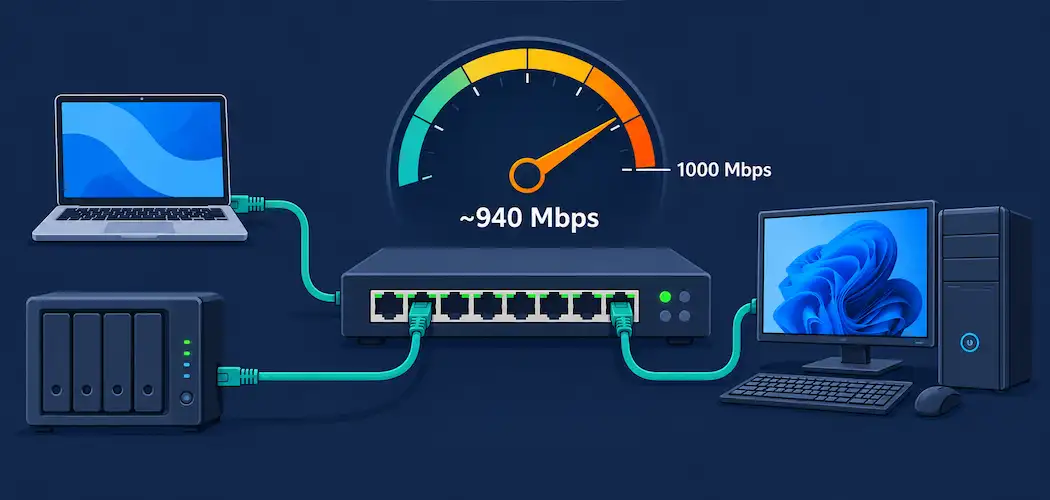
Gigabit Ethernet is often marketed as a flat “1000 Mbps” connection, but what it actually delivers in a real network depends on more than the number printed on the box. Here’s what Gigabit Ethernet actually provides in practice, what slows it down, and how it fits into a network that also has Wi-Fi and faster wired options available.
What “Gigabit” Actually Means
1 Gbps equals 1,000 Mbps — that part of the marketing is accurate. Gigabit Ethernet (802.3ab, standardized in 1999) runs over twisted-pair copper cabling, most commonly Cat5e or Cat6, and represented a major jump from the 100 Mbps “Fast Ethernet” standard that preceded it. Ethernet itself traces back to 1973, making it one of the oldest networking technologies still in active, continuous use — a testament to how well the underlying design has scaled across multiple speed generations.
What You Actually Get in Practice
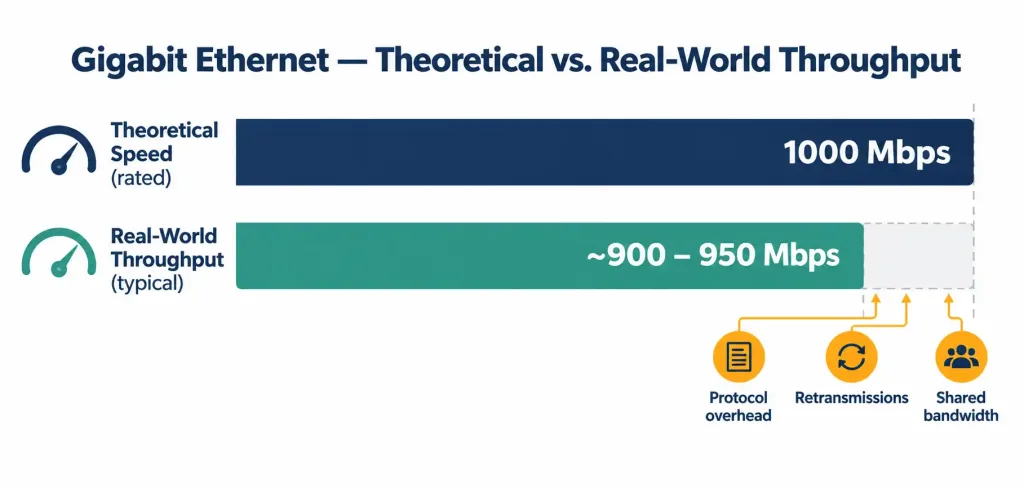
Real-world Gigabit Ethernet throughput typically lands somewhat below the full 1,000 Mbps — often in the 900–950 Mbps range under good conditions, though the exact figure depends heavily on the equipment and setup involved. The gap between the theoretical maximum and real-world throughput comes from several compounding factors:
- Protocol overhead: every Ethernet frame carries header and error-checking data alongside the actual payload, so some of the available bandwidth is always consumed by the protocol itself rather than user data.
- Retransmissions: on a network with electrical noise, a marginal cable run, or a loose connection, some frames need to be resent, which eats into effective throughput.
- The weakest link in the chain: a hard drive’s read/write speed, a switch’s internal processing capacity, or a weak network interface on either end of the connection can bottleneck the connection well below what the cabling itself could carry.
- Shared bandwidth: if multiple devices are transferring data simultaneously through the same switch, especially an unmanaged one, the available throughput gets divided among them rather than each device getting the full gigabit.
None of this makes Gigabit Ethernet a bad standard — it reliably delivers speeds that remain more than sufficient for the vast majority of home and small-business use cases. It just means “gigabit” describes the cable and port standard, not a guaranteed real-world transfer rate.
The Cable Distance Limit That Actually Matters
One detail that’s easy to overlook but genuinely important for planning any wired network: Ethernet over twisted-pair copper, including Cat5e and Cat6, is limited to a maximum run of 100 meters (about 328 feet) between active network equipment. Beyond that distance, signal degradation becomes severe enough that the connection becomes unreliable or fails outright. For longer distances — connecting a detached garage, a separate building, or a run across a large property — the practical options are fiber optic cabling (which supports much longer distances without this limitation) or a wireless bridge, not a longer copper run.
What About Power over Ethernet (PoE)?
Power over Ethernet is a separate capability from Gigabit Ethernet’s data speed, though the two are often used together. PoE lets a single Ethernet cable carry both data and electrical power to a connected device — commonly used for Wi-Fi access points, IP security cameras, and VoIP phones mounted in locations without a convenient power outlet nearby. Gigabit Ethernet speed and PoE power delivery are independent features of a given switch port: a switch port can support Gigabit speeds without PoE, PoE without Gigabit speeds (on older or lower-cost equipment), or both together, which is increasingly the standard on modern business-grade switches. If you’re specifically planning to power devices over the network cable, confirm the PoE standard your switch supports (PoE, PoE+, or PoE++) matches the power draw of the devices you intend to connect, since they support different maximum wattages per port.
Where Gigabit Ethernet Fits Today
Gigabit Ethernet remains the baseline wired standard for most home and small-business networks, and it’s genuinely sufficient for the majority of everyday tasks: web browsing, video streaming (including 4K), most online gaming, and typical file transfers. Where it starts to show real limits is in specific, bandwidth-intensive scenarios — large video production workflows, transferring very large files between networked storage devices, or any situation moving large amounts of data repeatedly between multiple machines on the same local network.
For those higher-demand cases, multi-gig Ethernet — 2.5GbE, 5GbE, and 10GbE — has become increasingly mainstream rather than a niche enterprise feature. Network controllers supporting 2.5 Gbps speeds (from manufacturers like Intel and Realtek) now ship on a wide range of consumer motherboards, routers, and network-attached storage devices, making a meaningful upgrade path available without needing full enterprise-grade equipment.
It’s also worth understanding how Gigabit Ethernet compares to modern Wi-Fi. Current Wi-Fi standards (Wi-Fi 6E and Wi-Fi 7) advertise very high theoretical maximum speeds, but real-world wireless throughput for any single device is governed by signal conditions, distance from the access point, and how many devices are sharing the same wireless channel at once — factors that don’t affect a dedicated wired connection in the same way. A wired Gigabit connection generally still delivers more consistent, predictable throughput than Wi-Fi under typical home conditions, which is why wired connections remain the preferred choice for anything latency-sensitive or bandwidth-intensive, even in a network with strong Wi-Fi coverage.
The Bottom Line
Gigabit Ethernet delivers real-world throughput close to, but reliably a bit under, its full 1,000 Mbps rating, with the gap explained by protocol overhead, equipment limitations, and shared bandwidth rather than any flaw in the standard itself. The 100-meter copper distance limit is the detail most worth remembering when planning a wired network layout, and Power over Ethernet is a separate, optional capability rather than something built into the Gigabit speed standard itself. For most home and small-business needs, Gigabit Ethernet remains genuinely sufficient — multi-gig options exist for the workloads that have outgrown it.
Frequently Asked Questions
What real-world speed should I expect from a Gigabit Ethernet connection?
Typically somewhat below the full 1,000 Mbps rating — often in the 900–950 Mbps range under good conditions, with the exact figure depending on your specific equipment, cabling quality, and network load.
What’s the maximum cable length for Gigabit Ethernet?
100 meters (about 328 feet) for Cat5e or Cat6 copper cabling between active network equipment. Longer distances require fiber optic cabling or a wireless bridge instead.
Does Gigabit Ethernet include Power over Ethernet (PoE)?
No — they’re independent features. A switch port can support Gigabit speeds without PoE, PoE without Gigabit speeds, or both together, depending on the specific hardware. Check your switch’s specifications for both capabilities separately.
Is it worth upgrading from Gigabit to multi-gig Ethernet (2.5GbE, 5GbE, 10GbE)?
For most everyday use, Gigabit Ethernet remains sufficient. Multi-gig Ethernet is worth considering specifically for high-bandwidth workloads like large file transfers to network storage, video production, or any task that currently feels bottlenecked by your wired connection — and the hardware supporting it has become significantly more affordable and common in recent years.