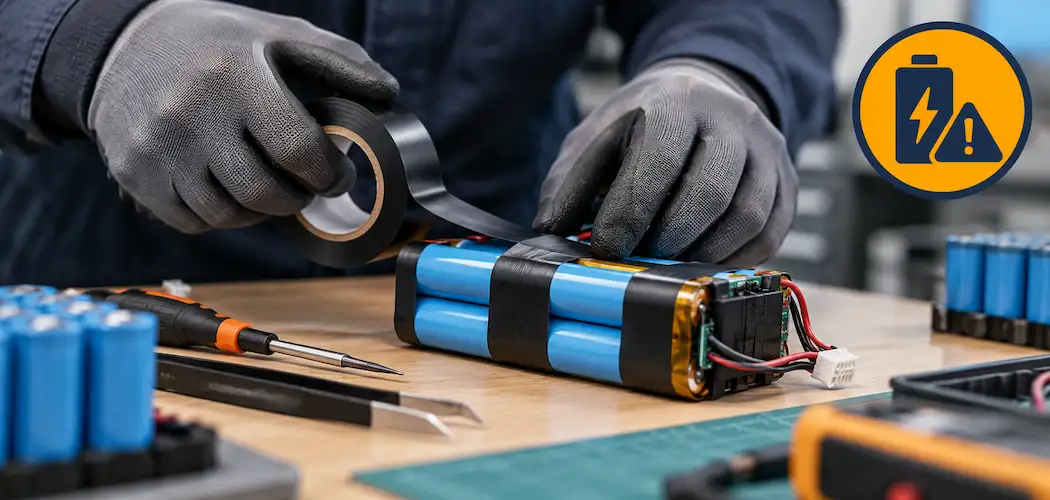
Lithium battery packs are held together by more than cells and wiring. Inside almost every pack — from a vape mod to an electric bike battery to a laptop cell group — a handful of specialized tapes do quiet but essential work: insulating conductive surfaces from each other, holding cells in position, protecting terminals from accidental contact, and resisting the heat a battery generates under load. Get the tape wrong, and you’ve built in a short-circuit risk that no amount of good cell chemistry can compensate for.
This guide covers two things that are often treated separately but actually belong together: what the common tape types in lithium battery assembly actually do, and how lithium batteries — taped, packaged, and boxed — need to be handled once they’re ready to ship. Both matter for the same reason: lithium battery safety is a system, not a single component, and tape and packaging are both part of that system.
Why Tape Selection Actually Matters
A lithium-ion cell holds a meaningful amount of stored energy in a small package, and its internal chemistry is intolerant of a few specific failure modes: short circuits between the positive and negative terminals, punctures that breach the cell casing, and sustained heat exposure beyond the cell’s rated range. Tape addresses the first and third of these directly — insulating conductive surfaces (nickel strips, exposed tabs, the metal can of the cell itself) from each other and from anything else conductive nearby, and in some cases providing a layer of thermal protection against heat generated during charge and discharge cycles.
This isn’t a cosmetic or purely mechanical choice. A tape that’s too thin, rated for too low a temperature, or chosen for the wrong adhesive chemistry can fail exactly when a pack is under the most stress — during fast charging, high-current discharge, or in a hot environment. That’s why reputable battery assembly operations specify tape by its actual rated properties (temperature range, dielectric strength, adhesive type) rather than by appearance or price alone.
Common Tape Types in Lithium Battery Pack Assembly
Polyimide (Kapton) Tape
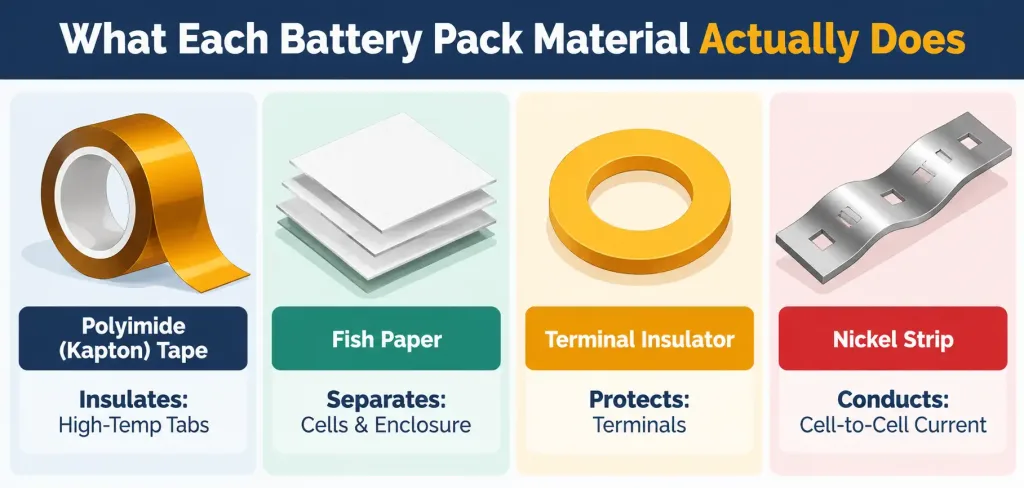
Polyimide film tape — widely known by the DuPont brand name Kapton, though many manufacturers now produce generic polyimide tape — is one of the most common high-temperature insulation materials in battery pack assembly. Polyimide film itself is well established in electronics manufacturing generally (it’s also used for flexible circuit boards and as a protective layer during soldering) specifically because it retains its insulating properties and physical integrity at temperatures that would degrade most other plastic films. It’s commonly used to insulate welded tab connections, wrap exposed conductive areas, and secure components in place during and after assembly, where both electrical insulation and heat resistance matter at the same point in the pack.
Fish Paper (Vulcanized Fiber Insulation)
Fish paper — a vulcanized fiber material, not an animal product, despite the name — is a long-standing insulation material used between cells and around terminals in battery pack construction. It’s typically supplied as sheets or self-adhesive rolls and used to physically separate cells from each other and from the metal shell of a pack enclosure, reducing the risk that a cell’s casing contacts another conductive surface if the pack flexes, vibrates, or is dropped. Terminal insulator rings — small punched discs placed around a cell’s terminal — serve a related, more targeted purpose: preventing accidental contact between a terminal and the rest of the pack’s conductive hardware during assembly and in service.
Nickel Strip: Conductive, Not Insulating
It’s worth being precise about this distinction, since the two materials are often discussed in the same breath: nickel strip is not a tape and is not an insulator. It’s a thin, pure-nickel conductor used to electrically connect cells together, typically joined by spot welding rather than soldering (soldering applies more sustained heat directly to the cell, which carries its own risk). Nickel strip’s job is to carry current reliably between cells; keeping it from contacting anything it shouldn’t is exactly what the insulating tapes and fish paper above are for. A pack under construction needs both — a conductive path where current should flow, and insulation everywhere it shouldn’t.
Choosing Adhesive and Backing by Function, Not Appearance
Rather than relying on visual cues like color or transparency — which say nothing reliable about a tape’s actual insulating or thermal performance — tape selection for battery assembly should be based on documented, testable properties:
- Temperature rating: the tape needs to hold its adhesive and insulating properties across the full range the pack will realistically experience, including the heat generated during fast charging or high-drain discharge, not just room temperature.
- Dielectric strength: a measurable rating of how much voltage the material can withstand before it breaks down and conducts — the actual property that determines whether a tape functions as reliable insulation, rather than any visual characteristic.
- Adhesive chemistry and backing material: different backings (polyimide, PET, fiberglass-reinforced) and adhesive types (acrylic, silicone) have different temperature tolerances, aging characteristics, and resistance to the chemicals a cell may be exposed to internally if it’s ever compromised.
- Thickness and conformability: thin enough to wrap tightly around small components without adding meaningful bulk to a pack, while still providing adequate insulation thickness for its rated voltage.
A quality-control check worth doing on any incoming tape, regardless of type: confirm it comes with a manufacturer’s technical data sheet stating its actual temperature rating and dielectric strength, rather than relying on a generic product listing with no specifications attached.
Common Mistakes in Tape Selection and Application
A few recurring mistakes show up often enough in battery pack assembly to be worth calling out directly:
- Substituting general-purpose electrical tape for purpose-rated insulation. Ordinary PVC electrical tape, while fine for many low-voltage wiring tasks, isn’t designed for the thermal cycling and chemical exposure a battery pack experiences, and its adhesive can degrade faster under sustained heat than a purpose-built polyimide or fiberglass-reinforced tape.
- Applying insulation too thin at stress points. A welded tab connection or a terminal edge is exactly where a pack is most likely to develop a tiny breach in insulation over time from vibration or flexing — these points generally warrant extra layers or a more robust material than flat surfaces elsewhere in the pack.
- Skipping the technical data sheet. Buying tape based on a product photo and a vague “high temperature” claim, without the manufacturer’s actual rated temperature range and dielectric strength figures, removes the ability to verify the material actually fits the application before it’s built into a finished product.
- Treating tape as purely mechanical. Tape that’s securing cells in place mechanically but offers no meaningful insulating value where it crosses a conductive surface isn’t doing the job that matters most — mechanical security and electrical insulation are both needed, and neither substitutes for the other.
From Assembly to Shipment: Why Packaging Rules Exist
Tape and insulation inside the pack solve the short-circuit problem during assembly and use. But a finished lithium battery still has to get from a factory to a warehouse, a retailer, or a customer — and transportation introduces its own risks: vibration, impact, pressure changes in aircraft cargo holds, and the possibility of packages being stacked, dropped, or crushed in transit. International shipping regulations exist specifically to address those risks, and they apply whether you’re shipping a single replacement battery or a pallet of finished packs.
UN38.3: The Testing Requirement Behind Every Shippable Battery
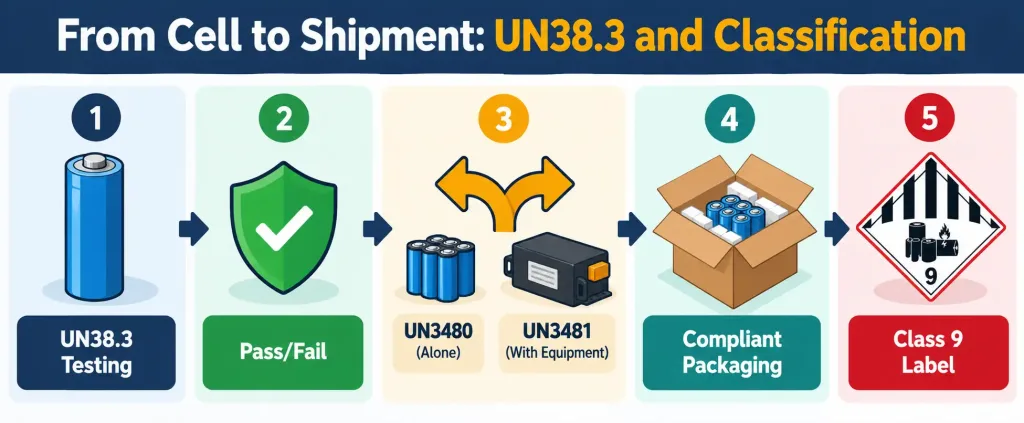
Before a lithium battery can legally be shipped by air, sea, or in most cases by road, it generally needs to have passed a specific battery of tests defined in UN38.3 — part of the United Nations Manual of Tests and Criteria for the transport of dangerous goods. These tests are designed to confirm a battery design can survive realistic transport stresses without failing dangerously:
- Altitude simulation — confirms the battery handles the low-pressure environment of aircraft cargo holds.
- Thermal test — cycles the battery through temperature extremes to check for leakage, venting, or rupture.
- Vibration and shock tests — simulate the physical stress of handling and transport.
- External short circuit test (at 55°C) — confirms the battery doesn’t fail catastrophically if its terminals are accidentally bridged.
- Impact and packaging drop test — evaluates both the cell and its packaging under physical impact.
- Overcharge test — applies specifically to rechargeable (secondary) batteries, confirming safe behavior if charged beyond normal limits.
- Forced discharge test — checks behavior when a cell is discharged past its normal cutoff.
A battery that hasn’t passed UN38.3 testing, or whose manufacturer can’t produce the test summary report on request, generally cannot be legally shipped by most carriers — this isn’t an optional best practice, it’s a baseline documentation requirement most freight forwarders and couriers will ask for before accepting a shipment.
UN3480 and UN3481: Knowing Which Classification Applies
Lithium-ion batteries being shipped are classified under one of two UN numbers, and the distinction actually matters for how the shipment needs to be packaged and labeled:
- UN3480 applies to lithium-ion batteries shipped by themselves — not packed with or inside any equipment.
- UN3481 applies to lithium-ion batteries packed with equipment or already installed inside equipment.
Both classifications fall under Class 9 (Miscellaneous Dangerous Goods), Packing Group II, and both require a Class 9 hazard label on the outer packaging along with the correct proper shipping name. The specific packing instructions differ by transport mode — air shipment under IATA’s Dangerous Goods Regulations uses a different set of packing instructions than sea freight under the IMDG Code or road transport under ADR — so the applicable rule set depends on exactly how the shipment is moving, not just what’s inside the box.
Packaging Requirements That Actually Apply
Regardless of transport mode, a few packaging principles are consistent across the regulations:
- Cells and batteries must be prevented from contacting each other or any conductive surface — individual non-conductive packaging or separation is required specifically to prevent in-transit short circuits.
- Batteries must be secured so they can’t move within the packaging. Movement during transit can loosen terminal caps or, in rare cases, trigger unintended activation.
- Outer packaging must be rigid and durable enough to withstand the normal rigors of transit without being damaged.
- Courier and small-parcel shipments face additional quantity limits — commonly capped at a small number of cells or batteries per package, a net weight limit, and a per-cell or per-battery watt-hour rating ceiling, though the exact limits depend on the specific transport mode and carrier.
- Damaged, defective, or recalled batteries face much stricter rules and, for air transport specifically, are generally not permitted to be shipped at all under the applicable regulations — this is a hard line, not a case-by-case judgment call, precisely because a damaged lithium cell’s failure modes are the least predictable.
Lithium-Ion vs. Lithium-Metal: Why the Classification Matters
Not every “lithium battery” is the same type for shipping purposes, and mixing up the two can lead to shipping under the wrong rules entirely:
- Lithium-ion batteries — the rechargeable type used in phones, laptops, power tools, and e-bikes — contain no metallic lithium and ship under UN3480 (alone) or UN3481 (with or inside equipment).
- Lithium-metal batteries — typically single-use, non-rechargeable, and found in products like watches, cameras, and some medical devices — contain metallic lithium and ship under the related but distinct UN3090 (alone) or UN3091 (with or inside equipment) classifications.
Both battery types require UN38.3 test documentation, and both fall under broadly similar Class 9 handling principles, but the specific weight and energy thresholds that determine packaging and labeling requirements differ between the two chemistries. A business shipping both battery types — not uncommon for a company selling a mix of rechargeable devices and button-cell-powered accessories — needs to apply the correct classification to each shipment rather than treating “lithium battery” as a single, interchangeable category.
Cell and Pack Safety Certification: IEC 62133, UL 1642, and UL 2054
Separate from the transport-specific UN38.3 testing, finished lithium battery cells and packs are also commonly subject to product safety certification standards, which address a related but distinct question: whether the battery is safe for its intended use, not just whether it survives shipping stress.
- UL 1642 is a U.S. standard covering lithium-based cells and multicell assemblies, testing for safety risks from electrical abuse, mechanical stress, and environmental exposure under both normal and deliberately abnormal conditions. It’s typically the foundation of a U.S. certification program for a given cell.
- UL 2054 covers complete battery packs — the assembled product, tape, insulation, nickel strip connections, and all — testing electrical, mechanical, and environmental safety at the finished-pack level. A pack built from cells that already hold UL 1642 certification can often reuse that underlying test data, streamlining the pack-level certification process.
- IEC 62133 is the internationally recognized equivalent, covering portable sealed rechargeable cells and batteries, and is generally required for market access across Europe, much of Asia, and other regions where UL certification alone isn’t sufficient for regulatory acceptance.
For a business sourcing battery packs from a manufacturer, asking specifically which of these certifications the pack holds — and for the underlying test report, not just a logo on a spec sheet — is a reasonable and increasingly standard due-diligence step, particularly for any product being sold into multiple international markets.
Why This Matters Even If You’re Not a Battery Manufacturer
A business doesn’t need to be manufacturing cells to need this information. Anyone shipping products with built-in rechargeable batteries — electronics, e-bikes, power tools, medical devices — or shipping replacement batteries on their own, is subject to these same classification, packaging, and documentation rules. Getting it wrong isn’t just a compliance paperwork issue: improperly packaged lithium batteries have been directly linked to serious transport incidents, which is exactly why airlines, couriers, and freight carriers enforce these rules strictly rather than treating them as a formality.
Bringing It Together: Tape Inside, Compliance Outside
The connecting thread between battery pack assembly and battery shipping is the same principle applied at two different stages: controlling where current can and can’t flow, and where physical stress can and can’t reach a cell. Inside the pack, polyimide tape, fish paper, and terminal insulators do that job at the component level. Outside the pack, UN38.3 testing and UN3480/3481-compliant packaging do the equivalent job at the shipment level — making sure a battery that was safely assembled stays safe through the physical stresses of transport.
Treating either half of this as optional, or assuming that “it looks fine” is an adequate substitute for rated materials and documented compliance, is where real incidents tend to originate. Specify tape by its actual rated properties, confirm UN38.3 test documentation exists before a shipment moves, and apply the correct UN classification and packaging for the specific transport mode being used — none of this is complicated once it’s broken down into its actual components, but all of it is necessary.
Frequently Asked Questions
What’s the difference between Kapton tape and fish paper in battery assembly?
Kapton (polyimide) tape is a thin, flexible film primarily used to insulate welded connections and wrap conductive components, chosen for its high-temperature stability. Fish paper is a thicker, more rigid vulcanized fiber sheet material typically used to physically separate cells from each other and from a pack’s enclosure. Both insulate, but they’re used in different roles within the same pack.
Is nickel strip a type of tape?
No — nickel strip is a conductive material used to electrically connect battery cells, typically via spot welding. It’s the opposite function of tape: tape insulates, nickel strip conducts. A properly built pack needs both, kept carefully separated from each other except at the intended connection points.
Do I need UN38.3 testing to ship a single replacement lithium battery?
In almost all cases, yes. UN38.3 test documentation is a baseline requirement most carriers and freight forwarders require before accepting any lithium battery shipment, whether it’s a single cell or a bulk shipment, because the testing confirms the battery design itself is safe to transport — it isn’t tied to shipment size.
What’s the difference between UN3480 and UN3481?
UN3480 covers lithium-ion batteries shipped on their own. UN3481 covers lithium-ion batteries that are packed with or already installed inside equipment. Both fall under Class 9 dangerous goods rules, but the specific packing instructions differ depending on which classification applies and which transport mode is being used.
Can a damaged lithium battery be shipped by air?
Generally, no. Damaged, defective, or recalled lithium batteries face much stricter handling rules than undamaged ones, and air transport of damaged batteries is generally prohibited outright under the applicable regulations, reflecting how unpredictable a compromised cell’s failure behavior can be.
What’s the difference between lithium-ion and lithium-metal batteries for shipping purposes?
Lithium-ion batteries are rechargeable, contain no metallic lithium, and ship under UN3480/UN3481. Lithium-metal batteries are typically single-use, contain metallic lithium, and ship under the related UN3090/UN3091 classifications with different weight and energy thresholds. Both require UN38.3 test documentation, but the specific packaging and labeling rules differ by chemistry.
Is UL or IEC certification required for every lithium battery pack?
Requirements vary by target market and product category, but UL 1642/UL 2054 certification is standard for products sold in the U.S., and IEC 62133 is generally expected for international markets, particularly across Europe and Asia. A manufacturer should be able to provide the underlying test report on request, not just a certification logo on a spec sheet.