
Public Key Infrastructure (PKI) gets pitched constantly as a general security upgrade, but its real value for business partnerships specifically is narrower and more concrete than most generic explainers admit: it lets two separate organizations verify each other’s identity and trust each other’s data without ever having met, using math instead of a phone call to confirm who’s really on the other end of a connection or a signed document.
Why This Is Worth Getting Right
Getting PKI for business partners right is worth real attention, and the stakes here are higher than they look. Grand View Research puts the global PKI market at $4.7 billion in 2024, growing at a 22.3% CAGR through 2034 — a sign of how central certificate-based trust has become to modern B2B infrastructure.
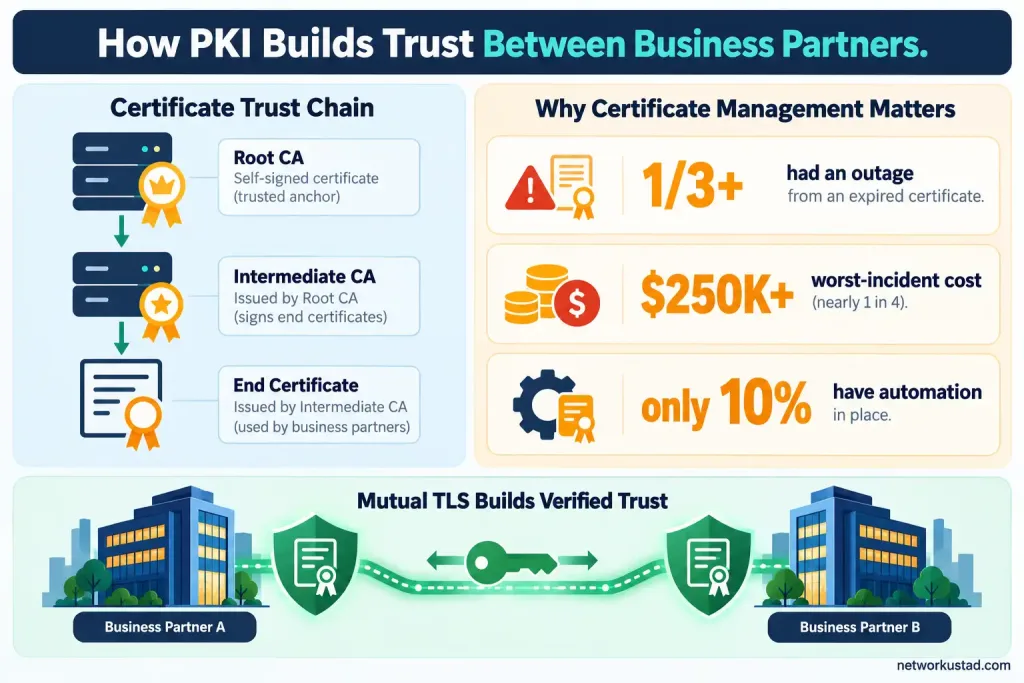
The risk of getting it wrong is just as real: DigiCert’s 2025 Certificate Management Outlook, surveying over 1,000 IT and security decision-makers, found more than a third of organizations had a service outage caused by an expired certificate in the past year, and nearly a quarter said their worst certificate-related incident cost more than $250,000. Most organizations now manage well over 1,000 certificates, and only 10% say they already have proper automation in place. PKI for business partners isn’t a theoretical concern — it’s actively breaking things at real companies, right now, because of how it’s managed.
What PKI Actually Does — and Doesn’t Do
It’s worth being precise here, since this gets oversimplified constantly. PKI verifies identity and protects data integrity: it confirms that a certificate genuinely belongs to the organization it claims to represent, and it ensures a signed or encrypted message hasn’t been tampered with in transit.
What it doesn’t do is stop phishing. A user who’s tricked into entering real credentials on a convincing fake login page hands those credentials over regardless of how strong the underlying PKI is — the certificate infrastructure never gets a chance to intervene, because the attack targets the human, not the cryptography. PKI for business partners is a trust and authentication layer, not a silver bullet against social engineering, and treating it as one leaves the actual phishing risk unaddressed.
Cross-Organization Trust: The Part Most Explainers Skip
This is the piece that actually makes PKI relevant specifically to business partnerships, rather than just general internal security. Two independent organizations, each running their own certificate authority (CA), need a way to trust each other’s certificates without merging their entire security infrastructure. Cross-certification is one mechanism for this: two CAs issue certificates to each other, effectively vouching for each other’s trust chain, so a certificate from Partner A’s CA is automatically trusted by Partner B’s systems.
Federation is a related but distinct approach, more common in modern B2B integrations, where a trusted third party or a shared identity standard lets both organizations authenticate users and systems against a common framework without either side having to directly certify the other’s entire CA. Choosing between these approaches depends on how deep and permanent the partnership is — cross-certification suits a long-term, tightly coupled relationship, while federation tends to fit looser, more transactional partner relationships better.
Digital Signatures for Contracts and Agreements
Digital signatures, built on PKI, let two parties sign an agreement with cryptographic proof of who signed it and confirmation that the document hasn’t changed since signing. That’s a genuinely strong property — but “legally equivalent to a handwritten signature” isn’t a blanket truth the way it’s sometimes presented. Legal recognition depends on jurisdiction and signature type: frameworks like the US ESIGN Act and eIDAS in the EU do give qualifying electronic signatures real legal standing, but the specific requirements for what counts as a “qualifying” signature vary, and high-stakes partner agreements are worth confirming against the relevant jurisdiction’s current rules rather than assuming automatic equivalence.
Securing the Actual Connections Between Partner Systems
Beyond documents and user logins, PKI secures the machine-to-machine connections that most B2B partnerships actually run on day to day — API calls, data feeds, shared databases. Mutual TLS (mTLS) is the mechanism that matters most here: unlike standard TLS, where only the server proves its identity to the client, mutual TLS requires both sides of a connection to present valid certificates, so a partner’s system and your own system each verify the other before any data moves. For any integration handling sensitive data between partner organizations, mutual TLS is a meaningfully stronger default than one-sided authentication, since it closes the gap where a compromised or spoofed client could otherwise pose as a trusted partner system.
Why Manual Certificate Management Keeps Failing
The outage statistics cited earlier aren’t abstract — they trace back to a specific, well-understood cause. Manual certificate tracking, through spreadsheets or calendar reminders, breaks down as certificate volume grows, and DigiCert’s research found incompatibility with legacy systems is the leading barrier organizations cite for not automating this (25%), followed by budget constraints (21%). Automated certificate lifecycle management using protocols like ACME, SCEP, or EST handles enrollment, renewal, and revocation without manual tracking, and it’s increasingly treated as a core cybersecurity priority rather than a nice-to-have — not least because shorter certificate lifespans, an industry-wide trend, make manual tracking even less sustainable than it already was.
Certificate Authorities, Trust Chains, and Revocation
A certificate’s trust ultimately traces back through a chain: an end-entity certificate is signed by an intermediate certificate authority, which is in turn signed by a root CA that’s been pre-trusted by operating systems and browsers. If any link in that chain is broken, expired, or revoked, trust fails — which is exactly why certificate revocation matters as much as issuance.
When a private key is compromised or an organization needs to invalidate a certificate before its natural expiration, revocation mechanisms (certificate revocation lists, or the faster Online Certificate Status Protocol) are what actually prevent a compromised certificate from continuing to be trusted. A PKI implementation that handles issuance well but has no clear, tested revocation process is only half-built, and it’s the half that matters most in an actual incident.
Public CAs vs. Private CAs for Partner Relationships
A practical decision that comes up early in any PKI for business partners rollout is whether to rely on a public certificate authority or stand up a private one. Public CAs — the kind browsers and operating systems trust by default — make sense for anything partner-facing on the open internet, like a web portal a partner logs into or an API endpoint a partner’s systems call over the public web.
A private CA, run internally or through a managed PKI service, makes more sense for internal trust between two organizations that have already agreed out-of-band to trust each other’s infrastructure directly, since it avoids the cost and process overhead of public certificate issuance for connections that never touch the open internet. Many partnerships end up using both: a public CA for anything customer- or internet-facing, and a private CA layered on top for the tighter, partner-specific trust relationships like mutual TLS between internal systems.
Building an Implementation Roadmap
Rolling out PKI for business partners well tends to follow a fairly consistent sequence, even across very different industries. The first step is almost always an inventory: most organizations don’t actually know how many certificates they’re running or where they all live until they go looking, and DigiCert’s research found over half now manage more than 1,000 — often scattered across cloud providers, internal servers, and partner-facing systems with no single owner.
The second step is choosing the right trust model for each partner relationship specifically, since a long-term manufacturing supplier and a short-term marketing vendor don’t need the same level of cross-certification or federation complexity. The third step is automating issuance and renewal before expanding the certificate footprint further, since adding more certificates to a manual process only makes the eventual cleanup harder. Only after those three steps does it make sense to formalize the specific cross-organization trust mechanism — cross-certification or federation — with each individual partner, because that step works far better once an organization actually understands its own certificate landscape first.
Common Mistakes Organizations Make With PKI for Business Partners
A few patterns show up often enough to name directly. Treating PKI purely as an internal security control, without building out the cross-organization trust mechanisms (cross-certification, federation) that actually matter for partner relationships, leaves the most partner-relevant use case unaddressed. Relying on manual certificate tracking past the point where certificate volume has grown beyond a few dozen is a second common mistake, and it’s the direct cause of the outage statistics covered above. A third mistake is assuming digital signatures carry automatic, universal legal weight without checking the specific jurisdiction and signature type involved in a given partner agreement — a costly assumption if a signed contract’s validity is ever actually challenged.
The Bottom Line
To sum up what a well-run PKI for business partners program actually looks like: PKI for business partners is genuinely valuable for exactly what it’s built to do: verifying identity across organizational boundaries, securing machine-to-machine connections through mutual TLS, and providing cryptographically sound digital signatures for agreements. It is not a phishing solution, and presenting it as one leaves a real gap in an organization’s actual security posture. The organizations seeing real outages and six-figure losses from certificate mismanagement aren’t failing at PKI’s core cryptography — they’re failing at the unglamorous operational side: automation, revocation processes, and the cross-organization trust mechanisms that are specifically what makes PKI relevant to partnerships in the first place.
Getting Partner Buy-In for a Shared Trust Model
Even a well-designed PKI for business partners rollout stalls if the partner on the other end isn’t on board, and that’s worth planning for as its own step rather than assuming technical soundness is enough to secure agreement. Smaller partners in particular may not have the internal expertise or infrastructure to participate in cross-certification the way a larger organization can, which is often where federation through a shared identity provider becomes the more realistic choice even when cross-certification would technically be the tighter trust model.
Being explicit, early in the relationship, about what a partner needs to support on their end — certificate issuance capability, a compatible trust anchor, basic key-management practices — avoids the common situation where a PKI for business partners initiative gets scoped and budgeted internally, only to discover midway through implementation that the partner organization can’t actually meet the technical requirements without help.
How This Plays Out in Practice
A mid-sized manufacturer and its logistics partner offer a useful concrete example of PKI for business partners working as intended. The manufacturer’s order-management system and the logistics partner’s shipment-tracking system need to exchange data constantly, in both directions, without a human manually approving each exchange. Mutual TLS between the two systems means each side’s certificate is checked before any shipment data moves, so a compromised or spoofed system on either end can’t quietly insert itself into that data flow undetected.
Layered on top, a cross-certification agreement between the two organizations’ certificate authorities means neither side has to manually import and track the other’s individual certificates as they’re renewed — the trust relationship between the two CAs handles that automatically, which is exactly the kind of operational simplification that makes PKI for business partners worth the setup effort over simply hard-coding a partner’s current certificate and hoping someone remembers to update it before expiration.
Frequently Asked Questions
Does PKI actually prevent phishing attacks?
No. PKI verifies identity and protects data integrity, but it doesn’t stop a user from being tricked into handing over real credentials on a fake login page — that attack targets the person, not the cryptography, so PKI alone doesn’t address it.
What’s the difference between cross-certification and federation for partner trust?
Cross-certification has two organizations’ certificate authorities directly vouch for each other, suited to deep, long-term partnerships. Federation uses a shared identity framework or trusted third party instead, and tends to fit looser, more transactional partner relationships better.
Are digital signatures legally equivalent to handwritten ones?
Often, but not automatically. Frameworks like the US ESIGN Act and the EU’s eIDAS regulation give qualifying electronic signatures real legal standing, but the specific requirements vary by jurisdiction and signature type, so it’s worth confirming for any high-stakes agreement.
Why do certificate-related outages keep happening?
Mostly due to manual certificate tracking failing to scale. DigiCert’s 2025 research found over a third of organizations had an outage from an expired certificate in the past year, with incompatibility with legacy systems as the leading barrier to automating the process.
What’s the most overlooked part of a PKI implementation?
Revocation. Many organizations handle certificate issuance reasonably well but have no clear, tested process for revoking a certificate when a key is compromised — which is exactly the moment a solid revocation process matters most.