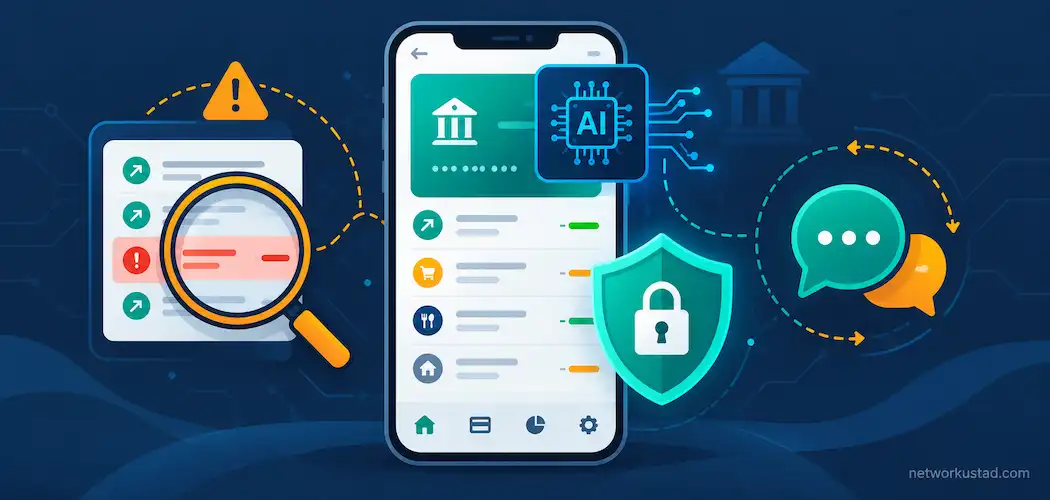
AI in mobile banking isn’t a future possibility anymore, and it hasn’t been for a while — it’s close to standard practice across the industry. Recent industry surveys put financial-institution AI adoption near universal across most major markets, which is a meaningfully different starting point than just a few years ago, when many banks were still openly debating whether to add it at all. What’s changed isn’t just that more banks use AI, but specifically where and how they use it day to day: fraud detection, customer service, back-office automation, and risk management are now the dominant, well-established use cases, not experimental side projects anyone’s still testing out.
Why This Shift Is Worth Taking Seriously
Finastra’s 2026 Financial Services State of the Nation report found only 2% of financial institutions report no AI use at all, and 71% now use AI specifically for risk management and fraud detection — tied with data analysis and reporting as the most common application. Six in ten institutions said they meaningfully improved their AI capabilities over the past year, and 43% now cite AI as their top innovation priority. This isn’t a marginal trend. It’s close to the default way modern banking software now operates.
What Counts as AI in Mobile Banking, Specifically
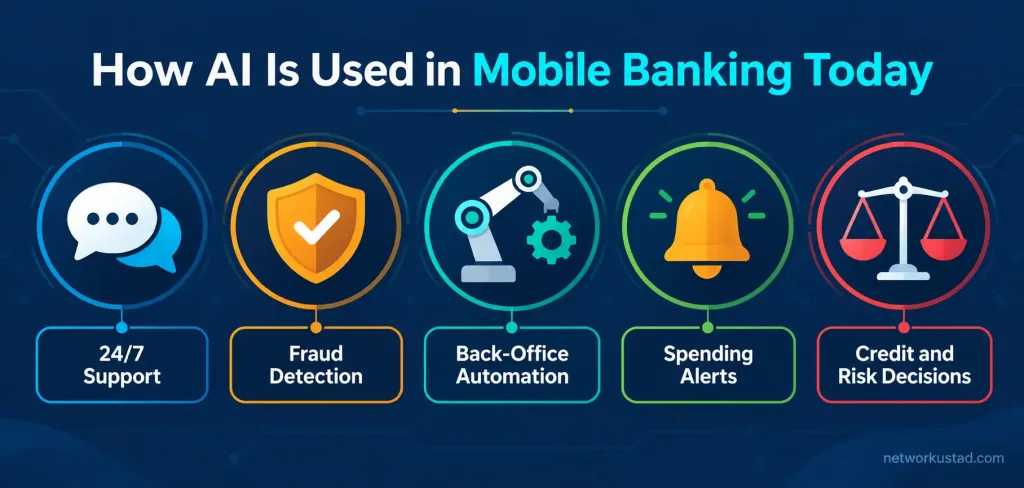
It helps to be genuinely concrete about what “AI in mobile banking” actually covers in practice, since the term gets used rather loosely in most coverage. In practice, it spans machine-learning models that flag unusual transactions in real time, natural-language chatbots that handle routine support questions, robotic process automation that handles repetitive back-office tasks, and predictive models used in credit and risk scoring. These are genuinely quite different technologies solving genuinely different problems, even though all of them get grouped loosely under the same single umbrella term.
1. Round-the-Clock Customer Support, With Real Limits
AI-powered chatbots and virtual assistants genuinely do extend customer support beyond normal business hours, handling balance checks, basic transaction questions, and simple account tasks without a human agent on the other end. That’s a real, tangible benefit — nobody has to wait until Monday morning to check whether a payment cleared. It’s worth being honest about the limits, though: these tools handle routine, well-defined questions well and struggle with anything genuinely unusual, like a disputed charge or a suspected identity-theft situation, where a human representative with actual account access and judgment still matters.
2. Fraud Detection That Reduces Risk — Not Eliminates It
This is the area where AI in mobile banking has moved fastest, and also where overstated marketing claims are most common. A 2025 Feedzai industry survey found 90% of financial institutions now use AI specifically to fight fraud and financial crime, most commonly for scam detection and transaction-fraud flagging. Among institutions using it, 39% reported fraud losses reduced by 40–60%, and 43% reported efficiency gains in the same range.
That’s a genuinely strong result. It is not, however, elimination of fraud. The same report found 60% of fraudsters are now using generative AI themselves — voice cloning and synthetic identity tactics in particular — which means fraud detection and fraud generation are both getting more sophisticated at the same time, not just one of them. Any claim that AI makes transactions fully, completely secure is simply inaccurate; it’s a continuously evolving contest, not a solved problem.
3. Robotic Process Automation for Back-Office Work
Robotic process automation (RPA) handles repetitive back-office tasks — data entry, compliance documentation, transaction reconciliation — that previously consumed significant staff time and were prone to manual error. Reducing that manual workload is a genuine efficiency gain for banks, and it indirectly benefits customers too, since staff freed from repetitive tasks can focus on more complex customer needs. It’s worth noting this is primarily an internal operations benefit; customers mostly experience it as faster processing times rather than a visible feature.
4. Personalized Spending Insights and Account Alerts
Transaction alerts, spending-pattern insights, and basic financial-health nudges are now common in mobile banking apps, built on AI models that analyze a user’s own transaction history. These tools can genuinely help someone notice an unusual charge quickly or spot a spending pattern they hadn’t consciously tracked. The caveat worth knowing: these insights are only as good as the transaction data behind them, and they’re a convenience layer on top of account security, not a substitute for actively checking statements or enabling account alerts for unusual activity.
5. Faster, More Consistent Risk and Credit Decisions
AI-assisted risk scoring and credit decisioning let banks evaluate loan and credit applications faster and, in principle, more consistently than a purely manual review process, by weighing a broader set of data points than a human reviewer could realistically process by hand. This genuinely speeds up approval times for straightforward applications. It’s also an area that deserves real scrutiny: a model trained on historical data can encode historical biases, so banks that use AI for credit decisions carry a real responsibility to audit those models for unfair outcomes, not just for speed and accuracy.
What “Security” Actually Means Here
A mobile banking app isn’t secure just because it uses AI. Real account security still depends on fundamentals that AI alone doesn’t replace: enabling multi-factor authentication, downloading apps only from official app stores, keeping a device’s operating system updated, and recognizing phishing attempts that try to extract a password or one-time code directly from the user rather than attacking the bank’s systems. AI-powered fraud detection catches a lot of unusual transaction patterns after the fact, but it doesn’t protect someone who willingly hands over their login credentials to a convincing fake support call. The two layers — AI-driven fraud monitoring on the bank’s side, and basic account hygiene on the user’s side — work together; neither one alone is “complete security.”
Common Mistakes Banks and Fintechs Make With AI Adoption
A few patterns show up often enough to name directly. Deploying an AI fraud-detection system and then declaring the fraud problem solved is one of the most common and most dangerous — fraud tactics evolve specifically in response to new detection methods, so a system tuned to catch last year’s scam patterns needs ongoing retraining, not a one-time setup.
Rolling out AI-powered credit decisioning without an active bias-auditing process is another frequent misstep, since a model can produce consistently unfair outcomes while still looking statistically accurate in aggregate. A third common mistake is treating customer-facing chatbots as a full replacement for human support rather than a first-line triage tool — customers with a genuinely unusual problem who get stuck in a bot loop with no clear path to a human tend to become more frustrated, not less.
Where AI in Mobile Banking Is Headed Next
Current adoption priorities point toward a few specific directions rather than a vague “more AI everywhere” trajectory. Finastra’s 2026 report lists AI-driven personalization, agentic AI automation (systems that can complete multi-step tasks rather than just answer single questions), and stronger governance and explainability of AI models as the next priorities institutions are investing in. That last point matters more than it might sound: as AI in mobile banking takes on more consequential decisions — credit approvals, fraud flags that freeze an account, risk scores that affect loan terms — being able to explain why a model made a specific decision becomes a real operational requirement, not just a nice-to-have, especially as regulators pay closer attention to automated financial decision-making.
The Bottom Line
AI in mobile banking has moved from an emerging idea to close to standard infrastructure, and the real benefits — faster fraud detection, more responsive customer support, efficient back-office processing, and faster credit decisions — are genuinely measurable, not just marketing language. The honest caveat is that none of this adds up to “complete security” or “eliminated fraud.” Fraud tactics are evolving alongside the detection tools meant to catch them, and real account protection still depends on basic user-side habits that no amount of bank-side AI investment replaces on its own.
What to Actually Look for in a Banking App’s AI Features
Marketing copy for banking apps tends to describe AI features in vague, impressive-sounding terms, without saying much at all about how any of it actually works under the hood. A few concrete questions cut through that.
Can you confirm or dispute a flagged transaction directly in the app? Or does it just notify you after the fact, with no action available? Does the chatbot hand off to a human quickly when a question goes beyond its scope? Or does it trap users in a repetitive loop? Does the app explain what triggers a spending alert, even briefly? Or are the alerts basically a black box? None of these questions require technical expertise.
A bank or fintech that can answer them clearly is generally more trustworthy about its AI in mobile banking features than one that only offers broad reassurances.
How This Differs Across Traditional Banks, Neobanks, and Fintech Apps
AI in mobile banking doesn’t look identical across every kind of provider. Traditional banks, often working with older core banking systems, tend to add AI features as a layer on top of existing infrastructure, which can mean slower rollout but generally stronger integration with established fraud and compliance systems built over decades.
Neobanks and newer fintech apps, built on modern infrastructure from the start, often ship AI-driven features faster and more prominently, but with a shorter track record for how those systems perform under real-world fraud attempts at scale. Neither approach is automatically better; a newer app’s flashier AI feature set doesn’t guarantee better underlying fraud protection than an established bank’s more conservative rollout, and the Finastra and Feedzai data cited above cover institutions of both types broadly, not one category exclusively.
Frequently Asked Questions
How many banks actually use AI today?
Nearly all of them in some form. Finastra’s 2026 report found only 2% of financial institutions report no AI use at all, with risk management, fraud detection, and data analysis as the most common applications.
Does AI actually stop banking fraud?
It significantly reduces it, but doesn’t eliminate it. A 2025 Feedzai survey found 39% of financial institutions using AI for fraud detection reported losses reduced by 40–60% — a real improvement, but fraudsters are also increasingly using generative AI themselves, so it remains an ongoing contest rather than a solved problem.
Is a mobile banking app automatically secure because it uses AI?
No. AI-powered fraud detection is one layer of protection on the bank’s side. Real account security also depends on the user enabling multi-factor authentication, avoiding phishing attempts, and keeping devices updated — AI doesn’t replace those basic habits.
Can AI-based credit decisions be unfair?
Yes, potentially. A model trained on historical data can encode historical biases, which is why banks using AI for credit and risk decisions need active bias auditing, not just a one-time accuracy check at launch.
What’s the biggest current use case for AI in banking?
Risk management and fraud detection, tied with data analysis and reporting, at 71% of institutions each according to Finastra’s 2026 survey — ahead of customer service chatbots and document automation.
Is AI in mobile banking the same at every bank or app?
No. Established banks tend to layer AI features onto existing core systems with strong compliance integration but slower rollout, while newer fintech apps ship AI features faster but with a shorter real-world track record. Both approaches appear in the adoption data cited throughout this article, not just one category of provider.