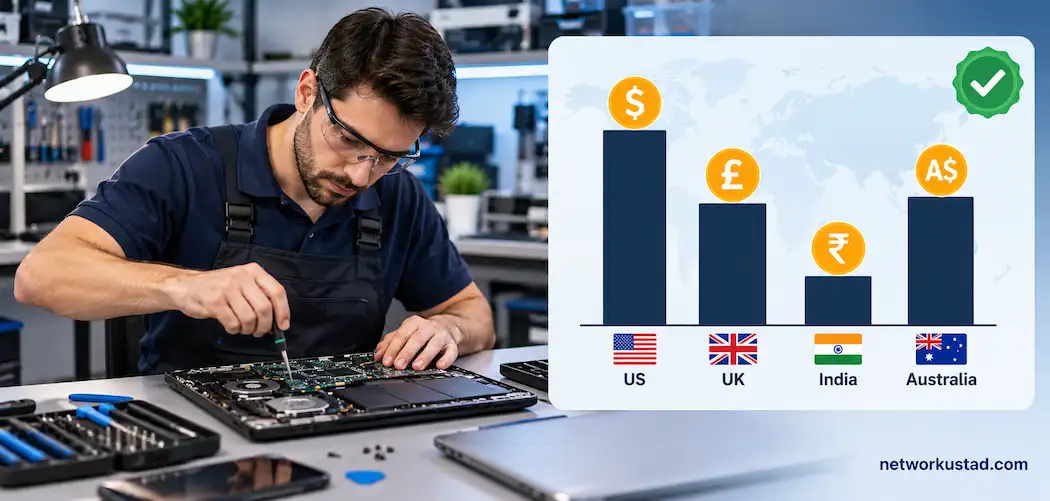
Computer repair technician salary figures circulate online with no sources attached more often than almost any other job-pay question, which makes the honest numbers — and their real sample sizes — worth laying out clearly before deciding whether this career pays what you’d expect.
Why the Original Numbers on This Topic Rarely Hold Up
Searching for computer repair technician salary data online turns up a lot of numbers presented with identical-looking confidence regardless of how solid the underlying source actually is. A figure drawn from a government labor survey covering tens of thousands of workers gets displayed the same way as a figure drawn from a few dozen self-submitted salary forms, with no visual or textual distinction between the two. That’s the core problem with most salary content on this topic, and it’s worth calling out explicitly before presenting any numbers here: a confident-sounding figure is not automatically a reliable one, and the gap between those two things is exactly what the source and sample-size notes throughout this article are meant to close.
What the Job Actually Involves
A computer repair technician installs, evaluates, and troubleshoots computers, networks, and peripheral hardware, with the role generally weighted more toward hardware diagnostics than software support. Formal education requirements vary by employer: some roles accept an associate degree in PC maintenance or a CompTIA A+ certification as sufficient, while others — particularly in larger IT departments or specialized enterprise roles — prefer a bachelor’s degree in computer science or a related engineering field. For an independent repair business rather than employment, certification tends to matter more for building customer trust than for meeting any legal requirement.
Computer Repair Technician Salary in the United States: The Most Reliable Figure Available
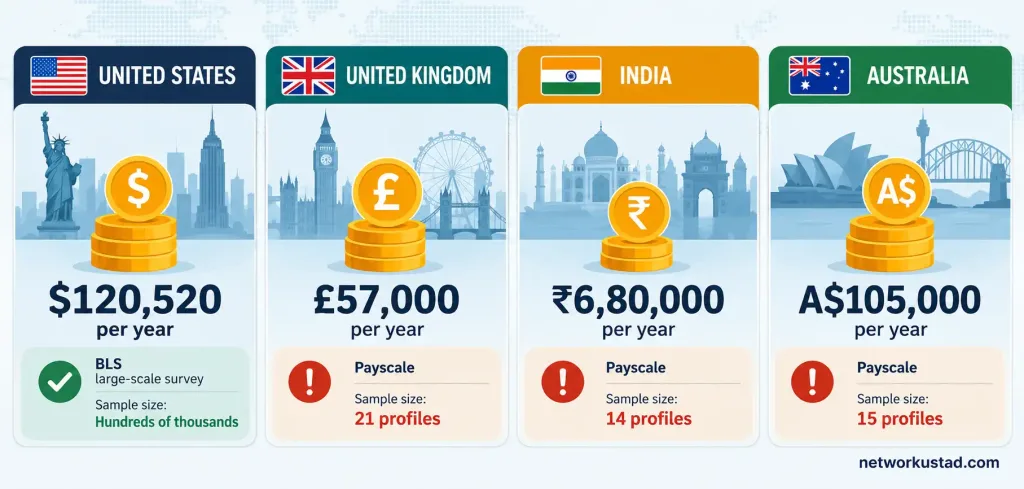
The US Bureau of Labor Statistics reports a median annual wage of $44,910 (median hourly wage $21.59) for the Computer, Automated Teller, and Office Machine Repairers category as of its most recent published data. This is the most statistically reliable figure in this article, since BLS wage data is compiled from a genuinely large employer survey rather than a small set of self-reported profiles. It’s worth noting this figure covers employed technicians specifically — someone running an independent repair business sets their own hourly rates (commonly $60–$90 for diagnostic work) and their actual take-home depends on volume and overhead, not this wage figure directly.
United Kingdom: A Figure Worth Reading With Caution
Payscale reports an average base salary of £23,166 per year for a Computer Repair Technician in the UK. This figure is worth treating carefully: it’s drawn from only 21 self-reported salary profiles, last updated in August 2024, which is a small enough sample that a handful of unusually high or low entries could shift the average meaningfully. It’s a reasonable ballpark, not a precise benchmark.
India: Also a Small Sample, Also Worth Flagging
Payscale puts the average annual base salary for a Computer Repair Technician in India at ₹300,000, based on just 14 salary profiles, last updated in November 2023. As with the UK figure, this is a small, self-reported sample rather than a large-scale wage survey, and it should be read as a rough indicator rather than an authoritative number.
Australia: Reported as an Hourly Rate
Payscale’s Australian data is reported hourly rather than annually: an average of AU$24.57 per hour, with a 10th-to-90th percentile range of roughly AU$21.45 to AU$34.52, based on 15 salary profiles updated in December 2024. The spread between the 10th and 90th percentile here is wide enough that “average” alone doesn’t tell the full story — experience level and location within Australia both move this figure substantially.
What Actually Moves Computer Repair Technician Salary Up
A few concrete factors move computer repair technician salary more than location alone. Certifications are the clearest lever: CompTIA A+ is the baseline most employers look for, but adding Network+ or a vendor-specific certification (from Dell, HP, or Apple, for instance) signals broader technical range and tends to come with a meaningfully higher offer than A+ alone. Specialization matters almost as much — a technician who can handle enterprise server hardware or data recovery work commands more than one doing only consumer laptop screen swaps, since fewer people can do the former reliably.
Years of direct, verifiable experience (not just time employed, but a track record of handled ticket volume or completed jobs) is the third major lever, and it’s the one independent reviewers like Payscale try to isolate with their “entry-level,” “mid-career,” and “experienced” salary breakdowns, even though the underlying sample sizes for those breakdowns are often smaller still than the headline average.
Remote IT Support vs. Hands-On Repair: Different Pay Pictures
Computer repair technician salary data gets muddier once remote IT support is mixed into the picture, and a lot of online salary aggregators don’t cleanly separate the two. Hands-on hardware repair — physically opening a device, replacing a part, diagnosing a component failure — is a distinct skill set from remote software troubleshooting, and the pay data for each doesn’t always track together.
Some wage surveys lump “computer support specialist” roles (often remote, software-focused) in with hardware repair technicians, which can pull a reported average in either direction depending on how a given employer’s job postings are categorized. When comparing a salary figure against your own situation, checking whether the underlying job description actually matches hands-on repair work, rather than general IT support, matters more than the headline number itself.
Common Mistakes When Comparing Computer Repair Technician Salary Data
A few patterns show up often enough in salary-comparison content to name directly. Treating a single country’s average as representative of every city or region within it is one of the most common — a technician’s computer repair technician salary in a major metro area with high demand and high cost of living can differ substantially from the same role in a smaller town, and national averages flatten that difference out entirely.
Citing a figure without checking its sample size or date, as the original version of this article did, is the second common mistake, and it’s exactly why this rewrite flags the UK, India, and Australia numbers as small-sample estimates rather than presenting them with the same confidence as the much larger BLS dataset. A third mistake is comparing an employed-technician wage figure directly against an independent business owner’s potential income, since the two have fundamentally different cost structures and risk profiles behind them.
Why These Numbers Differ So Much From Each Other
A few real factors explain the spread between countries, beyond simple cost-of-living differences. Sample size matters enormously for the UK, India, and Australia figures here — each is based on a few dozen or fewer self-reported profiles, compared to the BLS figure’s much larger underlying survey, so direct country-to-country comparison using these specific numbers isn’t especially meaningful. Local demand for in-person computer repair also varies: markets with more remote IT support and larger corporate IT departments tend to show lower demand (and pay) for independent hands-on hardware repair specifically. Certification and specialization matter too — a technician with networking or enterprise hardware certifications generally commands more than someone doing basic consumer repairs, regardless of country.
Employed Technician vs. Independent Business Owner
These wage figures describe employed technicians working for someone else — a repair chain, an IT department, a retailer’s service desk. Running an independent computer repair business is a genuinely different financial picture: income depends on the hourly and flat rates you set, how much of your week is billable repair work versus unpaid admin and marketing time, and your parts markup (commonly 50–100% over wholesale). A solo operator with steady volume can out-earn the median employed-technician wage, but also carries the business costs — insurance, tools, marketing, slow months — that an employed technician doesn’t.
Is Demand for This Role Actually Growing?
It’s worth being precise here rather than repeating a vague “high demand” claim with no backing. The US Bureau of Labor Statistics groups computer repair work under broader IT support categories whose outlooks vary by specialization — some computer-support roles are projected to grow, while demand for narrowly defined hardware-repair-only positions has softened somewhat as more support shifts toward remote and software-based troubleshooting. The more durable demand tends to sit with technicians who combine hardware repair with broader IT support skills, rather than hardware repair alone.
How to Read Any Computer Repair Technician Salary Figure You Find Online
Given how often unsourced computer repair technician salary numbers circulate, a short checklist helps separate a usable figure from a guess. First, check whether the source names an actual dataset — a government labor statistics bureau, a large-scale employer survey, or at minimum a stated sample size — rather than just asserting a number. Second, check the date; salary data more than two or three years old, especially for a fast-changing field, deserves a mental discount.
Third, check whether the figure describes an employee wage or a business owner’s income, since those two numbers answer genuinely different questions and shouldn’t be used interchangeably. Fourth, when a figure comes from a small self-reported sample — as several in this article do — treat it as a rough range rather than a precise number, and look for a second source to cross-check it against before relying on it for a real decision like a job offer negotiation or a pricing decision for your own repair business.
What This Means If You’re Deciding Whether to Pursue This Career
None of these figures alone should make or break a decision to pursue computer repair work, but together they paint a reasonably honest picture. The US BLS median gives a defensible floor for employed-technician pay in a large, well-measured market. The UK, India, and Australia figures suggest the role is viable but not especially lucrative as a straight employee position in those markets, with real variation by city and specialization that a single national average can’t capture.
For anyone weighing whether to go independent rather than take an employed role, the honest answer is that computer repair technician salary as an employee tends to be modest, while running your own repair business carries meaningfully higher upside alongside meaningfully higher risk and workload — a trade-off worth thinking through deliberately rather than assuming one path is simply “better paid” than the other.
The Bottom Line
The US BLS figure ($44,910/year, $21.59/hour median) is the most statistically solid number available for this role, and it describes employed technicians rather than independent business owners. The UK, India, and Australia figures from Payscale are useful directional indicators but rest on small, self-reported samples, so they’re worth treating as rough ranges rather than precise benchmarks. Whether this career pays well for you specifically depends heavily on whether you’re employed or self-employed, how specialized your skills are, and which local market you’re working in — a single global average was never going to answer that question accurately.
Frequently Asked Questions
What is the median salary for a computer repair technician in the US?
The US Bureau of Labor Statistics reports a median annual wage of $44,910 ($21.59/hour) for this occupation category, based on a large-scale wage survey rather than a small self-reported sample.
Do computer repair technicians make more as employees or running their own business?
It varies. Employed technicians earn the wage figures cited above with stable, predictable pay. Independent business owners set their own rates and can out-earn that median with steady volume, but also take on business costs that employed technicians don’t carry.
Are the UK, India, and Australia salary figures reliable?
They’re useful directional estimates, not precise benchmarks. Each comes from Payscale’s self-reported data with small sample sizes (14 to 21 profiles), compared to the much larger survey behind the US BLS figure.
Is demand for computer repair technicians actually growing?
It depends on specialization. Broader IT support roles that include hardware repair show steadier demand, while narrowly defined hardware-only repair work has softened somewhat as more troubleshooting shifts toward remote and software-based support.