
Reputation takes years to build and can take a single bad week to damage. That asymmetry is exactly why reputation risk deserves a real process, not a vague commitment to “building a strong brand.” Most companies that get caught flat-footed by a reputation crisis didn’t lack good values — they lacked a system for spotting the risk early and responding to it fast.
This guide walks through an actual framework for managing reputation risk: how to identify where it comes from, how to monitor for it, how to build a response plan before you need one, and how to fold it into regular business strategy instead of treating it as a one-time exercise.
Why Reputation Risk Deserves Its Own Process
Reputation risk is different from most operational risks because it doesn’t stay contained to one department. A product-quality failure, a data breach, an executive’s public misstep, or a labor dispute can all become a reputation crisis regardless of where in the business they originated. That’s why reputation risk management works best as a cross-functional process owned at a senior level, not something left entirely to a communications or marketing team after the fact.
The business case for taking this seriously isn’t just intuition. A widely cited World Economic Forum study found that on average, more than 25% of a company’s market value is directly attributable to its reputation — meaning reputation damage isn’t just a PR inconvenience, it’s a measurable financial risk.
A global Deloitte survey on strategic risk found that 87% of executives rated reputation as more important, or much more important, than other strategic risks their companies faced, and 88% said their companies were explicitly focusing on managing it. That survey is now several years old, but the underlying point hasn’t changed: reputation consistently ranks among the risks executives themselves consider most consequential, even when formal management processes haven’t caught up to that level of concern.
Step 1: Identify Where Your Reputation Risk Actually Comes From
A reputation risk assessment starts by mapping the specific ways your business could suffer reputational damage, rather than treating “reputation risk” as one generic category.
Operational sources: product recalls, safety incidents, service failures, or supply-chain problems that become public.
Conduct sources: executive or employee misconduct, discrimination or harassment issues, or violations of stated company values that get exposed publicly.
Data and security sources: breaches, leaks, or mishandling of customer or employee data, which combine reputational damage with potential legal and regulatory consequences.
Financial sources: restatements, fraud allegations, or governance failures that undermine investor and public trust.
Third-party sources: a supplier, partner, or contractor’s misconduct or failure that becomes associated with your brand, even when your own company did nothing wrong directly.
Social and environmental sources: environmental incidents, labor practices, or positions on social issues that create backlash from customers, employees, or advocacy groups.
Mapping these sources specifically to your own business — which ones are genuinely plausible given your industry, supply chain, and public profile — is far more useful than a generic list, since it tells you where to actually focus monitoring and preparation effort.
Step 2: Monitor for Early Warning Signs
Reputation risk rarely appears without warning; it usually builds through a buildup of smaller signals before a public incident actually breaks. A monitoring process should track several channels at once.
Media and social monitoring tools track mentions of your company, executives, and brand across news coverage and social platforms, flagging unusual spikes in volume or sentiment shifts before they become a full-blown story.
Internal escalation channels — whistleblower lines, HR complaint processes, customer service escalation patterns — often surface a building problem well before it reaches the public, if someone is actually paying attention to patterns rather than just individual complaints.
Stakeholder listening — structured check-ins with major customers, investors, employees, and community partners — surfaces concerns that might not show up in formal complaint channels at all, since many stakeholders won’t file a formal complaint over a growing concern until it’s already serious.
Industry and peer monitoring tracks how similar companies in your sector are handling comparable risks, since a reputation crisis at a close competitor or industry peer often signals a risk worth checking for in your own operations too.
Step 3: Build a Response Plan Before You Need One
A reputation crisis response plan built during the crisis itself is almost always worse than one built in advance, for the simple reason that decisions made under pressure and public scrutiny tend to be rushed.
Define a response team and clear decision authority in advance. Who actually has the authority to approve a public statement, and how quickly can that approval happen outside normal business hours? A plan that requires a full executive committee sign-off for every public response will be too slow for most real incidents.
Draft response templates and holding statements ahead of time for your most plausible risk scenarios, identified in Step 1. A holding statement — acknowledging an issue and confirming a response is underway, without committing to specific facts before they’re verified — buys time to investigate accurately without appearing unresponsive.
Establish internal communication protocols so employees hear accurate information from the company before they see speculation externally. Employees who learn about a crisis from social media before hearing from their own employer tend to trust leadership less going forward, independent of how the crisis itself is actually resolved.
Run a tabletop exercise periodically, walking through a plausible scenario with the actual response team to test whether the plan’s decision points, contacts, and timelines actually work in practice, rather than only on paper.
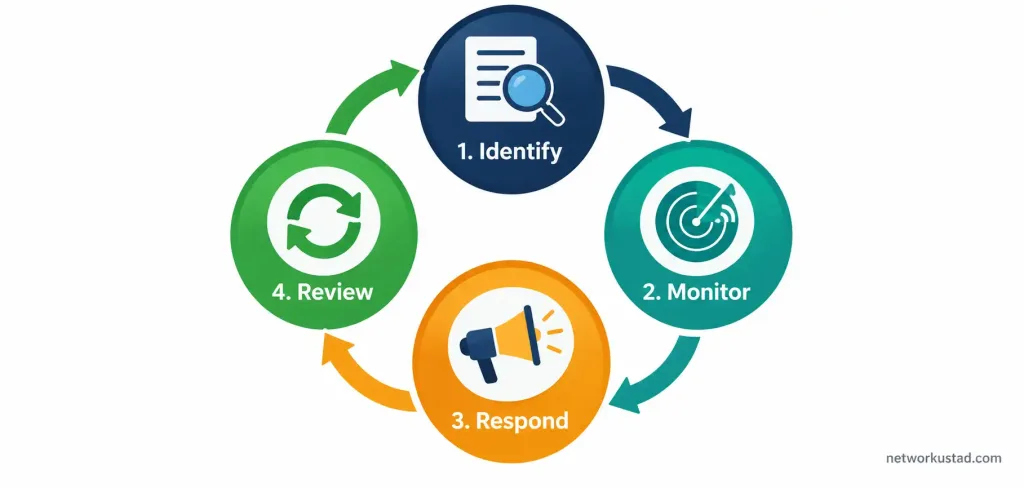
Step 4: Build Reputation Risk Into Regular Strategy and Planning
Treating reputation risk as a one-time project misses the point. It needs to be revisited on a regular cycle, the same way financial or operational risk reviews are.
Include reputation risk in formal risk-assessment cycles. Established enterprise risk management frameworks, such as ISO 31000 and the COSO ERM framework, both treat reputation as a risk category that should go through the same identify-assess-treat-monitor cycle as financial or operational risks, rather than being handled separately by a communications team alone.
Challenge planning assumptions during strategy sessions. When evaluating a new product launch, market expansion, or partnership, explicitly ask what reputational exposure the decision introduces, not just what financial or operational risk it carries.
Assess middle management, not just senior leadership, on how they model company values. Day-to-day culture is shaped heavily by middle managers, since most employees interact with them far more directly and frequently than with senior executives — making middle-management behavior a meaningful, if less visible, reputation risk factor in its own right.
Review stakeholder alignment regularly, checking whether your actual business practices still match what your major stakeholders — customers, employees, investors, communities — expect and value, rather than assuming alignment established years ago still holds.
A Practical Example of the Framework in Action
Picture a mid-sized manufacturer that discovers a quality defect in a recently shipped product line. Under the framework above, the operational source was already mapped in Step 1, so the team knows immediately which internal stakeholders need to be looped in. Monitoring from Step 2 picks up early customer complaints on social media before the issue reaches mainstream coverage, giving the response team a head start most companies don’t get.
Because a holding statement template for product-quality issues was already drafted in Step 3, legal and communications can issue an initial acknowledgment within hours rather than days, buying time to confirm the scope of the defect without looking unresponsive. The post-incident review required under Step 4 then feeds back into the risk assessment, updating the monitoring thresholds and response templates based on what actually happened. None of this prevents the underlying defect, but it meaningfully changes how the public perceives the company’s handling of it, which is exactly the gap reputation risk management is built to close.
Measuring Whether Your Reputation Risk Management Is Actually Working
A process without measurement tends to drift. A few practical indicators worth tracking over time: the volume and sentiment trend of media and social mentions, the time between an internal escalation and a formal risk-team review of it, employee survey results on trust in leadership and alignment with stated company values, and — after any actual incident — a structured post-incident review assessing how closely the real response matched the planned one, and what the plan should change as a result.
None of these indicators alone proves reputation risk is well managed, but tracking them consistently over time gives a far clearer picture than relying on the absence of a visible crisis as the only signal that things are fine.
Common Mistakes in Reputation Risk Management
Treating reputation risk as solely a communications-team responsibility, rather than a cross-functional risk with input from operations, legal, HR, and executive leadership, is one of the most common mistakes. Waiting until an incident happens to draft a response plan, instead of preparing response templates and decision authority in advance, is another — and it’s consistently the difference between a fast, controlled response and a slow, visibly reactive one.
Focusing monitoring entirely on external media and social mentions while ignoring internal escalation channels misses exactly the early warning signs that tend to surface first. And treating a single values statement or mission page as sufficient reputation protection, without checking whether middle-management behavior and actual business practices match it, leaves a gap between stated values and lived experience that eventually becomes visible to the public.
Frequently Asked Questions
Who should own reputation risk management inside a company?
It works best as a cross-functional responsibility with senior-level sponsorship — typically involving risk management, communications, legal, HR, and operations together — rather than being assigned entirely to one department. The specific ownership structure varies by company size, but the risk itself rarely stays contained to one function.
How is reputation risk different from a normal PR problem?
A PR problem is usually a single event needing a communications response. Reputation risk is the broader, ongoing exposure a company carries across multiple potential sources — operational, conduct-related, financial, and third-party — that could damage trust if any of them become public. Managing reputation risk means addressing the underlying exposures, not just responding well when something goes wrong.
Does reputation risk management fit into existing enterprise risk frameworks?
Yes. Frameworks like ISO 31000 and COSO ERM both treat reputation as a risk category that should go through the same identification, assessment, treatment, and monitoring cycle as other enterprise risks, rather than being managed as a separate, standalone function.
How often should a reputation risk assessment be updated?
At minimum annually, alongside other formal risk-review cycles, and sooner after any significant business change — a new market, a major partnership, a leadership change — that could introduce new reputational exposure.
What’s the fastest way to improve reputation risk readiness without a major overhaul?
Draft holding statements and define clear response-approval authority for your most plausible risk scenarios. This single step addresses the most common failure point — a slow, unclear decision-making process during an actual incident — without requiring a full framework rebuild first.
The Bottom Line
Reputation risk management works best as an actual process: identifying where the risk realistically comes from, monitoring for early warning signs across both external and internal channels, building a response plan before a crisis forces one, and folding reputation risk into regular strategic review rather than treating it as a one-time exercise. The business case is real and measurable — reputation accounts for a significant share of market value, by some estimates more than a quarter — which makes a structured process worth the investment well before an actual crisis makes the case for you.