Chip speed only tells part of the story when you’re choosing an iPhone for gaming. Display refresh rate, RAM, and how well the phone actually sheds heat during a long session matter just as much — a phone that benchmarks well but throttles hard after fifteen minutes isn’t actually the better gaming phone. This guide ranks the current iPhone lineup specifically for gaming, with real specs behind each pick rather than vague superlatives.
How We Picked the Best iPhones for Gaming
Five criteria decided these picks: raw chip performance, display refresh rate, RAM, thermal management under sustained load, and price relative to what each phone actually delivers for gaming specifically — not for photography, battery life in general use, or any other category a typical buying guide weighs. A phone that excels everywhere else but compromises badly on one of these five still loses ground against a phone built with gaming specifically in mind.
What Actually Matters for Gaming Performance
Before the picks, it’s worth knowing what to actually weigh against each other.
Chip generation sets the ceiling on raw performance, but a newer chip doesn’t always mean a meaningfully better gaming experience if the games you play don’t push that ceiling. Display refresh rate matters more for gaming than almost any other use case — a 120Hz display makes fast-paced games noticeably smoother than a standard 60Hz panel, which is the single biggest practical difference between Apple’s Pro and non-Pro lines for a gamer specifically.
RAM affects how well a phone handles memory-hungry games and how quickly apps reload after being pushed out of memory during multitasking. Thermal management determines whether performance actually holds up during a 30-minute session rather than just in a short benchmark — Apple’s newer Pro models use a vapor chamber cooling system specifically to address this.
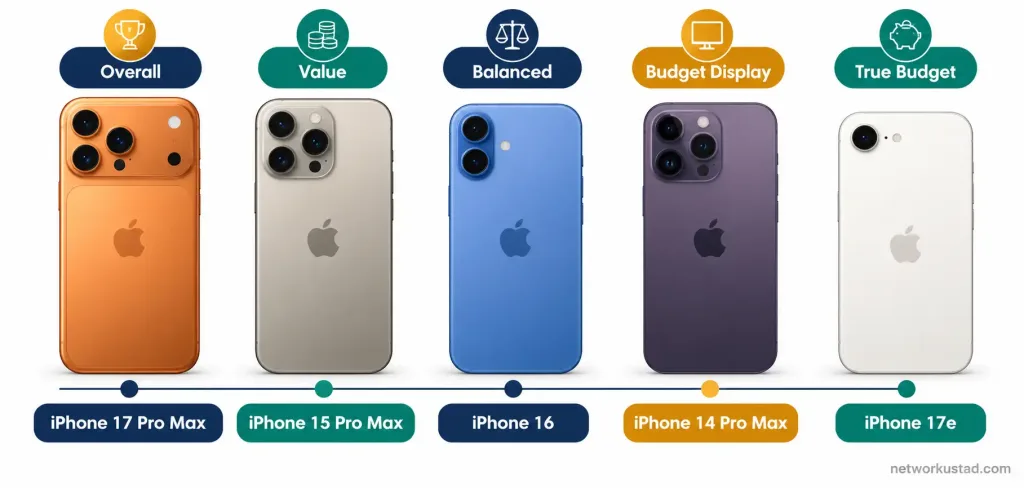
Best Overall Among the Best iPhones for Gaming: iPhone 17 Pro Max
Apple’s current flagship pairs the A19 Pro chip with a vapor chamber cooling system built specifically to keep performance steady during demanding games rather than letting the phone throttle after a few minutes — a real design response to the main complaint gamers have had with hot-running flagship phones in past generations. Early benchmarks show close to a 50% performance increase over the previous generation’s A18 Pro, though it’s worth noting that figure comes from early testing rather than extensive independent sustained-performance reviews, and the GPU still trails some competing Android flagships (the Dimensity 9400 and Snapdragon 8 Elite) in certain graphics-heavy benchmarks even with the raw gains.
Display: 120Hz OLED, which is the smoothness advantage this model carries over the standard iPhone 17. Storage: 256GB, 512GB, 1TB, or 2TB — the 1TB and 2TB tiers matter if you install several large AAA mobile titles at once, since modern game installs can run several gigabytes each. Battery: Roughly 5,088 mAh in the eSIM configuration (4,832 mAh otherwise), among the largest in Apple’s current lineup.
Best for: Anyone who wants the strongest available gaming performance and is willing to pay flagship pricing for it. Among the best iPhones for gaming right now, this is the one built most deliberately around sustained performance rather than short-burst benchmarks. The main drawback is simply the price — this is Apple’s most expensive phone, and the performance gain over the previous Pro Max generation may not justify an upgrade if you already own one.
Best Value: iPhone 15 Pro Max
If flagship Pro-level gaming performance matters more to you than owning the newest chip, the iPhone 15 Pro Max remains a strong pick, typically available at a meaningfully lower price now than at launch. The A17 Pro chip handles demanding AAA mobile titles capably, and the 120Hz OLED display delivers the same smoothness advantage as the current Pro Max line.
Display: 120Hz OLED. Storage: 256GB, 512GB, or 1TB. Battery: Roughly 4,441 mAh.
The tradeoffs worth knowing about: it can run noticeably warm during extended gaming sessions, since it doesn’t have the newer vapor chamber cooling system, and its RAM is more limited than the current generation’s — worth factoring in if you regularly switch between a demanding game and several other apps.
Best for: Someone who wants genuine flagship gaming performance without paying current-generation flagship pricing, and doesn’t mind the phone warming up during long sessions. This remains one of the best iPhones for gaming on a budget specifically because the performance didn’t disappear when the price dropped.
Best New Standard Model: iPhone 16
The standard iPhone 16 offers strong performance for most current AAA mobile games at a lower price than any Pro model, current or previous-generation. The A18 chip handles the large majority of popular mobile games without issue.
Display: 60Hz OLED — this is the main compromise versus the Pro line, and it’s a real one for gaming specifically. Many competing Android phones at a similar or lower price point offer 120Hz, so this is a genuine category where the standard iPhone lags behind. Storage: 128GB, 256GB, or 512GB. Battery: Roughly 3,561 mAh, the smallest battery among the picks in this guide.
Best for: Someone who wants solid, current-generation gaming performance without Pro-level pricing, and isn’t bothered by a 60Hz display. Among the best iPhones for gaming on this list, it’s the one where the display tradeoff is the deciding factor more than anything else. If display smoothness during gaming matters a lot to you specifically, this is the pick most likely to disappoint on that one dimension.
Best Mid-Range Pick: iPhone 14 Pro Max
A few generations back from current, the iPhone 14 Pro Max still holds up well for gaming thanks to its large 6.7-inch 120Hz display and genuinely reliable performance for games that don’t push the absolute newest graphics features. It’s available at a meaningfully lower price than any current model.
Display: 6.7-inch, 120Hz OLED. Storage: 128GB, 256GB, 512GB, or 1TB. Battery: Roughly 4,323 mAh.
The real limitations: it lacks Apple’s current-generation on-device AI features, and its 6GB of RAM is more limited than current models — multitasking-heavy use alongside a demanding game is where this is most likely to show.
Best for: Someone who wants a large, smooth 120Hz display and solid gaming performance on a meaningfully lower budget than a current flagship, and doesn’t need the newest AI-driven software features. It’s a genuine contender among the best iPhones for gaming on a tighter budget specifically because of that display.
Best True Budget Pick: iPhone 17e
For the lowest price point in Apple’s current lineup, the iPhone 17e still delivers an OLED display, genuinely solid everyday performance, and strong battery life relative to its price.
Display: 60Hz OLED. Storage: 256GB or 512GB. Battery: Roughly 4,005 mAh — strong for a budget-tier device.
Best for: Someone prioritizing price above all else who still wants a current-generation Apple device capable of running most mobile games acceptably. It earns its spot among the best iPhones for gaming on a true budget, though the 60Hz display and single rear camera are the clearest places this model compromises versus the rest of the lineup.
Controller Support: Often Overlooked, Genuinely Worth Checking
Every phone in this guide supports Bluetooth MFi (Made for iPhone) game controllers, which matters more for gaming comfort than most buying guides mention. A controller changes how long you can comfortably play, reduces thumb fatigue from on-screen controls, and often improves precision in fast-paced games significantly compared to touch-only input. If you expect to game for long stretches on any of these phones, budgeting for a controller alongside the phone itself is worth factoring into the real cost of a good gaming setup — a mid-range phone paired with a good controller can outperform the on-screen-only experience of a more expensive phone for many game genres.
A Quick Comparison at a Glance
| Model | Best For | Display | Storage Options | Battery |
|---|---|---|---|---|
| iPhone 17 Pro Max | Overall performance | 120Hz OLED | 256GB–2TB | ~5,088 mAh |
| iPhone 15 Pro Max | Value | 120Hz OLED | 256GB–1TB | ~4,441 mAh |
| iPhone 16 | Balanced, current-gen | 60Hz OLED | 128GB–512GB | ~3,561 mAh |
| iPhone 14 Pro Max | Smooth display on a budget | 120Hz OLED | 128GB–1TB | ~4,323 mAh |
| iPhone 17e | Lowest price | 60Hz OLED | 256GB–512GB | ~4,005 mAh |
This table is a quick reference only — the sections above cover the real tradeoffs behind each of the best iPhones for gaming in this guide, which matter more than the raw numbers alone.
A Quick Note on Apple’s Chip History
Apple has designed its own A-series chips in-house since the A4, introduced in 2010 — this isn’t a recent shift, and even significantly older iPhones used Apple-designed silicon rather than third-party chips. What has genuinely changed generation to generation is performance, efficiency, and increasingly, dedicated features for sustained performance like vapor chamber cooling — not whether the chip itself is Apple-designed.
Storage: How Much Do You Actually Need for Gaming?
Modern AAA mobile games can run several gigabytes each once you account for the base install plus downloaded assets and updates, and a handful of large titles installed at once can eat into storage faster than casual mobile gaming once did. 256GB is a reasonable baseline if you expect to keep multiple large games installed simultaneously; 128GB can get tight faster than expected if you’re also storing photos, videos, and other apps alongside a few demanding games.
Common Mistakes When Choosing an iPhone for Gaming
Focusing on chip benchmarks alone while ignoring display refresh rate is one of the most common mistakes — a 120Hz display makes a genuinely noticeable difference in how smooth fast-paced gameplay feels, independent of raw chip power. Assuming the newest chip automatically means the best sustained performance is another, since thermal management can matter as much as raw benchmark numbers once a session runs past the first few minutes. And underestimating storage needs is a third, particularly if you expect to keep several large, modern titles installed at once rather than one game at a time.
Frequently Asked Questions
Does a 120Hz display actually matter for mobile gaming?
Yes, noticeably, for games that support higher frame rates. Scrolling, camera panning, and fast-paced action all look and feel smoother at 120Hz compared to a standard 60Hz display, which is why it’s one of the clearest practical differences between Apple’s Pro and standard lines for a gaming-focused buyer.
Is the newest iPhone always the best choice for gaming?
Not automatically. The newest chip usually offers the highest raw performance ceiling, but a slightly older Pro-line phone can still deliver strong, genuinely flagship-level gaming performance at a lower price, with the main tradeoff usually being heat management during long sessions rather than raw power.
How much storage do I actually need for gaming on an iPhone?
256GB is a reasonable baseline if you expect to keep several large modern games installed at once. 128GB can fill up faster than expected once you account for game updates, downloaded content, and everything else sharing that storage.
Do older iPhones use different chips than newer ones?
All iPhones since the iPhone 4 in 2010 have used Apple’s own in-house-designed A-series chips, not third-party processors. What changes generation to generation is performance and efficiency, not who designs the chip.
Does a bigger battery always mean better gaming battery life?
Not entirely — chip efficiency and screen power draw both factor in alongside raw battery capacity. A phone with a smaller battery but a more power-efficient chip and display can sometimes last comparably long during gaming compared to a larger-battery phone with less efficient components.
Is a game controller worth buying for any of these iPhones?
If you expect to play for long stretches, yes. All five picks support Bluetooth MFi controllers, and a controller meaningfully reduces thumb fatigue and improves precision in fast-paced games compared to on-screen touch controls alone.
The Bottom Line on the Best iPhones for Gaming
The best iPhone for gaming depends on how much you’re willing to spend and which tradeoff matters most to you — the iPhone 17 Pro Max for the strongest current performance and genuine thermal management, the iPhone 15 Pro Max for flagship-level gaming at a lower price with some heat tradeoffs, the iPhone 16 for solid current-generation performance without Pro pricing, the iPhone 14 Pro Max for a smooth 120Hz display on an older budget, or the iPhone 17e if price is the deciding factor above everything else.
Matching the display refresh rate, RAM, and thermal design to how you actually play matters more than chasing the single newest chip on the shelf — that match, more than any one spec, is what separates the best iPhones for gaming from phones that just happen to run games.