Network devices are the unsung hardware behind every connection you make. From streaming video to running enterprise infrastructure, they keep data moving, secure, and reliable. Whether you’re studying for CCNA or building out real infrastructure, understanding what each device actually does, and where it fits, is foundational.
This guide covers the core network devices, hubs, repeaters, bridges, switches, routers, and gateways, plus more advanced tools like firewalls and load balancers. You’ll get real technical detail, honest tradeoffs, and a straight answer on which device actually fits which situation.
What Are Network Devices?
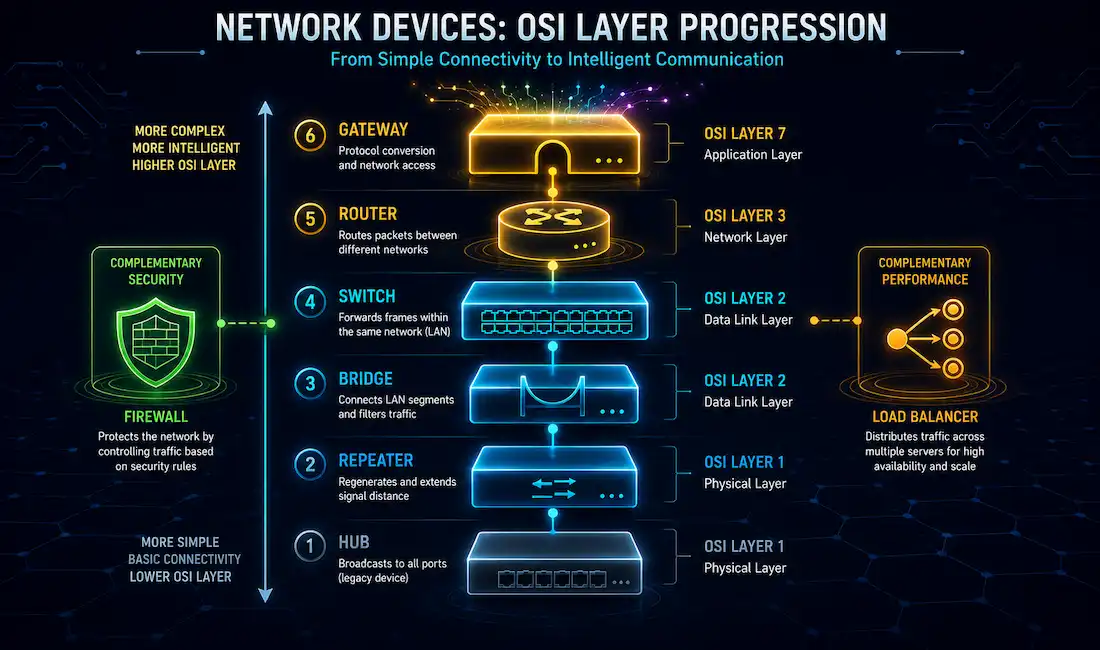
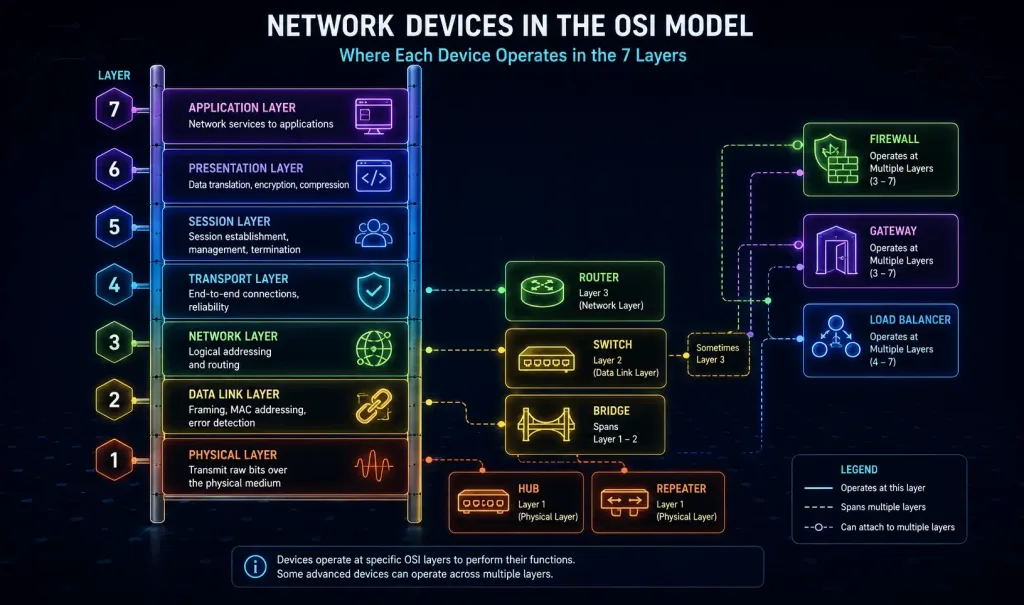
Network devices are specialized hardware that enable communication, data transfer, and connectivity within and between networks. They operate at different layers of the OSI model, ranging from simple physical-layer tools like hubs to sophisticated Layer 3+ systems like routers and load balancers. Their job, at every layer, is to keep data moving efficiently and securely.
Why Network Devices Matter
- Speed. Switches and routers optimize data transfer for fast, efficient performance.
- Scalability. They let networks grow without collapsing under their own weight.
- Security. Firewalls and gateways defend against unauthorized access and evolving threats.
- Flexibility. Modern devices support diverse environments, from small offices to large data centers.
Types of Network Devices
Hub
A hub works at the physical layer, physically connecting networking devices together. It’s not used in modern networks. Today, it’s studied mainly because understanding a hub makes understanding a switch much easier.
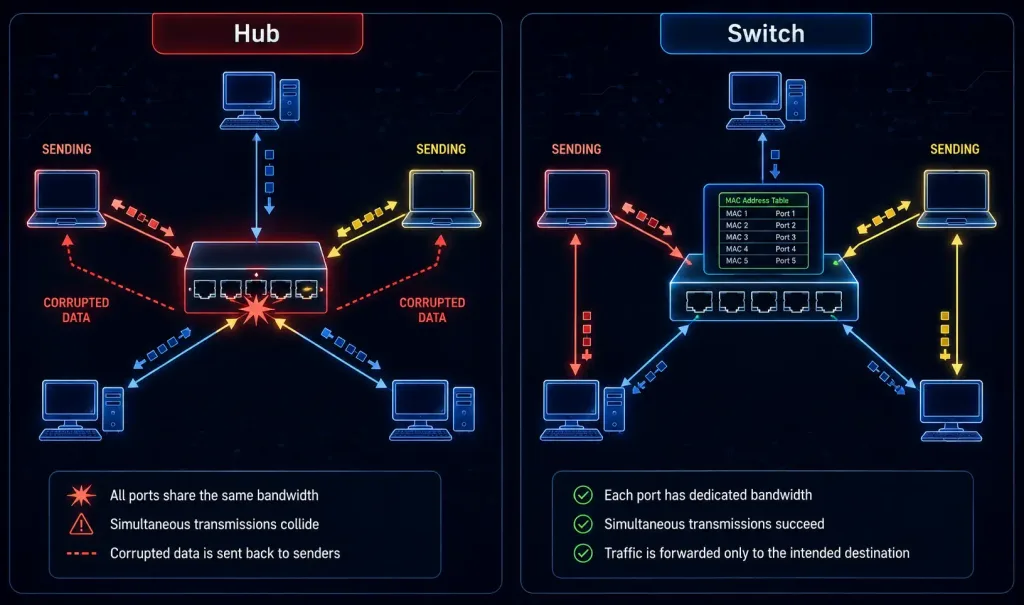
A hub copies data received on any port to every other port. Send a packet into port 1 of a 5-port hub, and it blindly copies that data out ports 2 through 5. It was a cheap, fast way to link multiple computers in early networks.
Hubs use Carrier Sense Multiple Access with Collision Detect (CSMA/CD) to control media access. An Ethernet hub communicates in half-duplex mode, which means collisions are basically inevitable. Only one computer can transmit at a time. If two computers transmit simultaneously, their signals collide and corrupt each other, forcing both to retry after a random delay. This becomes a real problem the moment more than a handful of devices share the hub.
A switch solves this collision problem entirely. A hub represents a single broadcast domain and a single collision domain. There are two types:
Passive Hub. Simply a physical connection point for wiring. It does nothing to the signal itself.
Active Hub. Smarter than a passive hub. It regenerates, concentrates, and strengthens the incoming signal before forwarding it. Active hubs are closely related to, and sometimes referred to as, repeaters.
Key features:
- Broadcasts data indiscriminately, which can cause real congestion.
- No filtering, no intelligence about the traffic it’s forwarding.
- Suited only to small, low-traffic, legacy setups.
Use case: Legacy systems, or educational labs specifically studying basic networking fundamentals.
Repeater
A repeater operates at the physical layer, typically with two Ethernet ports. It amplifies a weakening signal and retransmits it before it degrades too far to be usable, extending how far a signal can travel over the same network. As a signal weakens, the repeater regenerates it, bit by bit, back to its original strength.
Key features:
- Overcomes signal degradation over long cable runs.
- Does no actual data processing, just signal boosting.
- Simple and inexpensive.
Use case: Extending wired network reach across large physical spaces, like a warehouse or an industrial facility.
Bridge
Where a router connects two different networks, a bridge connects two sub-networks that are part of the same overall network. A bridge’s core job is storing and forwarding frames between the segments it connects.
Bridges operate at the Physical and Data Link Layer of the OSI Model. They can join two physical LANs into one larger logical LAN, or split one busy LAN into smaller, more manageable segments, reducing broadcast traffic across the whole network.
A bridge forwards or blocks frames based on MAC address, looking at which segment a destination device actually sits on. There are three main types:
Transparent Bridge. Maintains its own list of MAC addresses and stays invisible to other devices on the network, which have no idea it’s even there. It listens to traffic from every connected bridge and host, building its forwarding table automatically, without any manual configuration.
Source Route Bridge. A form of routing is used to establish connections between node pairs on different Token Ring networks specifically. (Note: this link points to an unrelated dating/social app article — an inherited link mismatch from the original article, flagged here per audit policy.) The path a packet takes through the network gets embedded directly inside the packet itself, rather than being calculated hop by hop.
Translational Bridge. Converts frame formats between different networking systems, reordering source and destination address bits when translating between Ethernet and Token Ring specifically.
Key features:
- Segments networks to reduce collisions.
- Improves performance on busy LANs.
- Some types are protocol-agnostic.
Use case: Connecting departments within a mid-sized office LAN, or splitting an overloaded segment into two more manageable ones.
Switch
An Ethernet switch connects multiple devices within a LAN, operating at Layer 2, the Data Link Layer. Some switches also operate at Layer 3 (Network Layer), and those get called Layer 3 switches or multilayer switches.
A switch’s basic job matches a hub’s: forwarding Layer 2 frames from source to destination. But a switch is far more intelligent. It uses MAC addresses to make forwarding decisions, without needing to know anything about what’s actually inside the frame, like an IPv4 packet in the payload.
Unlike a hub, which repeats every bit out every port except the one it arrived on, a switch consults a MAC address table, sometimes called a content-addressable memory (CAM) table, to make a targeted forwarding decision for each individual frame. Modern switches support a wide range of bandwidths: 10, 100, 1000, or 10,000 megabits per second, often on the same device.
Key features:
- Connects devices within a LAN.
- Learns MAC addresses and forwards Ethernet frames directly to their destination.
- Controls which devices can access which parts of the network.
- Supports usage monitoring on higher-end models.
- High-end switches accept pluggable modules for fiber or additional ports.
- Supports managed VLANs and port-level security.
- Handles unknown destinations by flooding once, then switches to targeted unicast or multicast once the destination is learned.
- Uses a CAM table, typically implemented in dedicated ASIC hardware for speed.
- Supports half or full duplex, depending on the connected device.
- A switch represents a single broadcast domain, unless VLANs are configured to split it into multiple.
Router
A router selects the best path for a data packet to travel, sitting at any gateway point where one network meets another. It forwards packets based on the destination network address and its own internal routing table, determining which outgoing port to use for each packet.
Routers require packets formatted in a routable protocol, almost universally TCP/IP today. They operate at Layer 3, the network layer, using the destination IP address to decide where a packet goes next. The router maintains that routing table itself, updating it as the network topology changes.
Key features:
- Routes data between LANs and WANs.
- Performs NAT, letting multiple internal devices share a single public IP address.
- Supports advanced features like QoS and VPN termination.
Use case: Home Wi-Fi routers, enterprise WAN edge devices, and the core routing infrastructure ISPs run.
Gateway
Gateways can technically operate at any layer of the OSI model, depending on what they’re actually translating between. Many real-world gateways, an email gateway or a VoIP gateway, for example, work specifically at the Application layer, since converting between different protocol formats often requires understanding application-level content, not just headers.
A gateway connects two networks that may run entirely different networking models, taking data from one system, interpreting it, and forwarding it into the other in a format that system understands. It’s a protocol converter at heart. Gateways are generally more complex than switches or routers, since they have to handle numerous protocols and standards from different vendors simultaneously. In practice, a router with added translation capability is often what a “gateway” actually is.
Key features:
- Converts between different data formats and protocols.
- Can double as a firewall or proxy in some implementations.
- Flexible across OSI layers, unlike most single-purpose devices.
Use case: Integrating cloud services with on-premises systems, or bridging legacy protocol environments with modern IP networks.
Advanced Network Devices
Modern networks demand more than basic connectivity. They need performance, security, and resilience built in.
Firewall
A firewall monitors and filters traffic based on defined security rules, protecting a network from unauthorized access and known threat patterns.
Key features:
- Blocks unauthorized access attempts.
- Filters traffic by IP address, port, or protocol.
- Available as dedicated hardware or as software running on general-purpose infrastructure.
Use case: Securing corporate network perimeters, or protecting a home network from unsolicited inbound connections.
Load Balancer
A load balancer distributes incoming traffic across multiple servers, improving performance and preventing any single server from becoming overloaded.
Key features:
- Improves reliability and uptime by spreading load.
- Uses algorithms like round-robin, or more advanced health-check-based routing.
- Essential for applications handling high, variable traffic volumes.
Use case: E-commerce platforms and cloud services that need to handle unpredictable, high-volume traffic without a single point of failure.
Network Device Comparison Table
| Device | OSI Layer | Core Function | Best For |
|---|---|---|---|
| Hub | 1 | Broadcasts data to all ports | Legacy or educational use only |
| Repeater | 1 | Extends signal range | Large physical spaces |
| Bridge | 1–2 | Filters and forwards by MAC address | Segmenting a busy LAN |
| Switch | 2 (some 3) | Directs data efficiently by MAC address | Modern LANs, essentially universal |
| Router | 3 | Routes data between networks | Internet connectivity, WAN links |
| Gateway | Varies (often Application) | Translates between protocols | Hybrid or cross-protocol integration |
| Firewall | Varies | Secures and filters traffic | Network perimeter protection |
| Load Balancer | Varies | Distributes traffic across servers | High-traffic applications |
Choosing the Right Network Device
Network size. A small network usually just needs a switch and a router. A larger network needs switches, routers, and likely load balancers working together.
Traffic load. Low traffic can tolerate simpler infrastructure. High traffic genuinely needs switches, and often load balancers, to avoid becoming a bottleneck.
Security needs. Basic protection comes from a router doing NAT. Real security needs a dedicated firewall, and possibly a gateway for cross-protocol environments.
Budget. For any real, functioning network today, a managed switch and a capable router are the realistic starting point, not a hub. Hubs are genuinely obsolete for production use, existing today mainly as a teaching tool, so they don’t belong on a legitimate buying shortlist even at the low end.
Scalability. Modular switches and routers with room to grow are worth the extra upfront cost if you expect the network to expand.
Conclusion
Network devices form the actual physical and logical backbone of every network, from a home Wi-Fi setup to a global enterprise WAN. Hubs and repeaters handle the physical layer. Bridges and switches handle Layer 2 forwarding intelligently. Routers and gateways handle Layer 3 and beyond, moving data between genuinely different networks. Firewalls and load balancers add the security and resilience a real production network actually needs. Understanding what each one does, and just as importantly, what each one doesn’t do, is core CCNA material and genuinely useful knowledge for building real infrastructure.
FAQs
What is the main function of a hub, and why isn’t it used anymore?
A hub connects multiple devices by broadcasting incoming data to every other port, operating at the physical layer with no filtering or intelligence at all. It’s been replaced by switches because broadcasting everything to everyone causes constant collisions and wasted bandwidth once more than a handful of devices are involved. It’s still worth understanding conceptually, since it makes learning how a switch actually improves on this so much clearer.
How does a router differ from a switch?
A router connects different networks and forwards data based on IP addresses at Layer 3, while a switch directs data within a single network using MAC addresses at Layer 2. A switch is about efficient delivery inside one network; a router is about getting traffic between separate networks entirely, including out to the internet.
What role does a gateway actually play in a network?
A gateway translates between networks running different protocols or standards, often operating at the Application layer since format conversion frequently requires understanding more than just packet headers. It’s more complex than a router or switch precisely because it has to handle multiple protocol standards from different vendors at once, making it the right tool specifically when you need to bridge genuinely different networking environments, not just route between similar ones.
How does a bridge improve network performance?
A bridge filters traffic between two network segments based on MAC address, keeping local traffic local and only forwarding frames that actually need to cross between segments. This reduces unnecessary broadcast traffic and collision domains, which matters most in busy LAN environments where a single flat network would otherwise choke on its own traffic.
What are the real advantages of a switch over a hub?
A switch delivers data directly to its intended destination using a MAC address table, instead of blasting it to every connected device the way a hub does. This dramatically reduces collisions, improves effective throughput, and enables features like VLANs and port security that a hub simply has no mechanism to support.
Can one device handle both wired and wireless connections?
Yes — most modern consumer and small-business routers integrate Wi-Fi directly, acting as a router, switch, and wireless access point all in one device. Larger enterprise deployments typically separate these functions into dedicated hardware instead, for better performance and easier troubleshooting, but for a home or small office, an integrated device is the normal, practical choice.
What’s the difference between a repeater and a router?
A repeater only amplifies and retransmits a signal to extend its range, with zero awareness of what data it’s actually carrying. A router actively reads destination IP addresses and makes real forwarding decisions between different networks. They solve completely different problems: one extends reach, the other directs traffic intelligently.
Why might a business need a dedicated gateway instead of just a router?
A standard router handles routing between IP networks just fine, but it generally doesn’t perform protocol translation between fundamentally different systems. A dedicated gateway steps in specifically when you need to bridge genuinely different protocol environments, cloud services talking to legacy on-premises systems being a common real-world example, translating formats in both directions so each side can actually understand the other.
Self-Assessment – Network Devices | Self-Assessment – IPv4 Packet Header | Self-Assessment – Network Layer | Self-Assessment – Auto-MDIX Cisco Switches | Self-Assessment – Duplex and Speed Setting on Switch