
Most people hear “audit” and think of a tax audit — stressful, tedious, best avoided. A social media audit is nothing like that. It’s a structured look at what’s actually working across your brand’s social accounts, what isn’t, and where effort is going to waste. Done properly, it takes an afternoon, not a quarter, and it usually surfaces at least one thing worth fixing immediately.
What a Social Media Audit Actually Covers
A social media audit evaluates your brand’s accounts, content, and performance across whatever platforms you’re active on, with the goal of finding gaps between what you’re doing and what’s actually moving the needle. It’s not a one-time checkbox — brands that revisit this every quarter catch drift (a platform’s algorithm shift, a competitor’s new approach, your own content getting stale) before it becomes a real problem.
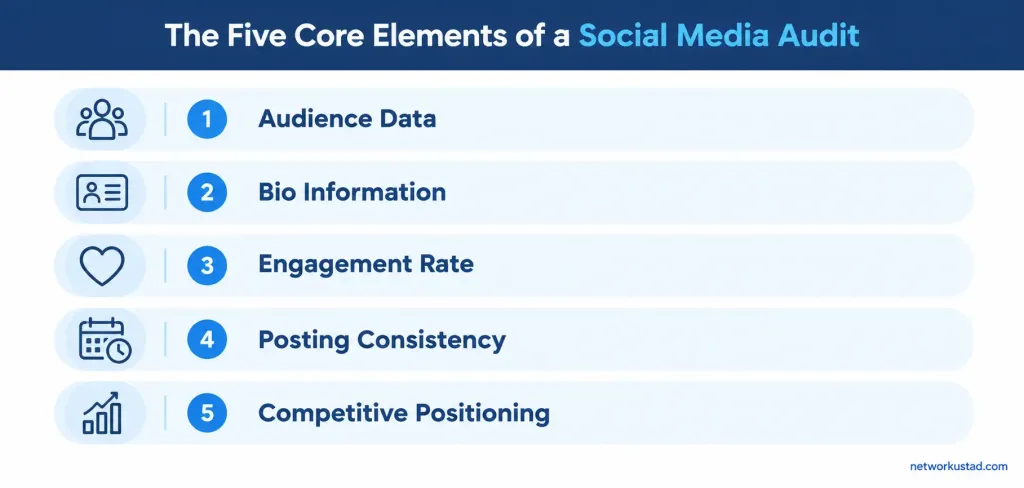
The Core Elements Worth Checking
Audience data. Who’s actually following you, and does that match who you’re trying to reach? A mismatch here — say, a B2B brand with a mostly consumer-skewing audience — usually means the content strategy and the actual target market have drifted apart.
Profile and bio information. Bios, links, and contact details across every platform should be current and consistent. This sounds trivial until you find three different outdated website links across four platforms, which happens more often than most brands expect.
Engagement rates. Likes and follower counts are vanity metrics on their own — engagement rate (interactions relative to reach or follower count) is the number that actually tells you whether content is landing. A account with a large following but thin engagement usually has a content problem, not an audience problem.
Posting consistency and timing. Irregular posting, or posting at times your audience isn’t actually online, quietly caps performance even when the content itself is good.
Competitive positioning. A quick look at what competitors are doing well (and poorly) on the same platforms gives useful context for whether your own numbers are actually good, or just look good in isolation.
Three Ways to Actually Run One
Do it yourself. For a single brand on two or three platforms, a spreadsheet and each platform’s native analytics (Instagram Insights, X Analytics, LinkedIn Page Analytics, and similar) are genuinely enough. It’s manual and takes a few hours, but it costs nothing beyond time.
Use dedicated audit or social listening software. Tools like Sprout Social, Hootsuite, Brandwatch, and NetBase Quid all offer social media auditing and listening features, pulling data across platforms into one dashboard instead of five separate logins. These make sense once you’re managing enough accounts or enough data volume that manual tracking becomes a real time sink — the right tool for your situation depends on your platform mix, budget, and whether you need listening (tracking brand mentions and sentiment) on top of straight analytics.
Hire an analytics or marketing agency. For brands without the internal time or expertise to run this well, an agency can handle the audit and translate findings into an actual action plan. This tends to make the most sense for larger accounts or brands managing a lot of simultaneous platforms and campaigns, where the cost is easily justified by the time saved and the quality of the resulting strategy.
None of these three is universally “best” — it depends on your scale, budget, and how much of this work you want to own internally versus hand off.
Why This Is Worth Doing Regularly
Platforms change their algorithms, audience behavior shifts, and content that worked a year ago can quietly stop performing without anyone noticing until engagement has already dropped. A regular audit — quarterly is a reasonable cadence for most brands — catches this early, rather than after a slow decline has already cost you reach and engagement. It also keeps your strategy honest: it’s easy to assume something is working because you’re used to doing it, and much harder to keep assuming that once the actual engagement numbers are in front of you.
Frequently Asked Questions
How often should I run a social media audit?
Quarterly works well for most brands — frequent enough to catch problems before they compound, infrequent enough that it doesn’t become busywork. A brand moving fast (frequent rebrands, new platforms, rapid growth) may benefit from doing it more often.
Do I need software to run a social media audit, or can I do it manually?
For one or two platforms, native analytics plus a spreadsheet are genuinely sufficient. Dedicated tools earn their cost once you’re tracking multiple platforms, need sentiment/listening data, or are managing enough volume that manual tracking eats real time every week.
What’s the single most useful thing to check in an audit?
Engagement rate relative to follower count, rather than raw follower count or likes alone. It’s the number most likely to reveal whether your content strategy is actually working or just accumulating passive followers.
Is hiring an agency worth it for a small brand?
Usually not necessary for a single brand on a couple of platforms — the DIY approach covers most of what you need. It becomes worth considering once you’re managing several platforms, running paid campaigns alongside organic content, or simply don’t have the internal time to do this properly every quarter.
The Bottom Line
A social media audit isn’t complicated — it’s checking audience fit, bio accuracy, engagement rate, posting consistency, and competitive context, on a regular schedule rather than once and never again. Whether you do it yourself with a spreadsheet, use a dedicated tool, or bring in an agency depends entirely on your scale and budget, not on which option is objectively “best.” The brands that actually catch problems early are the ones treating this as a recurring habit, not a one-off exercise.