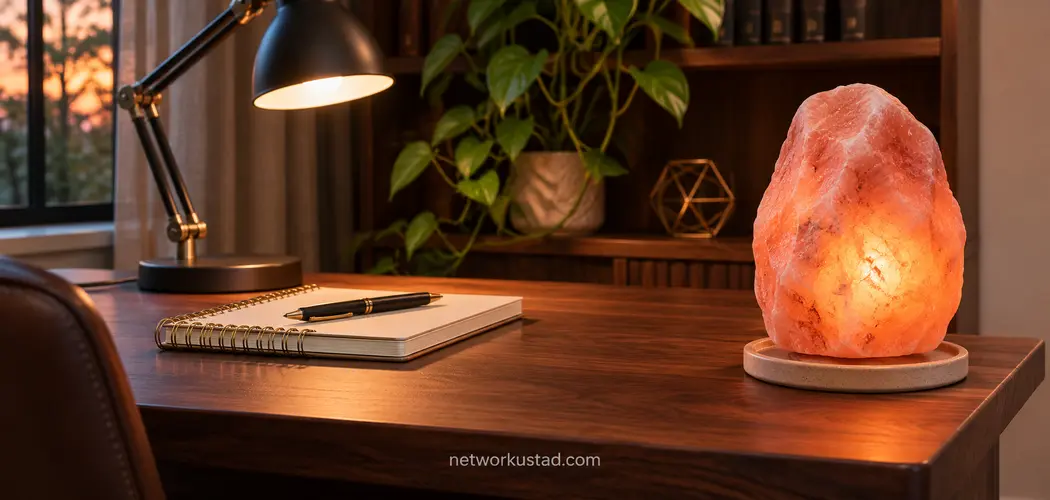
A Himalayan salt lamp can add a small pool of amber light to an office. If that’s the look you want, think of it the same way you would a small decorative lamp. Give it a stable spot, keep it away from water, and check what it looks like from your chair. Keep a separate light for work that needs clear, even illumination.
It’s easy to buy a decorative light for a problem it can’t solve. If your desk is hard to read at night, start with a task lamp. If a window is reflected in your screen, start by changing the angle or shading the window. A salt lamp makes sense when your work surface is already usable and you want a softer light in one part of the room.
What a Himalayan salt lamp can do for an office
The visible effect is simple. A bulb inside the salt casts a warm glow. The look varies with the shape and thickness of the rock, the bulb, and how bright the room is. In a sunny office it may barely stand out. At dusk, the same lamp can add light to a shelf or make an empty corner easier to see.
Choose it for the look it gives the room. Cleveland Clinic’s review of salt lamp health claims finds little evidence for the advertised benefits. A Himalayan salt lamp should not be relied on to clean the air, relieve respiratory symptoms, or improve concentration. Claims about neutralizing radiation from computers or phones also lack a reliable basis.
If the office smells stale, investigate where the smell is coming from. You may be able to address it by removing the source or checking whether the room’s ventilation is working as intended. A warm light can change how the room looks while the underlying air problem is still there.
Decide which kind of light you’re missing
Look at the room at the time of day you usually work. If you’re at a desk in daylight, you may need a way to control glare. If you read paperwork in the evening, you may need light directed at the page. If the work area already has enough light and the rest of the room looks flat, that’s where a small accent light can help.
| What you want to change | What to try |
|---|---|
| A dim page or keyboard | Aim an adjustable task light at the work surface. |
| A reflection on your screen | Shift the light or monitor, or use a blind to soften daylight. |
| A dark corner behind the desk | Try a small accent light on a stable shelf or side table. |
| Warm light with adjustable direction | Compare a shaded table lamp with a salt lamp. |
| Better indoor air quality | Address the source of the problem and review ventilation or filtration options. |
You can try the layout with a small lamp you already own. Set it where you think the new lamp would go and spend an evening with the arrangement. That gives you a sense of whether you like a light there or simply liked how it looked in the product photo.
Where to put a Himalayan salt lamp
Start with a dry, level surface that can hold the lamp’s weight. Leave room around it so a notebook, bag, or sleeve won’t catch it when you move. Pick an outlet you can reach without stretching the cord across a doorway or underfoot. Follow the model’s instructions for clearance and placement.
If you put it on the desk, choose a spot outside the main reach of your hands. The back corner can work, provided you can still reach the switch. A side table or shelf may be better if you move papers and equipment around frequently. The lamp should sit fully on the surface without the base overhanging an edge.
Think about what else shares that space. Keep drinks, plants that need watering, and humidifiers away from the lamp and its electrical parts. If a shelf sits above your computer or power strip, find another place. You want to be able to inspect the surface around the lamp easily and deal with moisture before it reaches other equipment.
If the office is used by several people, choose a spot everyone can work around. A desk that seems spacious when empty can fill up with laptops, chargers, and bags during the day. Try the arrangement with the usual equipment in place. If you need to move the lamp every time you spread out a document, give it a dedicated spot off the desk.
Check the view from your chair
Turn on the lamp and sit where you normally work. Look at a dark area of the screen to check whether the light appears as a reflection. If it does, move the lamp sideways or behind your usual line of sight, then check again. A few inches can change whether the light lands in the screen or on the wall beside it.
Do the same check with the overhead lights on and off. If you join video calls from that seat, open the camera preview. A lamp directly behind you might be brighter in the camera than it feels in person. Move it out of the frame or further off to one side if it draws attention away from your face.
If the screen itself is awkward to position, our computer monitor stand guide explains what to check for height, angle, and available desk space. Make those adjustments before deciding where the decorative lamp belongs.
Pair accent light with a task lamp
Put the light that does the work where you need it. If you write by hand, try moving the task lamp to the side opposite your writing hand and see whether the shadow on the page gets smaller. If you read beside a monitor, aim the light toward the page and check the screen for reflections. Make small changes while sitting at your normal distance.
A Himalayan salt lamp can then sit further away, where its glow has less effect on the working area. Try putting it on a side shelf or at the far end of a long desk. In a small room, a separate side table can keep the light visible while leaving the desk clear.
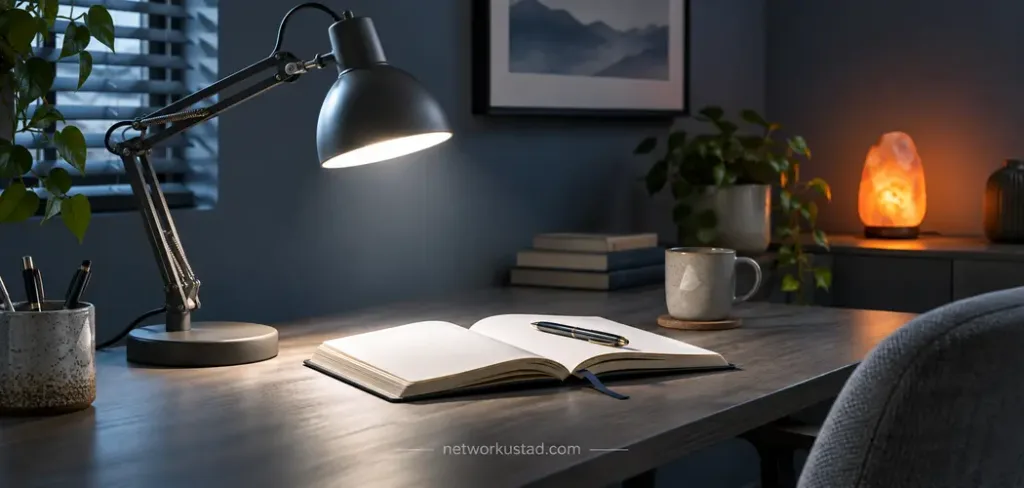
Use the two lights independently for a few evenings. Turn the accent lamp off and see whether you can still work comfortably. Then turn it on and check whether you like the effect. If you find yourself turning the main light off to make the salt lamp more visible, ask whether you can still read without leaning in or losing detail on the page. The decorative light should fit around the way you work.
What to check before buying a Himalayan salt lamp
Start with the dimensions and weight of the exact model. Product photos rarely show scale well. Mark the size of the base on your desk with a sheet of paper, then set out the things you use each day. If the paper is already in the way, the lamp will be too.
Check which bulb and cord assembly the model uses and whether the maker provides instructions for replacement. A listing should identify the lamp and give enough information to find its manual. If it has a dimmer, check which replacement bulbs the manufacturer allows. Choose a plug and electrical rating appropriate for the country where you’ll use it.
If you’re buying a used Himalayan salt lamp, ask for a photo of the model label, the plug, and the switch. Search your local product-safety authority’s recall database. In the U.S., the Consumer Product Safety Commission recalled certain Lumière rock salt lamps because the dimmer or plug could overheat. The notice identifies the affected models. Use the model information to check whether it applies to the lamp you’re considering.
Also check what is included and what it costs to replace a compatible bulb. If you’re choosing between two lamps, compare the complete price, including any parts you need to use it as directed. A return policy can matter if you’re buying online and haven’t seen the colour or brightness in person.
How to care for a Himalayan salt lamp
Follow the care instructions for your exact model. Before cleaning, switch the lamp off and unplug it if it is safe to do so. Let it cool. Use the method specified by the maker and keep liquids away from the electrical parts. Avoid rinsing or soaking the salt body.
Check the base and the surface beneath it from time to time, especially if the room gets humid. If you notice moisture, stop using the lamp and move it to a dry location only after it is safe to handle. A dry, suitable tray or coaster may help protect the furniture if the manufacturer permits it. Keep any vents clear and inspect the cord and plug before using the lamp again.
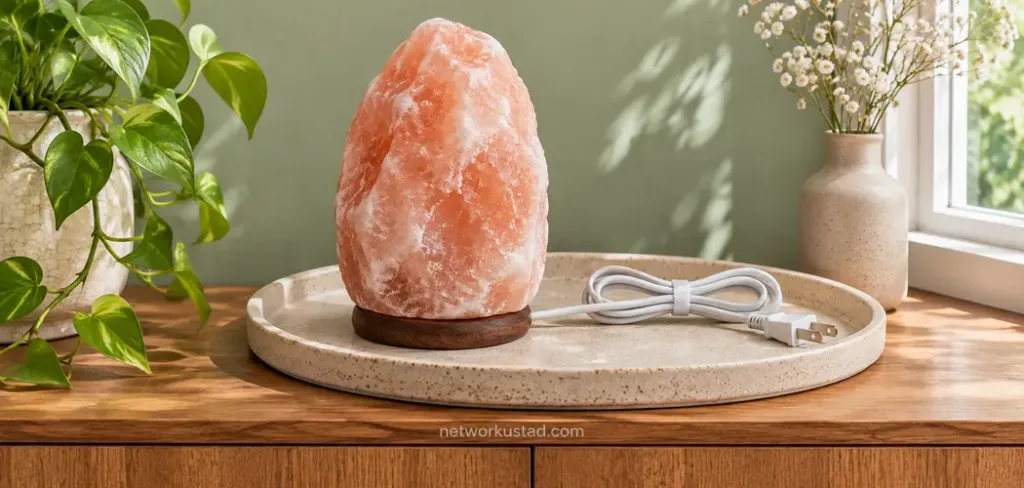
If you notice scorching, a damaged cord, a loose plug, or an unusually hot switch, stop using the lamp. Follow the manufacturer’s instructions or the instructions in any recall that applies. If you think the outlet is damaged or the lamp’s electrical parts have become wet, have the setup checked before reconnecting it.
If you use the lamp in a shared office, leave its instructions somewhere easy to find. Make sure others know how to switch it off and what kind of bulb it takes. A move to a different desk is a good time to check the surface, the outlet, and the path of the cord again.
Decide whether the lamp belongs on your desk
Before you buy a Himalayan salt lamp, run through four checks. Do you have enough light for your work already? Do you have a stable, dry spot with a suitable outlet nearby? Can you identify the model and read its instructions? Can you sit at your screen without seeing a distracting reflection?
If the answer to one of those questions is unclear, try a different location or fix the lighting problem first. You might decide that a small shaded lamp gives you the warm light you want while taking up less space. You might also find a spot on a shelf where the salt lamp adds colour without using up part of the desk.
Try the arrangement before committing to it
Give the lamp a trial run on an ordinary workday. Read a page at the desk, type for a few minutes, and check your camera view if you take video calls. See whether the switch is still within reach once your bag and papers are out. If the lamp adds clutter, move it to a side surface and repeat the same checks.
At the end of the day, turn the light off and look at the room again. This makes it easier to decide whether the lamp fills a dark spot you care about or simply adds an object you need to work around. If you’re buying it for someone else’s office, check that they have room for it and want a plug-in light before choosing the size.
Frequently asked questions
Can a Himalayan salt lamp replace a desk lamp?
Use it as an accent. If you need to read, write, or check small details, use a light you can aim at the work surface. Compare the two from your normal seat.
Does a salt lamp clean the air?
There is no good evidence that a household salt lamp provides meaningful air cleaning. If air quality is the reason you’re shopping, focus on the source of the problem and appropriate ventilation or filtration.
Can I use any bulb that fits?
Check the manufacturer’s specified bulb type and wattage. If you have a dimmer, follow the instructions for that control as well. A bulb fitting the socket doesn’t establish that it is suitable for the lamp.
Where should I put the lamp in a small office?
Try a stable side shelf or the back corner of the desk, away from drinks and the main work area. Sit down and check the screen for reflections before you settle on the spot.