Travel fare aggregators — the sites that let you compare flights, hotels, and packages across dozens of providers in one search — depend on gathering enormous amounts of pricing data, quickly and continuously. That data lives on airline, hotel, and travel-agency websites, most of which actively try to stop automated collection. Proxies are the tool that makes large-scale, reliable data collection possible.
If you’re building or running an aggregator, or just trying to understand how these platforms work under the hood, this guide explains what proxies are, the main types and how they differ, why fare aggregation specifically relies on them, and the legal and ethical lines worth keeping in mind before you scrape anyone’s site.
What a Proxy Actually Is
A proxy is a server that sits between you and the website you’re contacting. Instead of your request going straight to the target site, it goes to the proxy first, which forwards it on and relays the response back to you. To the destination site, the request appears to come from the proxy’s IP address rather than yours — so your real IP stays hidden and you’re assigned a different one for that traffic.
That’s the whole mechanism, and it’s why proxies are useful well beyond scraping: privacy, security, accessing region-specific content, and load testing all rely on the same basic idea. For data collection at scale, the key benefit is that you’re not hammering a website from a single identifiable address.
The Main Types of Proxy, and How They Differ
Proxies aren’t one thing. The differences between types matter a lot when you’re choosing which to use, because they trade off cost, speed, and how easily they’re detected.
Residential proxies route your traffic through IP addresses assigned by internet service providers to real homes and devices. Because the IP belongs to a genuine residential connection, traffic through it looks like an ordinary person browsing, which makes these proxies much harder for a target site to flag as automated. That realism is their main strength. Providers such as IPBurger specialize in residential pools. The trade-offs are cost (they’re the most expensive type) and speed (routing through consumer connections is slower than a datacenter).
Datacenter proxies come from servers in data centers rather than from ISPs and consumer devices. They’re fast and inexpensive, which makes them attractive when you need high throughput — but because their IP ranges are known to belong to data centers, sophisticated anti-bot systems spot and block them more readily. They’re best when speed and volume matter more than blending in.
ISP (static residential) proxies sit between the two: they use ISP-registered IPs like residential proxies, but are hosted on datacenter infrastructure, giving you the legitimacy of a residential IP with more stability and speed. They’re a common middle-ground choice.
Rotating proxies are a configuration rather than a source: they draw from a large pool and assign a different IP to each request (or rotate on a set interval). This is what lets a scraper spread thousands of requests across thousands of addresses so no single IP stands out. Rotation can be layered on top of residential, datacenter, or ISP proxies.
Mobile proxies route traffic through IPs assigned to mobile carriers (3G/4G/5G). Because carriers share these IPs among many real users, they’re among the hardest to block, though also among the most expensive. Some providers, such as OnlineProxy, focus specifically on mobile IPs for tasks where mobile-origin traffic is an advantage.
Larger providers offer several of these categories together, and some layer machine-learning-based request handling on top to adapt automatically to a site’s defenses — Oxylabs, for instance, is one of the vendors operating at that end of the market. If you’re targeting a specific country’s pricing — say, gathering fares as they appear to users in a particular market — you’d want proxies located there; a provider offering a Mexico proxy pool, for example, gives you IPs that present as local to that region. (Note: the proxy company formerly known as Blazing SEO now operates under the name Rayobyte.)
Why Fare Aggregators Rely on Proxies
Aggregators work on a simple principle: pull data from many external sources, compile it, and present it in one place. For travel, that means continuously extracting fares and availability from airlines, hotels, and online travel agencies — thousands of price points that change constantly.
The complication is that most of those sources don’t want to be scraped. Airlines and hotels deploy anti-bot measures that watch for automated behavior — unusually high request rates, non-human browsing patterns, missing browser fingerprints — and when they detect a bot, they block the offending IP, temporarily or permanently. On top of that, most servers enforce rate limits: too many requests from one IP in a short window and that IP gets throttled or suspended.
Run a collection operation from a single static IP and you’ll hit both walls fast — one address making thousands of requests is the easiest possible thing to detect and ban. Rotating proxies solve this by distributing requests across a large pool, so each IP makes only a modest number of requests and the traffic as a whole looks organic rather than like one relentless machine. That’s what allows an aggregator to keep pulling fresh pricing without constant interruptions.
In practice, aggregators mix types to balance competing needs. A search has to return results in seconds, so speed matters — datacenter proxies help there. But avoiding detection matters too, so rotating residential or mobile IPs handle the requests that need to blend in. The right setup is whichever combination keeps data flowing reliably for the specific sites being collected from, at a cost that makes sense.
The Part Most Guides Skip: Is This Actually Allowed?
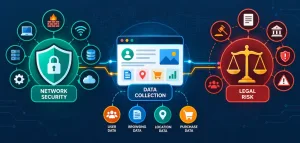
Here’s what a lot of proxy write-ups gloss over, and it matters: using proxies to bypass a website’s anti-scraping measures sits in a genuinely contested legal and ethical area, and you should understand it before you build anything.
A few things worth weighing:
- Terms of Service. Most airline, hotel, and travel-agency sites explicitly prohibit automated data collection in their terms. Scraping them anyway may breach those terms, which can have contractual consequences even where it isn’t a criminal matter.
- The legal picture is unsettled and jurisdiction-dependent. Courts in different countries — and even different cases within the same country — have come down in different ways on scraping publicly available data. Some rulings have treated scraping public data more permissively; others have sided with the site owners, particularly where terms were violated, technical barriers were circumvented, or the data was copyrighted or personal. The travel sector specifically has a long history of litigation over fare scraping. This isn’t settled law, so “everyone does it” is not the same as “it’s clearly fine.”
- Data ownership and copyright. Fare and inventory data may be protected, and compiling it into a competing product raises separate intellectual-property questions beyond the act of collection itself.
- Server load and good citizenship. Even where scraping is permissible, aggressive collection can burden the target’s infrastructure. Respecting rate limits, honoring
robots.txtwhere appropriate, and collecting only what you need are both ethical practice and a way to stay under the radar.
None of this means fare aggregation is off-limits — legitimate aggregators operate at scale, and many source data through official channels like partner APIs and licensing agreements rather than scraping alone. But if you’re going to collect data, do it with awareness of the rules that apply to your jurisdiction and your targets, ideally with legal advice for anything commercial. Proxies are a tool; how you use them determines whether you’re on solid ground.
Bottom Line
Proxies are the infrastructure that makes travel fare aggregation possible, letting platforms gather pricing from resistant sources without being blocked at the first IP. Choosing well means matching the proxy type to the job: residential and mobile IPs when you need to blend in, datacenter when you need raw speed, ISP proxies for a balance, and rotation layered on top to spread requests so they read as organic. Just as importantly, treat the legal and ethical side as part of the design, not an afterthought — the smartest proxy setup in the world won’t help if the collection itself lands you in a dispute you could have avoided.
This article is for general educational purposes and does not constitute legal advice. If you’re collecting data commercially, consult a qualified attorney about the rules that apply in your jurisdiction and to the specific sites you intend to access.