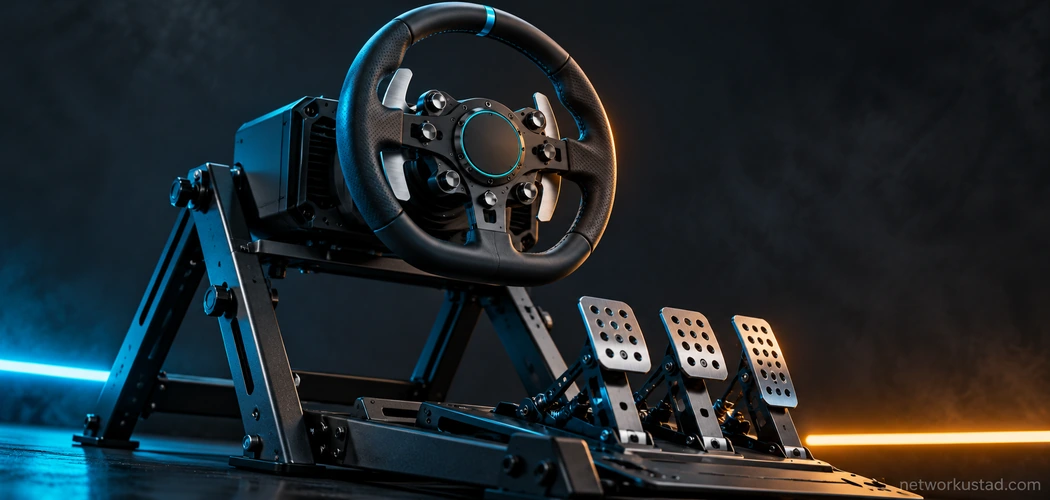
A racing wheel can change the way a driving game feels, but choosing one involves more than finding a realistic-looking rim. The wheel must work with your platform and games, fit somewhere secure, and make sense alongside the pedals and accessories you intend to use. An impressive specification is of little value if the product cannot be used comfortably in your available space.
This guide explains how to compare racing steering wheels without treating promotional language as evidence of performance. It is a buying framework, not a ranked list based on hands-on testing. Product references illustrate features and compatibility checks; they do not establish that one model is best for every player.
Start comparing racing steering wheels with platform compatibility
Write down your exact platform before looking at product photos. A PlayStation-compatible version and an Xbox-compatible version from the same product family may look similar while supporting different consoles. A listing that says PC compatible does not automatically establish support for your console as well.
Check the manufacturer’s current compatibility information for the exact model and version. Read the product name carefully, particularly when a marketplace combines several variants on one page. If you are buying used, confirm the model on the actual unit rather than relying on the seller’s broad description.
Compatibility also has a game-specific layer. A wheel may connect to a platform without every game supporting all its controls or feedback features. Look for the relevant game’s wheel-support information and the manufacturer’s setup notes. Avoid assuming that a USB connector makes a device universal.
For example, Logitech distinguishes the console support of its G29 and G920 within the same product family. Its Driving Force product information identifies the supported versions. Use that distinction as a reminder to verify the actual device you are considering, not as a substitute for checking your own game.
Understand force feedback rather than confusing it with vibration
Vibration and force feedback are related sensations, but they are not interchangeable descriptions. A vibration feature can create rumble. Motor-driven force feedback can also apply resistance or directional forces to the steering wheel in response to the game’s output.
Those forces can help communicate changing steering loads and other simulated effects. What you feel depends on the hardware, the game and the settings. A wheel with genuine force feedback is therefore a different proposition from a device offering only vibration and a centring mechanism.
When comparing racing steering wheels, ask what actually produces the feedback. Do not accept phrases such as realistic feel or immersive vibration as a complete explanation. Look for a clear description of the drive system and the supported features, then check whether the games you play use them.
More force is not automatically more useful. Excessive settings can feel tiring or obscure detail, and a poorly supported mount can move instead of allowing the player to interpret the wheel’s response. Start with recommended settings and adjust thoughtfully rather than assuming the maximum value is the correct one.
Gear, belt and direct-drive descriptions need context
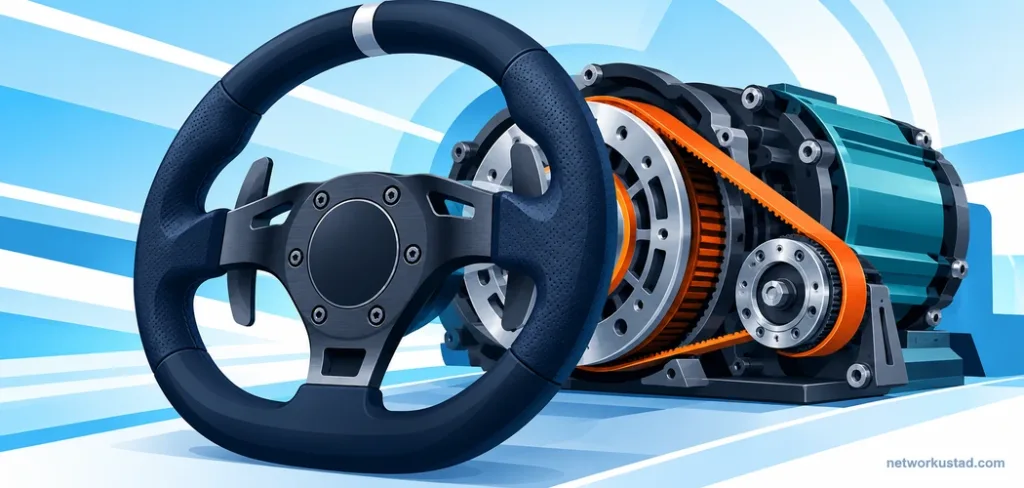
These terms describe different ways of transmitting motor force to the wheel. Gear-driven designs use gears, belt-driven designs use a belt arrangement, and direct-drive designs connect the wheel more directly to the motor. Some products combine mechanisms, so read the exact specification rather than forcing every model into a simple label.
The mechanism alone does not prove overall quality. Consider the complete product: supported platform, software, usable settings, mounting requirements, support arrangements and cost. Comparing two descriptions without using the products cannot establish which one will feel better to a particular person.
If reviews matter to your decision, prioritise ones that explain their test setup and distinguish observation from preference. A reviewer using a rigid cockpit and one game may report an experience that differs from yours at a desk with another title.
Treat pedals as part of the control system
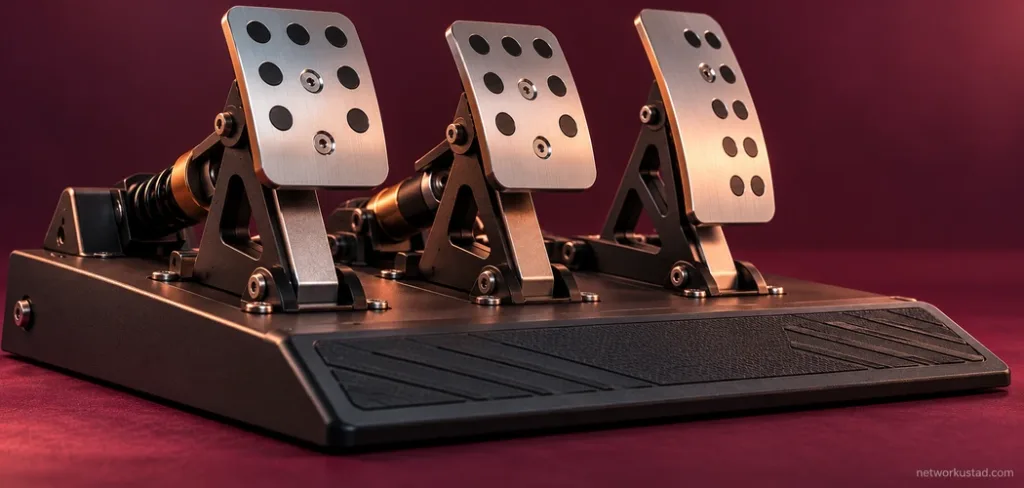
A pedal set is not described by its number of speeds. Two-pedal sets commonly provide accelerator and brake controls, while a third pedal may provide a clutch. Gear selection is handled through other controls, such as paddle shifters or a separate shifter, depending on the setup.
For racing steering wheels, the pedal package can be as important to daily use as the rim. Ask whether pedals are included, what adjustments are available and how securely they can be positioned. A visually substantial metal pedal face does not by itself establish that the whole unit will stay in place.
Consider the games and driving styles you actually enjoy. A clutch pedal is relevant when you intend to use a setup that supports it, but its presence is not a requirement for every player. Do not pay for a particular arrangement solely because a checklist describes it as more realistic.
Read descriptions of brake resistance and sensing carefully. Different designs can respond differently, and a demanding brake can require a stronger mounting arrangement. Avoid equating harder with better without considering how the pedals will be used and whether you can control them comfortably.
Check the pedal connection before buying an upgrade
An accessory belonging to the same manufacturer is not automatically compatible with every wheel base or console arrangement. Some pedals connect through a wheel base, while supported PC configurations may offer other connection options. Adapters and operating modes can also affect what works.
Thrustmaster publishes platform and accessory compatibility guidance for its equipment. Consult the relevant manufacturer’s equivalent information before buying an upgrade. Verify the exact base, pedal set, connection method and platform together rather than checking each product in isolation.
Mount racing steering wheels securely
Before ordering, identify where the wheel and pedals will go. A suitable setup needs adequate stability, comfortable positioning and enough room for cables and movement. A desk, wheel stand and dedicated cockpit solve different practical problems; none should be assumed to fit every home.
For desk use, check the clamp requirements, available clearance and the desk’s suitability for the intended loads. Do not improvise an attachment that interferes with the clamp or leaves the wheel insecure. Follow the manufacturer’s mounting instructions and any limitations for the product.
Racing steering wheels can apply force through their mounts. If the supporting surface moves, flexes excessively or becomes unstable, address that before increasing feedback settings. A stronger wheel is not an improvement if the surrounding setup cannot support it properly.
The pedals need attention too. A base sliding away or a chair rolling backwards can make consistent control difficult. Look for an appropriate mounting or support arrangement that suits the equipment and floor, without obstructing exits or creating a trip hazard.
Compare steering rotation with your intended games
Rotation describes how far a wheel can turn, but a single minimum number is not a reliable buying rule for every driving game. Different titles and simulated vehicles use different steering arrangements, and supported software settings may change how the physical movement is mapped.
Check the wheel’s available range and how calibration or rotation settings work on your platform. The presence of a large maximum range does not mean every game will use it in the same way. Equally, a smaller range should not be judged without considering the intended experience.
When assessing racing steering wheels, distinguish maximum rotation from steering accuracy, feedback quality and compatibility. They are separate characteristics. A product listing that highlights one impressive number may still leave important questions unanswered.
If you switch between several games, investigate whether profiles or convenient adjustments are available for the exact setup. A feature that saves time for someone who changes settings frequently may be irrelevant to someone who plays one title with a fixed arrangement.
Compare the complete cost of racing steering wheels
Compare the usable setup, not just the price shown beside a wheel base. Check what is included in the box: rim, base, pedals, power supply, mounting hardware and any required cables. A product photo may show optional accessories that are not supplied.
Add the cost of any stand, compatible shifter or necessary adapter you intend to use. Include delivery, applicable taxes and the practical cost of returns where relevant. Prices vary by market and seller, so an old best-value label should not decide a current purchase.
For racing steering wheels, buying more components at once is not always the most economical route. A complete, compatible entry setup can be more useful than an ambitious base that leaves you unable to afford suitable pedals or mounting. Conversely, avoid buying a temporary component that you already know cannot meet your needs.
Think about storage as part of cost and convenience. A setup you can assemble and put away comfortably may receive more use than a larger one that creates a daily obstacle. Measure the available space rather than relying on photographs taken in someone else’s room.
Look beyond the wheel rim and button count
Rim shape, material and controls affect usability, but appearance should not dominate the decision. Check whether important controls are reachable and whether their functions are supported in your games. More buttons do not necessarily produce a better experience if assigning or remembering them becomes awkward.
Paddle shifters can suit some driving styles, while a separate shifter may appeal to others. Confirm the connection and platform support before assuming an accessory can be added later. A detachable rim also needs an ecosystem check: compatible does not simply mean physically similar.
With racing steering wheels, adjustable should be followed by a specific explanation. Does it refer to pedal position, feedback settings, rotation, mounting or something else? Replace vague claims such as fully adjustable with the individual adjustments that matter to your setup.
Do not interpret premium materials as evidence of every other quality. A leather-covered rim can be appealing, but it does not establish quiet operation, durability, software stability or a favourable warranty. Assess those questions separately using reliable product information and documented experience.
Check software, updates and ongoing support
Read the manufacturer’s installation instructions before connecting unfamiliar equipment. Confirm the operating system requirements where a computer is involved and use official sources for software or firmware. Avoid downloading a driver from an unrelated site merely because its page includes the model name.
A setup procedure may involve calibration, an operating-mode selection or settings inside the game. Follow the sequence appropriate to the exact model. A problem caused by the wrong mode can look like a compatibility failure, so consult the support guidance before concluding that the hardware is defective.
When buying racing steering wheels, check whether current support material is available and understandable. Older models are not automatically unusable, but they deserve careful review of platform support, supplied accessories, condition and repair options. Do not infer that a product is discontinued simply because it first appeared years ago.
Separate an official specification from a seller’s promise. If a return depends on a claimed feature, keep a copy of the listing and obtain clarification before paying. A good deal becomes less attractive when the seller cannot explain what is included or how a problem will be handled.
Buying used: inspect the complete package
A used wheel can be worth considering, but its suitability depends on the actual unit. Ask for clear photographs of the model label, connections, cables, pedals and mounting parts. Confirm that the correct power supply is included where one is required, rather than assuming any replacement will do.
Request an appropriate demonstration of basic operation if practical. Check steering input, pedal response, buttons and feedback in a supported setup. A video showing lights switching on is not the same as showing that the system works as intended.
For racing steering wheels, cosmetic condition and functional condition are different questions. Read the manufacturer’s guidance about normal operation and warning signs, and avoid diagnosing every sound or movement from a short recording. If a fault is uncertain, price the risk realistically or choose a more verifiable purchase.
Understand the seller’s return arrangements and any remaining support before committing. Do not assume a transferable warranty or available replacement part without checking. Savings on the initial price should be weighed against missing components, uncertainty and the effort needed to resolve a problem.
A useful checklist before you order
You should be able to answer these questions:
- Does this exact version support my platform and main games?
- Is the feedback system clearly described rather than just called vibration?
- Are the pedals included, suitable and compatible with my intended setup?
- Can I mount the wheel and pedals securely in the space available?
- What does the complete usable package cost?
- Are setup instructions, official software and support available?
- Do I understand the seller’s returns and the supplied accessories?
Choosing racing steering wheels becomes easier when these practical requirements come first. Start with the equipment you can use reliably, then decide which additional features justify their cost. A convincing photograph or an unsupported best-of label cannot replace a compatible, stable and manageable setup.
This guide provides general buying information and is not a report of hands-on product testing. Compatibility, software support, included accessories, prices and warranty terms can change. Confirm details for the exact model, platform and game before purchasing, and follow the manufacturer’s installation and safety instructions. Product references are examples, not endorsements. Images depict generic concepts, not verified commercial models; the mechanical illustration is not an engineering or repair diagram.