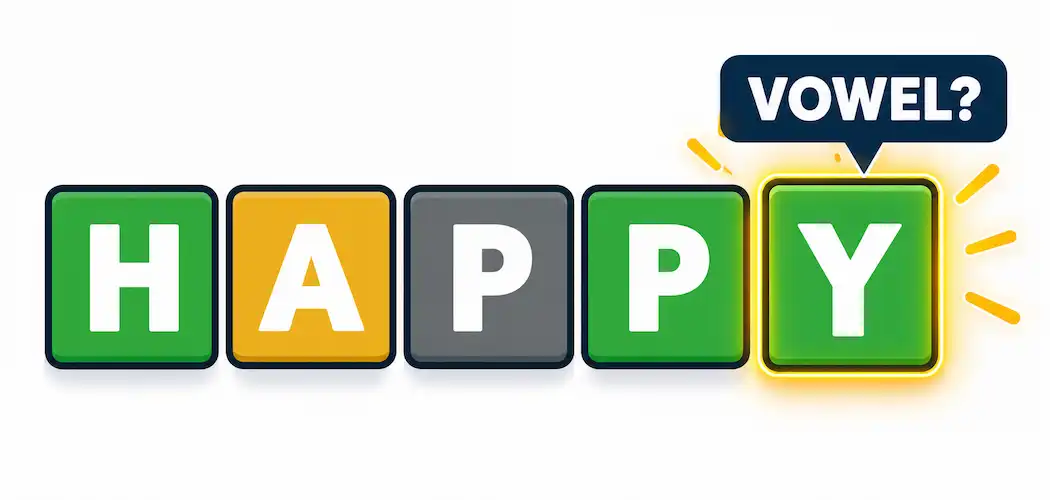
Most players sort letters into two neat piles — vowels and consonants — and then get stuck the moment Y shows up, because Y refuses to stay in either pile. In plenty of common five-letter words, Y is doing a vowel’s job: carrying the word’s main sound, the way A, E, I, O, and U normally would. Treating Y as a flexible, vowel-capable letter rather than a straightforward consonant is a small mental shift that genuinely changes how you should pick your opening guesses.
Where Y Actually Shows Up in Five-Letter Words
Y is far more common at the end of five-letter words than most players expect — HAPPY, CANDY, STORY, EVERY, PARTY, EARLY, and WORRY are all common, realistic Wordle answers, and in every one of them, Y is functioning as the word’s vowel sound at the end rather than as a hard consonant. This cuts directly against the old assumption that “-Y endings are rare” — they’re not; Y is one of the more frequent letters in the final position of five-letter English words, which makes it worth testing deliberately rather than treating as a long-shot letter.
Y also shows up as an internal vowel sound in words like RHYME and GYPSY, standing in for what would otherwise be an I sound. Recognizing both patterns — Y as an ending vowel and Y as a mid-word stand-in — gives you two separate reasons to work it into your guessing strategy rather than saving it for later in the game.
Building a Smarter Opening Guess
A strong opening word does two things at once: it tests several of the most frequent letters in English, and it avoids repeating any letter (since a repeated letter in your first guess wastes a guess slot testing the same information twice). The standard high-value letters to prioritize are the true vowels (A, E, I, O, U) plus the most common consonants (R, S, T, L, N) — and Y deserves a spot in that same conversation specifically because of how often it appears as that word-ending vowel sound.
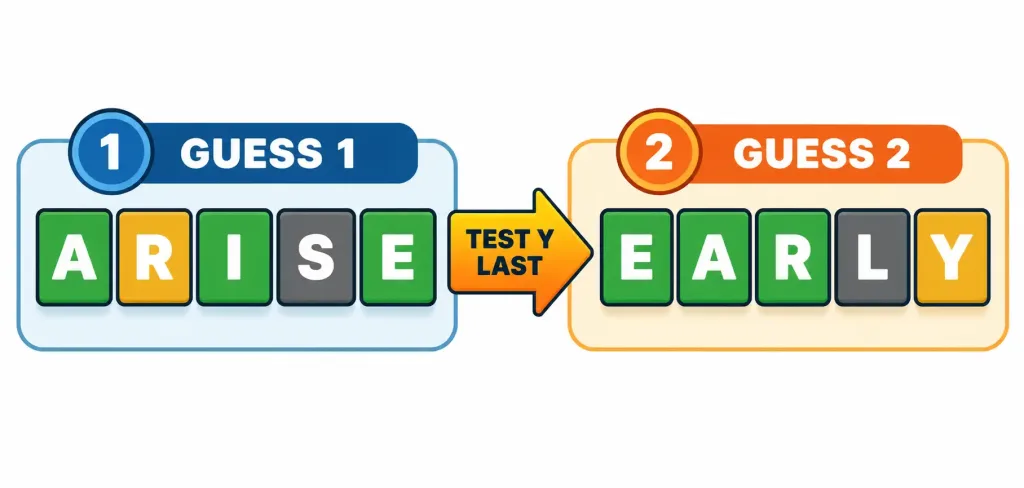
Words like ADIEU, AUDIO, or ARISE front-load vowels efficiently as an opener. A second guess that specifically tests Y in the final position — something like MONEY, EARLY, or STUDY — is a reasonable, deliberate way to learn whether the answer ends in that vowel-like Y sound, rather than treating Y as an afterthought letter you only consider once you’re stuck.
A Practical Two-Guess Opening Strategy
- First guess: a word that covers several common vowels and consonants with no repeated letters (e.g., ADIEU or ARISE).
- Second guess: a word that tests different letters still uncovered, including a Y in the final position if your first guess didn’t rule it out, to see whether the answer’s ending vowel sound is Y rather than a traditional vowel.
This two-guess approach typically narrows the field dramatically before you’ve used even half your six guesses, leaving the remaining attempts for genuine deduction rather than blind tries.
Common Mistakes Worth Avoiding
- Treating Y as a rare, low-value letter. It isn’t — it’s genuinely common as a word-ending vowel sound in five-letter words.
- Repeating letters in your opening guesses. Every repeated letter in an early guess is a wasted opportunity to learn something new about the answer.
- Ignoring letter position. Wordle rewards guessing correct letters in the correct position, so once you know a letter is in the word, think about where it’s likely to sit (Y, for instance, skews heavily toward the final position) rather than guessing it anywhere at random.
The Bottom Line
Y isn’t a wildcard letter to ignore until you’re out of better options — it’s a legitimate vowel stand-in that shows up disproportionately at the end of five-letter English words. Building at least one guess around testing Y in that final position, alongside a solid vowel-and-common-consonant opener, is a genuinely useful habit that improves your odds more than most “lucky guess” approaches people fall back on.
Frequently Asked Questions
Is Y really a vowel in Wordle strategy, or just a consonant that sometimes sounds like one?
Functionally, for strategy purposes, Y acts as a vowel whenever it carries a word’s vowel sound — most commonly at the end of five-letter words like HAPPY or STORY. Treating it as vowel-like in those positions is more useful than treating it strictly as a consonant.
Are words ending in Y actually common Wordle answers?
Yes — contrary to the idea that -Y endings are rare, they’re a fairly common pattern among valid five-letter Wordle answers, which makes testing for a Y ending a reasonable, deliberate strategic move rather than a long shot.
What’s the best way to test for Y early in the game?
Use a second guess that places Y in the final letter position, in a word that also tests other letters you haven’t ruled out yet — that way, even if Y isn’t the answer, you’re still gathering new information rather than wasting the guess.
How many guesses does Wordle give, and does it reset daily?
Wordle gives six guesses per puzzle, and a new word is released once every 24 hours. The game is free to play and has no time limit on completing each day’s puzzle.