Cell service drops out fast once you’re off the main road — up a fire trail, deep in a canyon, or just far enough from town that your bars disappear. A portable AM/FM radio won’t replace a phone or a two-way radio, but it does one thing reliably: it pulls in broadcast stations — including, in the U.S., NOAA weather alerts on models that support that band — when nothing else is getting a signal.
Worth being clear about from the start: a standard AM/FM radio is a receiver, not a transceiver. It lets you listen to broadcast stations; it does not let you talk to anyone. If what you actually need is to communicate with other people in your group out on the trail, that’s a job for a CB radio, a GMRS radio, or a satellite messenger — not an AM/FM set. What an AM/FM radio is genuinely good for is staying informed: local news, weather updates, and emergency broadcasts when you’re off-grid.
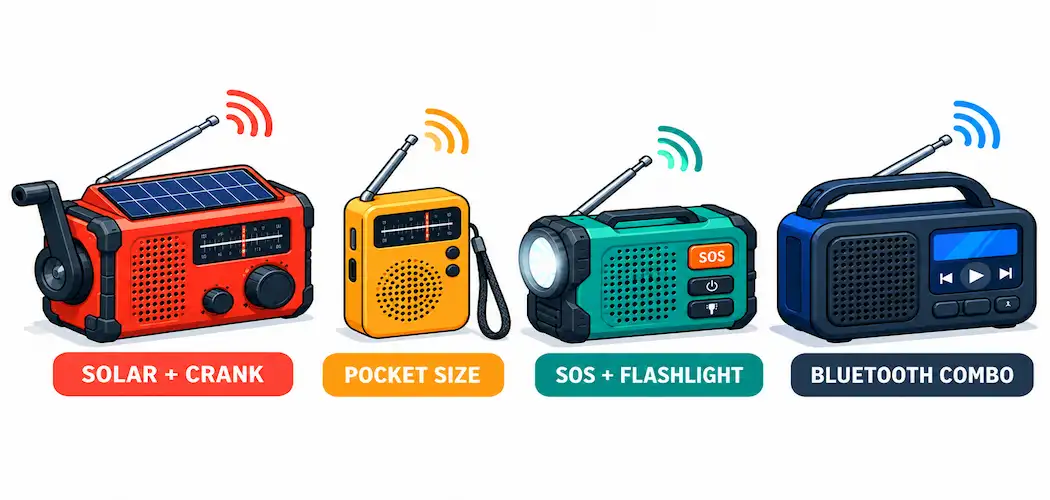
With that distinction in mind, here are four real, currently available portable radios worth considering, chosen for durability, battery options, and honest fit for outdoor and off-road use.
1. Sangean MMR-88 — Best for Multi-Power Flexibility
The Sangean MMR-88 is built specifically around the problem of running out of power in the field. It covers AM, FM, and NOAA weather band, and it can be charged four different ways: a built-in hand crank, a small solar panel, a rechargeable internal battery, or standard AA batteries as a backup. For off-roading or camping trips where you genuinely can’t guarantee an outlet, that flexibility matters more than any single spec.
It’s a sturdier, more rugged build than a typical bedside radio, with a rubberized housing designed to handle being tossed in a glove compartment or pack. Manufacturer-stated runtime varies by power source and usage, so check Sangean’s current listed figures for your specific unit before relying on it for a multi-day trip — crank and solar output, in particular, depend on how much physical effort or sunlight you actually put in.
2. C. Crane CC Pocket — Best for Compact Portability
The C. Crane CC Pocket is built for the opposite priority: minimum size and weight, for anyone who wants a radio that genuinely disappears into a jacket pocket or a glovebox tray. It covers AM, FM, and NOAA weather alert, with a clock and sleep timer built in — useful for a radio that’s as likely to sit on a nightstand at a campsite as it is to ride in a vehicle.
Reception quality on a radio this small is inherently more limited than on larger, longer-antenna models, which is the honest tradeoff for its size. It’s a good secondary or backup radio rather than a primary one for serious backcountry use, where a larger antenna generally pulls in weaker stations more reliably.
3. Midland ER310 — Best for Multi-Hazard Preparedness
The Midland ER310 is positioned less as a casual listening radio and more as an emergency-preparedness unit, and it shows in the feature set: AM/FM plus NOAA weather band, a built-in flashlight, an SOS beacon, and — notably — a USB output that can charge a phone from its internal battery, which itself can be topped up via hand crank, solar panel, or USB input. For anyone treating a portable radio as part of a broader emergency kit rather than just entertainment, this is the most purpose-built option of the four.
It’s bulkier than the CC Pocket, which is the tradeoff for the added flashlight and charging hardware — worth factoring in if pack space is tight.
4. A Compact Bluetooth/AM-FM Combo Radio
For anyone who wants AM/FM coverage alongside everyday audio playback (music or a podcast via Bluetooth from a phone), small combo radios exist that add a Bluetooth input and auxiliary jack to a standard AM/FM tuner — useful for a radio that pulls double duty as a campsite speaker when you don’t need the weather band or emergency features the dedicated units above focus on.
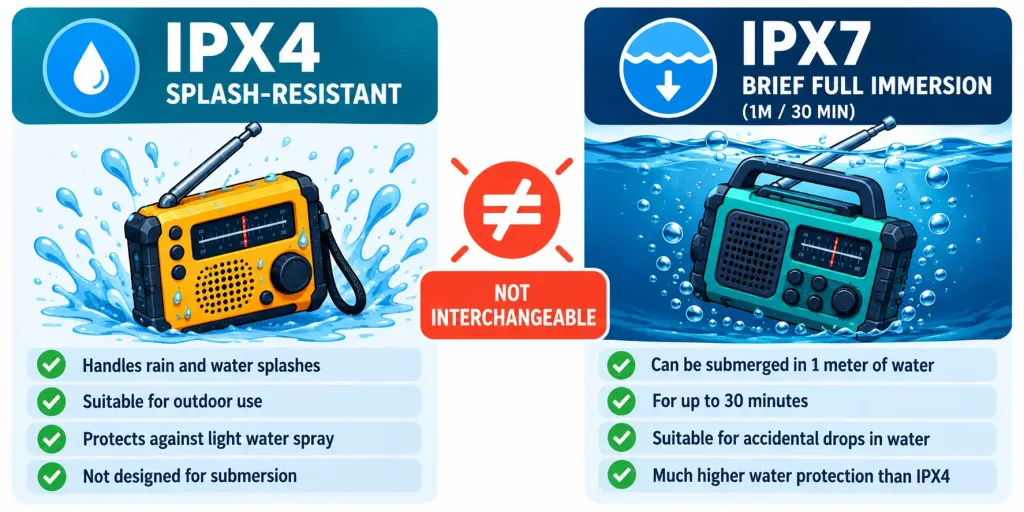
When shopping this category, check the listed water- and drop-resistance rating carefully: IPX ratings are specific and non-interchangeable — IPX4 means splash-resistant, while IPX7 means it can survive brief full immersion (roughly one meter, around 30 minutes) — so a product claiming splash resistance “from all angles” should be checked against its actual IPX rating rather than taken at face value in marketing copy.
What Actually Matters When Choosing One
- Power source flexibility. If you’re going somewhere without guaranteed outlet access for more than a day or two, hand-crank or solar charging is worth more than a marginally longer single-charge battery life on a plug-in-only model.
- NOAA weather band, if you’re in the U.S. For off-road or backcountry use specifically, a weather-band radio gives you access to continuous weather alerts that a plain AM/FM-only radio can’t receive at all.
- Realistic expectations about reception. A radio’s built-in antenna helps, but reception still depends heavily on terrain, distance from transmitters, and whether you’re inside a metal vehicle cabin. No radio “ensures you don’t miss a station” — rough or mountainous terrain can block reception regardless of the unit.
- Actual water/drop ratings, read correctly. IPX ratings measure water resistance specifically, not drop or shock resistance, which is usually rated separately (often against U.S. military MIL-STD-810 drop-test standards on ruggedized electronics). Check both ratings separately rather than assuming one implies the other.
The Bottom Line
A portable AM/FM radio is a genuinely useful tool for staying informed when you’re off the grid — not a communication device, and not a substitute for a GMRS or satellite option if staying in contact with other people is the actual goal. Among current options, the Sangean MMR-88 is the strongest all-rounder for multi-power flexibility, the C. Crane CC Pocket wins on pure portability, and the Midland ER310 is the one to pick if emergency preparedness (flashlight, SOS beacon, phone charging) matters more than casual listening.
Frequently Asked Questions
Can a portable AM/FM radio be used to talk to other people?
No. Standard AM/FM radios are receivers only — they pick up broadcast signals but can’t transmit. Two-way communication requires a different device entirely, such as a CB, GMRS, or satellite communicator.
What’s the difference between an IPX4 and IPX7 water resistance rating?
IPX4 means resistance to splashing water from any direction. IPX7 means the device can survive brief, temporary full immersion — typically around one meter of water for up to 30 minutes. They’re not interchangeable, and “splash-resistant” and “waterproof” describe genuinely different levels of protection.
Do I need a NOAA weather band radio specifically?
If you’re in the U.S. and spend time in areas without reliable cell service, yes — a weather-band radio gives continuous access to NOAA weather alerts that a plain AM/FM-only radio simply can’t receive, regardless of signal strength.
Does hand-crank or solar charging actually work well in the field?
It works, but output is limited by how much cranking effort or direct sunlight you actually provide — it’s best treated as an emergency backup charging method rather than a primary power source for daily use.